
Business
SMI supporting next phase of maritime R&D with funding and partnerships
‘SMI’s vision and goal for the next 10 years is to establish Singapore as a world-class Global Maritime Knowledge & Innovation Hub’ says Chairman.

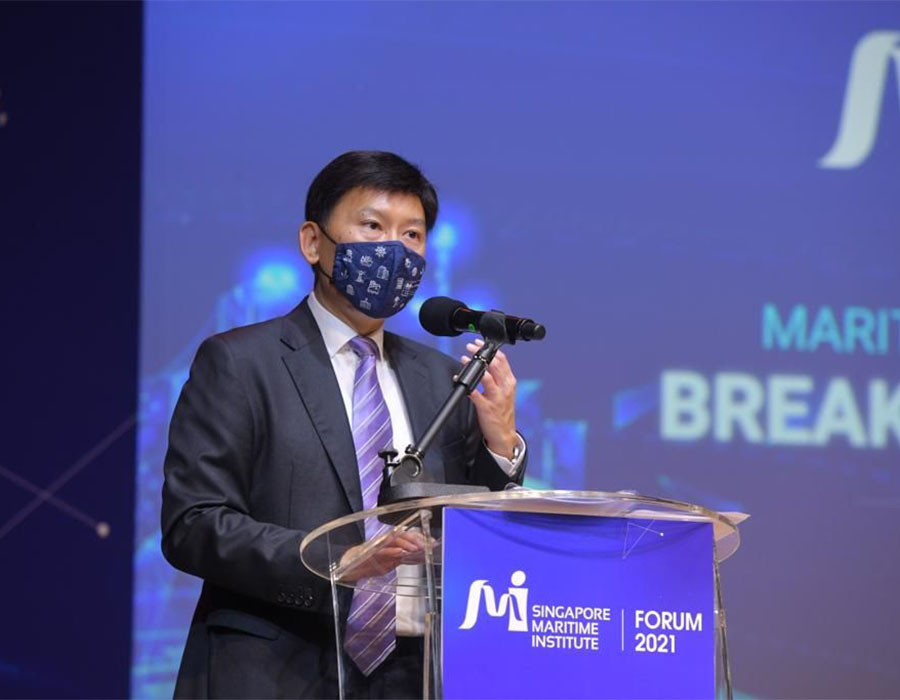
The Singapore Maritime Institute on Thursday (14 October) held its 11th edition of the SMI forum at the Singapore Polytechnic to highlight the role of research and development (R&D) towards enhancing maritime safety and efficiency.
The event with its theme Maritime Safety in the 4.0 Era: Breaking New Frontiers was streamed virtually to around 200 maritime professionals and academia around the world.
It was graced by Mr Chee Hong Tat, Singapore’s Senior Minister of State for Transport. In his opening address, Mr Chee outlined the key role of innovation, deep-tech and research in enabling Maritime Singapore to remain relevant and ahead in global competition.
Mr Chee highlighted how SMI had been instrumental in setting the R&D direction for the local maritime industry and congratulated SMI on achieving its 10-year milestone. To support SMI in pursuing its mission to grow Singapore as a leading global maritime research hub in next generation port, smart shipping, and green technologies, Mr Chee announced the Maritime and Port Authority of Singapore (MPA) will be allocating USD 80 million of funding to support SMI’s R&D activities for the next five years, from 2022-2026. This is in addition to funding under the Maritime Transformation Programme provided by NRF in 2019 that is managed by SMI.
Celebrating SMI’s 10th Anniversary
Established in April 2011, SMI celebrates its 10th Anniversary this year. A special commemorative video was launched at the SMI Forum to celebrate SMI’s journey and achievements over the past decade in driving maritime research and innovation to build up local maritime R&D capabilities.
“Throughout the past ten years, SMI had worked closely with the industry and research community both in Singapore and overseas. these international collaborative initiatives with strategic overseas research organisations further enriched and facilitated impactful global R&D exchange and open innovation with our centres of excellence,” says Mr Wong Weng Sun, Chairman of SMI Board and Governing Council.
“We shall continue to deepen our bilateral R&D relations with our existing international research partners and forge new ones to expand our knowledge frontiers and global R&D network
“SMI’s vision and goal for the next 10 years is to establish Singapore as a world-class Global Maritime Knowledge & Innovation Hub with a refreshed mission to make Singapore a leading global maritime research centre of excellence in three key areas of next Generation Port, smart shipping, and green technologies. SMI will share more details in the months ahead, and we invite you to join us in our next lap to deliver greater impact through maritime R&D.”
New Navigation Research Simulator Positions Singapore as a Leading Training Hub for Ship Crew
Mr Chee launched Southeast Asia’s first dedicated research simulator for safe navigation the Advanced Navigation Research Simulator (ANRS). Set up at the Centre of Excellence in Maritime Safety (CEMS), a Centre of Excellence jointly established by SMI and Singapore Polytechnic (SP), consisting of a full mission Ship Bridge and a Vessel Traffic Service (VTS) System which simulates ship navigation and VTS operations.
The simulator is equipped with state-of-the-art sensors to capture ship crew’s behaviours during training. It allows the CEMS to work closely with Singapore Maritime Academy at SP and industry partners to enhance the training assessment and delivery for ship crew using Artificial Intelligence.
Inking of Maritime R&D Collaborations
At the event, Mr Chee also witnessed the inking of several Memorandums of Understanding (MOUs):
MOU on R&D Collaboration between CEMS and Wärtsilä Voyage Pacific
Wärtsilä Voyage’s comprehensive collaboration with CEMS covers assistive technologies for use on-board ships and during training, simulators to study human behaviour and competency to enhance the safety of navigation, infusing wearable technologies. It also covers the development of training guidelines and contents for remote operations. Lastly, scenario-based “Standards Validation” simulation for autonomous vessel research will also be an area to support Singapore’s pursuit in Maritime Autonomous Surface Ship development. The projects are scheduled to be implemented over the next two years.
MOU with Industry to Advance Maritime Artificial Intelligence Research in Singapore
SMI and three industry partners, Kongsberg Digital AS, RightShip and Wärtsilä Voyage Limited, signed MOUs today to cooperate on a Maritime Artificial Intelligence (AI) R&D programme. Recognising the need to create an environment to promote data-driven innovation, and to drive increased use of data-driven tools, applications, and technologies in the maritime industry, SMI will collaborate with the various MOU parties to catalyse Maritime AI applications over the next two years.
Mr William Hodgman, the Australian High Commissioner to Singapore, Mrs Benita Lindström, Deputy Head of Mission, Embassy of Finland to Singapore and Mr Andreas Aure, First Secretary and Deputy Head of Mission, Royal Norwegian Embassy joined Mr Chee in witnessing the MOU signings.
Renewal of MOU between SMI and University of Turku, Finland to Promote Maritime R&D Activities
SMI and the University of Turku (UTU) in Finland first signed an MOU in 2016 to jointly promote and collaborate on maritime R&D activities, and will renew the MOU for another 5 years. SMI and UTU seek to further pursue innovation and deepen R&D collaborations in SMI’s renewed R&D focus areas in Next Generation Port; Smart Shipping; and Green Technologies. Mrs Benita Lindström, Deputy Head of Mission, Embassy of Finland in Singapore joined Mr Chee in witnessing the MOU signing.
Renewal of MOU between Maritime and Port Authority of Singapore and China Waterborne Transport Research Institute
MPA and China Waterborne Transport Research Institute also renewed the MOU signed in 2019 to collaborate on research. Under the MOU, WTI and MPA will continue cooperation in the field of maritime and port affairs, research and development.
Seeking Solutions for Automated Quay Crane Adoption through Maritime R&D Call
The launch of a new maritime R&D call on automated quay crane (QC) jointly by SMI, MPA and PSA was also announced at the SMI Forum. Open from 14 October 2021 to 5 January 2022, the aim is to support research and development of automated systems and novel concepts for full automated QC operations. The intended solution should address three focus areas to enhance vessel side operation:
- Reliable and fast human and obstacle detection under all-weather condition.
- Advance algorithm to integrate sensor, image and control signals technology to navigate a QC spreader automatically through non-standardised environment.
- Robust wired and/or wireless communication to transmit sensors’ data from the QC spreader to the QC Programmable Logic Controller.
(Interested parties can register at https://bit.ly/3FoQvDm for a briefing session organised by SMI to find out more about this R&D Call)
“SMI recognises the importance of establishing close linkages and partnerships with local and international industry and research communities, to further drive and propel maritime research and development collaborations in Singapore,” comments Mr Tan Cheng Peng, Executive Director of the Singapore Maritime Institute.
“The MOUs signify SMI’s commitment to foster strategic collaborations with diverse stakeholders, to build a stronger maritime R&D ecosystem and together, devise solutions to address complex challenges to be future-ready in the maritime domain.


Photo credit: Maritime and Port Authority of Singapore
Published: 15 October, 2021
Alternative Fuels
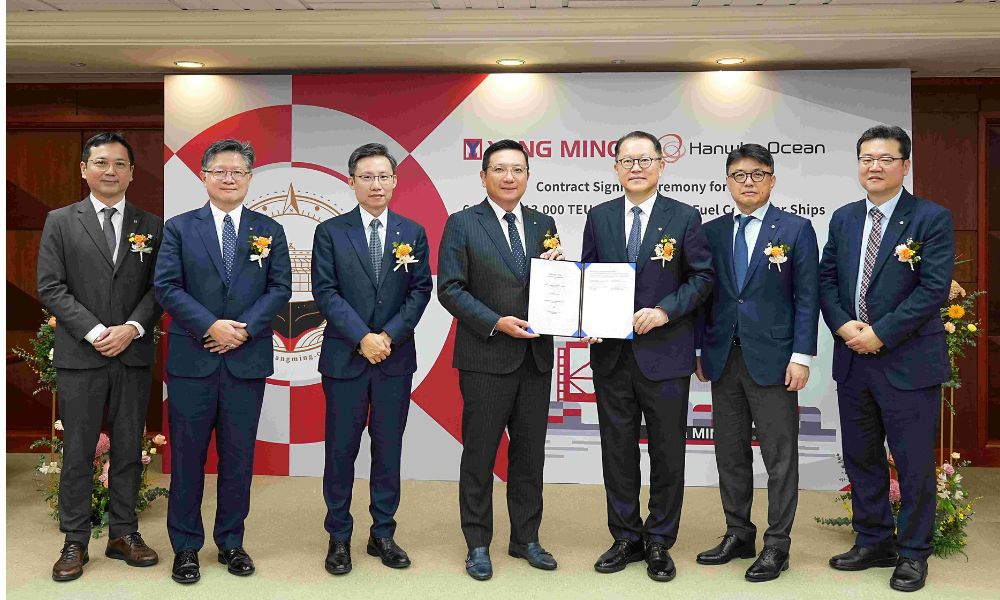
Yang Ming orders six LNG dual-fuel, ammonia-ready containerships from Hanwha Ocean
Each of the six new vessels will have a capacity of up to 13,650 TEU and feature LNG dual-fuel propulsion and Ammonia Fuel Ready specifications.
Alternative Fuels
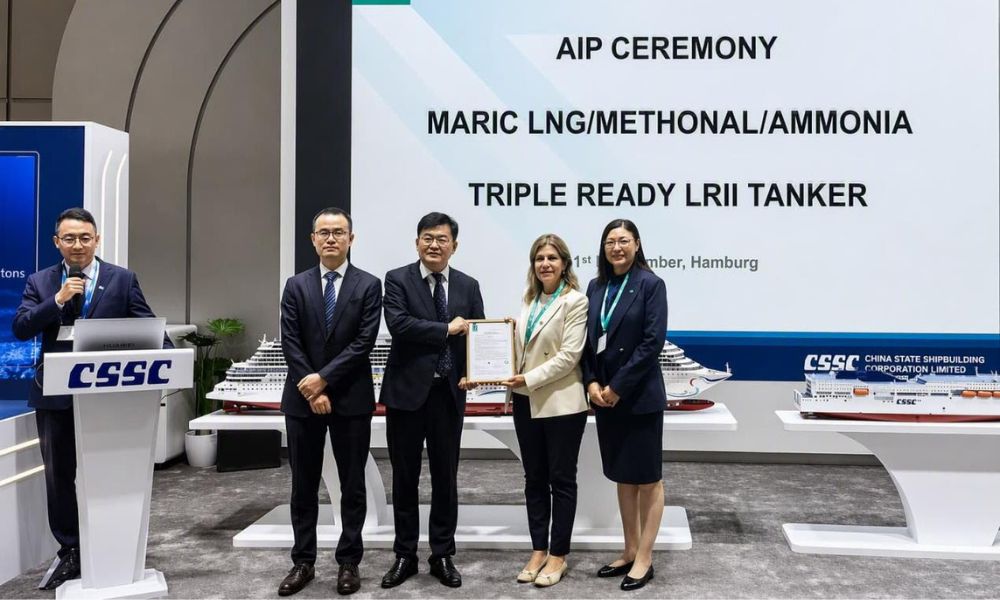
LR, China’s MARIC unveil tanker concept ready for three future bunker fuels
Both secured AiP for a new 114,000 DWT product and crude oil tanker designed to accommodate future conversion to LNG, methanol or ammonia.
Alternative Fuels
DNV: Alternative-fuelled vessel orders hit highest monthly level since October 2024
LNG-fuelled vessels accounted for the vast majority of August activity while the strong summer performance marked a significant acceleration in ordering activity after a relatively slow start to the year.
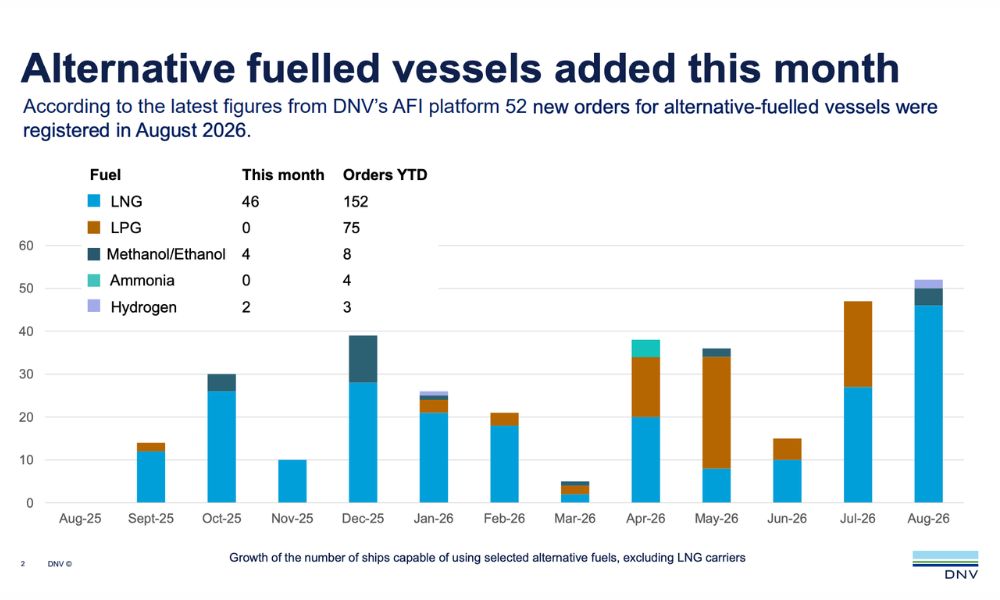
Latest data from classification society DNV’s Alternative Fuels Insight (AFI) platform alternative-fuelled vessel ordering was strong in August, with 52 new vessels added to the platform.
This is the highest monthly total since October 2024 and follows another active month in July, when 47 vessels were added to the database.
LNG-fuelled vessels accounted for the vast majority of August activity, with 46 orders recorded. The container segment led the way with 30 orders, while the car carrier segment contributed a further 12 LNG-fuelled vessels. In addition, four ethanol-fuelled bulk carriers and two hydrogen-powered bulk carriers were added during the month, as well as one LNG bunker vessel.
The strong summer performance marked a significant acceleration in ordering activity after a relatively slow start to the year. In total, 242 alternative-fuelled vessel orders have been placed in the first eight months of 2026, representing a 27% increase compared with the same period in 2025.
LNG remains the dominant fuel choice, accounting for 63% of all alternative-fuelled vessel orders registered so far this year. Container vessels represent the largest share of these LNG orders (59%), followed by car carriers (30%).
Jason Stefanatos, Global Decarbonization Director at DNV Maritime, said: “The past two months have been particularly strong for alternative-fuelled vessel ordering, with August recording the highest monthly total we’ve seen since October 2024. This has helped lift year-to-date orders to a level well above the same period last year.
“LNG remains the leading fuel choice, driven largely by activity in the container and car carrier segments. These sectors have been among the earliest adopters of alternative fuels, supported by predictable liner operations and increasing demand from cargo owners to reduce emissions across supply chains.
“For many owners, LNG offers a combination of emissions reductions, fuel availability and future flexibility while the longer-term fuel landscape continues to evolve.
“At the same time, the latest figures include orders for ethanol- and hydrogen-fuelled vessels, highlighting that owners continue to explore a range of decarbonization pathways. Different segments are making different fuel choices, but the overall level of activity demonstrates continued investment in lower-emission shipping.”
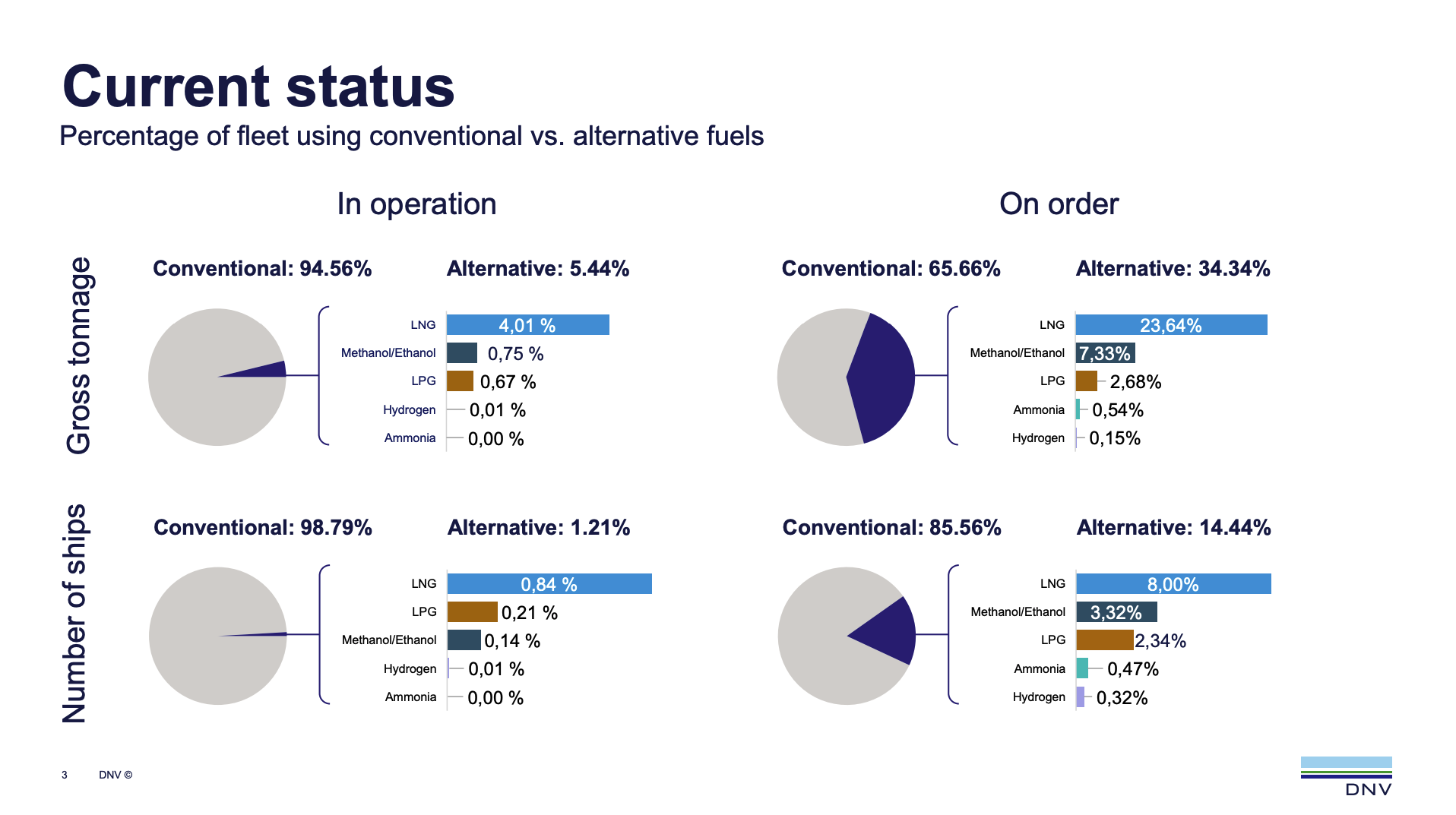
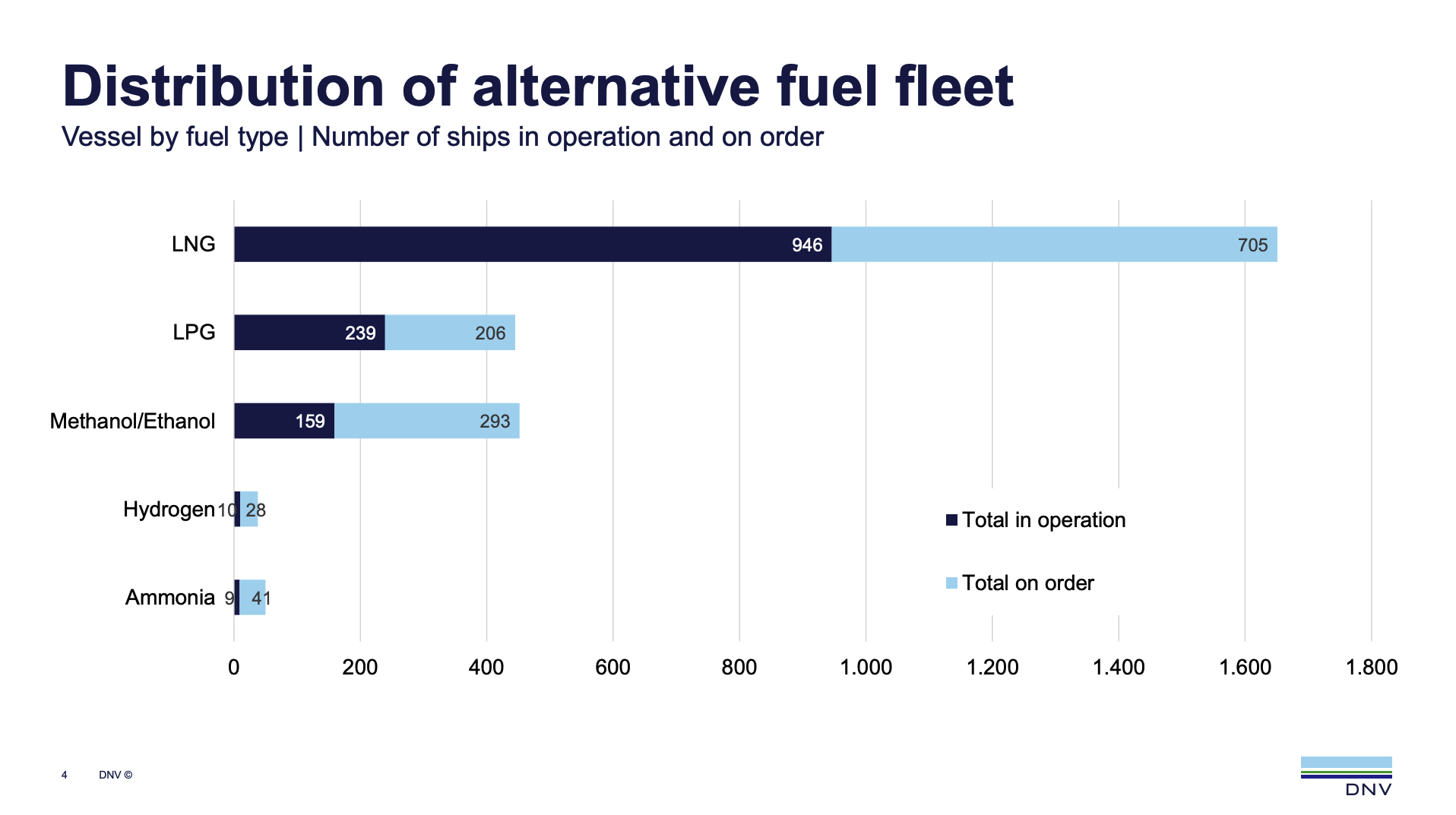
Photo credit: DNV
Published: 4 September, 2026

OUR INDUSTRY PARTNERS

Yang Ming orders six LNG dual-fuel, ammonia-ready containerships from Hanwha Ocean

LR, China’s MARIC unveil tanker concept ready for three future bunker fuels

DNV: Alternative-fuelled vessel orders hit highest monthly level since October 2024

TFG Marine advances global MFM rollout with two US Gulf bunker barges

GENA Solutions: Total renewable and low-carbon methanol project pipeline increases from 61.8 to 62.2 Mt by 2032

Baltic Exchange: Bunker Report (3 September 2026)

ENGINE: Americas Fuel Availability Outlook (3 September 2026)

Singapore-flagged tugboat “Kim Heng 3203” placed under Sheriff’s arrest

US targets five bunker companies in latest sanctions campaign against Iran

Singapore bunkering community supports Living Hope Evangelism’s 7th anniversary outreach for residents in need

China’s bunker market reshaped by tax rebates, trade flows and refining changes, says economist

Hengli Petrochemical’s ex-Singapore trading arm faces winding up application

Report: GCMD outlines practical approach to quantity assurance in marine biofuel supply chains

Rajah & Tann: Bunker disputes are won in the first 48 hours
-
 Vessel Arrest1 week ago
Singapore-flagged tugboat “Kim Heng 3203” placed under Sheriff’s arrest
-
 Sanctions2 weeks ago
US targets five bunker companies in latest sanctions campaign against Iran
-
 Events2 weeks ago
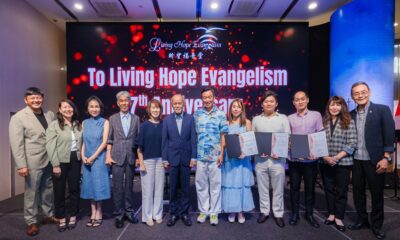
Singapore bunkering community supports Living Hope Evangelism’s 7th anniversary outreach for residents in need
-
 Interview1 week ago
China’s bunker market reshaped by tax rebates, trade flows and refining changes, says economist
-
 Winding up2 weeks ago
Hengli Petrochemical’s ex-Singapore trading arm faces winding up application
-
 Biofuel1 week ago
Report: GCMD outlines practical approach to quantity assurance in marine biofuel supply chains
-
 Bunker Claim4 days ago
Rajah & Tann: Bunker disputes are won in the first 48 hours
-
 Winding up2 weeks ago
Singapore: Notices of intended dividend issued for Ocean Bunkering Services, Hin Leong Marine