Connect with us

Alternative Fuels

HHI and DNV GL present green tanker solutions from joint research partnership

Joint research was initiated at the Gastech trade fair in Houston 2019 where they agreed to jointly develop low and zero carbon solutions for shipping.

Admin

Published

on

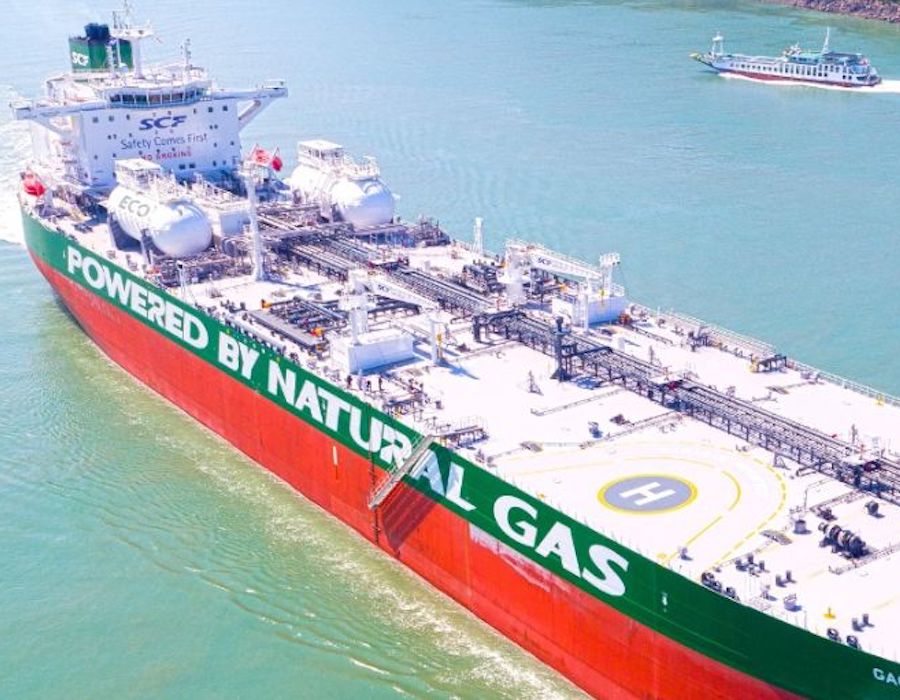
LNG fuelled Tanker Gagarin Prospect 1288x511 tcm8 193839

Classification Society DNV GL on Friday (18 December) said it teamed up with the world’s largest shipyard Hyundai Heavy Industries (HHI) to embark on the development of future-proof tanker designs and the joint development has yielded positive results.

In a recent “Green Tankers towards 2050” industry webinar, DNV GL and HHI Group presented the results of new joint research and explained how eco-friendly maritime solutions can help shipowners and managers to cope with stricter environmental regulations now and in the future.

The joint research was initiated by a memorandum of understanding (MOU) signed at Gastech trade fair in Houston 2019, when DNV GL and HHI agreed to develop low and zero carbon solutions for shipping.

The results of the MOU were presented by lead researchers from HHI Group companies Korea Shipbuilding & Offshore Engineering (KSOE), Hyundai Heavy Industries (HHI) and Hyundai Mipo Dockyard (HMD) in a virtual format, co-hosted by DNV GL from their headquarters in Høvik, Norway.

“Shipowners are faced with many uncertainties in the rapidly changing marketplace,” said Seong-Yong Park, COO and SEVP of HHI Group.

“We believe our research results, including proven engineering solutions and alternative fuels, will support them in developing their future strategy for ship operations and fleet renewal.”

During the webinar, DNV GL and HHI Group experts explained the recent development of regulations covering the greenhouse gas emissions from vessels, including the introduction of the design index for existing vessels (EEXI) and a new Carbon Intensity Indicator, which are due to enter into force in 2023.

To respond to these regulations, HHI Group introduced their range of eco-friendly ships that are equipped with alternative fuel technologies and energy-reducing systems, among them 40 LNG dual-fuelled ships already delivered or under construction.

“The International Maritime Organization (IMO) is strengthening environmental regulations, including a 50% reduction in ship greenhouse gas emissions by 2050 compared to 2008,” added H. J. Shin, Head of Future Ship Research Department at KSOE.

“We will help the shipping industry to reach these ambitious goals by taking a leading position in the eco-friendly maritime era through research and development.”

By applying DNV GL’s data-based carbon robust model to its very large crude carrier (VLCC) and Medium Range (MR) tanker ships, HHI Group noted it found that an LNG fuel propulsion system in combination with advanced energy saving devices (ESDs) can enable a vessel to meet the new Carbon Intensity Indicator over its expected lifetime.

“It is important to use alternative fuels like LNG and technological solutions that are available now, and not wait until 2030 or beyond”, noted Y. H. Chung, Head of Initial Design Department at HMD.

“Our joint research has shown that LNG as ship fuel combined with other energy saving devices can make a vessel both environmentally and economically fit for the next two decades at least”.

“Since ESDs mainly have an impact on fuel consumption during sailing, the benefits are greater for large vessels such as VLCCs, which spend more days operating at sea,” explained Christos Chryssakis, Business Development Manager at DNV GL – Maritime.

“These ships are also less sensitive to price variations when it comes to selection of LNG as fuel. This is because the capital expenditures are paid back faster due to a higher fuel consumption

“For smaller vessels with lower fuel consumption, such as MR Tankers, a higher price differential between very low sulphur oil (VLSFO) and LNG was required to pay back the initial investment. Therefore, these vessels were more sensitive to volatile fuel prices.”

Related: DNV GL and KSOE enter MOU on zero-emission ship tech


Photo credit: HHI Group
Published: 22 December, 2020

Continue Reading

Biofuel

South Korea: S-Oil launches B30-VLSFO bio bunker fuel supply

Company says it has established an integrated operating system in the Ulsan region covering the entire value chain, from feedstock procurement and blending to supply.

Admin

Published

on

By

South Korea: S-Oil launches B30-VLSFO bio bunker fuel supply

South Korean petroleum and refining company S-Oil on Wednesday (22 July) said it has started supplying B30 very low sulphur fuel oil (VLSFO), as the company seeks to support shipping’s decarbonisation efforts and growing demand for lower-carbon bunker fuels.

The company said its B30 VLSFO contains 30% sustainable biofuel blended with conventional VLSFO and can be used without requiring modifications to existing vessels, enabling shipowners to comply more readily with emissions regulations from the International Maritime Organization (IMO) and the European Union (EU).

S-Oil said it has established an integrated operating system in the Ulsan region covering the entire value chain, from feedstock procurement and blending to supply. The system combines VLSFO produced at its Onsan refinery with biofuel production facilities and storage infrastructure in the Ulsan region, allowing the entire process to be carried out within a single logistics hub.

According to the company, the integrated supply chain reduces transportation requirements during production while improving supply efficiency and reliability.

S-Oil also highlighted Ulsan Port as a strategic location for marine biofuel supply, noting the port has strong demand for bio-bunker fuels, particularly from car carriers, enabling prompt and stable deliveries to key customers.

An S-Oil official stated: “In the bio-marine fuel market, not only product quality but also securing a stable supply of raw materials and an efficient supply system are important competitive advantages.

“Based on our existing bunkering business capabilities and the excellent supply infrastructure in the Onsan area, we plan to supply stable and competitive low-carbon fuel.”


Photo credit: S-Oil
Published: 23 July, 2026

Continue Reading

Bunker Fuel

Antwerp-Bruges biofuel bunker sales drops 36% on year in Q2 2026, LNG down 13.4%

Biofuel recorded 26,833 mt in Q2 2026 with 41,939 mt recorded in the same period the year before while port data showed 76,513 mt of LNG being delivered in Q2 2026, down from 88,328 mt.

Admin

Published

on

By

Port of Antwerp-Bruges, Deurganck Dock

The Port of Antwerp-Bruges recently published bunker fuel sales data for the second quarter (Q2) of 2026.

Total bunker sales at the port was 2.05 million metric tonnes (mt) in Q2 2026, compared to sales of 1.99 million mt (+3%) during the similar period in 2025.

Deliveries of ultra low sulphur fuel oil, very low sulphur fuel oil, high sulphur fuel oil and marine gas oil in Q2 2026 (against on year) recorded respectively 164,987 mt (+43.6%  from 114,917 mt), 537,926 mt (+12.8% from 476,746 mt), 659,182 mt (+11.6% from 590,544 mt) and 366,329 (-15.7% from 434,766 mt).

Biofuel recorded 26,833 mt in Q2 2026 with 41,939 mt (-36%) recorded in the same period the year before. 

Port data showed 76,513 mt of liquefied natural gas (LNG) being delivered as a marine fuel in Q2 2026, down by 13.4% from 88,328 mt in Q2 2025. Meanwhile, there has been no deliveries of methanol at the port for the year so far.

Related: Antwerp-Bruges biofuel bunker sales plunge 50.6% on year in Q1 2026, LNG soars 214%


Photo credit: Port of Antwerp-Bruges
Published: 23 July, 2026

Continue Reading

Methanol

World Fuel and partners complete first green methanol bunkering of car carrier in Shanghai

Operation involved the delivery of approximately 2,800 MT of green methanol to “Arctic Tern” via a ship-to-ship transfer using SIPG Energy’s dedicated methanol bunkering vessel “M/V Hai Gang Zhi Yuan”.

Admin

Published

on

By

World Fuel and partners complete first green methanol bunkering of car carrier in Shanghai

Marine fuel provider World Fuel on Tuesday (21 July) said it successfully completed the first green methanol bunkering of M/V Arctic Tern, with EUKOR Car Carriers and SIPG Energy at the Port of Shanghai. 

Arctic Tern is the first vessel in the new Shaper Class series of car carriers. 

The operation involved the delivery of approximately 2,800 MT of green methanol to Arctic Tern via a ship-to-ship transfer using SIPG Energy’s dedicated methanol bunkering vessel M/V Hai Gang Zhi Yuan, the largest vessel of its kind in operation. 

The bunkering operation was carried out at Haitong Terminal, Waigaoqiao Port Area, Shanghai Port, with cargo handling operations conducted simultaneously during bunkering.

This marks EUKOR Car Carriers’ first green methanol operation and the first time Arctic Tern has bunkered methanol since its delivery on 9 July. The operation marked the first bunkering at Shanghai Port of green methanol produced locally in Shanghai for an international PCTC operator. 

It also demonstrated the city’s integrated green methanol value chain, spanning local production, storage and bunkering, and established a replicable “Shanghai Model” for green methanol supply.

World Fuel arranged the supply and delivery of the fuel on behalf of EUKOR Car Carriers, working with SIPG Energy as the physical supplier at the Port of Shanghai.

The green methanol supplied was produced from municipal solid waste, ISCC-EU certified, and had a carbon intensity value below 25 gCO₂e/MJ.

Arctic Tern is the first of fourteen Shaper Class vessels ordered by Wallenius Wilhelmsen. With a capacity of 9,300 car equivalent units and methanol dual-fuel capability, the vessel will be operated by EUKOR Car Carriers, jointly owned by Wallenius Wilhelmsen and Hyundai Motor Group. Following her first green methanol bunkering, Arctic Tern will continue her maiden voyage from Asia to Europe.

Xavier Leroi, COO Shipping Services at Wallenius Wilhelmsen and CEO of EUKOR Car Carriers, said: “Completing Arctic Tern’s first green methanol bunkering shortly after delivery is a significant milestone towards our decarbonisation ambition for both EUKOR Car Carriers and Wallenius Wilhelmsen. It demonstrates how investments in next-generation vessel technology and fuel flexibility are being translated into real-world operations. 

“This achievement reflects the strong collaboration between all parties involved. Together, we have shown how partnerships across the maritime value chain can help make lower-emission fuels available and operationally viable at scale.”

Mark Tamsitt, SVP Global Marine Sales at World Fuel, said, “The first bunkering event with a new fuel is a significant moment for any shipowner, and our role is to make it as seamless as possible. By connecting EUKOR Car Carriers with SIPG Energy’s proven green methanol capability at the Port of Shanghai, we were able to deliver on reliable supply, fuel quality, and safe processes. As more of our customers bring methanol dual-fuel tonnage into service, we are committed to being the partner that makes these kinds of operations routine.”

Mr. Zhang Da, General Manager of SIPG Energy, said, “Welcoming Arctic Tern to the Port of Shanghai for her first green methanol bunkering demonstrates the strength and maturity of our supply capability. Building on our well-established methanol ship-to-ship bunkering services for container vessels, we have already extended such services to pure car and truck carriers (PCTCs). This bunkering sets a new record for the largest single SIMOPs green methanol bunkering for PCTCs in China, marking another step in building Shanghai’s position as a global green energy hub for international shipping.”

This operation follows Wallenius Wilhelmsen’s announcement on 9 July that Arctic Tern would complete her first methanol bunkering shortly after delivery. The vessel entered service on routes between Asia and Europe immediately following handover from China Merchants Jinling Shipyard in Nanjing.


Photo credit: World Fuel
Published: 22 July, 2026

Continue Reading

Trending