Connect with us

Alternative Fuels

Interview: Lloyd’s Register and Methanol Institute explain methanol bunkering technical reference

Chris Chatterton and Douglas Raitt discuss the growth in interest of methanol as a marine fuel and how the guidance can support further and faster adoption of methanol as bunker fuel.

Admin

Published

on

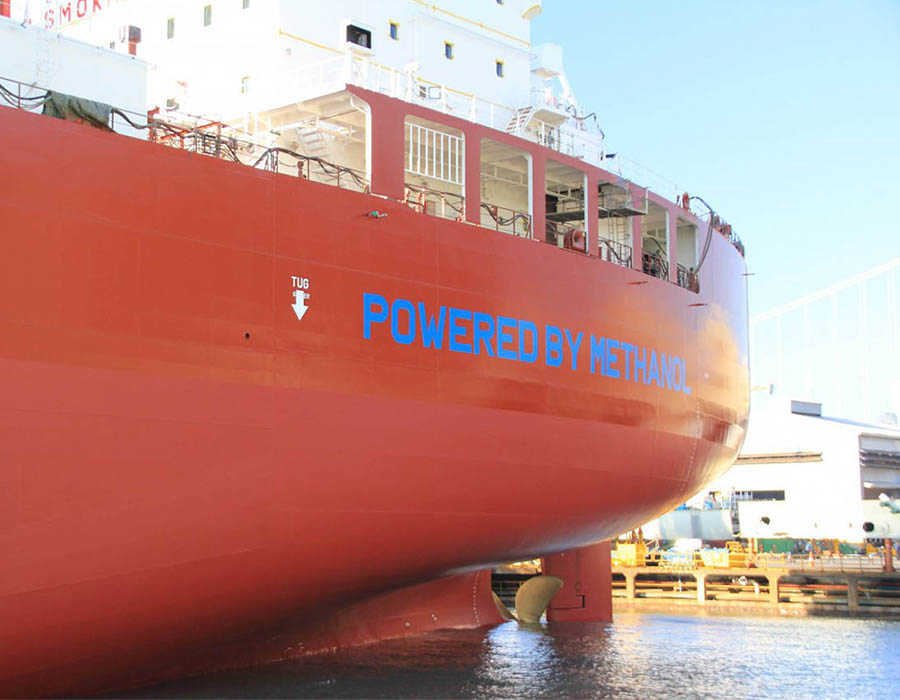
Powered by Methanol

Methanol Institute (MI) and Lloyd’s Register (LR) have recently released a bunkering technical reference to provide owners, fuel suppliers and port authorities with practical guidance on the safe bunkering of methanol as a marine fuel.

Singapore bunkering publication Manifold Times had a chance to catch up with Chris Chatterton of MI and Douglas Raitt, Global FOBAS Manager, LR in an email interview to discuss the growth in interest of methanol as a marine fuel and how this guidance can support further and faster adoption.

MT: By how much has the use of methanol as bunker fuel grown through the last five years, and how did it happen?

MI: From a standing start roughly five years ago, there are now 12 vessels currently trading on methanol internationally with about the same number scheduled for delivery in 2021-2022.

MT: What kind of methanol marine fuel projects are currently conducted at various countries? 

MI: There have been numerous projects trialling methanol to varying degrees over the past 5 years, by leading engine OEMs, research institutions and private organisations. Currently there are two, notable European pilot projects being conducted: Green Maritime Methanol and Fastwater.

MT: Apart from methanol carriers, which other vessel segments will be ideal candidates to use methanol as bunkers during the initial stage of adoption and why? 

MI: It is difficult to say which vessel segment could be prioritised as “ideal”, as much depends on how often they may prefer to bunker and proximity to major methanol hubs, how much fuel they would need to carry, amount of time spent in ECAs and many other factors.

Many smaller vessels which may have difficulty fitting a scrubber or gas infrastructure to their vessel may find methanol to be a more suitable, step-change solution.  We have demonstrated the benefits of blending Low levels of methanol in HFO with extremely good emissions reduction results on larger vessels.

Short sea shipping, feeder vessels, ferries, cruise and harbour craft which call to port or can more actively manage their bunker requirements are all good candidates as bunkering methanol is simple, not requiring any more time than MGO.

OSVs could benefit as many carry methanol on board as part of their “tool chest” for down hole applications and as a solvent.

For these types of vessels, we have a range of successful retrofit pilots which we can draw experience from.

For other vessel types and because methanol is liquid at ambient temperature, it is possible to design ‘fit for purpose’ tanks either above or below deck, as storage represents the largest hurdle to overcome.  However, we are currently working on more standardised methanol dual fuel designs for such purpose, together with major yards, OEMs, and shippers.

MT: Which locations are methanol available for purchase as fuel and what are the current options for its delivery? 

MI: Methanol is widely available at over 120 ports globally and can be provided as a bunker with little difficulty, either from a stationary site at berth or ship-to-ship.

MT: Methanol and its low flash point. What can be done about this for safe bunkering/handling/consumption as a vessel fuel? 

LR: The use of methanol as fuel falls under the International Code of Safety for Ships Using Gases or Other Low-flashpoint Fuels (IGF Code). Of course there is a need for more bespoke bunkering procedures with regards to methanol bunkering, hence LR’s initiative with the Methanol Institute to develop a methanol bunkering technical reference with associated bunker delivery mode operational safety checklists. It is our hope this will facilitate the wider recognition of methanol as a bunker, by raising the awareness of methanol as one of the fuels and viable solutions in assisting the shipping industry along its charted decarbonisation trajectory.

MT: Any changes to equipment of bunker tankers and consumer vessels when using methanol as bunker fuel? 

LR: The IMO’s Interim Guidelines for Methanol as a Low Flash Point Fuel outlines specific safety features of handling methanol on-board a vessel, which are non-exhaustive. The fuel delivery system is where the main differences can be found – beginning with fuel tanks which may require to be larger, or more of them, to accommodate more fuel to compensate for a lower energy equivalency versus MGO or HFO. The alternative to larger tanks may be to bunker more often.

However, as methanol is a liquid at ambient temperature, tank capacity can be flexibly installed on-board most vessel types and generally requires less space than gas-ready vessels. From here, double-walled, nitrogen-inerted piping will move fuel to higher pressure fuel pumps or fuel booster injector valve units as the system requires to move twice as much fuel, on a volumetric basis, again due to methanol’s lower energy density.

In the event a leak or breach of any kind is detected, sections of the fuel delivery system are automatically sealed off, with any remaining fuel in the fuel lines safely purged by nitrogen, along with gravity, to a separate holding tank. As methanol is a more aggressive product, robust material compatibility requirements can be identified on critical equipment within the fuel delivery system and common rail.

The common rail itself undergoes some slight modifications to include pilot fuel delivery, valve sealant oil delivery, and methanol purge lines – all connecting to multi-purpose injectors, whether new build or retrofit.

A bunker vessel could easily operate on methanol as well, with the same basic systems and safety procedures in place as above. Once all safety and material compatibility aspects for low flash point fuel are taken into consideration, the physical bunkering of methanol is not substantially different than bunkering MGO.

MT: What is calorific value of methanol versus traditional IMO compliant marine VLSFO/ULSFO fuels? 

LR: The calorific value of methanol is about half of the calorific value of diesel oils and residual fuels, also the density of methanol is lower than for diesel oils and residual fuels. Therefore, the bunker storage system could be up to double that of conventional IMO compliant fuels and distillates, if the same vessel range was maintained.  However, since it is assumed two fuels or more would be stored on board, with the sum total tank capacity on an energy equivalent basis for the required range, in between bunkering operations.

MT: Do you foresee any issue of off spec, compatibility, stability issues of using methanol as fuel? Are there such things as different types of methanol and can they be blended/mixed together without issues? 

LR: Methanol is a pure product (>99.85% purity), it readily dissolves in water and is bio-degradable. Methanol from different sources can readily be mixed and do not pose any compatibility or stability related issues. The likelihood of methanol being off-specification is non-existent and as such testing as we know it with conventional IMO compliant bunkers will not be required in the case of methanol.

Related: Lloyd’s Register and Methanol Institute launch methanol bunkering technical reference

Photo credit: Methanol Institute
Published: 2 September, 2019

Continue Reading

Biofuel

ENGINE on Biofuel Bunker Snapshot: B30-VLSFO prices drop across global hubs

B100 price surges in Rotterdam this week; Gibraltar’s B30-VLSFO price drops sharply; Singapore’s bio-blended bunker volumes rose sharply.
Admin

Published

on

By

ENGINE on Biofuel Bunker Snapshot: B30-VLSFO prices drop across global hubs

Once a week, bunker intelligence platform ENGINE will publish a snapshot of biofuel bunker prices in Europe, Fujairah and Singapore. The following is the latest snapshot:

  • B100 price surges in Rotterdam this week
  • Gibraltar’s B30-VLSFO price drops sharply
  • Singapore’s bio-blended bunker volumes rose sharply

Europe

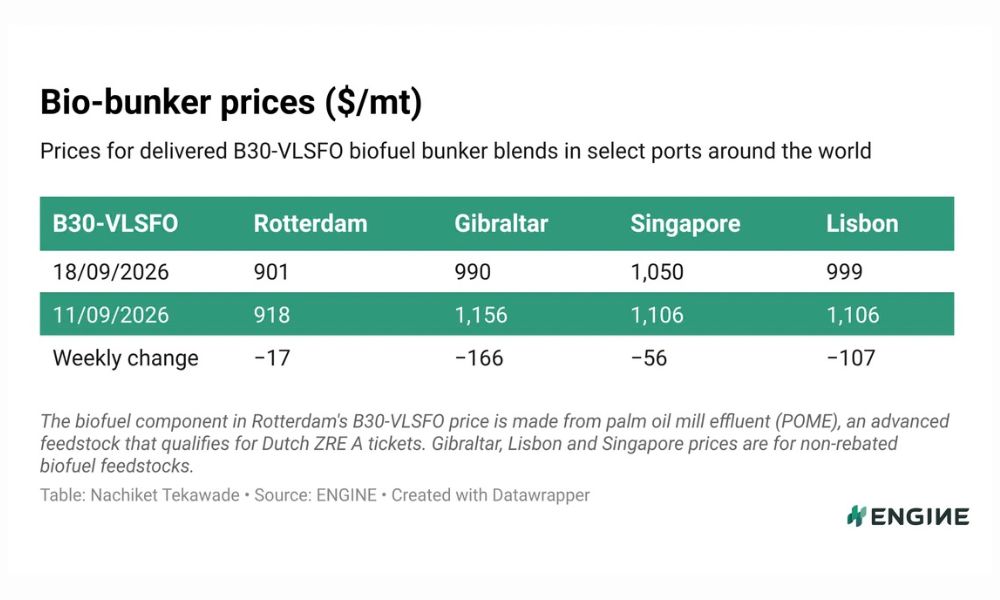
Rotterdam’s B30-VLSFO (POMEME) price has dropped $17/mt in the past week, most probably pressured by a $24/mt drop in the Dutch port’s conventional VLSFO price during the same period.

Rotterdam’s B30-LSMGO (POMEME) price has gained by $17/mt to $1,476/mt, which has been similar to a $19/mt gain in the port’s conventional LSMGO price.

B100 has been priced at $1,418/mt in Rotterdam today, a sharp $209/mt increase compared to last week.

Prima Markets’ POMEME barge price, which is an indicator of feedstock sourcing costs, has gone up by $35/mt to $2,059/mt.

Dutch suppliers can generate ZRE A tickets for selling low carbon fuels, which can be traded with other suppliers. The price of these tickets has dropped from €200/mtCO2e ($230/mtCO2e) last Friday to €190/mtCO2e ($218/mtCO2e) on Thursday this week.

Gibraltar’s B30-VLSFO (UCOME) price has slumped $166/mt lower in the past week. The port’s conventional VLSFO price has remained largely unchanged during this period.

This has cut the port’s B30-VLSFO price premium over conventional VLSFO by $172/mt in a single week to $250/mt.

Lisbon’s B30-VLSFO price has dropped $107/mt during the week. It has flipped to a modest $9/mt premium over Gibraltar’s B30-VLSFO price, coming from a $50/mt discount last Friday.

Lisbon’s B30-LSMGO price has slumped $115/mt to $1,600/mt, while the B100 price in the Portuguese port has plunged $215/mt lower to $1,665/mt.

Asia

Singapore’s B30-VLSFO (UCOME) price has dropped $56/mt since last Friday, while the port’s conventional VLSFO price has gained only $5/mt over the same period.

This has narrowed the port’s B30-VLSFO price premium by $61/mt in a single week.

Data this week showed Singapore’s bio-blended bunker sales rose by 48% in August to 57,000 mt, which was the highest monthly volume since April.

B30-VLSFO is priced at $1,015/mt in Hong Kong, which is a $35/mt price discount to Singapore.

Hong Kong’s B30-VLSFO price is at a $109/mt premium over its conventional VLSFO price.

By Nachiket Tekawade


Photo credit and source: ENGINE
Published: 22 September, 2026

Continue Reading

Biofuel

Petrochina International blends over 30,000 mt of marine biofuel since March

Company has been developing marine biofuel blending operations at China (Zhejiang) Pilot Free Trade Zone, leveraging storage and logistics facilities at its Aoshan base.
Admin

Published

on

By

Zhoushan completes China’s first batch of marine biofuel blending under pilot programme

Petrochina International Co Ltd recently said it has blended more than 30,000 metric tonnes (mt) mt of biofuel since completing the country’s first biofuel marine fuel blending operation on 13 March.

The company said the milestone demonstrates its ability to conduct continuous and large-scale biofuel marine fuel blending operations.

The company has been developing marine biofuel blending operations at China (Zhejiang) Pilot Free Trade Zone, leveraging storage and logistics facilities at its Aoshan base.

Its latest product, B24 marine fuel containing 24% biofuel component, meets relevant International Maritime Organization (IMO) requirements and marine fuel standards, according to the company. It said the product can be supplied for bunkering vessels operating on international routes.

It has used its global trading network to secure feedstock supplies and support cost control and supply security for the blending operations, it added.

The company said the large-scale blending of its marine biofuel products marks a development in China’s marine biofuel blending market.

It plans to work with upstream and downstream businesses within its group to support the development of Zhoushan Port as a major bonded marine fuel bunkering hub and contribute to its parent group’s transition towards lower-carbon energy.

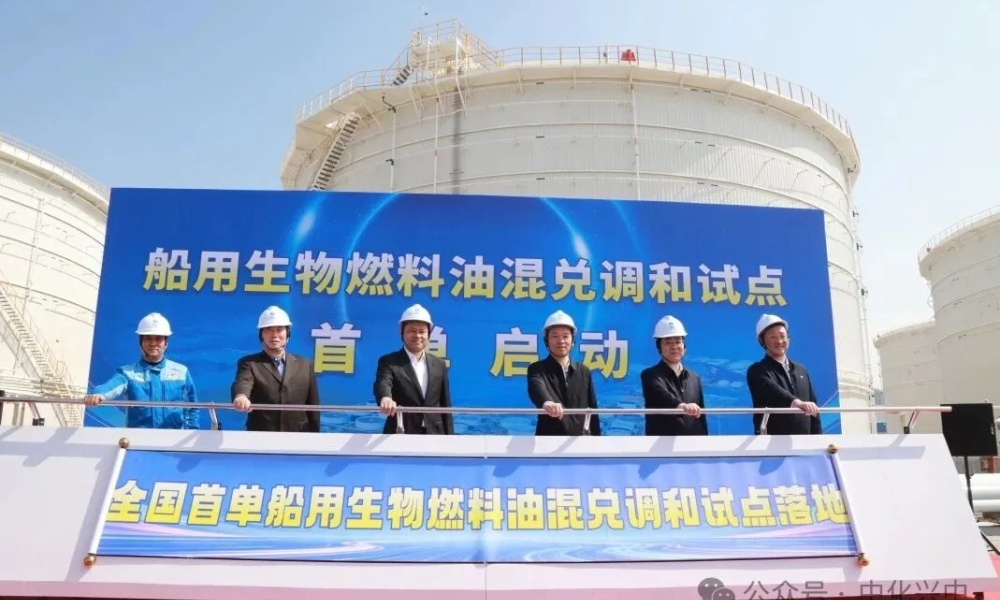
Manifold Times previously reported China (Zhejiang) Pilot Free Trade Zone launching the first pilot programme for marine biofuel blending in China with the completion of the first batch of B24-HSFO. 

The launch was marked with the blending of 2,000 mt of biodiesel and 6,300 mt of high sulphur fuel oil (HSFO) in storage tank F-02 of Sinochem-Xingzhong Oil Staging (Zhoushan), producing 8,300 mt of B24-HSFO. 

Manifold Times also reported the first cross-regional bonded bunkering operation of blended biofuel in East China was successfully completed at the Meishan Port Area of ​​Ningbo-Zhoushan Port. 

The B24-HSFO used in the bunkering operation was supplied by the Aoshan Petroleum Base in Zhoushan from the first pilot programme for marine biofuel blending in China. 

Related: Zhoushan completes China’s first batch of marine biofuel blending under pilot programme
Related: Ningbo wraps up East China’s first cross-regional biofuel blending and bunkering
Related: China debuts first marine biofuel blending pilot programme in Zhoushan
Related: China’s first batch of domestically blended marine biofuel delivered to Qingdao for bunkering


Photo credit: Sinochem-Xingzhong Oil Staging (Zhoushan)
Published: 21 September, 2026

Continue Reading

Ammonia

NYK wraps up first STS ammonia bunkering operation in Japan

Ammonia fuel was transferred from the ammonia carrier “Shoei Maru” via the STS method to an ammonia-fuelled medium gas carrier, scheduled for delivery in November 2026.
Admin

Published

on

By

NYK wraps up first STS ammonia bunkering operation in Japan

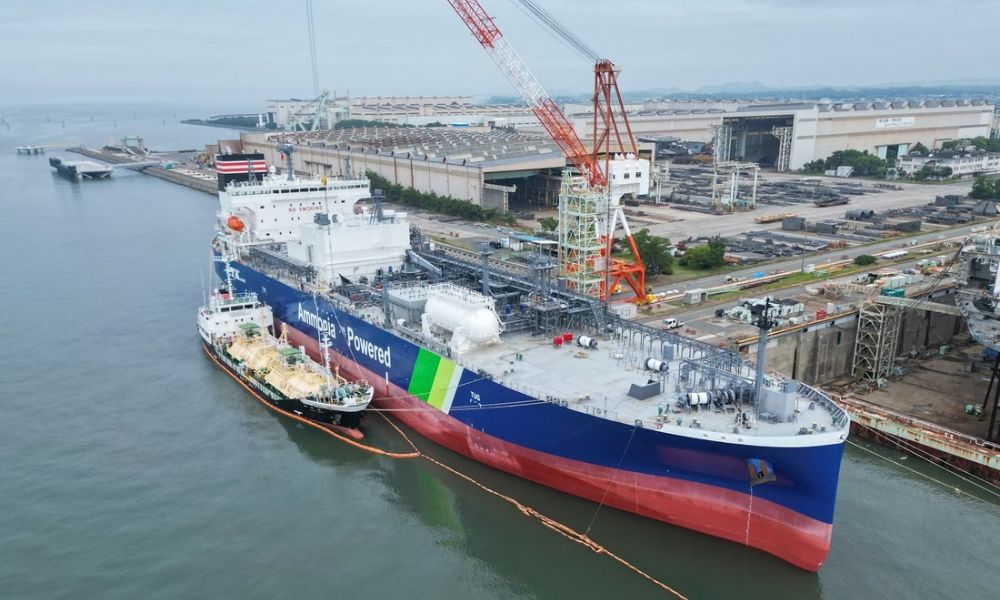
NYK Line, on Thursday (17 September) with Japan Marine United Corporation, Nihon Shipyard Co Ltd, Mitsubishi Gas Chemical Company, and Kokuka Sangyo Co Ltd, has completed the world’s first ship-to-ship (STS) ammonia bunkering operation to an ammonia-fuelled vessel. 

At a quay within Japan Marine United Corporation’s Ariake Shipyard, ammonia fuel was transferred from the ammonia carrier Shoei Maru via the STS method to an ammonia-fuelled medium gas carrier (AFMGC) scheduled for delivery in November 2026. 

The operation was conducted in preparation for sea trials of the AFMGC using fuel ammonia.

“This achievement represents an important initiative that has put into practice an operation essential for the future practical deployment of ammonia-fuelled vessels,” the company said. 

The bunkering operation was conducted following extensive discussions among the companies involved. Safe operating procedures and work processes were established prior to the operation, enabling the transfer to be completed safely. Through this initiative, we have accumulated practical insights regarding safe fuel supply operations.

This operation serves as a pioneering example of the fuel-supply framework that will be required for the widespread adoption of ammonia-fuelled vessels. 

The AFMGC is currently in the final stage of construction and is scheduled for delivery in November 2026. 

“The successful completion of this operation marks a significant milestone toward the broader commercial use of fuel ammonia and the practical deployment of ammonia-fuelled vessels. It also represents an important step forward in establishing an ammonia supply chain,” the company added. 


Photo credit: NYK
Published: 21 September, 2026

Continue Reading

Trending