Connect with us

Business

DNV GL: Green technologies enhance efficiency of shuttle tankers

LNG dual-fuel shuttle tankers demonstrate environmental sustainability and operational flexibility are commercially viable.

Admin

Published

on

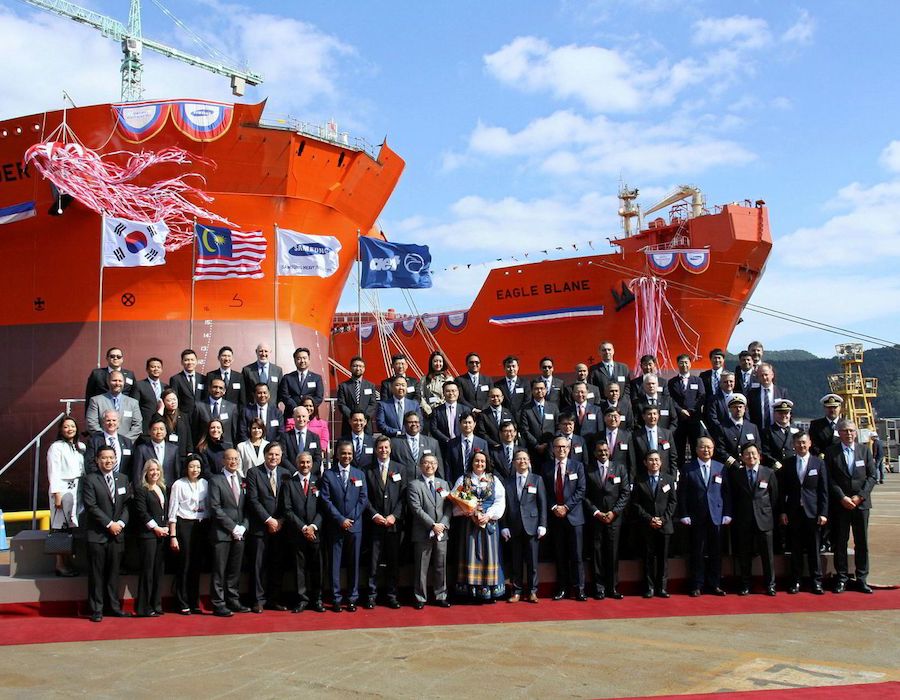
Christening ceremony of Eagle Blane and Eagle Balder

Classification society DNV GL has published an article analysing and outlining how technology can meet environmental targets while boosting the efficiency of shuttle tankers; the article is written by Business Director Tankers, Catrine Vestereng.

AET, one of the leading petroleum tanker owners and operators, has a long tradition of naming its vessels after some of the greatest energy locales, cities or ports in the world. Their latest two dynamic positioning shuttle tankers (DPSTs) will join the “B” ship series and are named after the Eagle Blane and Eagle Balder oil and gas fields on the Norwegian continental shelf.

Meeting international emission regulations

Eagle Blane and Eagle Balder not only continue AET’s naming tradition but also underline the company’s commitment to preserving the environment through state-of-the-art green technology, expanding AET’s fleet of environmentally friendly ships.

The twin-skeg, 123,100 dwt sister vessels will emit 85% less SOx, 98% less NOx, 98% less particulate matter and 93% less black carbon particulates than ships burning conventional fuel. They meet the International Maritime Organization’s (IMO) target to reduce carbon intensity per transport of work by 40% against 2008 baselines by 2030, and halving CO2 emissions by 2050.

The vessels will serve the Norwegian energy company Equinor on long-term charter in oilfields on the Norwegian continental shelf on the North Sea, the Norwegian Sea and the southern Barents Sea, as well as on the UK continental shelf.

“These trading areas not only require compliance with the Global Sulphur Cap but also with the new Gothenburg Protocol in force from 2020, which requires volatile organic compound (VOC) emissions to be capped at 131,000 tons per year,” explains John Baptist, Global Director VLCC & Shuttle Tankers, Crude Shipping at AET.

A new prototype

Powered by liquefied natural gas (LNG) as primary fuel, the DPSTs will be able to capture 100% of the harmful VOCs which escape into the air from crude oil cargoes during loading and voyage. The captured VOCs will be used as a supplementary fuel. “These are AET’s first vessels constructed with a VOC recovery system and fuelled by LNG. Being prototype vessels of this type, there were risks. The design and newbuilding teams have worked with all stakeholders to produce a very environment-friendly vessel type,” summarizes John Baptist. “Being part of the VOC reduction initiative makes this project even more exciting.”

Samsung Heavy Industries (SHI) built the shuttle tankers for AET Sea Shuttle AS (AETSS), a joint venture between the Norwegian shipping company ADS Shipping and AET Tankers which is headquartered in Singapore. AETSS is the owner and commercial operator of the vessels. Project management for the newbuilds was provided by MISC Group’s marine services arm Eaglestar and the Norwegian third-party ship management company OSM Maritime. “The shipyard has played an important role during the newbuilding process and maintained an excellent partnership with the classification society, which resulted in high-end technology solutions whilst ensuring regulatory compliance,” Baptist reports. “The collaboration with class in this project was exceptional in terms of the technical review. DNV GL has shown a high degree of technical expertise in defining, analysing and resolving critical design and engineering philosophies to ensure safe operation. For us, our project partners added remarkable value not only to the vessel but also for our company, as it helps us elevate our reputation among the top environment-friendly service providers.” Vidar Dolonen, Regional Manager Korea and Japan at DNV GL – Maritime , said about the project: “With this dual-fuel shuttle tanker project, DNV GL also broke new ground and we collaborated closely with our experts in various disciplines.

Enhanced technologies for more efficient operation

The vessels use a more efficient computer-controlled system for dynamic positioning that keeps them stationary above a specified seabed area while loading oil. The combination of LNG fuel, a powerful VOC recovery system and a more efficient dynamic positioning system enables estimated fuel savings of up to 3,000 tonnes per year compared with conventional DPSTs of the same size.

“These vessels are proof that environmental sustainability and commercial viability can coexist and are also testament to the fact that operational performance does not have to be sacrificed in the pursuit of reducing emissions,” Capt. Rajalingam Subramaniam, AET President & CEO and Chairman of AETSS says. “The goal was always to leverage our combined experience of AET, ADS and SHI to develop vessels that really push the boundaries in what is possible in North Sea dynamic positioning operations, and to prove the value of LNG dual-fuel solutions in the energy shipping segment.”

During the naming ceremony in October 2019, Lady Sponsor Ann-Elisabeth Serck-Hanssen, Senior Vice President for Asset Management in Marketing, Midstream and Processing at Equinor, said: “Taking these vessels on a long-term contract will further enhance our ability to provide safe, efficient and cost-competitive energy to our customers, and we are proud to play our part in what is an important step forward in the development of more sustainable energy shipping solutions.”

Increased operating opportunities

The two DPSTs will each be propelled by two low-pressure dual-fuel two-stroke engines, which meet IMO Tier III emissions requirements in gas mode without any exhaust gas after-treatment required. Designed for harsh operating conditions, the ships are equipped with latest-generation bow-loading systems (BLS) which offer greater connecting angles, extending the operating opportunities in conditions where shuttle tankers would normally struggle to connect. “The new-generation BLS is capable of connecting the loading hose in wave heights up to Hs = 4.5 m and at an entering angle of 110 degrees,” Stein Are Andersen, Sales Manager Offshore Loading Systems, MacGregor, reports.

Asked about future design and technology developments for shuttle tankers, Baptist believes that green energy will be the top item on the agenda, in particular LNG, VOC and hydrogen as fuels, as well as power generation optimization using variable frequency drives (VFD) batteries. Bow-loading system design has been improving and will continue to evolve to achieve more efficient offshore loading operations. “The demand for shuttle tankers as replacements of ageing tonnage is increasing. In my estimate about 40% of the existing tanker fleet is ready for replacement due to the 20-year age limitation,” Vidar Dolonen points out.

Related: AET names twin LNG dual fuelled DP shuttle tankers at ceremony


Photo credit and source:
DNV GL
Published: 24 February, 2020


Continue Reading

Winding up

Singapore: High Court to hear Norvic Shipping Asia winding up application on 31 July

Application for the winding up of Norvic Shipping Asia Pte Ltd was filed by Netherlands-registered Mur Shipping BV on 8 April, according to Government Gazette notice.

Admin

Published

on

By

RESIZED singapore high court

An application for the winding up of Norvic Shipping Asia Pte Ltd was filed by Netherlands-registered Mur Shipping BV on 8 April, according to a Tuesday (21 July) notice on the Government Gazette.

It noted the winding up application is directed to be heard before the Judge sitting in the General Division of the High Court at 10am on 31 July.

Any creditor or contributory of the company desiring to support or oppose the making of an order on the winding up application may appear at the time of hearing by himself or his counsel for that purpose.

A copy of the winding up application will be furnished to any creditor or contributory of the company requiring the copy of the winding up application by the solicitors of the applicant’s, Oon & Bazul LLC, on payment of the regulated charge for the same.

The Applicant’s address is Hiridostraat 5, Gebouw Prismatrium, 1101CW Amsterdam, The Netherlands.

The Applicant’s solicitors are Oon & Bazul LLC of 103 Penang Rd, #04-04/05/06 Singapore 238467. 

Queries on the winding up application may be directed to the following email addresses: [email protected] and [email protected].


Photo credit: Manifold Times
Published: 22 July, 2026

Continue Reading

Methanol

World Fuel and partners complete first green methanol bunkering of car carrier in Shanghai

Operation involved the delivery of approximately 2,800 MT of green methanol to “Arctic Tern” via a ship-to-ship transfer using SIPG Energy’s dedicated methanol bunkering vessel “M/V Hai Gang Zhi Yuan”.

Admin

Published

on

By

World Fuel and partners complete first green methanol bunkering of car carrier in Shanghai

Marine fuel provider World Fuel on Tuesday (21 July) said it successfully completed the first green methanol bunkering of M/V Arctic Tern, with EUKOR Car Carriers and SIPG Energy at the Port of Shanghai. 

Arctic Tern is the first vessel in the new Shaper Class series of car carriers. 

The operation involved the delivery of approximately 2,800 MT of green methanol to Arctic Tern via a ship-to-ship transfer using SIPG Energy’s dedicated methanol bunkering vessel M/V Hai Gang Zhi Yuan, the largest vessel of its kind in operation. 

The bunkering operation was carried out at Haitong Terminal, Waigaoqiao Port Area, Shanghai Port, with cargo handling operations conducted simultaneously during bunkering.

This marks EUKOR Car Carriers’ first green methanol operation and the first time Arctic Tern has bunkered methanol since its delivery on 9 July. The operation marked the first bunkering at Shanghai Port of green methanol produced locally in Shanghai for an international PCTC operator. 

It also demonstrated the city’s integrated green methanol value chain, spanning local production, storage and bunkering, and established a replicable “Shanghai Model” for green methanol supply.

World Fuel arranged the supply and delivery of the fuel on behalf of EUKOR Car Carriers, working with SIPG Energy as the physical supplier at the Port of Shanghai.

The green methanol supplied was produced from municipal solid waste, ISCC-EU certified, and had a carbon intensity value below 25 gCO₂e/MJ.

Arctic Tern is the first of fourteen Shaper Class vessels ordered by Wallenius Wilhelmsen. With a capacity of 9,300 car equivalent units and methanol dual-fuel capability, the vessel will be operated by EUKOR Car Carriers, jointly owned by Wallenius Wilhelmsen and Hyundai Motor Group. Following her first green methanol bunkering, Arctic Tern will continue her maiden voyage from Asia to Europe.

Xavier Leroi, COO Shipping Services at Wallenius Wilhelmsen and CEO of EUKOR Car Carriers, said: “Completing Arctic Tern’s first green methanol bunkering shortly after delivery is a significant milestone towards our decarbonisation ambition for both EUKOR Car Carriers and Wallenius Wilhelmsen. It demonstrates how investments in next-generation vessel technology and fuel flexibility are being translated into real-world operations. 

“This achievement reflects the strong collaboration between all parties involved. Together, we have shown how partnerships across the maritime value chain can help make lower-emission fuels available and operationally viable at scale.”

Mark Tamsitt, SVP Global Marine Sales at World Fuel, said, “The first bunkering event with a new fuel is a significant moment for any shipowner, and our role is to make it as seamless as possible. By connecting EUKOR Car Carriers with SIPG Energy’s proven green methanol capability at the Port of Shanghai, we were able to deliver on reliable supply, fuel quality, and safe processes. As more of our customers bring methanol dual-fuel tonnage into service, we are committed to being the partner that makes these kinds of operations routine.”

Mr. Zhang Da, General Manager of SIPG Energy, said, “Welcoming Arctic Tern to the Port of Shanghai for her first green methanol bunkering demonstrates the strength and maturity of our supply capability. Building on our well-established methanol ship-to-ship bunkering services for container vessels, we have already extended such services to pure car and truck carriers (PCTCs). This bunkering sets a new record for the largest single SIMOPs green methanol bunkering for PCTCs in China, marking another step in building Shanghai’s position as a global green energy hub for international shipping.”

This operation follows Wallenius Wilhelmsen’s announcement on 9 July that Arctic Tern would complete her first methanol bunkering shortly after delivery. The vessel entered service on routes between Asia and Europe immediately following handover from China Merchants Jinling Shipyard in Nanjing.


Photo credit: World Fuel
Published: 22 July, 2026

Continue Reading

Ammonia

HPA and MB Energy develop safety concept for STS ammonia bunkering

HPA says the Port of Hamburg will become “bunker ready” for ammonia, laying the groundwork for safe and reliable ammonia bunkering in the future.

Admin

Published

on

By

HPA and MB Energy develop safety concept for STS ammonia bunkering

The Hamburg Port Authority (HPA) and integrated energy company MB Energy on Tuesday (21 July) said they have completed a comprehensive risk analysis and developed a dedicated safety concept for ship-to-ship ammonia bunkering.

MB Energy said the analysis lays the groundwork for the safe introduction of ammonia as a future marine fuel.

“With our planned ammonia import terminal in Hamburg-Blumensand, MB Energy intends to provide the reliable land side supply infrastructure needed to support this transition across northern German ports,” it said in a social media post. 

Mabanaft Group was renamed to MB Energy last year and merged over 50 existing brands under one identity. 

Separately, HPA said the Port of Hamburg will become “bunker ready” for ammonia, laying the groundwork for safe and reliable ammonia bunkering in the future.

“The focus is in particular on container ships, cruise ships as well as RoRo and ConRo (Container/RoRo) ships,” it said. 

“We expect ammonia to establish itself as an alternative marine marine fuel in the coming years. With our preparatory work, we are already creating the conditions to welcome the first ammonia-powered ships in Hamburg and to bunker them safely.:

HPA added that the import terminal for ammonia planned by MB Energy from 2029 will make a decisive contribution to ensuring the reliable availability of ammonia as a bunker fuel in northern German ports in the long term. 

“The use of an ammonia bunker barge is considered a possible addition to the landside infrastructure to enable ship bunkering in the port and beyond in the future,” it said.

Related: Mabanaft Group renames as MB Energy, merging over 50 brands under one identity


Photo credit: Hamburg Port Authority
Published: 22 July, 2026

Continue Reading

Trending