Connect with us

Business

Stillwater Associates: IMO 2020 – No Large Speed Bump Thus Far

Consulting firm discusses strategies refiners are executing after IMO 2020 implementation, and changes to be expected ahead.

Admin

Published

on

Stillwater Associates

[vc_row][vc_column][vc_column_text]Transportation fuels consulting firm Stillwater Associates has published an article outlining their analysis on the IMO 2020 transition while offering insights of future changes, it has been written by Senior Associate Ralph Grimmer:

Over the past three years, Stillwater Associates has offered a series of articles on various aspects of IMO 2020. The long-awaited IMO 2020 regulations were implemented on January 1, 2020 – 40 days ago. In this article, we will provide our takeaways on how the initial rollout has gone, a recap of strategies/tactics that refiners are now executing, and a glimpse at further changes to come.

Stillwater Takeaways on the Initial Rollout of IMO 2020

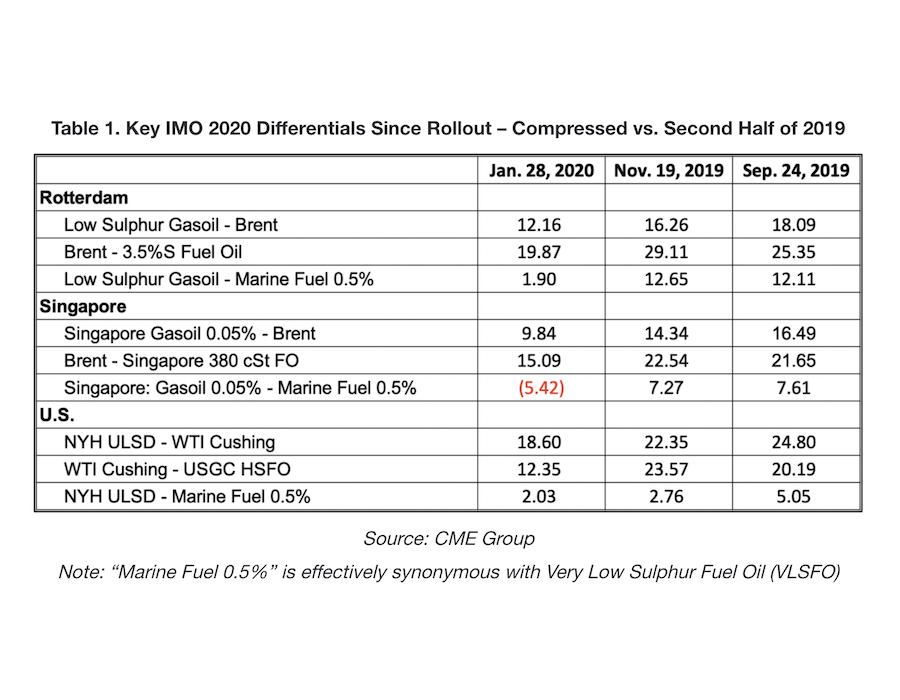
Without question, the biggest surprise from the rollout of IMO 2020 is what hasn’t happened. Futures markets as recently as mid-November 2019 reflected much larger key price differentials early in the IMO 2020 rollout in Rotterdam, Singapore, and the U.S. than what has transpired thus far. Comparing snapshots of the March 2020 contract on the CME futures market taken November 19th and September 24th of 2019 with those from January 28th of 2020, the differences are compelling (all figures are $/bbl):

Across the board, the March futures price differentials from January 28, 2020 are far smaller than for both November 19th and September 24th of 2019. The size of the IMO 2020 “speed bump” at initial rollout is markedly smaller than expected!

The figures below provide current futures market snapshots from March 2020 through December 2021. It’s quite apparent that futures price differentials are compressed in early 2020, gradually widening to more historic levels by early 2021. 

An early surprise that began in December 2019 was the strength of the VLSFO market. At one point, VLSFO prices (on a $/bbl basis) were higher than gasoil in both Rotterdam and Singapore. This is still the case in Singapore. Prevailing wisdom had been that VLSFO would trade at a price discount to gasoil.

From an operational perspective, the shift of notionally 75% of the open-ocean marine fuel from High Sulfur Fuel Oil (HSFO) to either VLSFO or Marine Diesel Oil (MDO) has proceeded much smoother than most industry observers expected. There have been very few reports of enforcement action taken against vessels for non-compliance with the sulphur cap.

There are, however, still valid concerns over the consistency of VLSFO quality. The three specs we’ve been hearing about most often are sediment, compatibility, and stability. Thus far, we are unaware of any vessel-operating problems caused by the use of VLSFO. However, this is an issue worth keeping on the radar screen.

There are ports in more than 20 countries that have regulated or banned operations of open-loop scrubbers in port areas.

Not all signatory countries to MARPOL Annex VI have put in place regulations for their individual countries compelling compliance. This could become a nuisance because a level playing field is not yet quite in place.

During the run-up to IMO 2020 implementation, many observers suggested that vessel operators would likely be motivated to employ slow steaming tactics to optimize operating costs versus revenue. From our research, shipowners have not embraced slow steaming very much over the past few months.

Current Refiner Strategies and Tactics

Stillwater assessed the future world of simple and complex refineries in previous IMO 2020 newsletter articles – one on Refiners’ Perspective and another focusing on how changes to crude slate pricing would force refiners into a “Choose Your Own Adventure” decision-making process. Simple refineries that produce HSFO are faced with the challenge of finding new homes for the displaced HSFO. The global HSFO market has shrunk by about 2.7 million barrels per day (MMBPD) with the rollout of IMO 2020. (Clearly, this figure depends on how much deliberate non-compliance is actually occurring.) Selling cutback high sulfur resid to other refiners or selling HSFO to power plants are certainly two options; neither of these options is as good as the former option of selling HSFO for bunker fuel.

Complex refineries (i.e. refineries with resid upgrading) have more freedom. They can:

  1. Maximize coking capacity throughput. For refiners with multiple refineries, this is a system optimization rather than the sum of individual refinery optimizations. Surplus resid from one refinery can be processed at another refinery in its system.
  2. Purchase cutback resid (HSFO) to process as a component of the refinery’s crude mix.

Marathon (on the U.S. West Coast) and Valero (on the U.S. Gulf Coast) have told securities analysts that they are processing purchased cutback resid in the refining networks.

Refineries with Vacuum Gas Oil (VGO) hydrotreating capability are currently finding it may be attractive to sell a portion of this nominal 650-1,050+° F stream rather than processing all of it on a cat cracking unit that is focused on producing gasoline. Both Valero and Marathon are selling VGO into the VLSFO blend pool. These economics depend on the VLSFO – RBOB price differential. Valero indicated to securities analysts last October that selling VGO for more than $5.00/bbl above than USGC RBOB was an opportunity to capture.[1] Valero has also indicated that they are selling some volumes of low sulfur Atmospheric Tower Bottoms (ATB) into the VLSFO blend pool.

Changes Yet to Come

  1. As HSFO displaced out of the marine fuel pool is placed elsewhere and inventories are drawn down to normal levels, we may see HSFO prices erode versus other commodities. A decline in HSFO prices could also exert a downward pull on sour crude prices relative to sweet crudes.
  2. ExxonMobil, Marathon, and BP have all told securities analysts that they expect sweet/sour crude differentials to widen. Thus far, the differentials have not materially changed.
  3. Port States will gain enforcement authority beginning March 1, 2020. (Currently, only Flag States have enforcement authority.) From that date, carriage of marine fuel with more than 0.5%S in any of a ship’s fuel tanks will place that vessel out of compliance with IMO 2020 regulations.
  4. SK Energy will bring its new 40 thousand-barrel-per-day (KBD) resid desulphurizing unit onstream in March 2020.
  5. Marathon will expand its Garyville, LA refinery coker capacity by 9 KBD by March 2020.
  6. China will be eliminating its Value Added Tax obligations on exports of VLSFO. This will be a huge change for the Singapore market, finally opening the door to marine fuel from China. The impact of this move by China will also be felt in Northwest Europe and the U.S.

Conclusion

Implementation of IMO 2020 thus far has not produced the much wider key crude oil and refined products price differentials that many industry observers had expected. Even so, IMO 2020 is still likely to be one of the most impactful refined product specification changes ever, largely because the change was both global and instantaneous. VLSFO has replaced HSFO as the preferred marine fuel for the majority of the world’s open-ocean marine vessels. More than two million barrels per day of HSFO has been displaced from the 2020 open oceans marine fuel pool by IMO 2020. It’s not clear that dependable new distribution channels have been developed for this entire ongoing volume of displaced HSFO. There may yet be marketplace bumps in the weeks ahead.

[1] OPIS daily alerts, “Valero Continues to Divert LSVGO From Cat-Cracking Into Bunker Market”, January 31, 2020


Photo credit and Source:
Stillwater Associates
Published: 21 February, 2020 [/vc_column_text][/vc_column][/vc_row][vc_row][vc_column][vc_gallery type=”image_grid” images=”2940,2942,2941″ title=”Additional Information”][/vc_column][/vc_row]

Continue Reading

Biofuel

BHP and GCMD trial multi-feedstock B100 bio bunker fuel on bulk carrier

Bio-blend in the BHP and GCMD pilot is being used on a BHP-chartered bulk carrier “Berge Lyngor”, which was bunkered in Singapore in early May.

Admin

Published

on

By

BHP and GCMD trial multi-feedstock B100 bio bunker fuel on bulk carrier

BHP and the Global Centre for Maritime Decarbonisation (GCMD) on Wednesday (3 June) said they have blended biofuels from two distinct feedstocks—used cooking oil and waste animal fats —and introduced the lower-emissions marine fuel into a BHP-chartered bulk carrier as part of a pilot project.

The bio-blend in the BHP and GCMD pilot is being used on a BHP-chartered bulk carrier Berge Lyngor, owned and operated by Berge Bulk, transporting BHP iron ore from Western Australia to China. When run on bio-blend, the vessel has the potential to reduce well-to-wake greenhouse gas emissions by approximately 79 per cent per voyage compared to sailing on very low sulphur fuel oil (VLSFO).

The vessel bunkered in Singapore in early May with a B100 bio-blend comprising 50 percent tallow-derived biodiesel, sourced and supplied by HAMR Energy, and 50 per cent used cooking oil (UCOME) supplied by Mitsui & Co Energy Trading Singapore (METS).

Mitsui also blended the fuel and Dan-Bunkering coordinated and executed the bunkering operation, which was performed by Global Energy’s barge MT Maple.

The BHP and GCMD pilot will assess how biofuels from multiple feedstocks can be blended, handled, and introduced under real-world operating conditions using existing used cooking oil bunkering infrastructure.

At the same time, insights from this pilot will help identify solutions to challenges related to fuel quality, handling, traceability, and onboard vessel performance.

Biofuels for global shipping today rely heavily on used cooking oil – a feedstock whose availability is approaching its projected limits. Biofuel from waste animal fats presents a promising option to expand the supply of lower-emissions marine fuels.

The outcomes of the pilot are expected to shed light on the practical steps to integrate biofuel blends from different feedstocks into existing supply chains. The diversity of biofuels will provide shipowners and operators with greater flexibility to optimise fuel procurement based on cost, availability, and lifecycle emissions performance.

Biofuels derived from different feedstocks can exhibit varying properties that may impact operations, including potential corrosion from oxidation, fuel system clogging caused by wax formation, which this pilot aims to assess.

The pilot will trace and verify the biofuel blend’s integrity aimed at bolstering confidence in emissions reductions reporting. The pilot will also provide insights into how robust tracing can support future marine fuel supply chains where biofuels from multiple feedstocks with varying lifecycle greenhouse gas emissions footprints are blended together.

This project is co-funded by the Maritime and Port Authority of Singapore under the Maritime Innovation and Technology Fund (MINT).


Photo credit: Global Centre for Maritime Decarbonisation
Published: 3 June, 2026

Continue Reading

Biofuel

NYK starts one-year B100 bio bunker fuel trial on car carrier

In this trial, NYK will operate a car carrier continuously on B100 for one year to evaluate the impact on engines, fuel supply systems, and operational practices.

Admin

Published

on

By

NYK starts one-year B100 bio bunker fuel trial on car carrier

Japanese shipping firm NYK on Tuesday (2 June) said it has commenced a one-year long-term trial involving the continuous use of 100% biofuel (B100) on an NYK-operated car carrier. 

In this trial, NYK will operate a car carrier continuously on B100 for one year to evaluate the impact on engines, fuel supply systems, and operational practices. High-purity biofuels such as B100 are known to be susceptible to degradation from oxygen, light, and heat, raising concerns about the stability of such fuels during long-term use.

In this trial, the biofuel primarily comprises FAME (Fatty Acid Methyl Ester) derived from used cooking oil and similar feedstocks.

The initiative is designed to evaluate the fuel’s effects on the vessel’s equipment and verify operational safety under real-world conditions. 

Through this effort, NYK seeks to accumulate technical expertise that will support the broader use of high-purity biofuels and further accelerate efforts to reduce greenhouse gas (GHG) emissions.

NYK has been advancing the use of biofuels through various initiatives. In 2024, the company conducted a trial using biofuel blend B24 and subsequently expanded practical usage to B30. However, the company said there remains limited global experience with the long-term continuous use of B100.

“By collecting long-term operational data through this trial, NYK aims to accumulate valuable technical insights to support both the safe operation of vessels and the wider adoption of high-purity biofuels,” it said. 


Photo credit: NYK
Published: 3 June, 2026

Continue Reading

Ammonia

AM Green plans to build green ammonia plant at Indian port

Initiative also includes development of green ammonia handling, storage and bunkering infrastructure, pilot bunkering operations, safety procedures and training programmes, says VOC Port Authority.

Admin

Published

on

By

india flag

VO Chidambaranar (VOC) Port Authority on Friday (29 May) said it has signed a Memorandum of Understanding (MoU) with India’s ammonia producer AM Green Ammonia to collaborate in the development of a green ammonia production plant.

The plant will have a capacity of one million tonnes per annum (MTPA) at Tuticorin.

The initiative also includes development of green ammonia handling, storage and bunkering infrastructure, pilot bunkering operations, safety procedures and training programmes. 

The project is expected to support the development of green fuel corridors connecting VOC Port with major ports in Europe and Asia, thereby strengthening India’s position in the global green fuels value chain.

VOC Port also signed a Memorandum of Understanding (MoU) with Bureau Veritas (India) Pvt. Ltd., to collaborate on Green Port certification, emissions accounting, ESG reporting, safety validation, development of green bunkering practices, and establishment of a Centre of Excellence for green fuels and sustainability.

The port also plans for an upcoming 750 m³ green methanol bunkering facility.


Photo credit: Naveed Ahmed on Unsplash
Published: 3 June, 2026

Continue Reading

Trending