Connect with us

Alternative Fuels

Wärtsilä partners Grieg Edge to build world’s first green ammonia tanker

Project is supported with USD5.3 million from the Norwegian government, and the MS Green Ammonia will start sailing in 2024.

Admin

Published

on

Wartsila green ammonia

Maritime technology group Wärtsilä on Friday (18 December) said it will be jointly running a project with Grieg Edge, the innovation hub of Norwegian shipping group Grieg Star, to launch an ammonia-fuelled tanker that produces no greenhouse gas emissions by 2024

With Norwegian government support worth NOK 46.3 million NOK (USD 5.3 million) under the Pilot-E funding scheme, the partnership aims to build the world’s first green ammonia fuelled tanker.

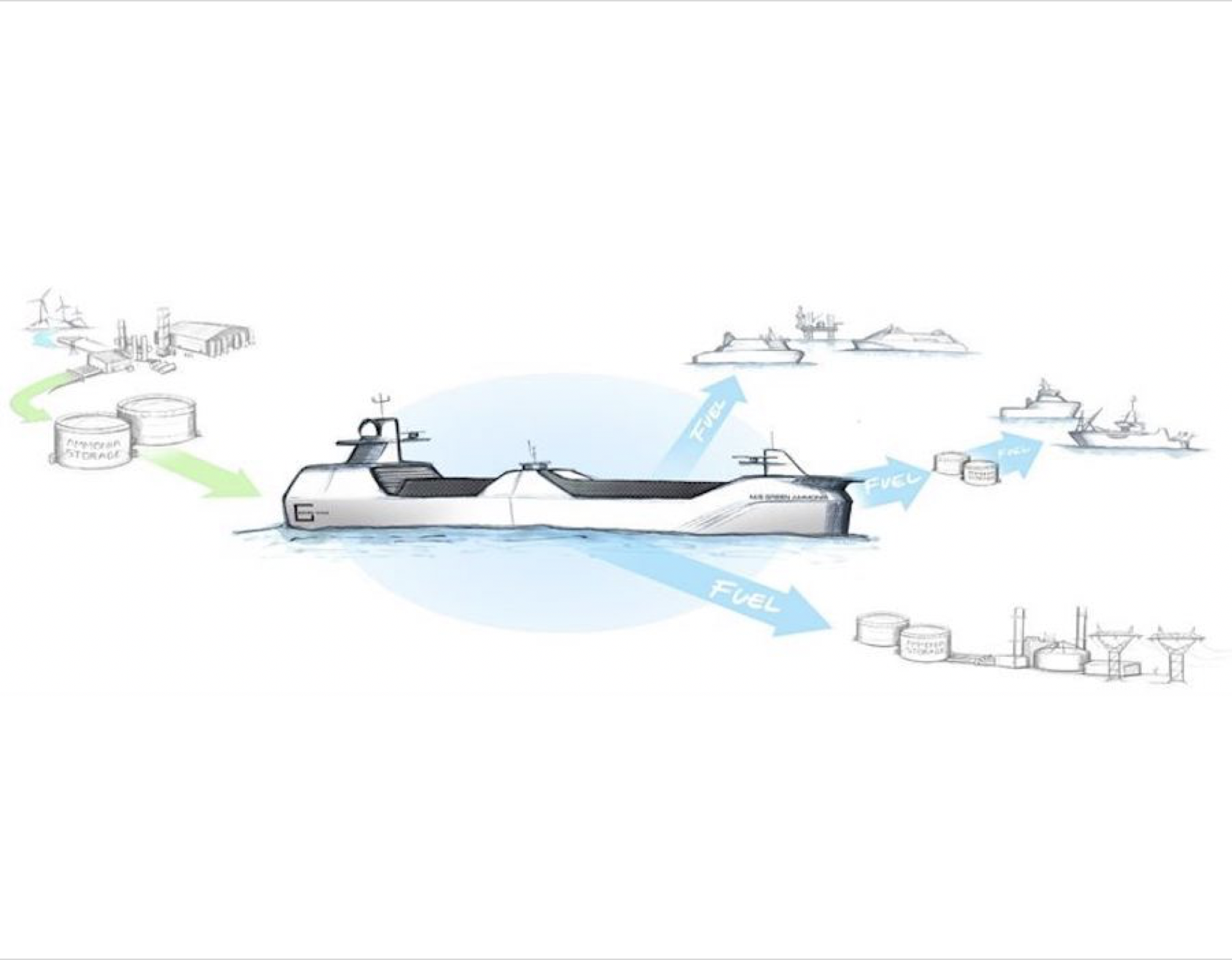
The MS Green Ammonia will be a vital link in the new green ammonia value chain and the vessel will start sailing in 2024 to set a new benchmark for future low emission vessels.

The project is the result of a Nordic industrial collaboration group founded from the Zeeds (Zero Emissions Energy Distribution at Sea) initiative.

“We regard the funding from Pilot-E as a valuable stamp of approval for our plans. Both Wärtsilä and we feel confident that this project represents the future for the maritime sector,” said Nicolai Grieg, Head of Grieg Edge.

“To have the support from the Norwegian Research Council and Innovation Norway is a significant step towards completion.”

“This year’s grants show that the Norwegian maritime industry is really at the forefront of developing emission-free solutions with great export potential. This is another great example of how we create new green industry and growth in Norway,” said Norwegian Minister of Trade and Industry, Iselin Nybø.

The partners said they plan to have MS Green Ammonia distribute green ammonia from a planned factory in Berlevåg, Norway to various locations and end-users along the coast.

The eventual design, size, and volume of the vessel will be dependent on the market and end-user interest. However, the project has already established Letters of Intent (LOI) with several heavyweight industrial partners.

“We see a strong interest from owners of ferries, offshore supply ships, fishing vessels, and from energy-producing companies. In total, they require an amount of energy surpassing what we can achieve in this project. The market is there without a doubt,” said Vidar Lundberg, Chief Business Development Officer, Grieg Star Group.

“Norway, with its high number of vessels using LNG or alternative fuels, with high volumes of green energy, and the cheapest electrical power in Europe, is probably the perfect arena for the world’s first market for green ammonia.”

Ship owners operating LNG-fuelled vessels represent a significant source of potential customers. Depending on the engine type, ammonia could be mixed with the LNG, or alternatively, the engine could be easily retrofitted to use only ammonia.

“We are in the midst of a transition to low carbon shipping, and the long traditions we have in Norway for cross industry cooperation is vital for the successful implementation of a new green value chain,” added Cato Esperø, Head of sales Wärtsilä Norway.

“The projects that now receive support through Pilot-E will make important contributions to the development of hydrogen and ammonia as alternative zero-emission fuels for various vessel categories,” noted Norway’s Minister of Climate and Environment, Sveinung Rotevatn.

Photo credit: Wärtsilä
Published: 21 December, 2020

Continue Reading

Alternative Fuels

J-ENG completes land-based testing of hydrogen-fuelled marine engine

Engine will be installed on a 17,500 DWT multipurpose vessel to be built by Onomichi Dockyard for MOL and MOL Drybulk, with onboard demonstration testing scheduled to begin in April 2028.
Admin

Published

on

By

12 2

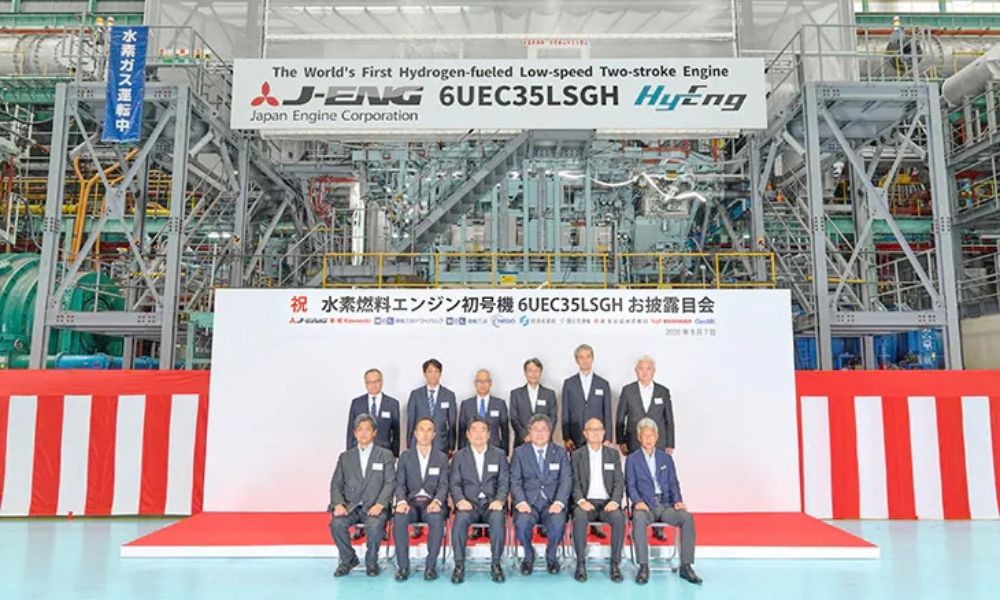
Japan Engine Corporation (J-ENG) on Friday (18 September) said it has completed land-based testing of the world’s first hydrogen-fuelled engine for large commercial vessels, the 6UEC35LSGH.

During factory testing, the engine achieved a hydrogen co-firing rate of at least 95%, reducing GHG emissions by more than 95% compared with conventional heavy-fuel-oil engines.

By adopting a high-pressure direct injection system, which injects fuel directly into the cylinder at high pressure, J-ENG said the engine achieves stable hydrogen combustion. 

Safety measures were also implemented, including a robust structure to prevent hydrogen leakage and double-walled piping for hydrogen supply lines. 

“Approval testing was conducted in the presence of ClassNK and was completed successfully,” the company said. 

The engine will be installed on a 17,500 DWT multipurpose vessel to be built by Onomichi Dockyard for Mitsui O.S.K. Lines and MOL Drybulk.

Hydrogen fuel will be supplied to the engine through a marine hydrogen fuel system, consisting of marine hydrogen fuel tanks and a fuel supply system, developed and manufactured by Kawasaki Heavy Industries.

In addition, Nippon Kaiji Kyokai (ClassNK) will conduct safety assessments throughout each stage of the engine’s development and the vessel’s design, construction and operation.

The vessel will then undergo sea trials before onboard demonstration testing begins in April 2028. 

Kawasaki will also develop and manufacture bunkering equipment for supplying liquefied hydrogen to vessels. 

“The demonstration will further evaluate the engine’s durability and performance under actual operating conditions,” J-ENG added.


Photo credit: J-ENG
Published: 22 September, 2026

Continue Reading

Alternative Fuels

DNV on IMO CCC 12: Revised guidelines for methanol as marine fuel

CCC 12 finalized the revision of the interim guidelines for use of methyl/ethyl alcohol as fuel while work continued on guidelines for low-flashpoint oil fuels and onboard carbon capture and storage systems.
Admin

Published

on

By

RESIZED Chris Pagan

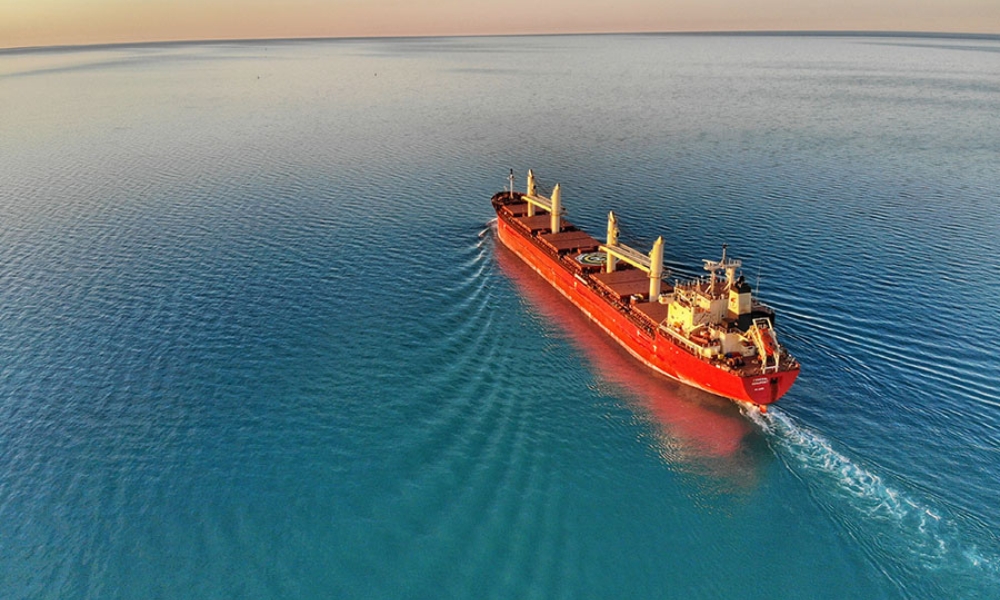
Classification society DNV on Monday (21 September) highlighted progress made on several regulatory and technical matters at the 12th session of the IMO Sub-Committee on Carriage of Cargoes and Containers (CCC 12), held from 14 to 18 September. 

This includes alternative fuels, cargo securing, onboard carbon capture systems, and battery carriage: 

Amendments to the IGF Code and development of guidelines for alternative fuels and related technologies

Methyl/ethyl alcohols

CCC 12 finalized the revision of the Interim Guidelines for the Safety of Ships Using Methyl/Ethyl Alcohol as Fuel (MSC.1/Circ.1621). The amendments revise all sections of the existing guidelines, taking into account experience gained to date.

The revised guidelines:

  • provide more flexibility in fuel tank placement and leakage-handling arrangements;
  • introduce a new concept for ventilation of fuel spaces;
  • expand guidance on the design of bunkering stations and fire extinguishing; and
  • add new guidance on bunkering operations and personal protective equipment.

Low-flashpoint oil fuels

CCC 12 continued work on the interim guidelines for ships using low-flashpoint oil fuels (fuel with a flashpoint between 52°C and 60°C). It was agreed not to develop detailed provisions for the “temperature-controlled engine room concept” but focus on a safety concept more aligned with the existing guidelines under the IGF code, however with major simplifications of the safety barriers. Work on the interim guidelines will continue in a Correspondence Group aiming for finalization at CCC 13 in 2027.  

Fuel cell power installations and IGF Code amendments

The revision of the Interim Guidelines for the Safety of Ships Using Fuel Cell Power Installations (MSC.1/Circ.1647), and other proposals for amendments to the IGF Code were not discussed in detail, but work will continue in a Correspondence Group reporting to CCC 13 in 2027.  

Development of a safety regulatory framework to support the reduction of GHG emissions from ships using new technologies and alternative fuels

Onboard carbon capture and storage (OCCS)

CCC 12 started the discussion to develop guidelines for the safety of ships fitted with OCCS. The guidelines should contain a technology-neutral main body for common ship-level requirements, while technology-specific safety requirements will be placed in individual annexes. Work on the guidelines will continue in a Correspondence Group reporting to CCC 13 in 2027. The guidelines are expected to be finalized in 2028.

Note: The full technical and regulatory news by DNV can be found here


Photo credit: Chris Pagan on Unsplash
Published: 22 September, 2026

Continue Reading

Biofuel

ENGINE on Biofuel Bunker Snapshot: B30-VLSFO prices drop across global hubs

B100 price surges in Rotterdam this week; Gibraltar’s B30-VLSFO price drops sharply; Singapore’s bio-blended bunker volumes rose sharply.
Admin

Published

on

By

ENGINE on Biofuel Bunker Snapshot: B30-VLSFO prices drop across global hubs

Once a week, bunker intelligence platform ENGINE will publish a snapshot of biofuel bunker prices in Europe, Fujairah and Singapore. The following is the latest snapshot:

  • B100 price surges in Rotterdam this week
  • Gibraltar’s B30-VLSFO price drops sharply
  • Singapore’s bio-blended bunker volumes rose sharply

Europe

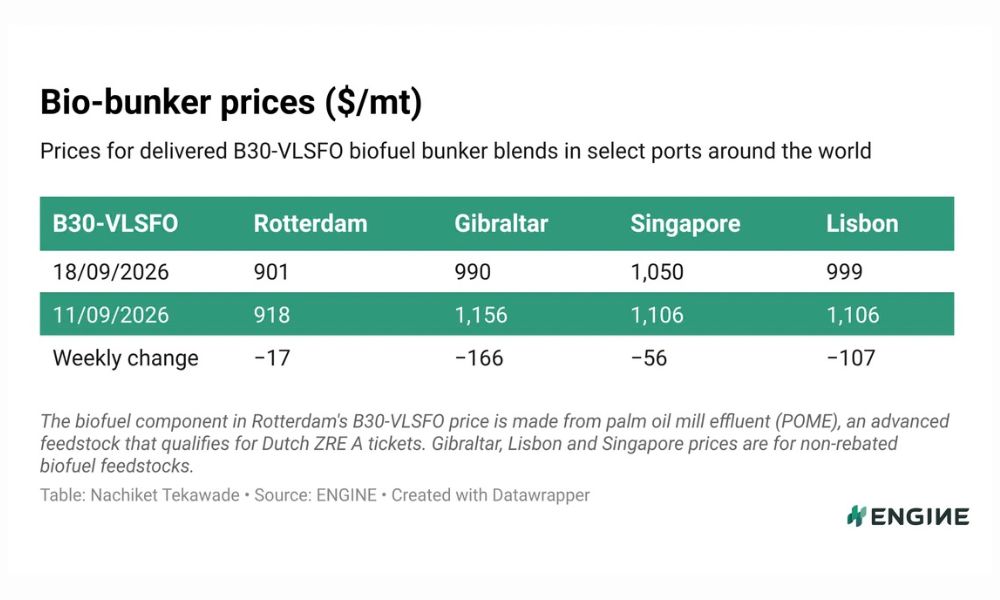
Rotterdam’s B30-VLSFO (POMEME) price has dropped $17/mt in the past week, most probably pressured by a $24/mt drop in the Dutch port’s conventional VLSFO price during the same period.

Rotterdam’s B30-LSMGO (POMEME) price has gained by $17/mt to $1,476/mt, which has been similar to a $19/mt gain in the port’s conventional LSMGO price.

B100 has been priced at $1,418/mt in Rotterdam today, a sharp $209/mt increase compared to last week.

Prima Markets’ POMEME barge price, which is an indicator of feedstock sourcing costs, has gone up by $35/mt to $2,059/mt.

Dutch suppliers can generate ZRE A tickets for selling low carbon fuels, which can be traded with other suppliers. The price of these tickets has dropped from €200/mtCO2e ($230/mtCO2e) last Friday to €190/mtCO2e ($218/mtCO2e) on Thursday this week.

Gibraltar’s B30-VLSFO (UCOME) price has slumped $166/mt lower in the past week. The port’s conventional VLSFO price has remained largely unchanged during this period.

This has cut the port’s B30-VLSFO price premium over conventional VLSFO by $172/mt in a single week to $250/mt.

Lisbon’s B30-VLSFO price has dropped $107/mt during the week. It has flipped to a modest $9/mt premium over Gibraltar’s B30-VLSFO price, coming from a $50/mt discount last Friday.

Lisbon’s B30-LSMGO price has slumped $115/mt to $1,600/mt, while the B100 price in the Portuguese port has plunged $215/mt lower to $1,665/mt.

Asia

Singapore’s B30-VLSFO (UCOME) price has dropped $56/mt since last Friday, while the port’s conventional VLSFO price has gained only $5/mt over the same period.

This has narrowed the port’s B30-VLSFO price premium by $61/mt in a single week.

Data this week showed Singapore’s bio-blended bunker sales rose by 48% in August to 57,000 mt, which was the highest monthly volume since April.

B30-VLSFO is priced at $1,015/mt in Hong Kong, which is a $35/mt price discount to Singapore.

Hong Kong’s B30-VLSFO price is at a $109/mt premium over its conventional VLSFO price.

By Nachiket Tekawade


Photo credit and source: ENGINE
Published: 22 September, 2026

Continue Reading

Trending