
Port & Regulatory
UK ETS expansion to maritime sector: DNV outlines key mechanisms and implications
DNV highlighted key information and implications of the UK Emissions Trading Scheme, which will be expanding to maritime activities from 1 July 2026.

Classification society DNV on Friday (5 June) highlighted key information and implications of the UK Emissions Trading Scheme, which will be expanding to maritime activities from 1 July:
The UK Emissions Trading Scheme (ETS) is rapidly evolving, shaping how industries price and manage greenhouse gas emissions as the UK moves toward net-zero. As the scheme expands and its carbon market strengthens, understanding its key mechanisms and implications is becoming increasingly important for the maritime sector.
UK ETS implementation timeline
The UK ETS expands to maritime activities from 1 July 2026, and the implementation timeline for the UK ETS in shipping introduces several steps that operators need to follow to be compliant. One of the first requirements is the submission of an Emissions Monitoring Plan (EMP) by the ship operator to the regulator (an equivalent to the EU ETS administering authority). An EMP is submitted per company (operator) and includes relevant data such as a list of ships, their particulars, emission sources, etc. The EMP does not undergo assessment by a verifier but instead is subject to approval by the regulator.
Operators must use an independent verifier accredited by UKAS, such as DNV, to verify their Annual Emissions Report (AER), a company-level report. Operators must submit their AER by 31 March each year and must surrender the number of emissions allowances by 30 April. The deadline to surrender allowances for the first scheme year (1 July to 31 December 2026) will be 30 April 2028. A standard reporting year runs from 1 January to 31 December, while in 2026, only half of the year is subject to reporting (from 1 July, 2026). A summary of the timeline is illustrated in the following figure:
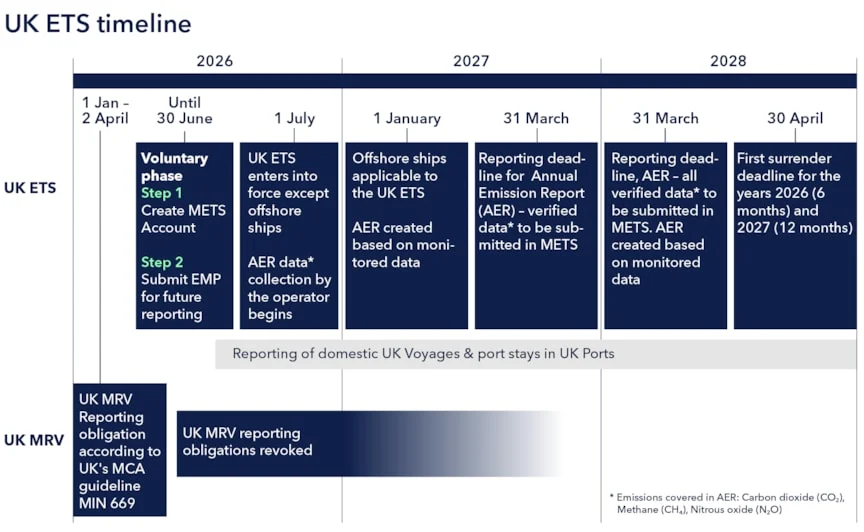
Further, Appendix 1 provides an annual wheel illustration of the UK ETS process.
UK ETS scope and compliance cycle
As of 1 July 2026, the UK ETS applies to cargo and passenger vessels of 5,000 GT and above, with the inclusion of offshore ships delayed until 1 January 2027. The scheme covers emissions from domestic voyages between UK ports. A domestic voyage includes voyages from one UK port to another, as well as voyages that start and end at the same UK port. In addition, emissions generated during ports of call are within scope, including time spent at berth, whether moored or anchored, at UK ports and offshore installations.
Ship operators are required to monitor and report emissions occurring in UK ports and on domestic UK voyages. As a result, emissions from ports of call on international routes are also captured under the UK ETS. The greenhouse gases covered are aligned with those under the EU ETS and include emissions from combustion and slippage of carbon dioxide (CO₂), methane (CH₄) and nitrous oxide (N₂O), calculated on a tank‑to‑wake basis. Methane and nitrous oxide are reported using IPCC AR5 global warming potential values (CH₄ = 28, N₂O = 265).
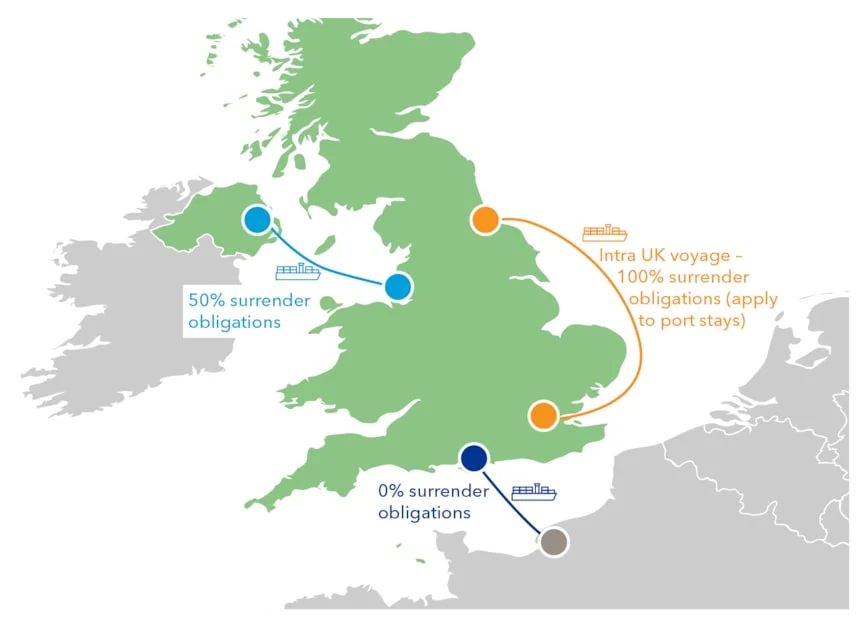
Exemptions apply to ships engaged in government non‑commercial maritime activities, fish‑catching and fish‑processing vessels, and ships operating Scottish ferry services. In contrast to the UK MRV framework (revoked as of 2 April 2026), voyages between the UK and ports outside the EEA, including those in UK Overseas Territories and Crown Dependencies, are not included in the UK ETS, as they are not considered domestic voyages. In addition, a 50% deduction applies to the UK ETS surrender obligation for voyages between Northern Ireland and Great Britain. Other exemptions are stated in the regulations.
The following figure illustrates the principles for a voyage between Northern Ireland and Great Britain, where the surrender obligation, is 50%, while port stays in both Northern Ireland and Great Britain are subject to a 100% surrender obligation. For a voyage between France and Great Britain, there is no (0%) surrender obligation for the voyage itself; however, the port stay in Great Britain remains subject to a 100% surrender obligation.
Note: The full version of DNV’s Technical and Regulatory News on UK ETS can be found here.
Photo credit: DNV and william william on Unsplash
Published: 8 June, 2026
Technology
Singapore: MPA working with industry on next phase of digital bunkering, says Deputy CE
‘We are now working with industry on the next phase, trialling capabilities to further strengthen the integrity and quality of bunker data shared between stakeholders and MPA,’ says David Foo.

LNG Bunkering
DNV report: LNG bunker fleet may need to more than double by 2030 to meet demand
Global LNG bunker vessel fleet may need to more than double by 2030 as demand from LNG-fuelled ships grows faster than the infrastructure required to supply them, according to DNV white paper.

EU ETS
KPI OceanConnect on EUAs: September is the deadline, but strategy is the bigger story
With 100% EU ETS exposure for 2026 emissions, an alternative fuels strategy can no longer be treated separately from carbon management, says Jesper Sørensen.


OUR INDUSTRY PARTNERS

Singapore: MPA working with industry on next phase of digital bunkering, says Deputy CE

Singapore-based Uni-Fuels H1 2026 net income jumps 1,415% to USD 1.4 million

Peninsula confirms one fatality, crew member missing from bunker tanker “Hercules Star”

DNV report: LNG bunker fleet may need to more than double by 2030 to meet demand

Burando Energies wraps up first physical bunker operation in Norway

KPI OceanConnect on EUAs: September is the deadline, but strategy is the bigger story

Europe & Africa Fuel Availability Outlook (9 Sep 2026)

China’s bunker market reshaped by tax rebates, trade flows and refining changes, says economist

Rajah & Tann: Bunker disputes are won in the first 48 hours

Singapore: Notices of annual meeting issued for Vroon Shipping Asia and related firms

Malaysia: MMEA detains two vessels over suspected illegal ship-to-ship transfer off Johor

NAPA: Why operational efficiency remains shipping’s golden ticket

Singapore strengthens LNG bunkering framework with new SS 727 standard

Ahti Climate and DNV connect verified emissions data to FuelEU pooling platform
-
 Interview2 weeks ago
China’s bunker market reshaped by tax rebates, trade flows and refining changes, says economist
-
 Bunker Claim1 week ago
Rajah & Tann: Bunker disputes are won in the first 48 hours
-
 Winding up2 weeks ago
Singapore: Notices of annual meeting issued for Vroon Shipping Asia and related firms
-
 Vessel Arrest1 week ago
Malaysia: MMEA detains two vessels over suspected illegal ship-to-ship transfer off Johor
-
 Decarbonisation2 weeks ago
NAPA: Why operational efficiency remains shipping’s golden ticket
-
 LNG Bunkering1 week ago
Singapore strengthens LNG bunkering framework with new SS 727 standard
-
 FuelEU1 week ago
Ahti Climate and DNV connect verified emissions data to FuelEU pooling platform
-
 Alternative Fuels7 days ago
Yang Ming orders six LNG dual-fuel, ammonia-ready containerships from Hanwha Ocean