Connect with us
DNV Decarbonization Insight Series August 2026 - What maritime professionals should know about AI Training

LNG Bunkering

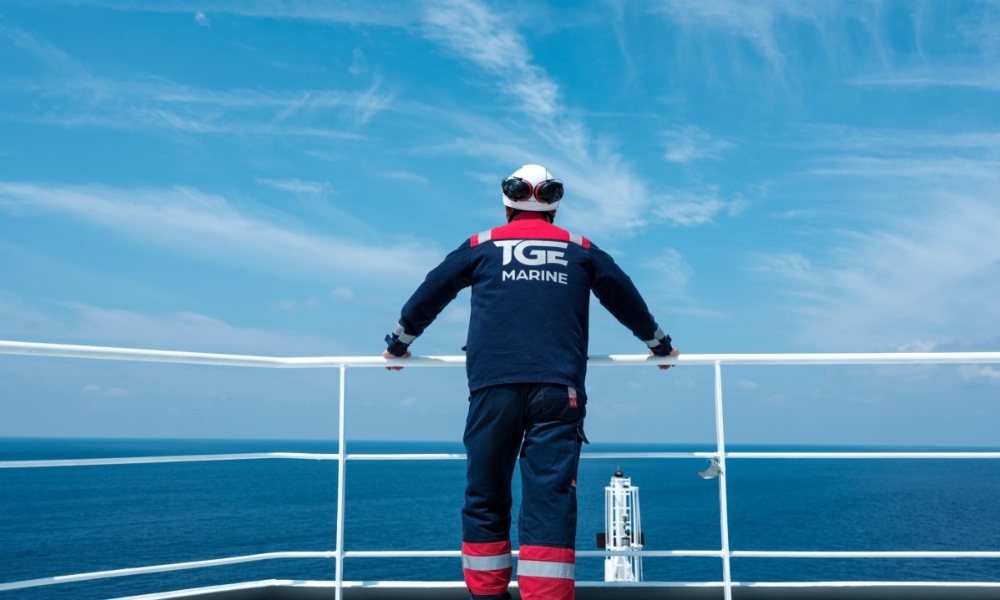
TGE Marine to supply fuel gas system for Sirius and Gasum LNG bunker vessel

The 7,800 m³ LNG bunker vessel “Celsius”, which was ordered by Sirius Shipping and Gasum, will have TGE Marine’s Type C Bi-lobe tanks and a cargo handling and fuel gas system on board.

Admin

Published

on

TGE Marine to supply fuel gas system for Sirius and Gasum LNG bunker vessel

TGE Marine Gas Engineering on Thursday (25 April) announced its collaboration with Turkish shipbuilder RMK Marine on a new 7,800 m³ LNG bunker vessel, which was ordered by Sirius Shipping and Gasum. 

The vessel Celsius will have TGE Marine’s Type C Bi-lobe tanks and a cargo handling and fuel gas system on board. The vessel will be used for servicing a variety of LNG fuelled vessels and accommodate the needs an LNG fuelled ship will have for efficient bunkering, gas freeing- and conditioning operations. 

This project has been ongoing since summer of 2024, and TGE Marine’s Technical Sales Director Johannes Dziuba has been at the forefront of this project. 

He said: “I am very happy that our close cooperation with RMK Marine has yielded us this project. We have previous experience working together with Sirius and we know that it will be a great vessel. Even more special for us, this is the first vessel we see being built in Turkey.”

“As we are using Type C tanks, these tanks can handle gases in high pressure and cryogenic conditions, which allows for the safe handling and efficient transport of LNG. All operations can be carried out with the utmost crew safety in mind.” 

Jonas Backman from Sirius Shipping, said: “We are happy that we can work with TGE Marine again. We have had a successful previous collaboration since 2017 with TGE Marine from our Coralius vessel.”

Jakob Nielsen, Sales Director, adds: “We are very excited and proud to be selected for the Sirius’ and Gasum’s new vessel! It is a great achievement for TGE Marine, and we believe this will be the start of a very good relationship and developing a strong position for building LNG Bunker vessels in Europe.”

“This will also play a very important part of the much-needed infrastructure for the rapid growing LNG fuelled shipping fleet in the Baltic Sea and Kattegat Sea.”

Manifold Times previously reported Gasum announcing it has chartered a new LNG and bio-LNG bunker vessel that will serve Gasum’s customers starting 2027.

The new vessel, to be named Celsius, will enable Gasum to fulfil its strategic ambition to increase LNG and bio-LNG availability in the Northwestern European maritime market.

Celsius will be owned by a Joint Venture between Gasum and Swedish shipping company Sirius Shipping. 

Related: Gasum to charter new LNG bunker vessel to serve Northwestern European market


Photo credit: TGE Marine
Published: 29 April, 2025

Continue Reading

LNG Bunkering

Explora Journeys names first LNG-powered ship “EXPLORA III” in Barcelona

As the first LNG-powered ship in the Explora Journeys fleet, the ship also offers a pathway towards renewable alternatives such as bio-LNG and synthetic LNG as these become increasingly available.

Admin

Published

on

By

Explora Journeys names first LNG-powered ship “EXPLORA III” in Barcelona

Explora Journeys recently officially named EXPLORA III in Barcelona, welcoming the brand’s first liquefied natural gas (LNG)-powered ship to the fleet. 

Following her early delivery in Genoa on 23 July 2026, EXPLORA III embarked on a journey through the Mediterranean before arriving in Barcelona for the official naming ceremony. 

“As the first LNG-powered vessel in the Explora Journeys fleet, EXPLORA III represents the next step in the brand’s investment in advanced marine technologies,” the company said on its website. 

Designed to operate on LNG today, the ship also offers a pathway towards renewable alternatives such as bio-LNG and synthetic LNG as these become increasingly available. 

The vessel is equipped with shore power capability, enabling connection to onshore electricity in ports where infrastructure exists, allowing engines to be switched off while alongside.

EXPLORA III departed on 3 August on its seven-night Maiden Journey to Lisbon.


Photo credit: Explora Journeys
Published: 5 August, 2026

Continue Reading

Alternative Fuels

Anew Climate joins SEA-LNG to support liquefied biomethane adoption in shipping

Anew’s membership in SEA-LNG comes as liquefied biomethane adoption accelerates under regulations like FuelEU Maritime, which requires fleet operators to pool to meet GHG intensity targets.

Admin

Published

on

By

RESIZED venti views

Low-carbon fuel solutions provider Anew Climate on Tuesday (4 August) announced that it has joined SEA-LNG to boost the coalition’s work to reduce emissions across the global shipping industry by promoting the adoption of the methane decarbonisation pathway.

Majority-owned by TPG Rise, Anew delivers liquefied biomethane (LBM or Bio-LNG) for maritime decarbonisation across vital shipping hubs in North America, Europe, and Asia, reducing GHG emissions by up to 80% compared to marine diesel on a full well-to-wake basis.

Anew’s membership in SEA-LNG comes as liquefied biomethane adoption accelerates under regulations like FuelEU Maritime, which requires fleet operators to pool to meet GHG intensity targets. Liquefied biomethane use generates credits within this pooling mechanism, which operators can use directly for compliance or sell to other fleet operators. 

Liquefied biomethane leverages existing LNG infrastructure and is already bunkered at roughly 70 ports across Europe, the US, and parts of Asia. Some pathways can achieve negative carbon intensity by avoiding emissions, such as methane that would otherwise be released from waste streams.

Andy Brosnan, President of Low Carbon Fuels, Anew Climate, said: “Bio-LNG is one of the most practical and scalable tools available today to help the maritime sector reduce emissions and meet evolving regulatory requirements. We’re seeing growing momentum across global shipping as stakeholders turn decarbonisation commitments into action. Through SEA-LNG, we look forward to collaborating with industry leaders to accelerate the availability and adoption of Bio-LNG and support the industry’s transition to lower-carbon fuels.”

Steve Esau, COO of SEA-LNG, added: “Anew’s membership expands our North American footprint and supports the methane decarbonisation pathway’s global expansion. As a first mover in bringing liquefied biomethane to scale, Anew joins a roster of fuel producers with a proven track record, a presence in strategic shipping hubs, and a tangible impact on compliance and decarbonisation today.”

Headquartered in North America with additional operational hubs in Europe and Asia, Anew brings an international supply perspective to the coalition, with partnerships including Avenir LNG and Seaspan Energy. Its portfolio of low- and negative-carbon fuels broadens the scope of Bio-LNG supply available to the global LNG-fuelled fleet, the leading alternative-fuel choice, now accounting for almost 90% of all alternative-fuel vessels on order.


Photo credit: Venti Views on Unsplash
Published: 5 August, 2026

Continue Reading

Alternative Fuels

ENGINE on Fuel Switch Snapshot: B100 and LBM prices decline in Rotterdam

Rotterdam B100 premium over VLSFO narrows; Dutch ZRE A price climbs by €25/mtCO2e; B100 flips to discount to LSMGO in Singapore.

Admin

Published

on

By

ENGINE on Fuel Switch Snapshot: B100 and LBM prices decline in Rotterdam

Once a week, bunker intelligence platform ENGINE will publish a snapshot of alternative and conventional bunker fuel prices in the world’s two biggest bunkering hubs. The following is the latest snapshot:

3 August 2026

  • Rotterdam B100 premium over VLSFO narrows
  • Dutch ZRE A price climbs by €25/mtCO2e
  • B100 flips to discount to LSMGO in Singapore

Rotterdam’s B100 has remained at a premium over VLSFO for another week, although the spread has narrowed by $69/mt to $41/mt over the past week. Its discount to LSMGO has widened by $77/mt to $417/mt.

Singapore’s B100 has slipped to a $6/mt discount to LSMGO, from a $2/mt premium a week earlier.

ENGINE on Fuel Switch Snapshot: B100 and LBM prices decline in Rotterdam

Liquefied biomethane (LBM) in Rotterdam has regained its price advantage over VLSFO for vessels with Otto medium speed (Otto MS) engines. The benchmark has shifted from a $25/mt premium a week ago to a $68/mt discount.

For vessels with diesel slow speed (diesel SS) engines, Rotterdam’s LBM discount to VLSFO has widened by $93/mt to $242/mt.

In Singapore, LNG’s premium over LSMGO for Otto MS engines has narrowed by $11/mt to just $4/mt over the past week.

For vessels with diesel SS engines, Singapore LNG is priced at a $79/mt discount to LSMGO.

Liquid fuels

Rotterdam’s VLSFO and LSMGO prices have climbed by $26-34/mt over the past week.

The gains have come despite a $6.89/bbl ($51/mt) slump in front-month ICE Brent futures, to $83.92/bbl ($615/mt), and a $1.85/mtCO2e decline in Dec26 EUA prices to $93.34/mtCO2e.

Rotterdam’s HSFO price has bucked the trend, falling by $45/mt.

Fuel availability remains tight for prompt deliveries in the ARA, with suppliers recommending lead times of 5-7 days to secure stems, a trader said.

Rotterdam’s B100 price has dropped by $43/mt over the past week.

Prima Markets-assessed Dutch ZRE A ticket prices have climbed by €25/mtCO2e to €130/mtCO2e, adding downward pressure on Rotterdam’s B100 benchmark.

“Market sources had explained the strong gains by pointing out that not enough renewable fuels are blended to meet the Dutch maritime mandate this year,” Prima said.

Singapore’s VLSFO price has risen by $16/mt over the past week, while LSMGO has edged down by $4/mt.

VLSFO availability in Singapore remains very tight, with suppliers recommending lead times of 16-20 days. LSMGO availability has improved, with lead times easing to 5-8 days from 9-11 days a week earlier.

Singapore’s B100 price has fallen by $11/mt over the past week.

Liquid gases

Rotterdam’s LNG prices have fallen by $67/mt over the past week, while LBM prices have retreated by $67-68/mt.

LBM discounts to LNG in Rotterdam have remained broadly unchanged, widening slightly by $1/mt to $290-298/mt.

In Singapore, LNG prices have eased by $15/mt over the past week.

By Konica Bhatt


Photo credit and source: ENGINE
Published: 4 August, 2026

Continue Reading

Trending