Connect with us

Environment

T&E analysis of MSC shipping GHG emissions in EU is inaccurate, it says

MSC clarifies only 40-45% of the 11 million mt of emissions were actually in the EU, unlike what T&E stated.

Admin

Published

on

5df6e4f25dcb9 1576461554

Swiss-Italian international shipping line Mediterranean Shipping Company (MSC) on Thursday (12 December) pointed out an analysis conducted by the European Federation for Transport and Environment (T&E) of the former’s carbon dioxide (CO2) emissions data is inaccurate.

“MSC fully supports reporting CO2 emissions transparently and precisely in the European Union (EU) Monitoring, Reporting and Verification (MRV) system, as mandated by EU legislation,” it said.

“It is however vital that the raw data reported in the system are analysed accurately and take operational realities fully into account, to give a realistic picture of the related emissions.

“In this respect, a recently published report by Transport and Environment (T&E) offers an incomplete analysis of these data and therefore does not give an accurate picture of the emissions from the shipping sector.

“In particular, the T&E analysis fails to take a number of operational aspects of MSC’s services fully into account, and thus does not offer a complete assessment of our role and impact in terms of emissions.”

CO2 emissions should be compared on an equal basis, adds MSC.

“The analysis by T&E focuses on emissions in the EU and, if it is to be fully comparable across shipping lines and industries, should only take into account emissions which actually occurred in the geographical area of the EU,” it notes.

“According to an MSC analysis of its own operational records, only 40-45% of the 11 million tons of emissions reported in the MRV were actually in the EU.”

T&E recently published a report labelling MSC as the 8th biggest emitter of CO2 in the EU during 2018 due to 11 million tons of CO2 emissions.

Related: Environment group adds MSC to list of top 10 EU GHG emitters in 2018

Photo credit: Mediterranean Shipping Company
Published: 16 December, 2019


Continue Reading

Wind-assisted

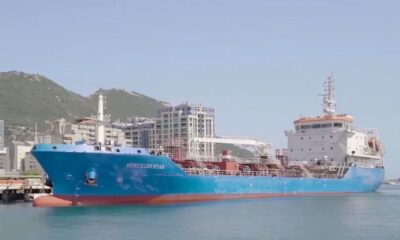
Fairfield Maritime Japan, Neste ink charter deal for WAPS-equipped MR tanker duo

Vessels will utilise low-sulphur fuels and will be capable of being retrofitted to operate on methanol at some point in the future.

Admin

Published

on

By

RESIZED scott graham

Fairfield Maritime Japan (FMJ) on Wednesday (22 July) said it has signed a long-term charter contract with Neste for two vessels. 

The agreement enables FMJ to fund and manage the construction of two Ice Class 1A medium range (MR) oil and chemical tankers for Neste’s transports to and from its refinery in Porvoo, Finland. Neste is a producer of renewable diesel and sustainable aviation fuel (SAF), also refining a wide range of oil products in Porvoo. 

Fairfield Maritime Japan Ltd. is a portfolio company of Fairfield-Maxwell Ltd., a family office for the Sugahara family headquartered in New York City.

The two new ships will each have the capacity to ship 50,000 deadweight tons (DWT) and will be built by HD Hyundai Co., Ltd. of South Korea and delivered in the first and second quarters of 2029.

As Ice Class 1A certified ships, the two new vessels will be capable of navigating in ice conditions with the support of icebreakers, adhering to the Finnish Swedish Ice Class Rules.

These rules encompass the specific requirements for vessels navigating the Baltic Sea during the winter season. The highly ice-resistant ships will be able to approach and depart Porvoo in the winter months, contributing to operational continuity for Neste’s Porvoo facility.

The vessels will utilise low-sulphur fuels and will be capable of being retrofitted to operate on methanol at some point in the future. 

The vessels will be ready for the future with the possibility to connect to shore power when that is available. In addition, the ships will be equipped with wind-assisted propulsion systems (WAPS) to supplement the ships’ main engines. These technologies will reduce fuel consumption, emissions and operating costs.

“We’re pleased to partner with Fairfield Maritime Japan and Fairfield-Maxwell. With these new state-of-the-art vessels, we are continuing our efforts to deliver safe and efficient sea transport to and from our Porvoo refinery,” said Sander Wilgenhof, Head of Chartering, Neste.

“We are proud to be Neste’s long-term partner,” said Ryuichi Osonoe, President, Fairfield Maritime Japan. 

“We believe that our knowledge and expertise will significantly assist Neste in its sea transportation. We are looking forward to seeing these two new ships cross the sea to safely export out of Neste’s Porvoo refinery.”

“Fairfield has been a partner of choice for world-class shippers for nearly 70 years,” said Byron Sugahara, chairman of the board of Fairfield-Maxwell. 

“This agreement with Neste is  confirmation that our family’s legacy in the shipping industry remains strong and provides a solid foundation for continued growth and success.”


Photo credit: Scott Graham
Published: 24 July, 2026

Continue Reading

Methanol

World Fuel and partners complete first green methanol bunkering of car carrier in Shanghai

Operation involved the delivery of approximately 2,800 MT of green methanol to “Arctic Tern” via a ship-to-ship transfer using SIPG Energy’s dedicated methanol bunkering vessel “M/V Hai Gang Zhi Yuan”.

Admin

Published

on

By

World Fuel and partners complete first green methanol bunkering of car carrier in Shanghai

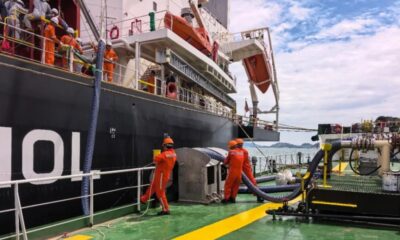
Marine fuel provider World Fuel on Tuesday (21 July) said it successfully completed the first green methanol bunkering of M/V Arctic Tern, with EUKOR Car Carriers and SIPG Energy at the Port of Shanghai. 

Arctic Tern is the first vessel in the new Shaper Class series of car carriers. 

The operation involved the delivery of approximately 2,800 MT of green methanol to Arctic Tern via a ship-to-ship transfer using SIPG Energy’s dedicated methanol bunkering vessel M/V Hai Gang Zhi Yuan, the largest vessel of its kind in operation. 

The bunkering operation was carried out at Haitong Terminal, Waigaoqiao Port Area, Shanghai Port, with cargo handling operations conducted simultaneously during bunkering.

This marks EUKOR Car Carriers’ first green methanol operation and the first time Arctic Tern has bunkered methanol since its delivery on 9 July. The operation marked the first bunkering at Shanghai Port of green methanol produced locally in Shanghai for an international PCTC operator. 

It also demonstrated the city’s integrated green methanol value chain, spanning local production, storage and bunkering, and established a replicable “Shanghai Model” for green methanol supply.

World Fuel arranged the supply and delivery of the fuel on behalf of EUKOR Car Carriers, working with SIPG Energy as the physical supplier at the Port of Shanghai.

The green methanol supplied was produced from municipal solid waste, ISCC-EU certified, and had a carbon intensity value below 25 gCO₂e/MJ.

Arctic Tern is the first of fourteen Shaper Class vessels ordered by Wallenius Wilhelmsen. With a capacity of 9,300 car equivalent units and methanol dual-fuel capability, the vessel will be operated by EUKOR Car Carriers, jointly owned by Wallenius Wilhelmsen and Hyundai Motor Group. Following her first green methanol bunkering, Arctic Tern will continue her maiden voyage from Asia to Europe.

Xavier Leroi, COO Shipping Services at Wallenius Wilhelmsen and CEO of EUKOR Car Carriers, said: “Completing Arctic Tern’s first green methanol bunkering shortly after delivery is a significant milestone towards our decarbonisation ambition for both EUKOR Car Carriers and Wallenius Wilhelmsen. It demonstrates how investments in next-generation vessel technology and fuel flexibility are being translated into real-world operations. 

“This achievement reflects the strong collaboration between all parties involved. Together, we have shown how partnerships across the maritime value chain can help make lower-emission fuels available and operationally viable at scale.”

Mark Tamsitt, SVP Global Marine Sales at World Fuel, said, “The first bunkering event with a new fuel is a significant moment for any shipowner, and our role is to make it as seamless as possible. By connecting EUKOR Car Carriers with SIPG Energy’s proven green methanol capability at the Port of Shanghai, we were able to deliver on reliable supply, fuel quality, and safe processes. As more of our customers bring methanol dual-fuel tonnage into service, we are committed to being the partner that makes these kinds of operations routine.”

Mr. Zhang Da, General Manager of SIPG Energy, said, “Welcoming Arctic Tern to the Port of Shanghai for her first green methanol bunkering demonstrates the strength and maturity of our supply capability. Building on our well-established methanol ship-to-ship bunkering services for container vessels, we have already extended such services to pure car and truck carriers (PCTCs). This bunkering sets a new record for the largest single SIMOPs green methanol bunkering for PCTCs in China, marking another step in building Shanghai’s position as a global green energy hub for international shipping.”

This operation follows Wallenius Wilhelmsen’s announcement on 9 July that Arctic Tern would complete her first methanol bunkering shortly after delivery. The vessel entered service on routes between Asia and Europe immediately following handover from China Merchants Jinling Shipyard in Nanjing.


Photo credit: World Fuel
Published: 22 July, 2026

Continue Reading

Ammonia

HPA and MB Energy develop safety concept for STS ammonia bunkering

HPA says the Port of Hamburg will become “bunker ready” for ammonia, laying the groundwork for safe and reliable ammonia bunkering in the future.

Admin

Published

on

By

HPA and MB Energy develop safety concept for STS ammonia bunkering

The Hamburg Port Authority (HPA) and integrated energy company MB Energy on Tuesday (21 July) said they have completed a comprehensive risk analysis and developed a dedicated safety concept for ship-to-ship ammonia bunkering.

MB Energy said the analysis lays the groundwork for the safe introduction of ammonia as a future marine fuel.

“With our planned ammonia import terminal in Hamburg-Blumensand, MB Energy intends to provide the reliable land side supply infrastructure needed to support this transition across northern German ports,” it said in a social media post. 

Mabanaft Group was renamed to MB Energy last year and merged over 50 existing brands under one identity. 

Separately, HPA said the Port of Hamburg will become “bunker ready” for ammonia, laying the groundwork for safe and reliable ammonia bunkering in the future.

“The focus is in particular on container ships, cruise ships as well as RoRo and ConRo (Container/RoRo) ships,” it said. 

“We expect ammonia to establish itself as an alternative marine marine fuel in the coming years. With our preparatory work, we are already creating the conditions to welcome the first ammonia-powered ships in Hamburg and to bunker them safely.:

HPA added that the import terminal for ammonia planned by MB Energy from 2029 will make a decisive contribution to ensuring the reliable availability of ammonia as a bunker fuel in northern German ports in the long term. 

“The use of an ammonia bunker barge is considered a possible addition to the landside infrastructure to enable ship bunkering in the port and beyond in the future,” it said.

Related: Mabanaft Group renames as MB Energy, merging over 50 brands under one identity


Photo credit: Hamburg Port Authority
Published: 22 July, 2026

Continue Reading

Trending