Connect with us

Business

Stillwater Associates: IMO 2020 – No Large Speed Bump Thus Far

Consulting firm discusses strategies refiners are executing after IMO 2020 implementation, and changes to be expected ahead.

Admin

Published

on

Stillwater Associates

[vc_row][vc_column][vc_column_text]Transportation fuels consulting firm Stillwater Associates has published an article outlining their analysis on the IMO 2020 transition while offering insights of future changes, it has been written by Senior Associate Ralph Grimmer:

Over the past three years, Stillwater Associates has offered a series of articles on various aspects of IMO 2020. The long-awaited IMO 2020 regulations were implemented on January 1, 2020 – 40 days ago. In this article, we will provide our takeaways on how the initial rollout has gone, a recap of strategies/tactics that refiners are now executing, and a glimpse at further changes to come.

Stillwater Takeaways on the Initial Rollout of IMO 2020

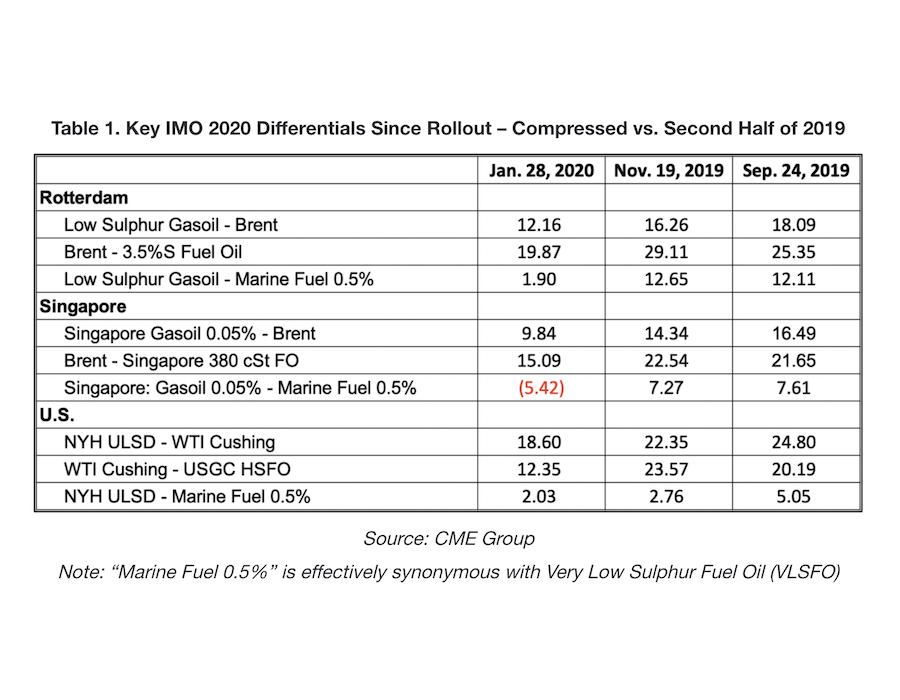
Without question, the biggest surprise from the rollout of IMO 2020 is what hasn’t happened. Futures markets as recently as mid-November 2019 reflected much larger key price differentials early in the IMO 2020 rollout in Rotterdam, Singapore, and the U.S. than what has transpired thus far. Comparing snapshots of the March 2020 contract on the CME futures market taken November 19th and September 24th of 2019 with those from January 28th of 2020, the differences are compelling (all figures are $/bbl):

Across the board, the March futures price differentials from January 28, 2020 are far smaller than for both November 19th and September 24th of 2019. The size of the IMO 2020 “speed bump” at initial rollout is markedly smaller than expected!

The figures below provide current futures market snapshots from March 2020 through December 2021. It’s quite apparent that futures price differentials are compressed in early 2020, gradually widening to more historic levels by early 2021. 

An early surprise that began in December 2019 was the strength of the VLSFO market. At one point, VLSFO prices (on a $/bbl basis) were higher than gasoil in both Rotterdam and Singapore. This is still the case in Singapore. Prevailing wisdom had been that VLSFO would trade at a price discount to gasoil.

From an operational perspective, the shift of notionally 75% of the open-ocean marine fuel from High Sulfur Fuel Oil (HSFO) to either VLSFO or Marine Diesel Oil (MDO) has proceeded much smoother than most industry observers expected. There have been very few reports of enforcement action taken against vessels for non-compliance with the sulphur cap.

There are, however, still valid concerns over the consistency of VLSFO quality. The three specs we’ve been hearing about most often are sediment, compatibility, and stability. Thus far, we are unaware of any vessel-operating problems caused by the use of VLSFO. However, this is an issue worth keeping on the radar screen.

There are ports in more than 20 countries that have regulated or banned operations of open-loop scrubbers in port areas.

Not all signatory countries to MARPOL Annex VI have put in place regulations for their individual countries compelling compliance. This could become a nuisance because a level playing field is not yet quite in place.

During the run-up to IMO 2020 implementation, many observers suggested that vessel operators would likely be motivated to employ slow steaming tactics to optimize operating costs versus revenue. From our research, shipowners have not embraced slow steaming very much over the past few months.

Current Refiner Strategies and Tactics

Stillwater assessed the future world of simple and complex refineries in previous IMO 2020 newsletter articles – one on Refiners’ Perspective and another focusing on how changes to crude slate pricing would force refiners into a “Choose Your Own Adventure” decision-making process. Simple refineries that produce HSFO are faced with the challenge of finding new homes for the displaced HSFO. The global HSFO market has shrunk by about 2.7 million barrels per day (MMBPD) with the rollout of IMO 2020. (Clearly, this figure depends on how much deliberate non-compliance is actually occurring.) Selling cutback high sulfur resid to other refiners or selling HSFO to power plants are certainly two options; neither of these options is as good as the former option of selling HSFO for bunker fuel.

Complex refineries (i.e. refineries with resid upgrading) have more freedom. They can:

  1. Maximize coking capacity throughput. For refiners with multiple refineries, this is a system optimization rather than the sum of individual refinery optimizations. Surplus resid from one refinery can be processed at another refinery in its system.
  2. Purchase cutback resid (HSFO) to process as a component of the refinery’s crude mix.

Marathon (on the U.S. West Coast) and Valero (on the U.S. Gulf Coast) have told securities analysts that they are processing purchased cutback resid in the refining networks.

Refineries with Vacuum Gas Oil (VGO) hydrotreating capability are currently finding it may be attractive to sell a portion of this nominal 650-1,050+° F stream rather than processing all of it on a cat cracking unit that is focused on producing gasoline. Both Valero and Marathon are selling VGO into the VLSFO blend pool. These economics depend on the VLSFO – RBOB price differential. Valero indicated to securities analysts last October that selling VGO for more than $5.00/bbl above than USGC RBOB was an opportunity to capture.[1] Valero has also indicated that they are selling some volumes of low sulfur Atmospheric Tower Bottoms (ATB) into the VLSFO blend pool.

Changes Yet to Come

  1. As HSFO displaced out of the marine fuel pool is placed elsewhere and inventories are drawn down to normal levels, we may see HSFO prices erode versus other commodities. A decline in HSFO prices could also exert a downward pull on sour crude prices relative to sweet crudes.
  2. ExxonMobil, Marathon, and BP have all told securities analysts that they expect sweet/sour crude differentials to widen. Thus far, the differentials have not materially changed.
  3. Port States will gain enforcement authority beginning March 1, 2020. (Currently, only Flag States have enforcement authority.) From that date, carriage of marine fuel with more than 0.5%S in any of a ship’s fuel tanks will place that vessel out of compliance with IMO 2020 regulations.
  4. SK Energy will bring its new 40 thousand-barrel-per-day (KBD) resid desulphurizing unit onstream in March 2020.
  5. Marathon will expand its Garyville, LA refinery coker capacity by 9 KBD by March 2020.
  6. China will be eliminating its Value Added Tax obligations on exports of VLSFO. This will be a huge change for the Singapore market, finally opening the door to marine fuel from China. The impact of this move by China will also be felt in Northwest Europe and the U.S.

Conclusion

Implementation of IMO 2020 thus far has not produced the much wider key crude oil and refined products price differentials that many industry observers had expected. Even so, IMO 2020 is still likely to be one of the most impactful refined product specification changes ever, largely because the change was both global and instantaneous. VLSFO has replaced HSFO as the preferred marine fuel for the majority of the world’s open-ocean marine vessels. More than two million barrels per day of HSFO has been displaced from the 2020 open oceans marine fuel pool by IMO 2020. It’s not clear that dependable new distribution channels have been developed for this entire ongoing volume of displaced HSFO. There may yet be marketplace bumps in the weeks ahead.

[1] OPIS daily alerts, “Valero Continues to Divert LSVGO From Cat-Cracking Into Bunker Market”, January 31, 2020


Photo credit and Source:
Stillwater Associates
Published: 21 February, 2020 [/vc_column_text][/vc_column][/vc_row][vc_row][vc_column][vc_gallery type=”image_grid” images=”2940,2942,2941″ title=”Additional Information”][/vc_column][/vc_row]

Continue Reading

Winding up

Singapore: High Court to hear Norvic Shipping Asia winding up application on 31 July

Application for the winding up of Norvic Shipping Asia Pte Ltd was filed by Netherlands-registered Mur Shipping BV on 8 April, according to Government Gazette notice.

Admin

Published

on

By

RESIZED singapore high court

An application for the winding up of Norvic Shipping Asia Pte Ltd was filed by Netherlands-registered Mur Shipping BV on 8 April, according to a Tuesday (21 July) notice on the Government Gazette.

It noted the winding up application is directed to be heard before the Judge sitting in the General Division of the High Court at 10am on 31 July.

Any creditor or contributory of the company desiring to support or oppose the making of an order on the winding up application may appear at the time of hearing by himself or his counsel for that purpose.

A copy of the winding up application will be furnished to any creditor or contributory of the company requiring the copy of the winding up application by the solicitors of the applicant’s, Oon & Bazul LLC, on payment of the regulated charge for the same.

The Applicant’s address is Hiridostraat 5, Gebouw Prismatrium, 1101CW Amsterdam, The Netherlands.

The Applicant’s solicitors are Oon & Bazul LLC of 103 Penang Rd, #04-04/05/06 Singapore 238467. 

Queries on the winding up application may be directed to the following email addresses: [email protected] and [email protected].


Photo credit: Manifold Times
Published: 22 July, 2026

Continue Reading

Methanol

World Fuel and partners complete first green methanol bunkering of car carrier in Shanghai

Operation involved the delivery of approximately 2,800 MT of green methanol to “Arctic Tern” via a ship-to-ship transfer using SIPG Energy’s dedicated methanol bunkering vessel “M/V Hai Gang Zhi Yuan”.

Admin

Published

on

By

World Fuel and partners complete first green methanol bunkering of car carrier in Shanghai

Marine fuel provider World Fuel on Tuesday (21 July) said it successfully completed the first green methanol bunkering of M/V Arctic Tern, with EUKOR Car Carriers and SIPG Energy at the Port of Shanghai. 

Arctic Tern is the first vessel in the new Shaper Class series of car carriers. 

The operation involved the delivery of approximately 2,800 MT of green methanol to Arctic Tern via a ship-to-ship transfer using SIPG Energy’s dedicated methanol bunkering vessel M/V Hai Gang Zhi Yuan, the largest vessel of its kind in operation. 

The bunkering operation was carried out at Haitong Terminal, Waigaoqiao Port Area, Shanghai Port, with cargo handling operations conducted simultaneously during bunkering.

This marks EUKOR Car Carriers’ first green methanol operation and the first time Arctic Tern has bunkered methanol since its delivery on 9 July. The operation marked the first bunkering at Shanghai Port of green methanol produced locally in Shanghai for an international PCTC operator. 

It also demonstrated the city’s integrated green methanol value chain, spanning local production, storage and bunkering, and established a replicable “Shanghai Model” for green methanol supply.

World Fuel arranged the supply and delivery of the fuel on behalf of EUKOR Car Carriers, working with SIPG Energy as the physical supplier at the Port of Shanghai.

The green methanol supplied was produced from municipal solid waste, ISCC-EU certified, and had a carbon intensity value below 25 gCO₂e/MJ.

Arctic Tern is the first of fourteen Shaper Class vessels ordered by Wallenius Wilhelmsen. With a capacity of 9,300 car equivalent units and methanol dual-fuel capability, the vessel will be operated by EUKOR Car Carriers, jointly owned by Wallenius Wilhelmsen and Hyundai Motor Group. Following her first green methanol bunkering, Arctic Tern will continue her maiden voyage from Asia to Europe.

Xavier Leroi, COO Shipping Services at Wallenius Wilhelmsen and CEO of EUKOR Car Carriers, said: “Completing Arctic Tern’s first green methanol bunkering shortly after delivery is a significant milestone towards our decarbonisation ambition for both EUKOR Car Carriers and Wallenius Wilhelmsen. It demonstrates how investments in next-generation vessel technology and fuel flexibility are being translated into real-world operations. 

“This achievement reflects the strong collaboration between all parties involved. Together, we have shown how partnerships across the maritime value chain can help make lower-emission fuels available and operationally viable at scale.”

Mark Tamsitt, SVP Global Marine Sales at World Fuel, said, “The first bunkering event with a new fuel is a significant moment for any shipowner, and our role is to make it as seamless as possible. By connecting EUKOR Car Carriers with SIPG Energy’s proven green methanol capability at the Port of Shanghai, we were able to deliver on reliable supply, fuel quality, and safe processes. As more of our customers bring methanol dual-fuel tonnage into service, we are committed to being the partner that makes these kinds of operations routine.”

Mr. Zhang Da, General Manager of SIPG Energy, said, “Welcoming Arctic Tern to the Port of Shanghai for her first green methanol bunkering demonstrates the strength and maturity of our supply capability. Building on our well-established methanol ship-to-ship bunkering services for container vessels, we have already extended such services to pure car and truck carriers (PCTCs). This bunkering sets a new record for the largest single SIMOPs green methanol bunkering for PCTCs in China, marking another step in building Shanghai’s position as a global green energy hub for international shipping.”

This operation follows Wallenius Wilhelmsen’s announcement on 9 July that Arctic Tern would complete her first methanol bunkering shortly after delivery. The vessel entered service on routes between Asia and Europe immediately following handover from China Merchants Jinling Shipyard in Nanjing.


Photo credit: World Fuel
Published: 22 July, 2026

Continue Reading

Ammonia

HPA and MB Energy develop safety concept for STS ammonia bunkering

HPA says the Port of Hamburg will become “bunker ready” for ammonia, laying the groundwork for safe and reliable ammonia bunkering in the future.

Admin

Published

on

By

HPA and MB Energy develop safety concept for STS ammonia bunkering

The Hamburg Port Authority (HPA) and integrated energy company MB Energy on Tuesday (21 July) said they have completed a comprehensive risk analysis and developed a dedicated safety concept for ship-to-ship ammonia bunkering.

MB Energy said the analysis lays the groundwork for the safe introduction of ammonia as a future marine fuel.

“With our planned ammonia import terminal in Hamburg-Blumensand, MB Energy intends to provide the reliable land side supply infrastructure needed to support this transition across northern German ports,” it said in a social media post. 

Mabanaft Group was renamed to MB Energy last year and merged over 50 existing brands under one identity. 

Separately, HPA said the Port of Hamburg will become “bunker ready” for ammonia, laying the groundwork for safe and reliable ammonia bunkering in the future.

“The focus is in particular on container ships, cruise ships as well as RoRo and ConRo (Container/RoRo) ships,” it said. 

“We expect ammonia to establish itself as an alternative marine marine fuel in the coming years. With our preparatory work, we are already creating the conditions to welcome the first ammonia-powered ships in Hamburg and to bunker them safely.:

HPA added that the import terminal for ammonia planned by MB Energy from 2029 will make a decisive contribution to ensuring the reliable availability of ammonia as a bunker fuel in northern German ports in the long term. 

“The use of an ammonia bunker barge is considered a possible addition to the landside infrastructure to enable ship bunkering in the port and beyond in the future,” it said.

Related: Mabanaft Group renames as MB Energy, merging over 50 brands under one identity


Photo credit: Hamburg Port Authority
Published: 22 July, 2026

Continue Reading

Trending