Connect with us

Alternative Fuels

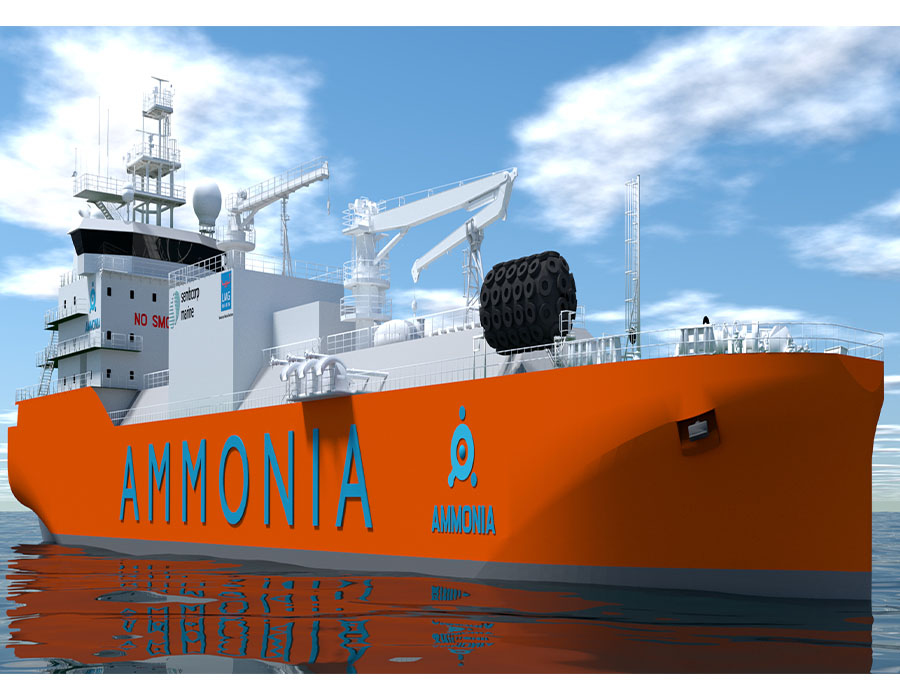
Sembmarine receives AiP for conceptual design of ammonia bunkering vessel

Design took into consideration ammonia’s toxicity, cargo containment system and bunkering system from Wartsila Gas Solutions and Trelleborg Westbury.

Admin

Published

on

Ammonia Bunkering Vessel Sembcorp Marine LMG Marin Design

Sembcorp Marine Ltd, through its wholly-owned subsidiaries, Sembcorp Marine Integrated Yard Pte. Ltd. (SMIY) and LMG Marin AS (LMG Marin), together with its partners, Mitsui O.S.K Lines, Ltd, and ITOCHU Corporation, on Wednesday (11 January) said they have attained an Approval in Principle (AIP) from the American Bureau of Shipping (ABS) for the conceptual design of an ammonia bunkering vessel.

Leveraging SMIY’s vast expertise and technological bench strength in the design and construction of marine vessels, as well as LMG Marin’s cutting-edge design capabilities, the Group designed a NH3 bunkering vessel and provided associated information for a Hazard Identification Study (HAZID).

Sembcorp Marine, with support from its partners and ABS, carried out a comprehensive HAZID in fulfilment of the AIP application which was also instrumental in the attainment of AIP.

The vessel’s rigorous design took into consideration ammonia’s toxicity, as well as design input on the cargo containment system and bunkering system from Wartsila Gas Solutions and Trelleborg Westbury/KLAW LNG respectively.

This vessel, if realised, will be the first of its kind bunker vessel. It will also augment Singapore’s marine decarbonisation efforts with resultant positive impact on the global maritime industry. A successful outcome will support the International Maritime Organization’s ambition to halve the total annual GHG emissions from international shipping by 2050 compared to 2008 levels.

The Group believes in playing an active part in contributing to decarbonisation in the maritime industry. It has developed a suite of comprehensive Gas Value Chain solutions.

Notably, the Group is building a 12,000 m³ LNG (Liquefied Natural Gas) bunkering vessel for Mitsui O.S.K. Once completed, this vessel will be the largest LNG bunkering vessel built in Singapore, complementing Singapore’s advocacy for decarbonisation and augmenting the development of Singapore’s ecosystem and infrastructure to support LNG bunkering.

In April 2021, Sembcorp Marine entered into a Memorandum of Understanding with Shell and Penguin International to jointly develop hydrogen as a marine fuel, another first for Singapore as this nation-state continues to champion decarbonisation and emission-free shipping in the future.

Sembcorp Marine President and CEO, Mr Wong Weng Sun, said: “Sembcorp Marine is delighted to undertake another collaborative effort that has the potential to revolutionise shipping and transportation. This collaboration clearly underpins the Global Centre for Maritime Decarbonisation’s ongoing pursuit to define the safety and operation envelopes to enable ammonia pilot demonstrations in Singapore.”

“We are cognizant that the push to accelerate decarbonisation must be supported by a portfolio of solutions. We are leveraging our proven expertise and differentiated capabilities in the design and fabrication of offshore structures and vessels to support the offshore, marine and energy industries’ mission critical search for viable solutions to reduce their carbon footprint. This joint project is also in line with Sembcorp Marine’s Sustainability Vision to reduce our carbon footprint.”

Related: SMW 2021: Shell and Sembcorp Marine to trial hydrogen fuel cell with RoRo vessel retrofit


Photo credit: Sembcorp Marine Ltd
Published: 12 January, 2022

Continue Reading

Ammonia

Amogy and LOTTE Fine Chemical to explore ammonia bunkering in South Korea

Under a MoU, both will explore supplying ammonia to vessels equipped with Amogy’s Ammonia-to-Power technology, leveraging LFC’s ammonia terminal at Ulsan Port and ship-bunkering capabilities.

Admin

Published

on

By

Amogy, LOTTE Fine Chemical to explore ammonia bunkering in South Korea

Ammonia-to-power solutions provider Amogy and LOTTE Fine Chemical Co Ltd (LFC) on Thursday (10 September) announced the signing of a Memorandum of Understanding (MoU) to jointly advance ammonia-to-hydrogen and ammonia-to-power solutions in South Korea.

Under the MoU, Amogy and LFC will explore collaboration across three priority areas that combine LFC’s ammonia supply and infrastructure capabilities with Amogy’s downstream ammonia cracking and power generation technology.

In hydrogen refuelling infrastructure, LFC would supply green ammonia through its overseas procurement and domestic infrastructure, with Amogy’s ammonia cracking technology converting the ammonia into high-purity hydrogen on-site for use at hydrogen refueling stations. 

For distributed ammonia-to-power generation at commercial and community-scale sites, LFC would provide ammonia supply, storage, and logistics, while Amogy would provide its Ammonia-to-Power generation modules, including fuel cell or internal combustion engine configurations. 

In marine ammonia bunkering, the companies would explore supplying ammonia to vessels equipped with Amogy’s Ammonia-to-Power technology, leveraging LFC’s ammonia terminal at Ulsan Port and ship-bunkering capabilities.

“As Korea continues to build out its clean ammonia and hydrogen infrastructure, partnerships that connect upstream supply with downstream technology are essential to accelerating deployment,” said Seonghoon Woo, CEO of Amogy.

“LOTTE Fine Chemical’s ammonia infrastructure, paired with our ammonia-to-hydrogen and ammonia-to-power technology, gives us a strong foundation to advance hydrogen refuelling, distributed power, and marine applications across the region.”

“LFC has built the infrastructure to import, store, and supply ammonia safely and at scale, including the world’s first ship-bunkering supply of ammonia,” said Suk Min Hwang, Vice President of Ammonia Business Division at LOTTE Fine Chemical. 

“This collaboration with Amogy allows us to extend that infrastructure into new downstream applications, supporting Korea’s transition to a clean ammonia and hydrogen economy.”

LFC has achieved the world’s first commercial import of green ammonia in addition to the world’s first domestic ship-bunkering supply using green ammonia.

Amogy’s proprietary ammonia cracking technology enables the efficient conversion of ammonia into hydrogen, supporting both high-purity hydrogen production and ammonia-to-power generation across stationary, distributed, and marine applications.

Building on the MoU, Amogy and LFC will continue joint evaluation of collaboration opportunities across hydrogen refuelling, distributed power, and marine ammonia bunkering, with further details on project scope and timing to be finalised for execution.


Photo credit: Amogy
Published: 11 September, 2026

Continue Reading

Events

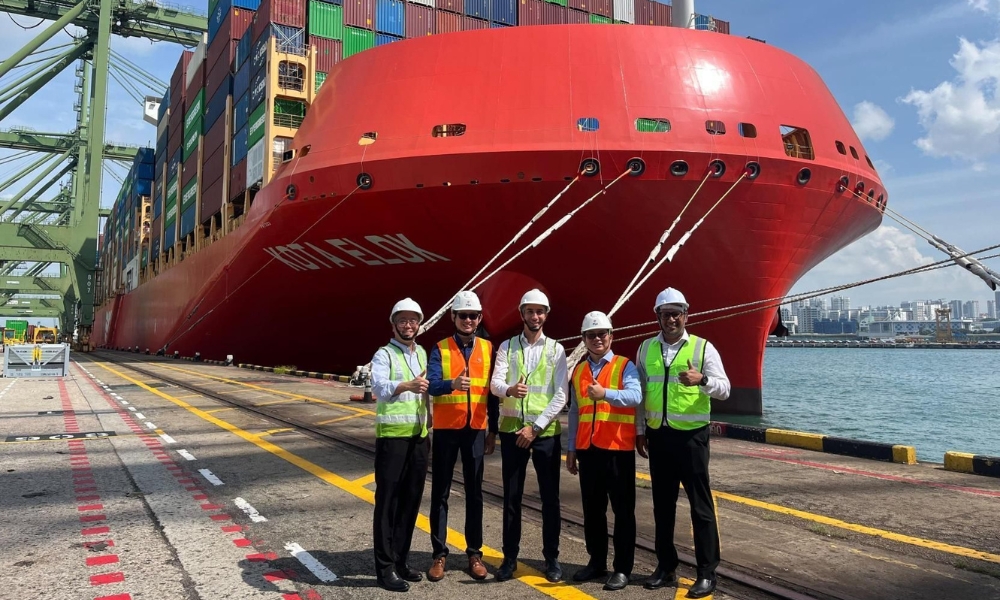
PIL’s new LNG dual-fuel boxship “Kota Elan” makes maiden call in Singapore

“Kota Elan” is currently operating on PIL’s East Coast Service 1 (ES1) route that connects Asia with South America and is now on its way to Brazil.

Admin

Published

on

By

PIL’s new LNG dual-fuel boxship “Kota Elan” makes maiden call in Singapore

Singapore-based Pacific International Lines Pte Ltd (PIL) on Thursday (10 September) said its newest 13,000 TEU LNG dual-fuel container vessel Kota Elan made its maiden call in Singapore on 4 September. 

In a social media post, PIL said a ceremony was held on board the vessel where representatives from PSA Singapore presented a commemorative plaque to the Master of Kota Elan, Captain Thanabalan Govindaraju, marking its inaugural call at one of the world’s busiest and most connected ports.

The company said Kota Elan is currently operating on PIL’s East Coast Service 1 (ES1) route that connects Asia with South America. 

The vessel is now on its way to Brazil, before calling at Uruguay and Argentina, and then finally returning to Asia.

“As one of the latest additions to our growing fleet of greener vessels, Kota Elan reflects PIL’s commitment to building a more sustainable future for shipping through cleaner and more efficient operations,” the company said.


Photo credit: Pacific International Lines
Published: 11 September, 2026

Continue Reading

Engine

Polaris Shipping orders WinGD engines capable of running on methanol, ethanol

Ability to operate on either fuel gives Polaris Shipping greater flexibility to respond to changes in fuel availability, pricing and regulatory requirements over the vessels’ operating lives.

Admin

Published

on

By

Polaris Shipping orders WinGD engines capable of running on methanol, ethanol

Swiss marine power company WinGD on Thursday (10 September) said it has won a contract that will give Polaris Shipping true fuel flexibility for its future Newcastlemax fleet with an order of four X72DF-M-1.0 engines that can operate on methanol and ethanol. 

The ability to operate on either fuel gives Polaris Shipping greater flexibility to respond to changes in fuel availability, pricing and regulatory requirements over the vessels’ operating lives and is a key benefit of WinGD’s alcohol-fuel engine platform.

The WinGD engines will power four 210,000 DWT Ore carriers being built for Polaris Shipping at Qingdao Beihai Shipbuilding Heavy Industry Co in China, with delivery scheduled for 2031. 

Dr. Carmelo Cartalemi, Head of Strategic Marketing, WinGD, said “Shipowners are looking for flexible solutions to help them meet their decarbonisation goals without compromising on reliability, safety or financial stability. 

“Our alcohol-fuel engine platform enables ships to operate on either ethanol or methanol, giving shipowners and managers the option to select the fuel that best fits their operational and commercial requirements. With fuel markets and regulations continuing to evolve, that flexibility can be a valuable asset over the lifetime of a vessel.”

The X72DF-M1.0 can run on methanol and ethanol. This provides flexibility between the two fuels, while maintaining compliance with the regulatory requirements applicable to both fuels.

WinGD will also provide dedicated service and lifecycle support for the new alcohol fuels, helping shipowners and operators build familiarity with the technology, optimise operation and maintenance, and adopt methanol and ethanol propulsion in a safe and economically sustainable way

Polaris Shipping, said: “Fuel availability and economics will continue to evolve over the lifetime of these vessels. Selecting an engine platform that gives us access to both methanol and ethanol means we can provide to our charter a greater choice in how the ships are operated in the future, rather than having to predict today which fuel will be most competitive in the years ahead. 

“We’re investing for the long-term, and this engine choice gives us the confidence to do that.”

The order adds to WinGD orderbook of alternative fuel engine technology, which now spans LNG, methanol, ethanol and ammonia. Beihai Shipyard is also working with WinGD on the installation of its ammonia-fuelled engine for CMB TECH’s newbuild 210,000 dwt dry bulk carriers. 


Photo credit: WinGD
Published: 11 September, 2026

Continue Reading

Trending