
Scrubbers
Mitsubishi DIA-SOx R scrubbers gain class societies, flag states approval
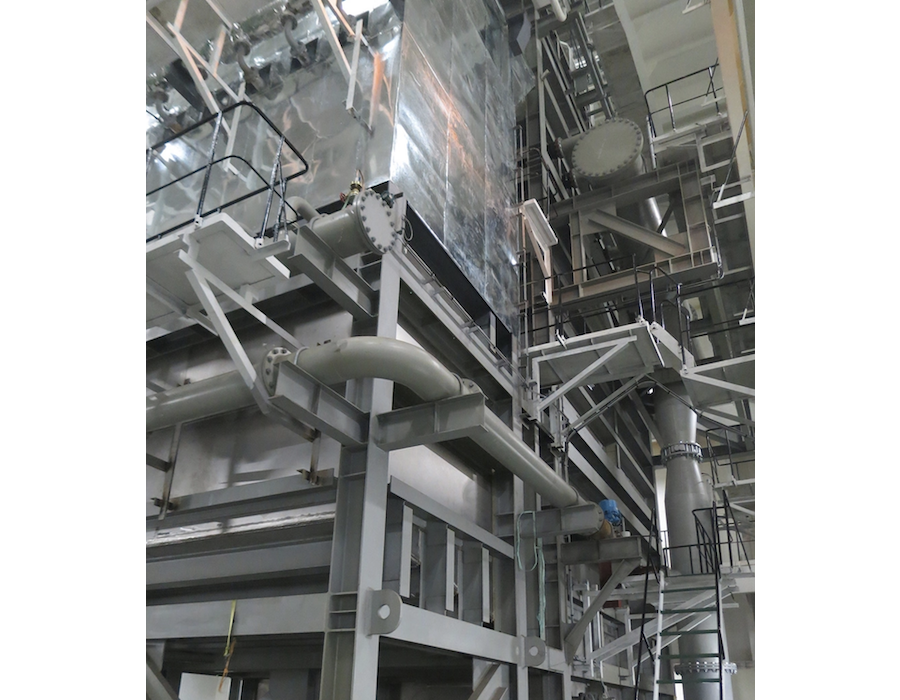
Two ultra-large container ships with scrubbers installed continued use of existing fuel oil while meeting all SOx emission regulations.

ECA
VPS examines North-East Atlantic ECA on current bunker fuel mix and testing
Impact of this new ECA, will not only affect bunker fuel selection and testing, but it will also require a review of, voyage planning, bunker procurement and scrubber strategy, amongst others.
Steve Bee, Group Marketing and Strategic Projects Director, and Emilian Buksak, Decarbonisation Advisor of marine fuels testing company VPS, on Wednesday (8 April) highlighted MEPC 84 approved a new emission control area (ECA) covering the North-East Atlantic Ocean, with agreements reached on adopted amendments to MARPOL Annex VI.
The new ECA, which will become the world’s largest emission control area, will be implemented on 1st September 2027
In a recent article, VPS outlined how VPS testing, data, CEM systems and advisory services can support vessels in both their operational and compliance challenges associated with this new ECA:
The recent International Maritime Organisation’s (IMO), Maritime Environmental Protection Committee (MEPC) meeting in London, had its main focus on setting binding greenhouse gas emission reduction targets for the global shipping sector. In keeping with the Committee’s continuing drive to decarbonise shipping and reduce the pollutant emissions from the global fleet, one major outcome from the MEPC-84 meeting was the approval of a new emission control area (ECA) covering the North East Atlantic Ocean, with agreements reached on adopted amendments to MARPOL Annex VI.
This new ECA, which will become the world’s largest emission control area, will be implemented on 1st September 2027, with the ECA requirements taking effect on 1st September 2028. It will cover the territorial seas and exclusive economic zones of Greenland, Iceland, the Faroe Islands, Ireland, the United Kingdom, France, Spain and Portugal, extending up to 200 nautical miles from their baselines:
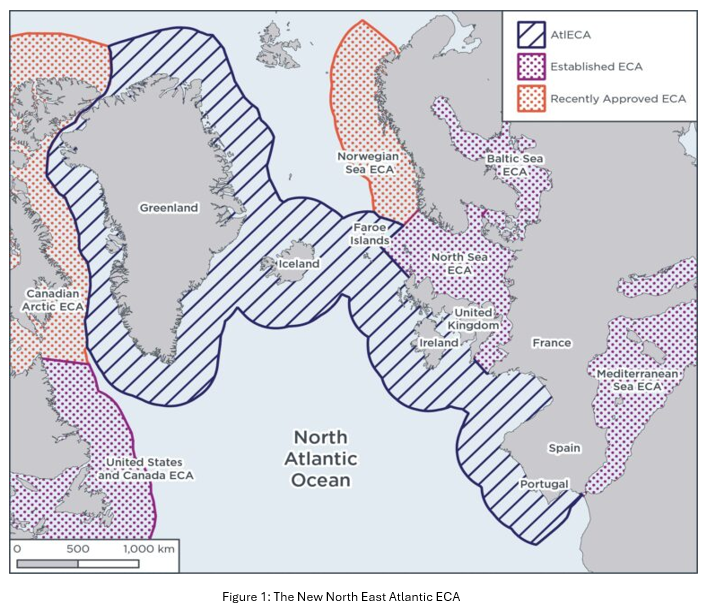
A key advantage of the new NE Atlantic ECA is that it will close the gap between the existing ECAs in the North and Baltic Sea, plus the Mediterranean, creating an almost continuous zone of reduced shipping emissions. It will also connect to the newly approved ECAs in the Canadian Arctic and Norwegian Sea, which are scheduled for implementation in 2026 and 2027 respectively. Together these ECAs will cover almost half of all Arctic coastal waters, improving air quality, by reducing SOx, NOx and Particulate Matter (PM), protecting public health, and reducing the environmental impacts from shipping.
The sulphur limit for the marine fuels allowed to be burnt within this new ECA will reduce from the current 0.50% to 0.10%. This will force vessels to use either effective abatement technology (scrubbers), or alternatively burn marine distillates, ultra-low-sulphur fuels (ULSFOs), or biofuels with a sulphur content of less than 0.10%.
Without doubt this new ECA will cause a significant change to the current fuel mix, probably on an even greater scale than was witnessed with the introduction of the Mediterranean ECA back in May 2025. The fuel mix in the Mediterranean Pre-ECA implementation was, 53% VLSFO, 28% HSFO, 16% MGO, 2% ULSFO and 1% Biofuels. But from the 1st May 2025, the fuel mix changed to, 30% VLSFO, 29% HSFO, 30% MGO, 8% ULSFO and 4% Biofuels.
So, in terms of actual tonnage, the Mediterranean ECA witnessed a decrease in VLSFOs by 23%, whilst MGO usage increased by 107%. At the same time, ULSFO and biofuels supply increased 4-fold.
Regarding fuel quality within the Mediterranean post-ECA implementation, MGO off-specification rates increased to 4%. However, the most worrying off-specification rates were for ULSFOs which saw a 10-times increase from 2% to 20% from the start of the ECA, with the main off-specification parameters being pour point, sulphur, TSP, CCAI, water and viscosity.
Therefore, it is fair to assume we’ll witness a similar dramatic fuel mix change upon the implementation of the NE Atlantic ECA, with possibly similar fuel off-specification issues, highlighting the continuing need for proactive fuel testing to protect vessels, crew and the environment.
Whilst the focus on fuel quality is essential, the multi-pollutant nature of this new ECA, covering SOx, PM and NOx, also brings the role of continuous emissions monitoring increasingly to the fore. Therefore, a further consideration relating to the impact of this new ECA relates to vessel newbuilds and the stricter NOx Tier III requirements. For newbuilds subject to the stricter NOx Tier III requirements, compliance depends not only on engine certification at delivery, but on demonstrating that exhaust after-treatment systems, typically Selective Catalytic Reduction (SCR) or Exhaust Gas Recirculation (EGR), continue to perform as designed throughout the service life of the vessel.
For scrubber-equipped ships, real-time SO₂ measurement provides the operational evidence of equivalency that Port State Control inspections increasingly expect to see. Plus, for vessels operating under multiple overlapping regulatory regimes, including the new NE Atlantic ECA, EU MRV, EU ETS and FuelEU Maritime, continuous emissions monitoring via the VPS EMSYS CEM system delivers a single, verified source of emissions data that can be applied across all of them.
As noted by DNV in their MEPC 84 technical and regulatory update, the newly adopted IMO measurement guidelines can also be used for determining actual methane and nitrous oxide under the EU ETS and FuelEU Maritime, confirming the direct route from IMO-recognised measurement to EU compliance reporting.
At an operational level, the new ECA will introduce considerable complexity in the way fuel consumption is attributed across voyage segments, with VLSFOs burnt outside the zone and compliant fuels inside, all of which carry implications for consumption reporting, charterparty allocation and EU MRV alignment. VPS Maress can provide the underlying fuel and energy data into one auditable platform, helping crews manage the operational complexity that the new ECA introduces, including voyage segmentation, fuel changeover and emissions accounting, plus providing the consolidated data foundation that feeds existing EU MRV and IMO DCS reporting obligations.
VPS PortStats via the VPS Verisphere eco-system, (VeriSphere | VPS), further supports bunker procurement planning with port-by-port intelligence on compliant fuel availability and price spreads. Such intelligence and insights, will prove particularly valuable in the months immediately following 1st September 2028, when the supply pressure on 0.10% sulphur fuels is likely to peak.
Regarding the more strategic decisions ahead, including Tier III engine selection for newbuilds, retrofit feasibility for existing tonnage, and charterparty clauses allocating the ECA fuel cost premium between owners and charterers, VPS Advisory Services can provide the integrated commercial and technical perspective needed to navigate this transition with confidence.
Therefore, its clear the impact of this new ECA, will not only affect the choice of fuel to be burnt onboard and its subsequent quality testing, but it will also require a review of, voyage planning, bunker procurement, scrubber strategy, engine certification, compliance documentation and charterparty exposure.
Related: DNV on IMO MEPC 84: Revisiting Net‑Zero Framework
Photo credit: VPS
Published: 14 May, 2026
Scrubbers
No open-loop EGCS with HSFO bunker fuel allowed in Saudi Arabian ports
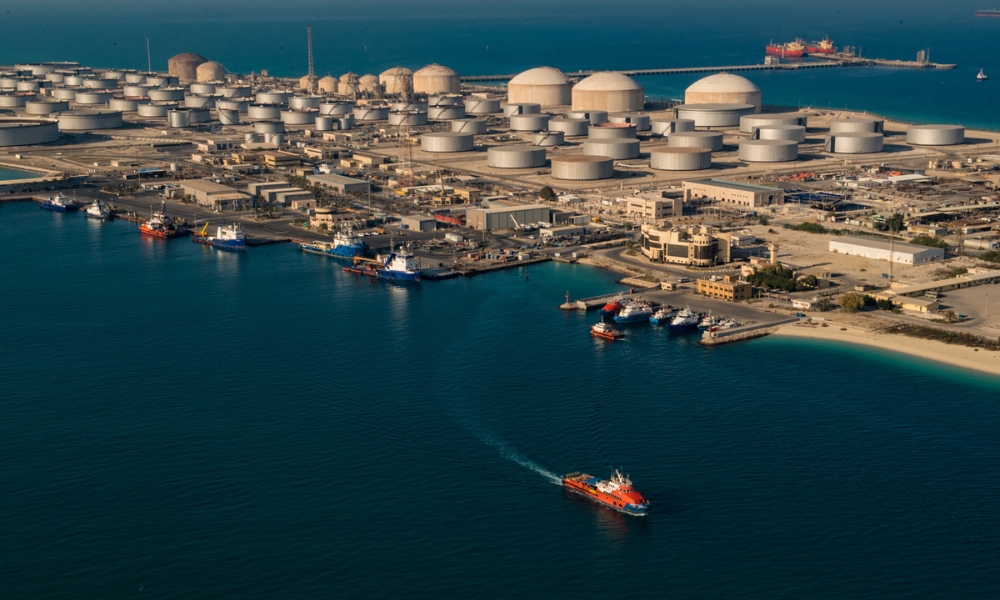
Use of HSFO with an Open-Loop Exhaust Gas Cleaning System at 0.5% or 0.1% sulphur mode setting is prohibited until further notice for the ships entering Saudi Arabian ports, says GAC.
Bunker Fuel
Equatorial navigates through sanctions and green transition amid shifting bunkering landscape
Shipowners’ demand for ‘cheapest compliant fuel’ suggests a potentially more competitive and shrinking market for LSFO, forecasts Choong Sheen Mao, COO at Equatorial.


OUR INDUSTRY PARTNERS

Singapore withdraws remaining 127 charges against Hin Leong founder OK Lim

Singapore: Coastal Logistics Pte Ltd to be wound up voluntarily

PIL’s LNG dual-fuel boxship “Kota Elok” arrives in Singapore on maiden call

CIMC SOE secures order for 12,000-cbm LNG bunkering vessel from Sinopec Clean Energy

ABS awards AiP to Korean institute for SMR-powered container ship concept design

EXMAR’s “ANTWERPEN” completes first commercial voyage using ammonia bunker fuel

ENGINE on Fuel Switch Snapshot: LSMGO surges to greater premium over biofuel

US reinstates Iran oil sanctions, orders wind-down by 17 July

ENGINE: East of Suez Fuel Availability Outlook (7 July 2026)

ENGINE: Europe and Africa Fuel Availability Outlook (8 July 2026)

Malaysia: Maharani Freeport to implement MFM and e-BDN technologies for enhanced bunkering transparency

Evergreen Marine director questioned, offices searched in Taiwan insider trading probe

Singapore retains world’s leading maritime centre ranking in 2026 ISCD Index

Russian court orders marine fuel supplier Transbunker assets transferred to state
-
 Sanctions2 weeks ago
US reinstates Iran oil sanctions, orders wind-down by 17 July
-
 Bunker Fuel Availability2 weeks ago
ENGINE: East of Suez Fuel Availability Outlook (7 July 2026)
-
 Bunker Fuel Availability2 weeks ago
ENGINE: Europe and Africa Fuel Availability Outlook (8 July 2026)
-
 Technology7 days ago
Malaysia: Maharani Freeport to implement MFM and e-BDN technologies for enhanced bunkering transparency
-
 Legal2 weeks ago
Evergreen Marine director questioned, offices searched in Taiwan insider trading probe
-
 Business2 weeks ago
Singapore retains world’s leading maritime centre ranking in 2026 ISCD Index
-
 Legal2 weeks ago
Russian court orders marine fuel supplier Transbunker assets transferred to state
-
 Lubricants2 weeks ago
VPS on longer drains, lower cost: The role of oil analysis of synthetic engine oils