Connect with us

Business

IBIA explainer: IMO’s new flashpoint documentation requirement

Suppliers will need to provide an actual measured flashpoint value on the bunker delivery note, unless the flashpoint has been measured at or above 70°C.

Admin

Published

on

IBIA

The International Bunker Industry Association (IBIA) on Monday (20 June) published an explainer on IMO’s new flashpoint documentation requirement which was recently approved at MEPC 78 as part of the draft amendments to MARPOL Annex VI. 

Suppliers will be required to include Information about flashpoint of fuel oil on the BDN under draft amendments to MARPOL Annex VI, in line draft amendments to SOLAS recently approved by the IMO.

The 78th session of the Marine Environment Protection Committee (MEPC 78, June 6-10) approved draft amendments to appendix V of MARPOL Annex VI, for adoption by MEPC 79.

Appendix V of MARPOL Annex VI, “Information to be included in the bunker delivery note”, already requires sulphur content and density to be documented on the BDN.

The draft amendment will require either flashpoint measured in Celsius (°C) or a statement that flashpoint has been measured at or above 70°C.

What this means in practice is that suppliers will need to provide an actual measured flashpoint value on the BDN, unless the flashpoint has been measured at or above 70°C.

In other words, a statement will be adequate if the flashpoint has been measured at or above 70°C, but suppliers can also provide an actual flashpoint on the BDN for values above 70°C if they choose to do so.

Following the draft amendments to appendix V of MARPOL Annex VI are adopted by MEPC 79, the new flashpoint documentation requirement is expected to enter into force on May 1, 2024.

Prior to making the amendment to requirements for the BDN, MEPC had decided to await the outcome of the 105th session of the Maritime Safety Committee (MSC), to see what MSC agreed regarding the flashpoint data to be recorded and reported in relation to safety. MEPC would then draft corresponding draft amendments to appendix V of MARPOL Annex VI.

IBIA submitted a document to MSC 105, commenting on the draft SOLAS amendments with regard to flashpoint. IBIA explained that in practice, fuel oils are typically only tested to determine if the flashpoint is above 70°C, because that is considered to be sufficient to guarantee it is above the 60°C minimum limit in SOLAS. You can read IBIA’s paper MSC 105/5/1 on this link.

Following discussion, MSC 105 approved draft amendments to SOLAS Chapter II-2, including a requirement for a pre-delivery declaration of conformity with regulation SOLAS II.2/4.2.1, and for the ship to receive a BDN with the flashpoint specified, or a statement that flashpoint has been measured at or above 70°C. (More information on this link)

IBIA believes this outcome from MEPC and MSC is better than the original proposals to include flashpoint as mandatory information in the BDN, regardless of the measured value. IBIA has stressed time and again that requiring specified flashpoint values above 70°C is neither necessary not practical in relation to compliance with the 60°C minimum limit for fuel oils required under SOLAS.

Related: IBIA comments on IMO’s GHG strategy to MEPC 78
Related: IMO Update by DNV: Marine Environment Protection Committee – MEPC 78


Photo credit: IBIA
Published: 22 June, 2022

Continue Reading

Legal

Shell Singapore charged over Pulau Bukom oil leaks, reporting delays

Shell faces four charges under Singapore’s Prevention of Pollution of the Sea Act over two 2024 oil discharge incidents at its Pulau Bukom facility.
Admin

Published

on

By

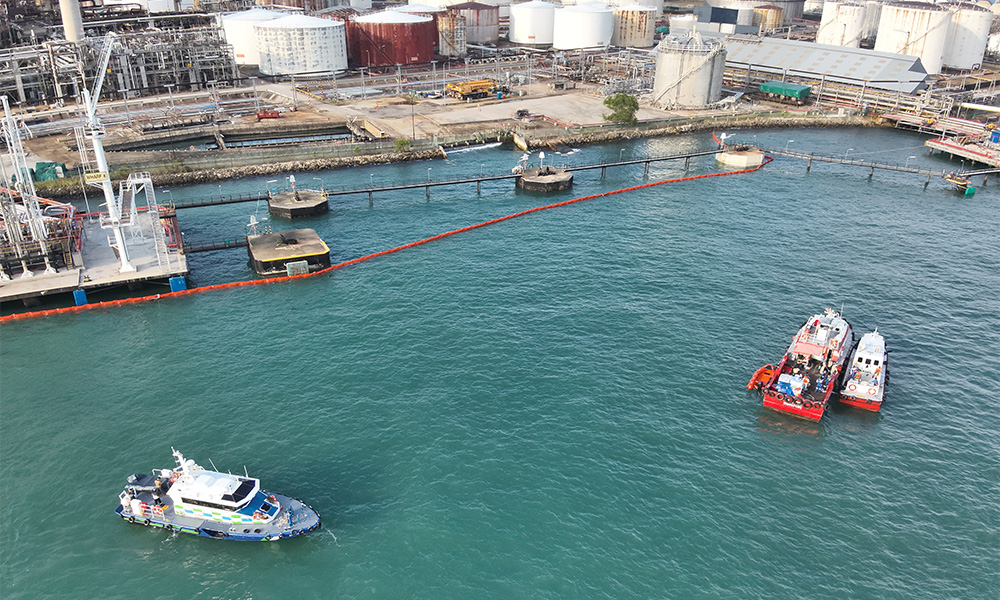
2 MPA craft (left) supporting Shell craft in the clean up operations of the oil sheens taken on 28 Dec 9am

Shell Singapore has been charged over two incidents in 2024 involving oily mixtures discharged into Singapore waters from its facilities at Pulau Bukom, according to media reports on Tuesday (22 September). 

The company faces four charges under the Prevention of Pollution of the Sea Act, including allegations that it failed to report the discharges to the port master immediately. 

The first incident occurred on 20 October 2024, when approximately 40 metric tonnes (mt) of oily mixture was discharged through a hole in a pipeline at the Shell Singapore Energy and Chemicals Park at about 8am.

Shell is accused of reporting the incident to the port master at about 12.55pm, several hours after the discharge occurred. 

The second incident took place between 26 and 28 December 2024. An estimated 485kg to 956kg of oil mixture was discharged into Singapore waters from the same facility.

Shell is accused of failing to report the incident immediately, with notification to the port master made at about 11.50am on 26 December 2024, according to the charges.

Singapore’s pollution-prevention regulations require occupiers of such facilities to report oil or oily-mixture discharges into Singapore waters “without delay and to the fullest extent possible”.

Shell’s representative requested an eight-week adjournment at the 22 September hearing, citing the need to obtain internal instructions, appoint counsel and locate historical records. The company said the business associated with the incidents had been divested in 2025.

The case was adjourned to October. Shell is also facing prosecution by Singapore’s National Environment Agency over the same incidents.

Related: Shell reports up to 40 mt of slop leaked from pipeline into Singapore waters
Related: Singapore: No new oil sightings after recent pipeline leak and bunkering incidents
Related: Singapore: Clean-up of oil from Shell pipeline leak to be completed in days
Related: Singapore: Oil leak at Pulau Bukom stopped; cleanup of oil sheens completed


Photo credit: Maritime and Port Authority of Singapore
Published: 25 September, 2026

Continue Reading

Incident

MPA probes Singapore Strait collision involving fishing vessel, bulk carrier

MPA says there were no reported injuries among the crew of either vessel in the incident involving China-registered fishing vessel “Lu Qing Yuan Yu” and Panama-registered bulk carrier “First Margaux” .
Admin

Published

on

By

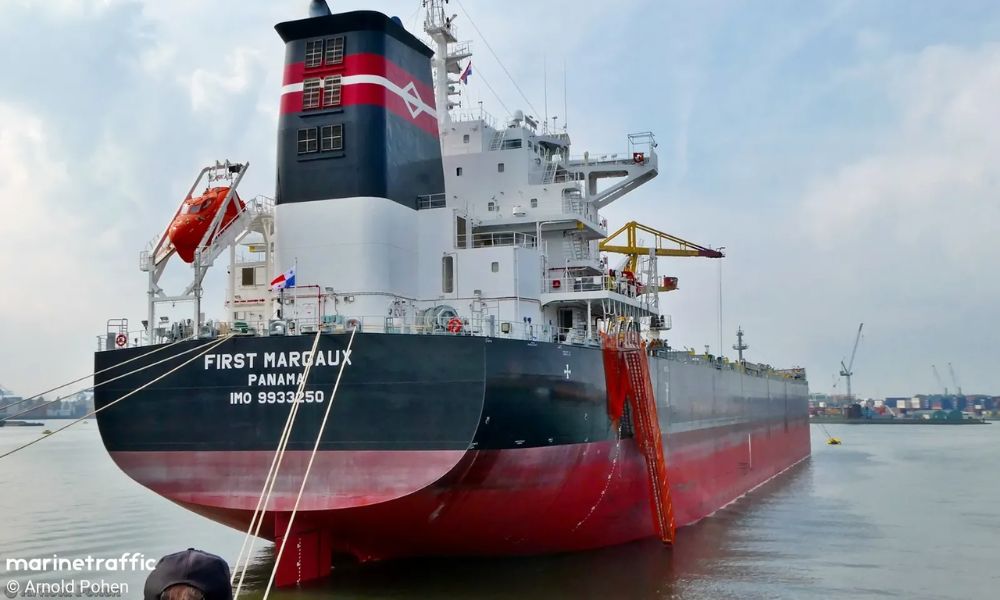
Panama-registered bulk carrier “First Margaux”

The Maritime and Port Authority of Singapore (MPA) on Tuesday (22 September) said it is investigating the incident involving the China-registered fishing vessel Lu Qing Yuan Yu and the Panama-registered bulk carrier First Margaux in the Singapore Strait on 17 September.

MPA said there were no reported injuries among the crew of either vessel or pollution arising from the incident and navigational traffic was not affected.

Videos circulating on social media showed the bulk carrier colliding with the fishing vessel.  

“The fishing vessel took on water during the incident but remained afloat and stable, with the crew taking measures to manage the situation onboard,” MPA said. 

The vessel was subsequently towed to Raffles Reserved Anchorage for assessment. 

Essential crew remained onboard to support the tow, while the Singapore Civil Defence Force supported the transfer of other crew to shore. 

MPA added it also issued navigational safety broadcasts to keep other vessels clear of the tow and escorted the vessel into port with a MPA craft.


Photo credit: MarineTraffic / Arnold Pohen
Published: 25 September, 2026

Continue Reading

Mass Flowmeter

TFG Marine deploys first MFM-equipped bunker barge in Jamaica

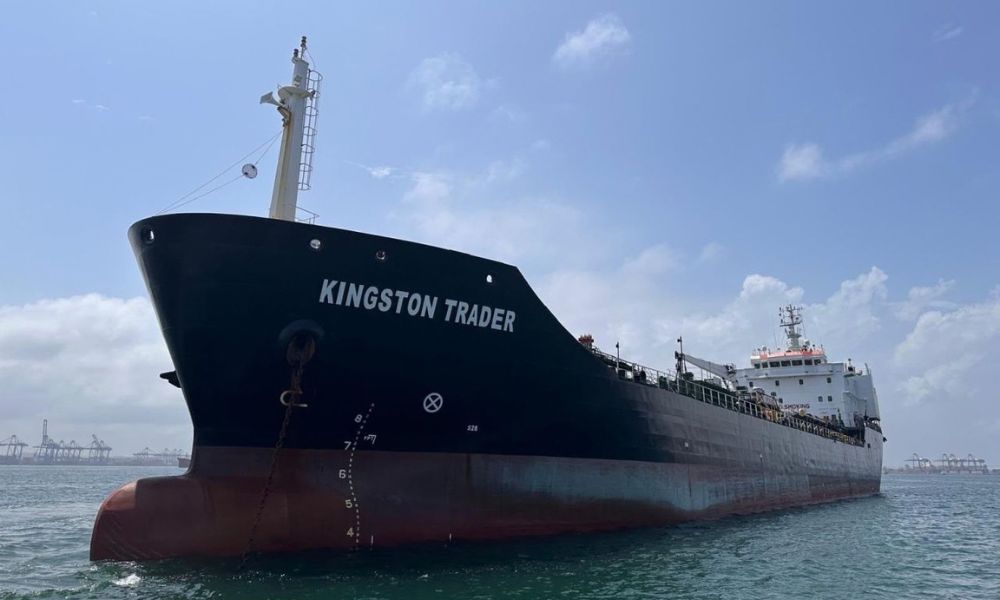
Bunker barge “Kingston Trader” is currently on its way to Jamaica following the successful installation of a Coriolis mass flow meter (MFM) system, certified to ISO 22192.
Admin

Published

on

By

TFG Marine deploys first MFM-equipped bunker barge in Jamaica

Global marine fuel supply and procurement firm TFG Marine on Thursday (24 September) said its bunker barge Kingston Trader is currently on its way to Jamaica following the successful installation of a Coriolis mass flow meter (MFM) system, certified to ISO 22192.

The company said the latest installation brings the proportion of TFG Marine’s fleet equipped with MFMs to approximately 88%, marking another step in the continued rollout of this technology across its global bunkering operations.

“The barge will operate in Jamaica through our local partnership with Scott Petroleum, becoming the first bunkering vessel in the region equipped with this technology and bringing greater accuracy, transparency and assurance to fuel measurement for customers across the Caribbean,” TFG Marine said in a social media post. 

“Together with Scott Petroleum, we look forward to working collaboratively with the Maritime Authority of Jamaica, the The Port Authority of Jamaica, Petrojam Limited and other stakeholders to share our experience of MFM technology, explore its wider benefits and support the continued development of bunkering standards across the region.” 

Manifold Times previously reported TFG Marine continuing to expand MFM technology across its US Gulf Coast bunker fleet with Buffalo B414 and Buffalo B304 being fitted with the equipment. 

Last year, TFG Marine announced it reached a key milestone in its global digitalisation programme with the installation of an ISO 22192-compliant MFM on the Buffalo 404, a barge on time charter from American bunker barge company Buffalo Marine Service Inc.

The installation was part of TFG Marine’s wider strategy to equip close to 90% of its global bunkering fleet with MFMs by 2026 as a commitment towards improving data integrity, streamlining operations and strengthening trust in marine fuel transactions.

Related: TFG Marine advances global MFM rollout with two US Gulf bunker barges
Related: TFG Marine installs first ISO-certified mass flow meter on US Gulf bunkering barge


Photo credit: TFG Marine
Published: 25 September, 2026

Continue Reading

Trending