Connect with us

Business

Hill Dickinson: Sulphur regs going smoothly, but plan ahead to meet March debunkering deadline

Some issues arising over the margin for error in testing for sulphur content and presence of sediment is causing concern in some areas, highlights lawyer.


Admin

Published

on

bradley bethan website 1

London-based Beth Bradley of the Hill Dickinson marine legal team on Thursday (30 January) published an article reviewing potential issues for ship owners to meet the 1 March deadline for part two of IMO’s Regulation 14.1.3 of Marpol Annex VI: 

The transition to low sulphur fuels has so far been smooth, thanks to the efforts of shipping industry stakeholders in preparing for the change, which entered into force on 1 January this year.

However, there are some issues arising over the margin for error in testing the sulphur content and the presence of sediment is causing concern in some areas, warns maritime law specialist Hill Dickinson.

And, as the 1 March deadline for part two of the regulations looms, the legal expert advises ship operators to start planning now to debunker any remaining high sulphur fuel in good time.

Beth Bradley, a London-based partner with Hill Dickinson marine team, explains: ‘It is nearly a month from the implementation date of Regulation 14.1.3 of Marpol Annex VI and, while it is too early to draw firm conclusions, a couple of themes are emerging as a result of the change.’

Regulation 14.1.3 Marpol Annex VI, lowers the sulphur content for marine fuel for use on board vessels not fitted with exhaust gas cleaning equipment from 3.5% m/m to 0.50% m/m and took effect of 1 January 2020 (the ‘sulphur cap’). Regulation 14.4.3 Marpol Annex VI limiting sulphur content to 0.10% m/m in Emission Control Areas remains in place.

In the opening weeks of 2020 there have been very few reports of enforcement action taken against vessels for non-compliance with the sulphur cap. Consequently, the transition has been smoother than expected from a port state control perspective. This is in no small amount attributable to the efforts of the key stakeholders (owners, charterers, insurers and bunker suppliers) to prepare to be compliant as of 1 January 2020. 

While this suggests a high level of compliance, it is only part of the picture, warns Ms Bradley, explaining that issues relating to the sulphur content of fuel, as well as the quality of some blended low sulphur fuels, are already arising. 

Compliance with Regulation 14.1.3 means using a fuel with a sulphur content of 0.50% m/m maximum. If the sulphur content exceeds that threshold, owners may be exposed to enforcement action. Consequently, the frequency of owners having samples tested for sulphur content has increased. 

Where the bunkers are found to be marginally in excess of the limit, problems are arising largely owing to the difference between Regulation 14.3.1 and most supply contracts. An on-specification supply for sulphur content will, usually, from a suppliers’ point of view be deemed to be up to 0.53% m/m, since that reflects the laboratory margin of confidence for testing. 

‘As a result, a time consuming and costly stand-off can occur while the sulphur content issue is resolved and decisions made regarding whether to de-bunker and obtain alternative bunkers,’ says Ms Bradley.

In addition, over the past four weeks there have been a number of alerts issued concerning sediment issues, in particular, in low sulphur fuels supplied in Singapore, Piraeus, Amsterdam, Rotterdam, Miami and San Vincente. The propensity to sediment can cause engine problems, from sludging of filters to engine damage and blackouts in the worst circumstances.

Ms Bradley warns: ‘Quality claims relating to bunkers are not a new phenomenon but, in the past, they have tended to be localised. The spread of alerts concerning sediment suggests a potentially wider issue concerning the stability of some blended low sulphur fuel.’

She cautions: ‘Liability, depending on the reasons for sedimentation, may not be straightforward. While charterparties and bunker supply contracts will contain a specification for the fuel, usually by reference to the ISO 8217 standard, some organic compounds which cause sedimentation may not be caught by the Table Two parameters (although the issue may be caught by clause 5.3 of ISO 8217).’

Where shipowners have devolved the responsibility to provide bunkers to the vessel to their time charterers, the time charterers’ obligation as a matter of English law is twofold; (a) to provide bunkers in accordance with the contractual specification and (b) to provide bunkers which are fit for purpose. 

‘As such, if the bunkers are within specification but are causing sedimentation, or are otherwise not fit to be consumed by the vessel, owners may have recourse against their time charterers,’ counsels Ms Bradley, adding: ‘The position is not necessarily the same under bunker supply contracts, particularly if there are clear provisions excluding claims relating to fitness for purpose, which can make it difficult to pursue the supplier.’

Hill Dickinson outlines that, from a practical point of view, the usual advice to owners applies:

  • ensure that they have clean bunker tanks 
  • avoid co-mingling of bunkers, and  
  • monitor sampling during the supply 

Time charterers arranging the supply of bunkers (or owners if dealing direct with the suppliers) need to ensure that they understand the supply contract and have the time bar and sampling provisions firmly in mind in order to preserve their rights of recourse against the supplier, if available. 

It also warns that, while the use on board of high sulphur fuel is now impermissible unless the vessel is fitted with exhaust gas cleaning systems, high sulphur fuel may be carried until 1 March. 

Ms Bradley predicts: ‘Looking ahead, enforcement action and quality issues will remain live topics as the shipping industry adjusts to the sulphur cap. The next pinch point will be 1 March 2020 when the carriage ban takes effect. 

‘Owners have a little over a month in which to arrange to de-bunker high sulphur fuel and would be best advised to start planning those operations (if not already in hand) now, so as to avoid the consequences of missing the deadline,’ she advises.


Source: Hill Dickinson
Published: 4 February, 2020

Continue Reading

Biofuel

Petrochina International blends over 30,000 mt of marine biofuel since March

Company has been developing marine biofuel blending operations at China (Zhejiang) Pilot Free Trade Zone, leveraging storage and logistics facilities at its Aoshan base.
Admin

Published

on

By

Zhoushan completes China’s first batch of marine biofuel blending under pilot programme

Petrochina International Co Ltd recently said it has blended more than 30,000 metric tonnes (mt) mt of biofuel since completing the country’s first biofuel marine fuel blending operation on 13 March.

The company said the milestone demonstrates its ability to conduct continuous and large-scale biofuel marine fuel blending operations.

The company has been developing marine biofuel blending operations at China (Zhejiang) Pilot Free Trade Zone, leveraging storage and logistics facilities at its Aoshan base.

Its latest product, B24 marine fuel containing 24% biofuel component, meets relevant International Maritime Organization (IMO) requirements and marine fuel standards, according to the company. It said the product can be supplied for bunkering vessels operating on international routes.

It has used its global trading network to secure feedstock supplies and support cost control and supply security for the blending operations, it added.

The company said the large-scale blending of its marine biofuel products marks a development in China’s marine biofuel blending market.

It plans to work with upstream and downstream businesses within its group to support the development of Zhoushan Port as a major bonded marine fuel bunkering hub and contribute to its parent group’s transition towards lower-carbon energy.

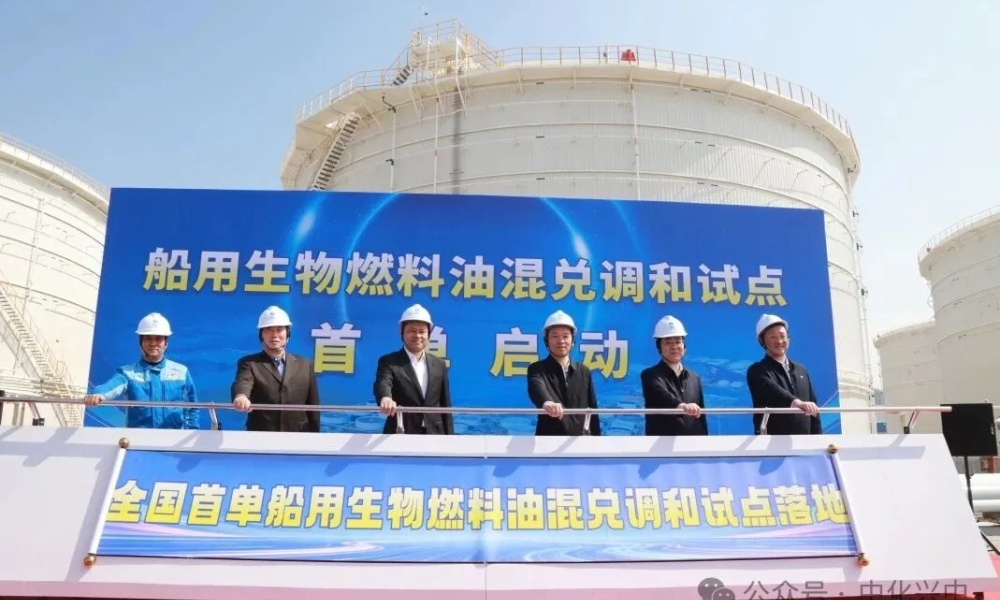
Manifold Times previously reported China (Zhejiang) Pilot Free Trade Zone launching the first pilot programme for marine biofuel blending in China with the completion of the first batch of B24-HSFO. 

The launch was marked with the blending of 2,000 mt of biodiesel and 6,300 mt of high sulphur fuel oil (HSFO) in storage tank F-02 of Sinochem-Xingzhong Oil Staging (Zhoushan), producing 8,300 mt of B24-HSFO. 

Manifold Times also reported the first cross-regional bonded bunkering operation of blended biofuel in East China was successfully completed at the Meishan Port Area of ​​Ningbo-Zhoushan Port. 

The B24-HSFO used in the bunkering operation was supplied by the Aoshan Petroleum Base in Zhoushan from the first pilot programme for marine biofuel blending in China. 

Related: Zhoushan completes China’s first batch of marine biofuel blending under pilot programme
Related: Ningbo wraps up East China’s first cross-regional biofuel blending and bunkering
Related: China debuts first marine biofuel blending pilot programme in Zhoushan
Related: China’s first batch of domestically blended marine biofuel delivered to Qingdao for bunkering


Photo credit: Sinochem-Xingzhong Oil Staging (Zhoushan)
Published: 21 September, 2026

Continue Reading

Winding up

Singapore: Final general meetings scheduled for Dromond Shipping, related firms

A member is entitled to attend the meetings and should notify the liquidators’ team office via email no later than 48 hours prior to the meeting.

Admin

Published

on

By

steve pb from Pixabay

The final general meetings of Dromond Shipping Pte Ltd  and related companies have been scheduled to take place on 19 October, according to the company’s liquidator on a notice posted on Friday (18 September) on the Government Gazette.

The other companies are Tidewater Emergency Response Services Pte Ltd, Tidewater Production Solutions Pte Ltd and Tidewater Salvage Pte Ltd. 

The final general meetings of the members of the companies will be held via electronic means on 19 October 2026 at 2.00 pm, 2.30 pm, 3.00 pm and 3.30 pm (Singapore time), respectively.

The meetings are being held for the purpose of having accounts laid before the members showing the manner in which the winding up of the respective companies has been conducted and how the property of the respective companies has been disposed of and to hear any explanation that may be given by the liquidators. 

The details of the liquidator is as follows:

Tan Kim Han
Joint and Several Liquidators
137 Amoy Street, #02-03, Far East Square
Singapore 049965

Note: A member is entitled to attend the above meeting and should notify the Liquidators’ team office via email to [email protected] or [email protected] no later than 48 hours prior to the meeting.


Photo credit: steve pb from Pixabay
Published: 21 September, 2026

Continue Reading

Ammonia

NYK wraps up first STS ammonia bunkering operation in Japan

Ammonia fuel was transferred from the ammonia carrier “Shoei Maru” via the STS method to an ammonia-fuelled medium gas carrier, scheduled for delivery in November 2026.
Admin

Published

on

By

NYK wraps up first STS ammonia bunkering operation in Japan

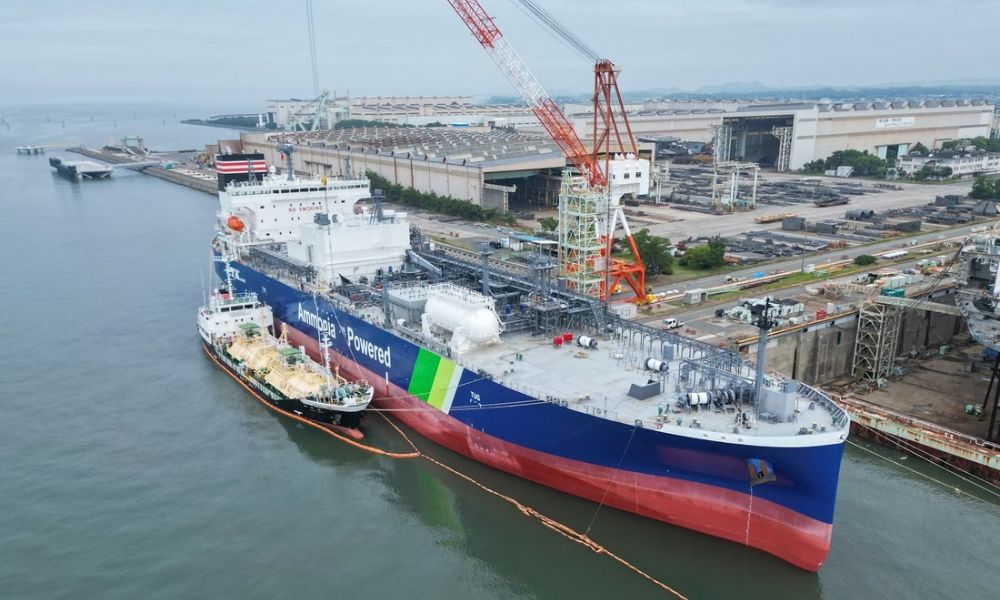
NYK Line, on Thursday (17 September) with Japan Marine United Corporation, Nihon Shipyard Co Ltd, Mitsubishi Gas Chemical Company, and Kokuka Sangyo Co Ltd, has completed the world’s first ship-to-ship (STS) ammonia bunkering operation to an ammonia-fuelled vessel. 

At a quay within Japan Marine United Corporation’s Ariake Shipyard, ammonia fuel was transferred from the ammonia carrier Shoei Maru via the STS method to an ammonia-fuelled medium gas carrier (AFMGC) scheduled for delivery in November 2026. 

The operation was conducted in preparation for sea trials of the AFMGC using fuel ammonia.

“This achievement represents an important initiative that has put into practice an operation essential for the future practical deployment of ammonia-fuelled vessels,” the company said. 

The bunkering operation was conducted following extensive discussions among the companies involved. Safe operating procedures and work processes were established prior to the operation, enabling the transfer to be completed safely. Through this initiative, we have accumulated practical insights regarding safe fuel supply operations.

This operation serves as a pioneering example of the fuel-supply framework that will be required for the widespread adoption of ammonia-fuelled vessels. 

The AFMGC is currently in the final stage of construction and is scheduled for delivery in November 2026. 

“The successful completion of this operation marks a significant milestone toward the broader commercial use of fuel ammonia and the practical deployment of ammonia-fuelled vessels. It also represents an important step forward in establishing an ammonia supply chain,” the company added. 


Photo credit: NYK
Published: 21 September, 2026

Continue Reading

Trending