Connect with us

Alternative Fuels

ENGINE on Fuel Switch Snapshot: B100 discounts to conventionals narrow in Rotterdam

Rott B100’s discount to LSMGO drops by nearly $200/mt; LNG premiums over LBM narrow in Rotterdam; Singapore B100’s discount to LSMGO below $250/mt.

Admin

Published

on

ENGINE on Fuel Switch Snapshot: B100 discounts to conventionals narrow in Rotterdam

Once a week, bunker intelligence platform ENGINE will publish a snapshot of alternative and conventional bunker fuel prices in the world’s two biggest bunkering hubs. The following is the latest snapshot:

  • Rott B100’s discount to LSMGO drops by nearly $200/mt
  • LNG premiums over LBM narrow in Rotterdam
  • Singapore B100’s discount to LSMGO below $250/mt

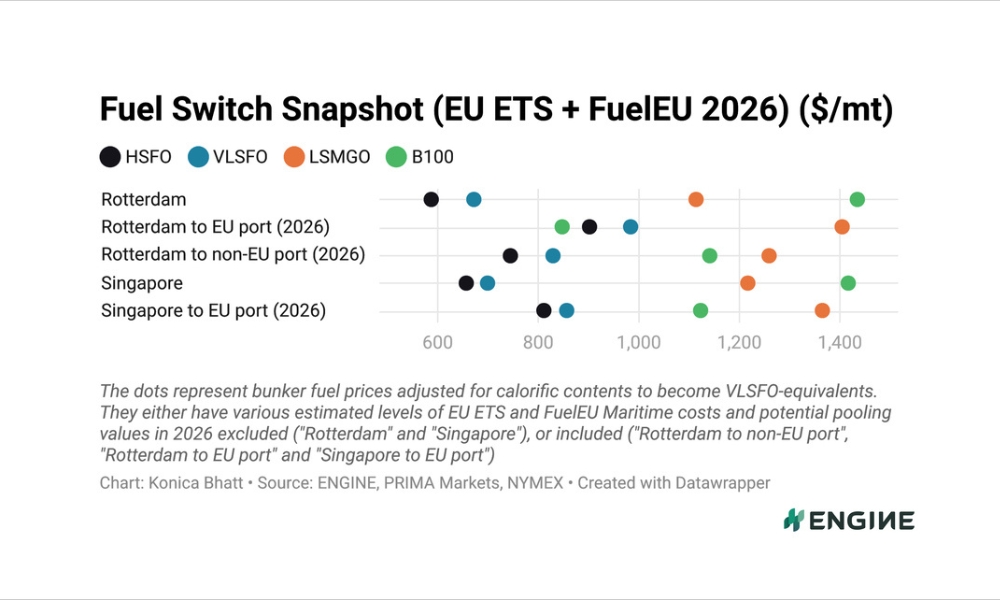
Rotterdam’s B100 discount to VLSFO has narrowed by $87/mt, while its discount to LSMGO has dropped by a sharper $197/mt over the past week.

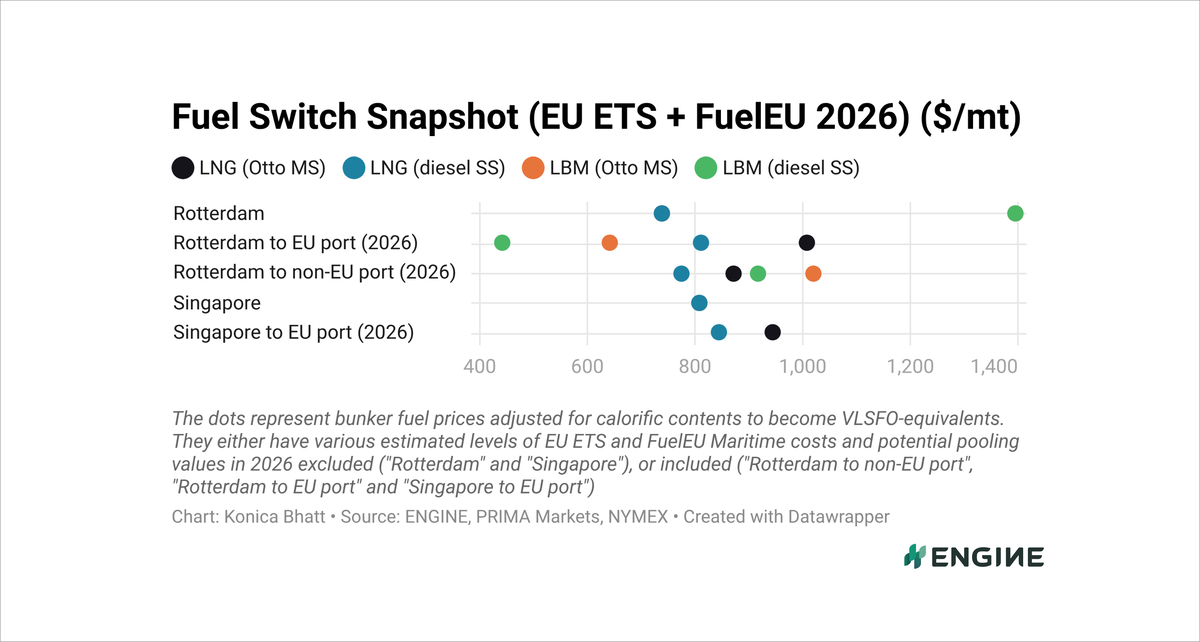
LNG discounts to LSMGO in Rotterdam have also narrowed by $68-72/mt to $399-595/mt.

At the same time, LNG premiums over liquefied biomethane (LBM) sold at 0 gCO2e in Rotterdam have eased by $30/mt to $364-370/mt, depending on engine type and methane slip.
ENGINE on Fuel Switch Snapshot: B100 discounts to conventionals narrow in Rotterdam

Singapore B100’s discount to LSMGO has narrowed for another week, falling by $302/mt to $241/mt for EU-bound voyages.

For dual-fuel vessels bunkering in Singapore and sailing to the EU, B100 premiums over LNG have widened by $132-134/mt, depending on engine type.

Liquid fuels

Rotterdam’s conventional fuel prices have declined for a fourth consecutive week. VLSFO and HSFO prices have dropped by $20–76/mt, tracking a $113.40/mt ($6.92/bbl) fall in front-month ICE Brent futures, while LSMGO has fallen more sharply by $131/mt.

In contrast, Rotterdam’s B100 price has risen by $66/mt over the past week.

Singapore’s HSFO and VLSFO benchmarks have declined by $27–92/mt, while LSMGO has dropped by a steeper $346/mt. B100 price in Singapore has followed the downward trend, falling by $44/mt.

Liquid gases

Rotterdam’s LNG and LBM bunker prices have declined for a fourth straight week. LNG has fallen by $58-63/mt, while LBM has dropped by a smaller $28-32/mt.

Singapore’s LNG prices have seen even sharper cuts, declining by $176-178/mt over the past week.

By Konica Bhatt


Photo credit and source: ENGINE
Published: 21 April, 2026

Continue Reading

Alternative Fuels

Höegh Autoliners orders six more ammonia, methanol-ready Aurora class PCTCs

Höegh Autoliner inked a contract with China Merchants Group for six additional Aurora class PCTCs, which will be built by China Merchants Heavy Industry (Jiangsu) and delivered between 2029 and 2031.
Admin

Published

on

By

Höegh Autoliners orders six more ammonia, methanol-ready Aurora class PCTCs

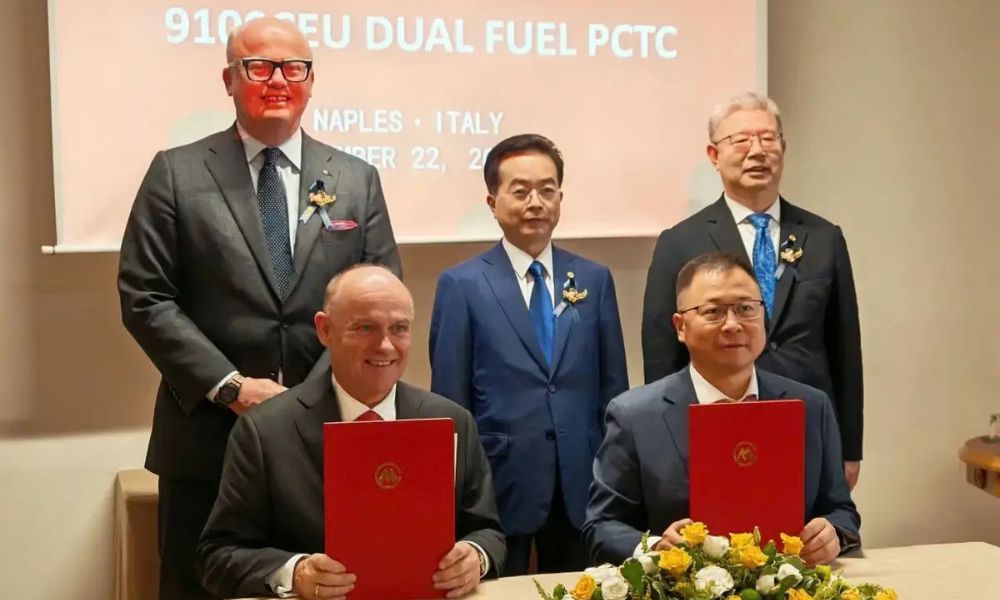
Höegh Autoliners on Tuesday (22 September) said it has formally signed a contract with China Merchants Group (CMG) for six additional Aurora class pure car and truck carriers (PCTCs). 

The contract was signed during a high-level meeting in Naples attended by senior representatives from both companies, including Miao Jianmin, Chairman of China Merchants Group. Chair of Höegh Autoliners, Leif O. Høegh, and Andreas Enger, CEO of Höegh Autoliners.

The six additional dual-fuel LNG and zero-carbon-ready vessels will be built by China Merchants Heavy Industry (Jiangsu) Co., Ltd. (CMHI) and delivered between 2029 and 2031. 

With 18 Aurora Class vessels in the programme, Höegh Autoliners is building the fleet needed for a zero- emission future and setting the pace for the transformation of deep-sea shipping.

The Aurora Class vessels can carry up to 9,100 cars and reduce carbon emissions per transported car by up to 58 per cent compared with conventional PCTCs. They have DNV’s ammonia-ready and methanol-ready notations and are designed to be converted to run on future zero-carbon fuels.

Leif O. Høegh, Chair of the Board of Directors of Höegh Autoliners, said: “For nearly 100 years, we have developed, adapted and led the way through major changes in shipping. It is in our DNA to keep moving and challenge what is possible. This signing continues that story. We are investing in the vessels that will define our fleet for decades and help move our industry towards zero emissions.”

Andreas Enger, CEO of Höegh Autoliners, said: “This is not just another vessel-building agreement. It is a statement about the future of deep-sea shipping and the role we intend to play in shaping it. The Aurora Class is at the heart of our fleet renewal and our path to a sustainable future. By expanding the programme to 18 vessels, we are securing efficient, flexible and future-ready capacity while setting the pace towards zero-emission operations.”

Miao Jianmin, Chairman of China Merchants Group, said: “Höegh Autoliners is a pioneer in international shipping and will celebrate its 100th anniversary next year. We would like to offer our congratulations in advance! Over the past century, Höegh Autoliners has achieved remarkable development and has grown into a leading company in the global RoRo shipping sector. We truly admire what you have accomplished.”


Photo credit: Höegh Autoliners
Published: 24 September, 2026

Continue Reading

Newbuilding

CLdN orders two LNG dual-fuel RoRo vessels from HD Hyundai Heavy Industries

New vessels will be built with space reserved for the future addition of larger electric shaft generators and batteries as the technology matures.
Admin

Published

on

By

CLdN orders two LNG dual-fuel RoRo vessels from HD Hyundai Heavy Industries

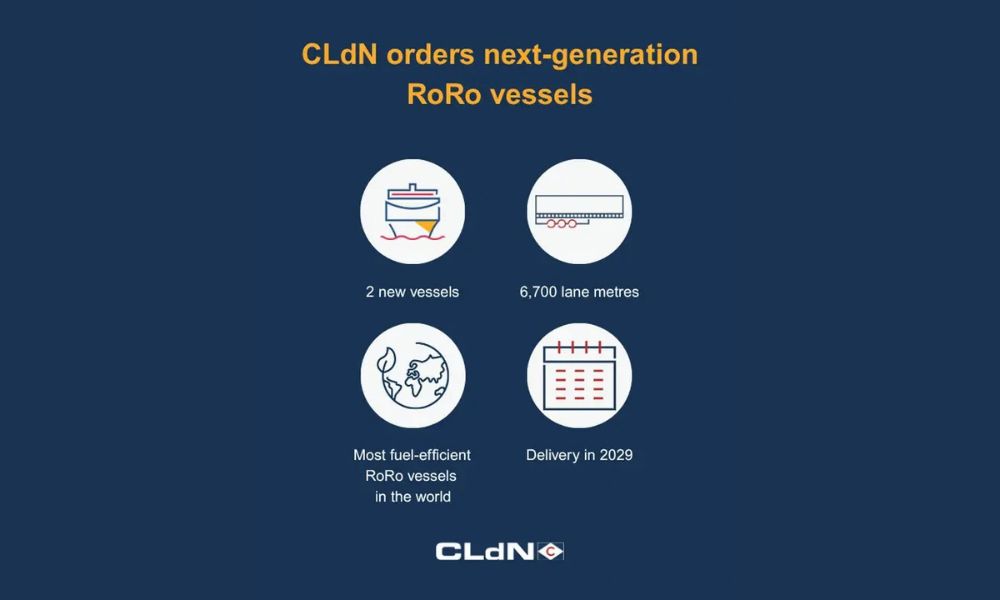
Europe’s multimodal logistics providers CLdN on Tuesday (22 September) announced it has placed an order for two new 6,700 lane-metre RoRo vessels with HD Hyundai Heavy Industries (HD Hyundai HI).

Construction of the new vessels is set to begin towards the beginning of 2028, with delivery scheduled for mid-2029. 

“The ships will be the 15th and 16th vessels ordered by CLdN from the South Korean shipbuilder over the past 10 years,” the company said on its website. 

The new vessels will be dual-fuel capable, able to run on standard marine diesel or LNG, and will be built with space reserved for the future addition of larger electric shaft generators and batteries as the technology matures.

While fuel consumption per vessel is expected to be similar to that of CLdN’s existing 5,000 lane-metre class ships, the increased cargo capacity of the new vessels is expected to deliver 30 to 40% better fuel efficiency per tonne-kilometre of cargo carried making the vessels the most fuel-efficient RoRo ships in the world.

The new vessels are designed with one additional deck and increased ground space compared to CLdN’s existing 5,000 lane-metre class ships, with a configuration specifically adapted for trailer cargo. 

“The addition of these vessels to CLdN’s fleet will ensure customers benefit from an even broader range of shipping options via CLdN’s extensive fleet of RoRo and container vessels,” the company said. 


Photo credit: CLdN
Published: 24 September, 2026

Continue Reading

Alternative Fuels

GCMD, Equinor to combine expertise on alternative bunker fuels, decarbonisation solutions

Equinor brings extensive experience to partnership as a vessel charterer and marine fuel supplier, including chartering dual-fuel LNG and methanol tankers, testing biofuels and supplying methanol.
Admin

Published

on

By

GCMD, Equinor to combine expertise on alternative bunker fuels, decarbonisation solutions

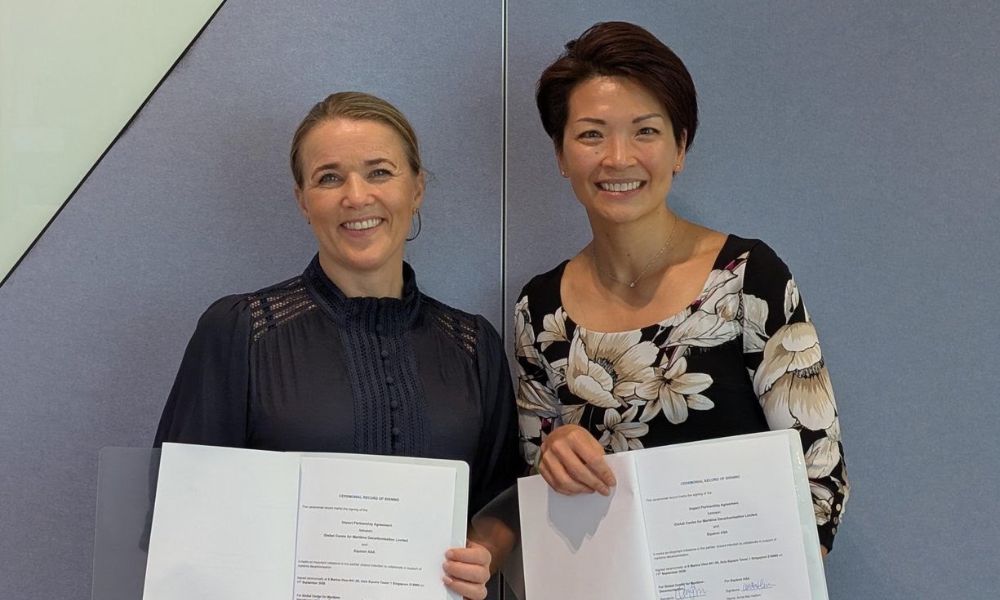
The Global Centre for Maritime Decarbonisation (GCMD) and Equinor on Tuesday (22 September) announced a five-year Impact partnership.

The partnership brings together GCMD’s capabilities in conducting real-world maritime pilots with Equinor’s experience as a charterer, energy provider and developer of low-carbon solutions.

Together, the organisations will leverage their complementary expertise to help address technical and operational gaps in scaling alternative marine fuels and supporting the development and uptake of other maritime decarbonisation solutions.

GCMD’s work on alternative fuels, including biofuels, ammonia and methanol, focuses on two critical aspects of deployment: operational safety and robust monitoring, reporting and verification (MRV). Its pilots and studies are generating operational data to support safe bunkering and handling of these fuels. 

At the same time, its assurance work seeks to strengthen confidence in quantity, quality and GHG emissions abatement.

“Equinor brings extensive experience as a vessel charterer and marine fuel supplier. This includes chartering dual-fuel LNG, LPG and methanol tankers, testing and using biofuels and supplying methanol to the maritime sector,” GCMD said.

Equinor is also piloting the use and supply of ammonia as a marine fuel, contributing to the development of associated safety, regulatory and bunkering arrangements.

Combining these perspectives can help address practical barriers to alternative fuels deployment while strengthening assurance across emerging marine fuel value chains.

Beyond alternative fuels, GCMD is working to accelerate the adoption of solutions that can reduce emissions from the existing fleet, including energy efficiency technologies (EETs) and onboard carbon capture and storage (OCCS).

GCMD’s work on EETs includes quantifying real-world fuel savings from technologies such as wind-assisted propulsion systems and developing financing mechanisms to scale their adoption. In OCCS, Project CAPTURED demonstrated an end-to-end value chain for onboard captured and liquefied CO₂, generating evidence that contributed to the recognition of captured CO2 under the EU ETS and in-principle support at the IMO for recognising carbon mineralisation as permanent storage.

Equinor brings decades of experience in offshore CO₂ storage, including its role in the development and operation of Northern Lights, the world’s first cross-border CO2 transport and storage facility, where liquefied CO₂ is transported by ship to an onshore receiving terminal before it is sent by pipeline for permanent geological storage beneath the North Sea.

Through the partnership, GCMD and Equinor will explore opportunities to combine their respective capabilities and experience to support the deployment and scaling of maritime decarbonisation solutions.


Photo credit: Global Centre for Maritime Decarbonisation
Published: 23 September, 2026

Continue Reading
Advertisement

OUR INDUSTRY PARTNERS


Trending