Connect with us

Bunker Fuel Availability

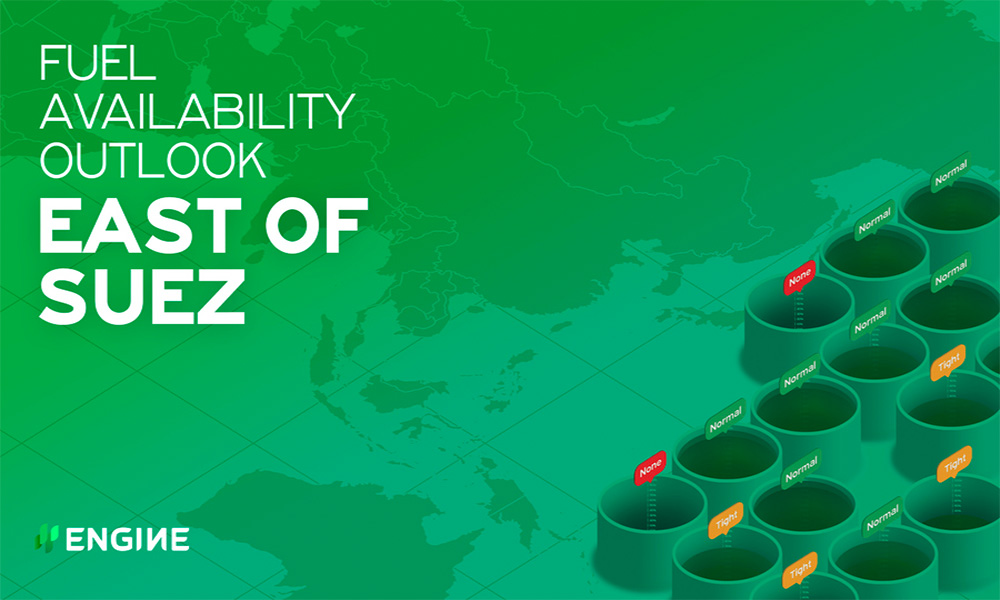
ENGINE: East of Suez Bunker Fuel Availability Outlook (5 May 2026)

Bunker availability tight in Zhoushan; bunker supply extremely tight in Singapore; fuel availability tight across all grades in Fujairah.

Admin

Published

on

RESIZED ENGINE East of Suez

The following article regarding regional bunker fuel availability outlook for the East of Suez region has been provided by online marine fuels procurement platform ENGINE for publication on Singapore bunkering publication Manifold Times:

  • Bunker availability tight in Zhoushan
  • Bunker supply extremely tight in Singapore
  • Fuel availability tight across all grades in Fujairah

Singapore and Malaysia

Bunker fuel availability across all grades in Singapore is extremely tight. VLSFO delivery schedules in the port have stretched further, now ranging between 9-18 days, compared to 7-15 days previously. HSFO lead times have shortened slightly to 4-10 days from last week’s 7-12-day window. LSMGO availability has tightened as well, with lead times extending to 5-9 days.

There are very limited suppliers offering small HSFO parcels in Singapore, and a premium is expected for quantities of 500 mt and below, a trader said.

At Malaysia’s Port Klang, VLSFO supply remains relatively stable, especially for smaller prompt volumes. Tighter conditions persist for LSMGO, while HSFO availability continues to face constraints, making both grades increasingly difficult to secure.

East Asia

Availability in Zhoushan has tightened across all fuel grades, with several suppliers reporting low stocks. However, lead times in Zhoushan have shortened this week, with all grades now requiring around 5-7 days for delivery, down from last week’s 8-10 days.

Bunker demand in China remained comparatively soft over the Chinese Labour Day holiday period from 1-5 May, with most suppliers not accepting new orders during this window.

Bunker availability across northern China remains mixed. Dalian and Qingdao are well supplied with VLSFO and LSMGO, although HSFO is tight in Qingdao. Tianjin is experiencing tight supply across all grades. In Shanghai, VLSFO and HSFO availability is limited, while LSMGO supply remains relatively stable.

In southern ports, availability is mixed – Fuzhou is tight on both VLSFO and LSMGO, Xiamen has adequate VLSFO but limited LSMGO, while Yangpu and Guangzhou remain constrained across both grades.

Bunker fuel availability in Hong Kong has tightened this week, with lead times for all grades holding at around seven days.

Taiwan’s bunker market remains steady, although HSFO stocks have completely depleted, according to another trader. Lead times are approximately three to four days for both VLSFO and LSMGO at Keelung, Hualien, Taichung and Kaohsiung.

There are no barges available at Suao and Hualien, the trader said. CPC Corporation is the only physical supplier in Taiwanese ports currently, the trader added.

In South Korea’s southern ports – Busan, Ulsan, Masan, Onsan, Yeosu and Kwangyang – availability of all three conventional bunker grades is tight. Recommended lead times for VLSFO and LSMGO are at around 3-5 days.

Across western ports, including Incheon, Daesan, Dangjin, Pyeongtaek and Taean, lead times remain around five days for all grades, matching the previous week’s estimates.

Meanwhile, weather-related disruptions continue to pose risks in South Korean ports.

In Japan, supply conditions remain largely tight across key hubs such as Tokyo Bay, Nagoya and Osaka. “Overall tightness continues due to crude procurement constraints and Middle East tensions,” a trader said.

Recommended lead times stand at approximately 10-11 days for HSFO and VLSFO across major ports including Tokyo, Nagoya, Osaka. LSMGO is extremely tight at Kashima, Mizushima, Tokuyama and Oita.

Oceania

Bunker supply across Australian ports has improved, although prices remain elevated and smaller suppliers are still constrained on volumes, a local trader said.

On the east coast, supply dynamics differ by location. In New South Wales, Port Kembla can deliver VLSFO via truck or pipeline. Sydney suppliers maintain healthy inventories of VLSFO and LSMGO, while HSFO remains limited, with lead times typically around a week.

In Western Australia, VLSFO deliveries in Kwinana and Fremantle typically require around a week’s lead time and are supplied by barge via a single provider.

In Queensland, ports including Brisbane and Gladstone are quoting about a week’s lead time for VLSFO and LSMGO. HSFO in Brisbane is available only on request. VLSFO and LSMGO deliveries are handled by two barges run by separate suppliers, while HSFO supply is subject to enquiry.

Supply is more stable in Victoria, with ample VLSFO stocks in Melbourne and Geelong, though prompt HSFO availability remains constrained. Bunkering at both ports is handled by a single barge, with lead times typically around a week.

Australia’s cyclone season, which usually runs from November to April, is coming to an end, reducing weather-related disruptions.

In New Zealand, supply remains stable, with VLSFO readily available in Tauranga and Auckland, including pipeline connections at some Tauranga berths. At Marsden Point, both VLSFO and LSMGO can be supplied directly to vessels via pipeline.

South Asia

In India, VLSFO supply still remains tight across Kandla, Sikka, Hazira and New Mangalore.

Weather conditions are expected to disrupt operations at several ports – including Kandla, and Sikka – between 5 and 7 May, potentially impacting bunkering activity.

Prompt availability is good in Sri Lanka, with Colombo and Hambantota holding ample stocks across all grades and at least one supplier able to deliver promptly.

Middle East

A recent drone attack in the UAE port of Fujairah has led to the suspension of all cargo operations, a source familiar with the matter said. The port’s OTB terminal is presently not operational, the source said.

However, general cargo operations at Fujairah Port remains active, with vessels continuing to call for loading and discharge of bulk and general cargo.

“Fujairah Anchorage remains fully operational, with vessels continuing to call for bunkering and husbandry services without disruption,” the source added.

Prompt bunker availability in Fujairah across all grades is very tight currently, another source said. Meanwhile, LSMGO availability is tight at Djibouti port.

Operations at Kuwait’s Shuaiba and Shuwaikh continue without disruption. Saudi Arabia has not issued any official notices, but bunker supply in Jeddah remains constrained, especially for VLSFO. However, LSMGO availability has improved this week.

In Qatar, bunkering is proceeding without issues at Hamad, Doha and Al Ruwais, with operations also ongoing at Mesaieed and Ras Laffan. However, VLSFO and LSMGO supply remains constrained in Ras Laffan, while in Al Ruwais deliveries are limited to smaller vessels such as dhows and barges.

By Aparupa Mazumder


Photo credit and source: ENGINE
Published: 6 May, 2026

Continue Reading

Bunker Fuel

Baltic Exchange: Bunker Report (17 September 2026)

Bunker report panellists include Island Oil Limited, Cockett Marine Oil Pte, Monjasa A/S, KPI OceanConnect, NSI Marine and Transparensea Fuels.

Admin

Published

on

By

Baltic Exchange logo

The following bunker report has been provided by freight market information provider Baltic Exchange for post on Singapore bunkering publication Manifold Times:
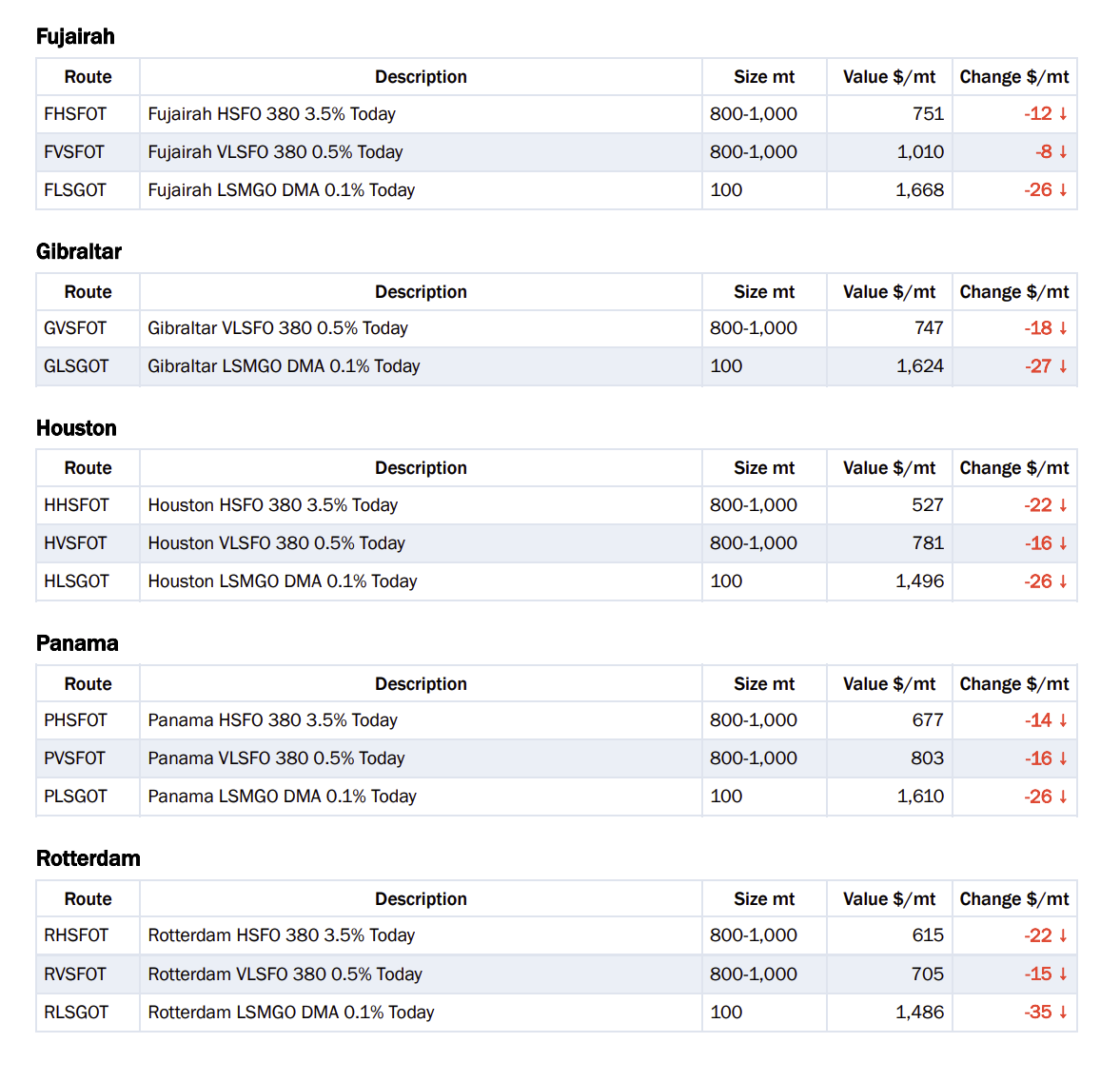
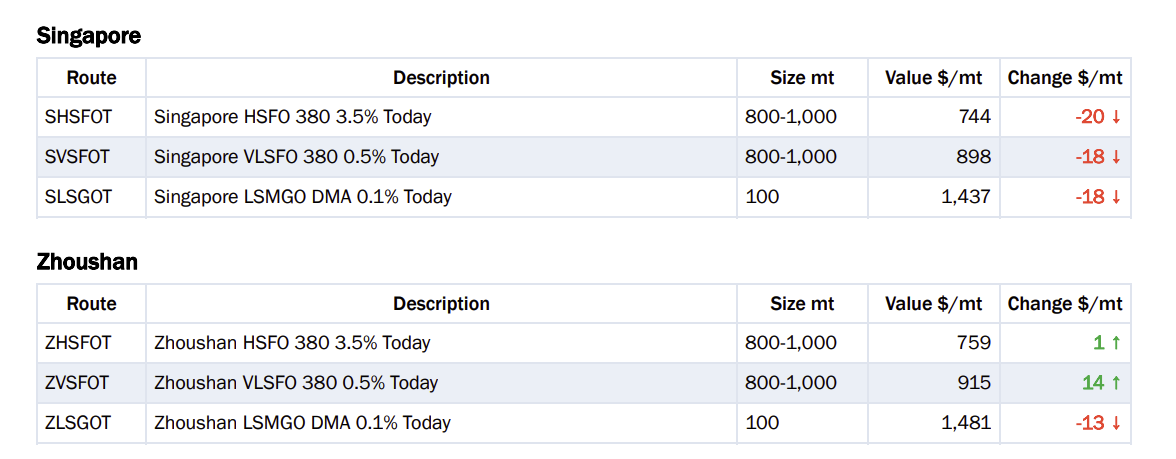
Screenshot 2026 09 18 at 1.22.26 PM

Screenshot 2026 09 18 at 1.22.41 PM

All values are in US$/metric ton, all-in (invoice price), delivered on board
Delivery in 7-10 days
ISO 8217:2010
IFO 380 3.5% Sulphur
IFO 380 0.5% Sulphur
DMA 0.1% Sulphur

Fujairah – Offshore Anchorage Area
Gibraltar – Anchorage area
Houston – Houston Harbor
Panama – (Pacific) dangerous cargo area, Balboa
Rotterdam – Waalhaven Maasvlakte range
Singapore – Anchorage, under SBA Scheme
Zhoushan – Southern anchorage area

Submitted weekly at Close of Business UK time Daily

Panellists:
Cockett Marine Oil Pte, Island Oil Limited, KPI OceanConnect, Monjasa A/S, NSI Marine and Transparensea Fuels 


Photo credit and source: Baltic Exchange
Published: 18 September, 2026

Continue Reading

Bunker Fuel

ENGINE: Americas Bunker Fuel Availability Outlook (17 Sep 2026)

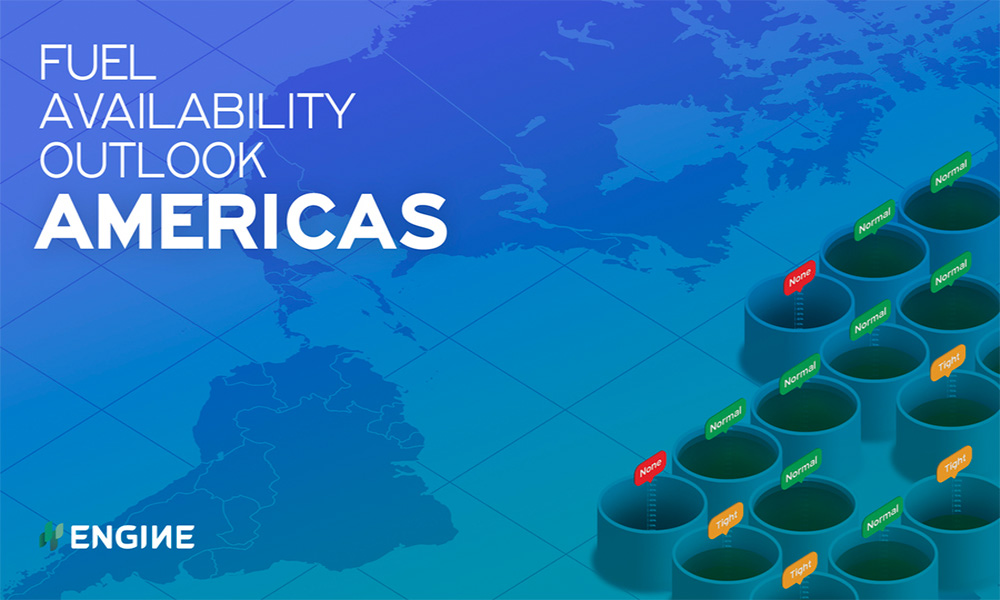
New York HSFO availability to tighten; Panama Canal transits face delays; supply tight in Rio de Janeiro and Rio Grande.
Admin

Published

on

By

RESIZED ENGINE Americas

The following article regarding bunker fuel availability in the Americas region has been provided by online marine fuel procurement platform ENGINE for post on Singapore bunkering publication Manifold Times:

  • New York HSFO availability to tighten
  • Panama Canal transits face delays
  • Supply tight in Rio de Janeiro and Rio Grande

North America

Bunker demand has been good in the US Gulf Coast port of Houston over the past week and prompt fuel availability is a bit tight across most suppliers, a trader tells ENGINE.

Lead times for HSFO and LSMGO are currently estimated to be between 5-7 days, while VLSFO requires between 5-6 days.

At the Galveston Offshore Lightering Area (GOLA), high winds gusts up to 24 knots are forecast in intervals between 17-19 September and could disrupt bunker operations, a source said.

Deliveries are done on a first-come, first-served basis, subject to weather conditions. Lead times for HSFO and VLSFO are between 3-7 days at the anchorage. LSMGO has been delivered by suppliers within 2-3 days over the past week.

On the East Coast, bunker demand at the port of New York has recorded neither highs nor lows this week.

Lead times for all three conventional fuel grades are between 5-8 days. HSFO availability at New York is expected to tighten over the week, a trader tells ENGINE.

Weather conditions have been calm in New York, with winds mostly below 10 knots and gusts peaking at around 18 knots on Sunday. No backlog or bunker barge readiness issues have been reported.

Bunker demand has picked up on the US West Coast compared with previous weeks, a trader said.

Availability is normal at the ports of Los Angeles and Long Beach, where all three conventional grades require lead times of 4-7 days.

In Canada’s Vancouver the market has seen healthy demand and availability is normal. HSFO and LSMGO require lead times between 4-6 days. VLSFO requires at least five days of lead time this week, a source said.

Latin America and the Caribbean

Transits through the Panama Canal are currently subject to waiting times of 3-4 days, a source said. Lower water levels at the canal have reduced the number of transit slots available in recent weeks.

Availability is normal at Balboa and Cristobal, where HSFO, VLSFO and LSMGO can all be delivered within 3-4 days by most suppliers.

Deliveries at Balboa are done on a first-come, first-served basis, with priority given to vessels holding confirmed transit schedules, a source said.

In Colombia, prompt fuel availability is good at Cartagena, Santa Marta and Barranquilla. VLSFO and LSMGO can all be delivered within 3-4 days, a trader said.

HSFO is also available at these Colombian ports, but supply is not regular, the trader added.

HSFO supply is tight in Callao and is offered with prior consultation. VLSFO and LSMGO are more readily available and 3-7 days of lead time is recommended, a trader said.

In Brazil, availability of VLSFO and LSMGO is decent at Santos, with both grades deliverable in 6-7 days, and the port remains congested. The earliest delivery date for both the grades is 23 September, a trader said.

Supply of both grades is very tight in Rio de Janeiro, Paranagua and Rio Grande, where they are offered with prior consultation and require 7-10 days of lead time.

Belem and Vila do Conde have good availability of VLSFO and LSMGO, with lead times of 3-7 days.

At Zona Comun, VLSFO and LSMGO availability has improved, with suppliers now able to deliver within 3-6 days, down from 5-7 days previously, a source said.

Wind gusts of up to 19 knots are forecast at the Argentinian anchorage on Thursday, before conditions are set to improve after that. Deliveries are done on a first-come, first-served basis.

By Gautamee Hazarika


Photo credit and source: ENGINE
Published: 18 September, 2026

Continue Reading

Bunker Fuel

Panama bunker fuel sales down 1.8% on year in August 2026

Total bunker sales at Panama was 411,383 mt in August 2026, compared to sales of 419,056 mt during the similar period in 2025, according to PMA data.
Admin

Published

on

By

RESIZED jhernandezb05 from Pixabay

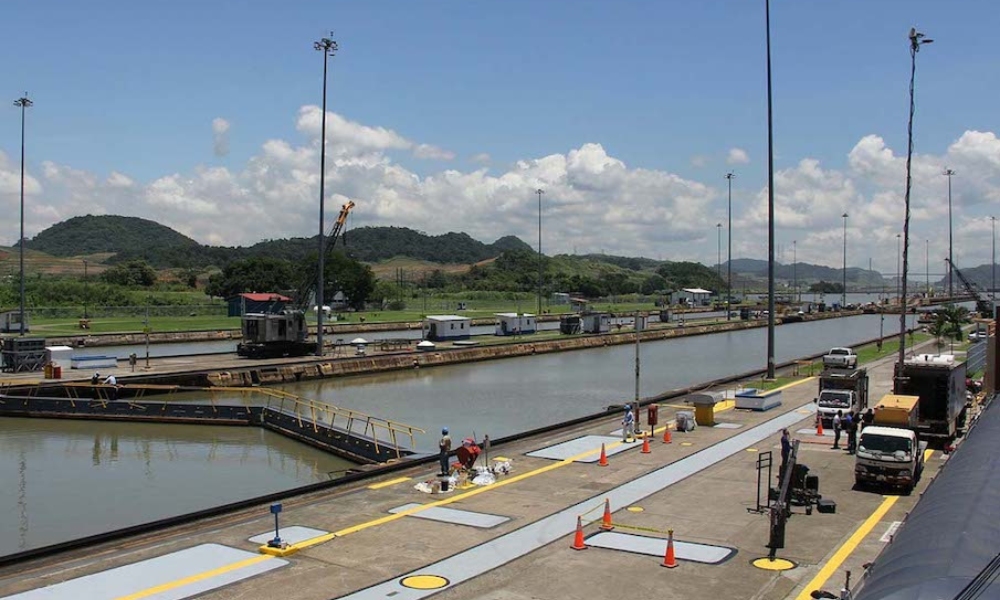
Bunker fuel sales at Panama dropped 1.8% year-on-year in August 2026, according to the latest data from La Autoridad Maritima de Panama, also known as the Panama Maritime Authority (PMA).

Total bunker sales at Panama was 411,383 metric tonnes (mt) in August 2026, compared to sales of 419,056 mt during the similar period in 2025.

In August 2026, the Pacific side of Panama posted bunker sales of 334,990 mt; 185,636 mt of VLSFO, 117,840 mt of RMG 380, 4,214 mt for marine gas oil (MGO), and 27,300 mt of low sulphur marine gas oil (LSMGO) were delivered.

The similar region saw total marine sales of 351,419 mt a year before in August; with VLSFO sales at 227,644 mt, RMG 380 sales at 84,932 mt, MGO sales at 356 mt, and 38,487 mt of LSMGO being sold.

Panama’s Atlantic side, meanwhile, recorded total bunker fuel sales of 76,393 during August 2026; the figure comprised 61,272 mt of VLSFO, 3,521 mt of RMG 380, 3,097 mt of MGO, and 8,503 mt of LSMGO.

It saw total sales of 67,637 mt in August a year before; with VLSFO sales of 53,514 mt, RMG 380 sales of 3,305 mt, 3,168 mt of MGO, and LSMGO sales of 7,650 mt.


Photo credit: jhernandezb05 from Pixabay
Published: 17 September, 2026

Continue Reading

Trending