Connect with us

Bunker Fuel

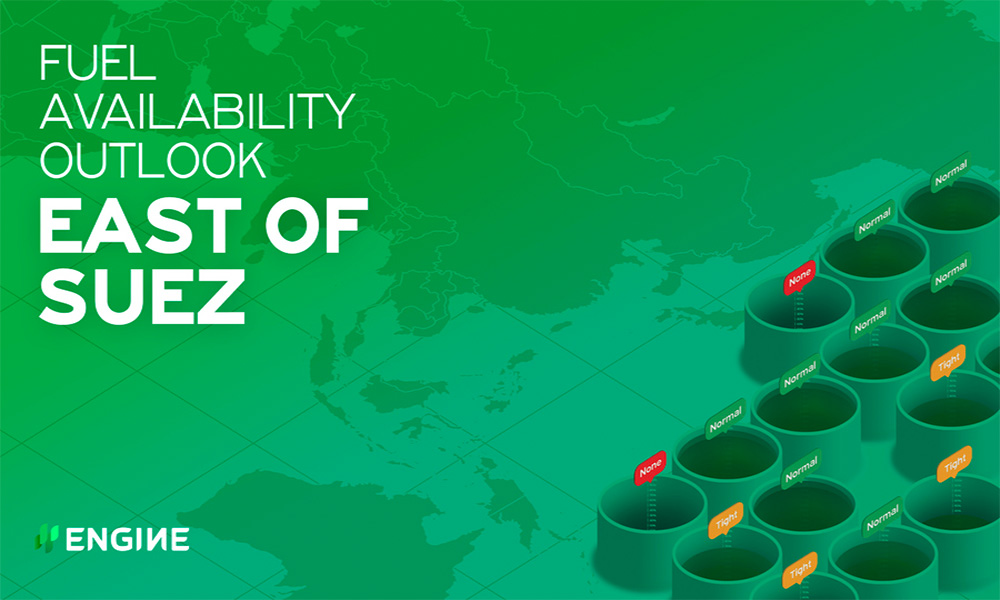
ENGINE: East of Suez Bunker Fuel Availability Outlook (16 Jan 2024)

VLSFO availability remains tight in Singapore; VLSFO and LSMGO tight in several Chinese ports; LSMGO availability good in Omani ports.

Admin

Published

on

RESIZED ENGINE East of Suez

The following article regarding regional bunker fuel availability outlook for the East of Suez region has been provided by online marine fuels procurement platform ENGINE for publication on Singapore bunkering publication Manifold Times:

  • VLSFO availability remains tight in Singapore
  • VLSFO and LSMGO tight in several Chinese ports
  • LSMGO availability good in Omani ports

Singapore

Prompt VLSFO availability remains tight in Singapore amid strong demand for the grade. At least eight suppliers are grappling with tight delivery schedules, which has added to the supply pressure. Lead times for VLSFO have increased from 9-13 days last week, to 8-17 days now. In contrast, HSFO maintains lead times of 7-10 days, while LSMGO requires a shorter 3-8 days lead time.

Singapore sold about 51.27 million mt of conventional bunker fuels in 2023 – the highest yearly volumes since 2013, according to preliminary figures from the Maritime and Port Authority of Singapore. This increase is attributed to the increase in number of vessels arriving for bunkers in 2023.

Total bio-bunker sales touched 524,000 mt in 2023, an increase from 140,000 mt in 2022.

Looking at the fuel stock situation in Singapore, residual fuel oil stocks have averaged 10% higher this month compared to December, according to Enterprise Singapore’s data. In contrast, middle distillate stocks have seen a 13% decrease so far in January.

China and East Asia

In Zhoushan, VLSFO availability remains tight due to a lack of product supply available with suppliers and delays in the arrival of resupply cargoes. This has stretched lead times to seven days for the grade.

The other two grades – LSMGO and HSFO – remain more readily available with shorter lead times of 3-5 days.

In Dalian, VLSFO and LSMGO supply has tightened, and all three bunker grades are under pressure in nearby Tianjin, with deliveries subject to inquiry. Qingdao is experiencing tight prompt availability of VLSFO and LSMGO, while HSFO supply is subject to firm inquiry.

The southern Chinese ports of Shanghai and Xiamen are facing tight availability for VLSFO and LSMGO, while HSFO availability is constrained in Shanghai. Guangzhou is grappling with a tight supply for both VLSFO and LSMGO, and in Fuzhou, both grades are subject to inquiry. Meanwhile, bunker supply is relatively better in Yangpu.

Hong Kong is also facing a shortage of stocks amid high demand, pushing lead times to almost two weeks now. Bad weather conditions are forecast on Wednesday and may disrupt bunker operations in the port.

In South Korean ports, VLSFO and LSMGO supply has been tight, despite slower demand this week. Recommended lead times vary widely between 4-9 days for both grades in South Korean ports.

High winds and waves are expected to impact bunkering in the South Korean ports of Ulsan, Onsan, Busan, Daesan, Taean, and Yeosu between 18-21 January, potentially affecting bunker deliveries.

In Japan, sluggish bunker demand due to cold weather conditions is observed, with varying lead times across ports. Lead times of 7-8 days are recommended in Tokyo and Chiba, 7-8 days in Osaka and Kobe, and longer 10-11 days in Oita. The harsh winter has led Japanese refineries to redirect their supply towards heating demand, resulting in reduced availability for bunkers.

All grades remain in tight availability in Nagoya, Yokkaichi and Mizushima.

Adverse weather conditions are forecast in Subic Bay (Philippines) between 16-17 January and intermittently in Ho Chi Minh and Hai Phong (Vietnam) between 17-21 January, posing potential challenges for bunker deliveries.

South Asia

Kandla, situated on India’s northwest coast, has good availability of VLSFO and LSMGO, with prompt supply available. However, several other Indian ports, including Mumbai, Cochin and Chennai, are grappling with supply challenges for both grades.

Suppliers in Visakhapatnam, Paradip and Haldia have nearly depleted their VLSFO and LSMGO stocks, a source says.

Middle East

Persistent attacks on commercial ships in the Red Sea have prompted several shipping companies to reroute vessels via the southern tip of Africa rather than the shorter Suez Canal route. Despite concerns in the Red Sea, Fujairah continues to witness an uptick in demand.

This has kept prompt availability tight for all grades in Fujairah. Most suppliers are recommending lead times of 7-10 days.

A similar scenario is observed in the UAE port of Khor Fakkan, where lead times of 7-10 days are recommended for all fuel grades. On the other hand, LSMGO remains readily available for prompt supply in nearby Omani ports, including Sohar, Salalah, Duqm, and Muscat.

By Tuhin Roy


Photo credit and source: ENGINE
Published: 17 January 2024

Continue Reading

Methanol

World Fuel and partners complete first green methanol bunkering of car carrier in Shanghai

Operation involved the delivery of approximately 2,800 MT of green methanol to “Arctic Tern” via a ship-to-ship transfer using SIPG Energy’s dedicated methanol bunkering vessel “M/V Hai Gang Zhi Yuan”.

Admin

Published

on

By

World Fuel and partners complete first green methanol bunkering of car carrier in Shanghai

Marine fuel provider World Fuel on Tuesday (21 July) said it successfully completed the first green methanol bunkering of M/V Arctic Tern, with EUKOR Car Carriers and SIPG Energy at the Port of Shanghai. 

Arctic Tern is the first vessel in the new Shaper Class series of car carriers. 

The operation involved the delivery of approximately 2,800 MT of green methanol to Arctic Tern via a ship-to-ship transfer using SIPG Energy’s dedicated methanol bunkering vessel M/V Hai Gang Zhi Yuan, the largest vessel of its kind in operation. 

The bunkering operation was carried out at Haitong Terminal, Waigaoqiao Port Area, Shanghai Port, with cargo handling operations conducted simultaneously during bunkering.

This marks EUKOR Car Carriers’ first green methanol operation and the first time Arctic Tern has bunkered methanol since its delivery on 9 July. The operation marked the first bunkering at Shanghai Port of green methanol produced locally in Shanghai for an international PCTC operator. 

It also demonstrated the city’s integrated green methanol value chain, spanning local production, storage and bunkering, and established a replicable “Shanghai Model” for green methanol supply.

World Fuel arranged the supply and delivery of the fuel on behalf of EUKOR Car Carriers, working with SIPG Energy as the physical supplier at the Port of Shanghai.

The green methanol supplied was produced from municipal solid waste, ISCC-EU certified, and had a carbon intensity value below 25 gCO₂e/MJ.

Arctic Tern is the first of fourteen Shaper Class vessels ordered by Wallenius Wilhelmsen. With a capacity of 9,300 car equivalent units and methanol dual-fuel capability, the vessel will be operated by EUKOR Car Carriers, jointly owned by Wallenius Wilhelmsen and Hyundai Motor Group. Following her first green methanol bunkering, Arctic Tern will continue her maiden voyage from Asia to Europe.

Xavier Leroi, COO Shipping Services at Wallenius Wilhelmsen and CEO of EUKOR Car Carriers, said: “Completing Arctic Tern’s first green methanol bunkering shortly after delivery is a significant milestone towards our decarbonisation ambition for both EUKOR Car Carriers and Wallenius Wilhelmsen. It demonstrates how investments in next-generation vessel technology and fuel flexibility are being translated into real-world operations. 

“This achievement reflects the strong collaboration between all parties involved. Together, we have shown how partnerships across the maritime value chain can help make lower-emission fuels available and operationally viable at scale.”

Mark Tamsitt, SVP Global Marine Sales at World Fuel, said, “The first bunkering event with a new fuel is a significant moment for any shipowner, and our role is to make it as seamless as possible. By connecting EUKOR Car Carriers with SIPG Energy’s proven green methanol capability at the Port of Shanghai, we were able to deliver on reliable supply, fuel quality, and safe processes. As more of our customers bring methanol dual-fuel tonnage into service, we are committed to being the partner that makes these kinds of operations routine.”

Mr. Zhang Da, General Manager of SIPG Energy, said, “Welcoming Arctic Tern to the Port of Shanghai for her first green methanol bunkering demonstrates the strength and maturity of our supply capability. Building on our well-established methanol ship-to-ship bunkering services for container vessels, we have already extended such services to pure car and truck carriers (PCTCs). This bunkering sets a new record for the largest single SIMOPs green methanol bunkering for PCTCs in China, marking another step in building Shanghai’s position as a global green energy hub for international shipping.”

This operation follows Wallenius Wilhelmsen’s announcement on 9 July that Arctic Tern would complete her first methanol bunkering shortly after delivery. The vessel entered service on routes between Asia and Europe immediately following handover from China Merchants Jinling Shipyard in Nanjing.


Photo credit: World Fuel
Published: 22 July, 2026

Continue Reading

Ammonia

HPA and MB Energy develop safety concept for STS ammonia bunkering

HPA says the Port of Hamburg will become “bunker ready” for ammonia, laying the groundwork for safe and reliable ammonia bunkering in the future.

Admin

Published

on

By

HPA and MB Energy develop safety concept for STS ammonia bunkering

The Hamburg Port Authority (HPA) and integrated energy company MB Energy on Tuesday (21 July) said they have completed a comprehensive risk analysis and developed a dedicated safety concept for ship-to-ship ammonia bunkering.

MB Energy said the analysis lays the groundwork for the safe introduction of ammonia as a future marine fuel.

“With our planned ammonia import terminal in Hamburg-Blumensand, MB Energy intends to provide the reliable land side supply infrastructure needed to support this transition across northern German ports,” it said in a social media post. 

Mabanaft Group was renamed to MB Energy last year and merged over 50 existing brands under one identity. 

Separately, HPA said the Port of Hamburg will become “bunker ready” for ammonia, laying the groundwork for safe and reliable ammonia bunkering in the future.

“The focus is in particular on container ships, cruise ships as well as RoRo and ConRo (Container/RoRo) ships,” it said. 

“We expect ammonia to establish itself as an alternative marine marine fuel in the coming years. With our preparatory work, we are already creating the conditions to welcome the first ammonia-powered ships in Hamburg and to bunker them safely.:

HPA added that the import terminal for ammonia planned by MB Energy from 2029 will make a decisive contribution to ensuring the reliable availability of ammonia as a bunker fuel in northern German ports in the long term. 

“The use of an ammonia bunker barge is considered a possible addition to the landside infrastructure to enable ship bunkering in the port and beyond in the future,” it said.

Related: Mabanaft Group renames as MB Energy, merging over 50 brands under one identity


Photo credit: Hamburg Port Authority
Published: 22 July, 2026

Continue Reading

Bunker Fuel

Alkagesta highlights key insights of Malta bunkering market in 2026

Darren Lee Axisa discusses the key trends influencing Malta’s bunkering market and the factors that will determine Malta’s long-term competitiveness as a regional bunkering hub.

Admin

Published

on

By

Alkagesta highlights key insights of Malta bunkering market in 2026

In an article published on Alkagesta Market Insights, Darren Lee Axisa, Malta Country Manager of Alkagesta, on Monday (20 July) discussed the key trends influencing Malta’s bunkering market and the factors that will determine Malta’s long-term competitiveness as a regional bunkering hub: 

Malta’s bunkering and energy market is moving through a period of structural adjustment. The disruptions that defined the first half of 2026 have accelerated shifts in product demand, terminal strategy, and the competitive dynamics of one of the Mediterranean’s most strategically positioned bunkering hubs. For Alkagesta, whose storage footprint on the island approaches 300,000 cubic metres, the period has tested operational flexibility while reinforcing the value of diversified infrastructure access.

A Market Shifting in Two Directions

Malta’s broader economy has remained resilient — GDP growth reached 3.9% in Q1 2026 — but the bunkering market has undergone a significant product mix shift, the roots of which predate the current geopolitical disruption.

The Mediterranean Emission Control Area, which came into force on 1 May 2025, triggered an immediate and measurable realignment in fuel demand across the region. VPS data covering the first six months post-ECA implementation shows that across the top ten Mediterranean bunkering ports, VLSFO volumes fell 23%, MGO more than doubled, ULSFO quadrupled, and biofuels increased fivefold. In Valletta specifically, the shift was even more pronounced: VLSFO dropped 57% from 111,641 mt to 47,732 mt, while MGO volumes more than tripled from 33,299 mt to 103,445 mt, and ULSFO rose from 2,821 mt to 34,535 mt over the same period.

This structural rotation has been further accelerated by the broader regulatory environment. FuelEU Maritime and EU ETS requirements are pushing shipowners toward cleaner, verifiable fuel options at every port call — a direction Alkagesta had already positioned itself ahead of, having been among the first movers in the Mediterranean to support the transition to 0.1% sulphur fuel oil following the ECA’s introduction.

Layered on top of this regulatory shift has been a period of reduced terminal capacity affecting bunkering market availability across the island. Fuel oil volumes dropped roughly 35% year-on-year between January and May 2026, falling from approximately 382,000 mt in 2025 to 247,000 mt. DMA demand moved sharply in the opposite direction, rising from around 150,000 mt in January to April 2025 to 247,000 mt over the same period in 2026 — a trend consistent with both the ECA-driven product mix shift and the disruption to heavier fuel availability during the constrained period.

Note: The full article can be read here


Photo credit: Alkagesta
Published: 22 July, 2026

Continue Reading

Trending