Connect with us

Bunker Fuel

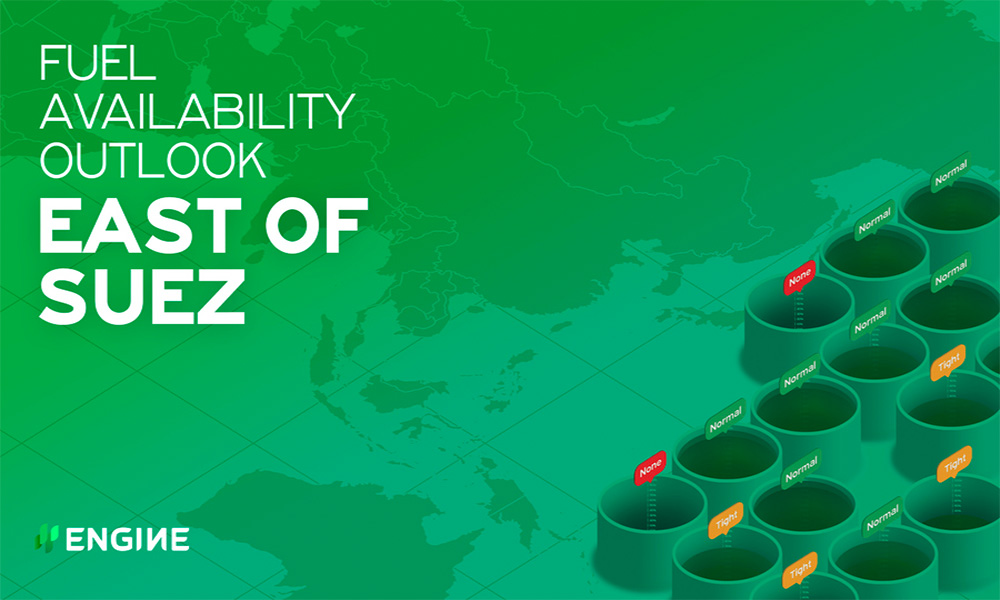
ENGINE: East of Suez Bunker Fuel Availability Outlook (13 May 2026)

Bunker supply tight in Singapore; bunker availability improves in Zhoushan; fuel availability tight across all grades in Fujairah.

Admin

Published

on

RESIZED ENGINE East of Suez

The following article regarding regional bunker fuel availability outlook for the East of Suez region has been provided by online marine fuels procurement platform ENGINE for publication on Singapore bunkering publication Manifold Times:

  • Bunker supply tight in Singapore
  • Bunker availability improves in Zhoushan
  • Fuel availability tight across all grades in Fujairah

Singapore and Malaysia

VLSFO and HSFO availability in Singapore is very tight right now. VLSFO delivery schedules in the port have stretched further, now ranging between 12-14 days, compared to 9-18 days previously. HSFO lead times stand at 9-14 days, from last week’s 4-10-day window. LSMGO availability has tightened as well, with lead times extending to 8-9 days, from last week’s 5-9 days.

There are very limited suppliers offering small HSFO parcels in Singapore, and a premium is expected for quantities of 500 mt and below, a trader said.

At Malaysia’s Port Klang, VLSFO supply remains relatively stable, especially for smaller prompt volumes. Tighter conditions persist for LSMGO, while HSFO availability continues to face constraints, making both grades increasingly difficult to secure.

East Asia

Availability in Zhoushan has slightly improved this week, with lead times for all grades shortening to around 4-7 days, down from last week’s 5-7 days.

Bunker availability across northern China remains mixed, with lead times ranging between 4-7 days for all grades. Dalian and Qingdao are well supplied with VLSFO and LSMGO, although HSFO is tight in Qingdao. In Shanghai, VLSFO and HSFO availability is limited, while LSMGO supply remains relatively stable.

Prompt bunker fuel availability has improved in southern Chinese ports. Lead times here range between 3-6 days, another trader said. Notably, Fuzhou is tight on both VLSFO and LSMGO, while Xiamen has adequate VLSFO but limited LSMGO.

HSFO availability in Hong Kong is exceptionally this week. Expected lead times for all grades are around seven days at least.

Taiwan’s bunker market remains steady, according to another trader. Lead times are approximately four days for both VLSFO and LSMGO at Keelung. In Hualien, Taichung and Kaohsiung, lead times for VLSFO and LSMGO range between 2-3 days. There are no barges available at Suao and Hualien, the trader said.

In South Korea’s southern ports – Busan, Ulsan, Masan, Onsan, Yeosu and Kwangyang – availability of all three conventional bunker grades is tight. Recommended lead times for VLSFO and LSMGO are at around 7-10 days, up from last week’s 3-5 days.

Across western ports, including Incheon, Daesan, Dangjin, Pyeongtaek and Taean, lead times remain around eight days for all grades, higher than the previous week’s estimates of five days.

In Japan, supply conditions remain largely tight across key hubs such as Tokyo Bay, Nagoya and Osaka. “Major Japanese refiners have significantly curtailed spot supply for ocean-going vessels to prioritize domestic demand,” a trader said.

Overall, LSMGO availability in Japanese ports is extremely scarce, the trader said. “A domestic shortage of gasoil has led to a near-total absence of offers for the bunker market,” he added.

Recommended lead times stand at approximately 10-11 days for HSFO and VLSFO across major ports including Tokyo, Nagoya, Osaka.

Oceania

Bunker supply conditions vary across Australia’s east coast. In New South Wales, VLSFO can be delivered in Port Kembla by truck or pipeline. Suppliers in Sydney have ample VLSFO and LSMGO stocks, though HSFO availability remains constrained, with lead times of about seven days.

In Western Australia, VLSFO supply in Kwinana and Fremantle is available through a single barge operator, with lead times generally standing at about seven days.

In Queensland, suppliers in Brisbane and Gladstone are indicating lead times of around seven days for VLSFO and LSMGO. Deliveries of VLSFO and LSMGO are carried out by two separate barges operated by different suppliers, while HSFO supply depends on request.

Supply conditions in Victoria are comparatively steady, with Melbourne and Geelong holding sufficient VLSFO inventories, although prompt HSFO supply remains tight. Bunker operations at both ports rely on a single barge, with recommended lead times of roughly seven days.

In New Zealand, bunker availability continues to be steady. VLSFO is easily accessible in Tauranga and Auckland, with certain Tauranga berths linked to pipeline infrastructure. At Marsden Point, vessels can receive both VLSFO and LSMGO directly through pipeline deliveries.

South Asia

In India, VLSFO availability continues to be constrained at Kandla, Sikka, Hazira and New Mangalore.

Prompt bunker supply remains strong in Sri Lanka, with Colombo and Hambantota carrying sufficient stocks across all fuel grades and at least one supplier capable of offering immediate deliveries.

Middle East

Prompt bunker availability in Fujairah across all grades is very tight currently, with supply across all grades subject to enquiry, another source said.

Bunker demand has substantially dropped in Fujairah as many vessels continue to wait until transit through the Strait of Hormuz – currently under a US blockade – clears. Only a handful of suppliers can provide fuel grades in the port, “as no imports coming in at the moment,” the source said.

Bunker demand in Saudi Arabia’s Jeddah is moderate. There is adequate LSMGO available at the port, while VLSFO remains constrained.

Operations at Kuwait’s Shuaiba and Shuwaikh continue without disruption. Meanwhile, LSMGO availability is tight at Djibouti.

In Qatar, bunkering is proceeding without issues at Hamad, Doha and Al Ruwais, with operations also ongoing at Mesaieed and Ras Laffan. However, VLSFO and LSMGO supply remains constrained in Ras Laffan.

By Aparupa Mazumder


Photo credit and source: ENGINE
Published: 13 May, 2026

Continue Reading

Legal

Singapore: Bunker Partner succeeds in High Court bid to wind up Victory Shipping

Estonia-based marine fuels and commodities trading company Bunker Partner filed a winding up application against Victory Shipping on 13 April.

Admin

Published

on

By

Singapore: Estonian firm Bunker Partner files bid to wind up of Victory Shipping

The High Court of Singapore granted a winding up order against Victory Shipping Pte Ltd on 12 June, according to a Thursday (25 June) notice on the Government Gazette. 

The winding up application was filed by Estonia-based marine fuels and commodities trading company Bunker Partner on 13 April.

Victory Shipping, with representations in Malaysia, India and the U.A.E., operates dry bulk shipping contracts around the globe with voyages performed mainly in the Middle East and Southeast Asia.

The winding up order also included the following name and address of a liquidator:

Mr Farooq Ahmad Mann
C/o M/s Mann & Associates PAC
3 Shenton Way #03-06C
Shenton House
Singapore 068805

The notice noted that all creditors of the Victory Shipping should file their proof of debt with the liquidator who will be administering all the affairs of the company. 

Manifold Times previously reported a virtual hearing between Victory Shipping and Integr8 Fuels Pte Ltd, organised by the High Court of the Republic of Singapore.

The event was to set aside a statutory demand served on 3 October 2025 by Integr8 Fuels lawyers under Section 125(2)(c) and Section 10 of the Insolvency, Restructuring and Dissolution Act 2018 (IRDA) against Victory Shipping, according to court documents obtained by the bunkering publication.

Integr8 Fuels provides bunker trading and brokerage services to shipowners and operators that enables them to optimise fuel procurement.

Related: Singapore: Court to hear Bunker Partner’s winding-up bid against Victory Shipping on 12 June
Related: Singapore: Estonian firm Bunker Partner files bid to wind up Victory Shipping
Related: Singapore: Victory Shipping aiming to set aside bankruptcy court process from Integr8 Fuels


Photo credit: Manifold Times
Published: 26 June, 2026

Continue Reading

Digital platform

VPS debuts VeriSphere Webshop, enhancing digital access to marine fuel solutions

Key addition is the MySurveys application, designed to support bunker quantity survey processes by providing detailed insights into quantity losses, density variations, and bunkering performance.

Admin

Published

on

By

VPS debuts VeriSphere Webshop, enhancing digital access to marine fuel solutions

Marine fuels testing company VPS on Thursday (25 June) announced the launch of its VeriSphere Webshop, a major step forward in the evolution of its digital platform and customer experience.

The new webshop provides customers with direct, self-service access to a growing portfolio of VPS products and services, including digital applications, Application Programming Interfaces (APIs) and sampling equipment; enabling faster, more flexible engagement with VPS’s global offerings.

The VeriSphere Webshop has been designed to simplify how shipowners, operators, and stakeholders across the marine fuel value chain, access critical tools and data. Through a streamlined interface, users can:

  • Browse and subscribe to VPS digital applications
  • Purchase services and products directly online
  • Discover complementary solutions tailored to their operational needs from VPS as well as its ecosystem partners

Alongside the launch of the webshop module, VPS continues to expand the capabilities of its VeriSphere platform, introducing new applications and enhancing existing solutions to deliver deeper operational insights.

A key addition is the MySurveys application, designed to support bunker quantity survey processes by providing detailed insights into quantity losses, density variations, and bunkering performance. This capability represents an important step in the digitalisation of traditionally manual survey processes, enabling greater transparency and benchmarking across operations.

Further enhancements across the platform reinforce VPS’s commitment to delivering actionable, data-driven insights across fuel quality, equipment performance, and operational risk management.

With continuous improvements to applications such as PortStats and the broader VeriSphere suite, VPS is enabling customers to move beyond static reporting toward pro-active operational intelligence.

By combining its extensive global fuel quality database with advanced analytics and digital delivery, VPS aims to empowere its customers to identify risks early, optimise fuel performance, simplify compliance and improve operational efficiency.

Dr. Malcolm Cooper, CEO at VPS, said: “The launch of the VeriSphere Webshop marks an important milestone in our digital journey.

“We are making it easier than ever for our customers to access the data, insights, and tools they need, when they need them. As the maritime industry continues to evolve, our focus is on delivering scalable, digital solutions that drive better decision-making, improve operational performance of vessels, prevent downtime and support the transition towards more sustainable maritime operations.”

VPS added that the VeriSphere Platform will continue to evolve with an expanding portfolio of products, services, and ecosystem partnerships.

Related: VPS unveils digital bunker fuel and emissions platform Verisphere


Photo credit: VPS
Published: 26 June, 2026

Continue Reading

Alternative Fuels

ICS report: LNG and biofuels seen as most viable marine fuels over next decade

This was followed closely by HFO combined with abatement technologies while methanol ranked in fourth place, according to ICS’s new Maritime Barometer Report.

Admin

Published

on

By

RESIZED william william on Unsplash

A new report by the International Chamber of Shipping (ICS), published on Tuesday (23 June) found that  LNG and biofuels are seen as the most viable marine fuels over the next decade.

This was followed closely by HFO (Heavy Fuel Oil) combined with abatement technologies while methanol ranked in fourth place. 

The report found that in 2025 to 2026, maritime leaders are displaying a preference for traditional fuels that have established supply mechanisms. 

The ICS Maritime Barometer Report 2025–2026 surveyed C-suite level leaders, shipowners, and operators worldwide to identify the key risk areas shaping shipping. 

Despite slight decline, LNG shared top spot with biofuels as one of three most viable future fuels over the next decade. 

LNG maintained its position as a joint leading fuel in the Barometer, with roughly 51.35% of leaders naming it as one of the most viable fuels over the next decade. 

“This is despite a marginal softening in sentiment amongst maritime leaders compared to last year’s survey, reflecting its continued role as the most immediately scalable alternative within the current fuel mix,” the report said. 

However, the report noted that this positioning is increasingly shaped not just by infrastructure maturity, but by how geopolitical instability translates into fuel-specific perceptions of security, routing exposure, and price volatility across global trade flows.

This is particularly evident in Asia-Pacific and the Middle East, where LNG’s role is reinforced through continued investment in import and bunkering infrastructure.

Singapore remains the world’s leading LNG bunkering hub, supported by expanding small-scale supply chains and vessel availability, while South Korea and China are rapidly scaling receiving and bunkering capacity to support both shipping and power demand growth.

Biofuels record one of the sharpest increases in sentiment across the future fuels landscape to match LNG at 51.35% in this year’s report.

“This could reflect a shift driven less by structural conviction and more by operational response to heightened uncertainty in global energy and trade systems,” it said. 

Their growing prominence could be closely linked to the increasing attractiveness of low-friction compliance options in a context where alternative fuels remain constrained by uneven infrastructure development, fragmented regulatory alignment, and delayed capital deployment across key regions.

Compared with LNG, which is shaped by infrastructure lock-in and geopolitical price exposure, biofuels offer immediate operational flexibility.

Japan has emerged as a key driver of marine biofuel adoption, with government-backed trials involving major shipping lines such as NYK testing biofuel blends on international routes. China has also expanded pilot programmes using biodiesel and waste-derived fuels in coastal shipping, reflecting a pragmatic approach to emissions reduction in regional trade flows.

Note: The ‘ICS Maritime Barometer Report 2025–2026’ can be viewed here


Photo credit: william william on Unsplash
Published: 26 June, 2026

Continue Reading

Trending