Connect with us

Business

ENGINE: Americas Bunker Fuel Availability Outlook

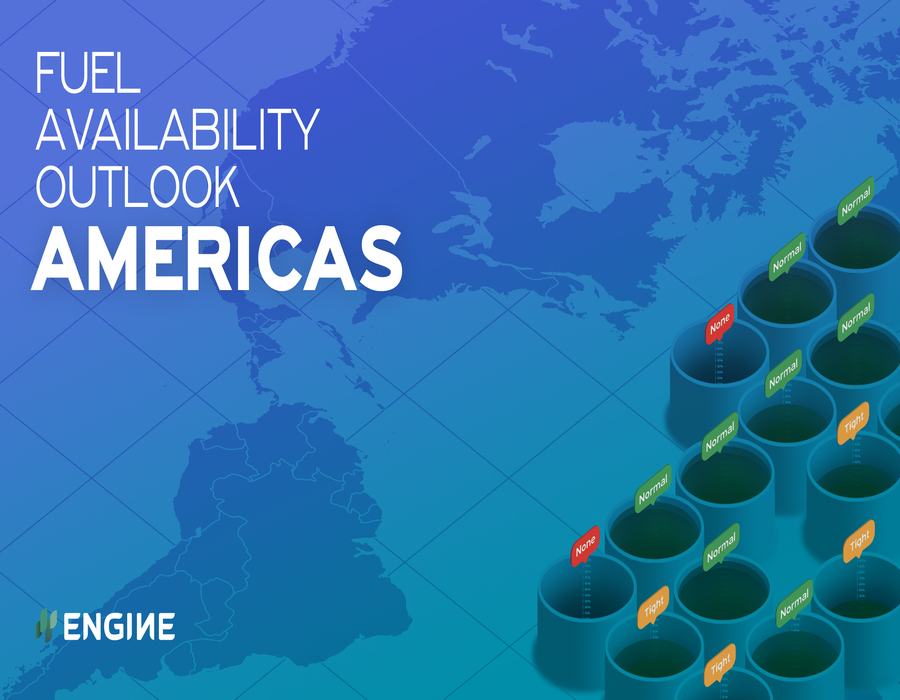
Several suppliers offer prompt products in Houston; HSFO remains limited in Los Angeles; VLSFO availability is tight in Colombian ports.

Admin

Published

on

Resized Americas Bunker Fuel Availability Outlook image for Manifold Times

The following article regarding bunker fuel availability in the Americas region has been provided by online marine fuel procurement platform ENGINE for post on Singapore bunkering publication Manifold Times:

30 June 2022

  • Several suppliers offer prompt products in Houston
  • HSFO remains limited in Los Angeles
  • VLSFO availability is tight in Colombian ports


North America

Prompt VLSFO and LSMGO are available with several suppliers in the Houston area. A supplier that typically has tighter availability has resumed offers for prompt deliveries, sources say.

Securing VLSFO for prompt dates in New York is mostly tight. Only few suppliers can offer the grade for prompt deliveries. A supplier is avoiding offers for smaller stem sizes, sources say.

A supplier is running low on LSMGO stock in New York adding pressure on others’ supply, while has better stocks of VLSFO and HSFO.

VLSFO and LSMGO availability are tight for prompt dates in San Francisco. A supplier requires 6-7 days of lead time to supply vessel at anchorage.  

HSFO supply continues to be limited in Los Angeles and other West Coast ports. VLSFO and LSMGO availability are tight for prompt dates in Los Angeles. A supplier is not accepting standalone LSMGO orders, but rather in combinations with other grades, sources say.

VLSFO availability is tight in Philadelphia for prompt dates. A supplier is running low on stock adding pressure on others’ supply.

Bunker suppliers in Canada will observe a public holiday on 1 July. The earliest bunker delivery dates with a supplier in Montreal is seven days out.

VLSFO availability is tight in Mexico’s Veracruz. A supplier has paused offers for the grade.


Latin America

Prompt availability remains tight for all grades in Panama. A supplier can offer VLSFO and LSMGO in Balboa with lead times of 5-6 days. Another supplier’s earliest estimated delivery date is five days out for VLSFO, while has no LSMGO stock.  

One supplier has tight barge availability in Balboa and can supply the grade via pipeline at Rodman port.

Prompt availability is tight in Zona Comun, several suppliers have limited delivery slots for early July dates, but a supplier can offer VLSFO and LSMGO from 5 July onwards.

Bunker fuel availability is normal in Bahia Blanca. Recommended lead times for VLSFO and LSMGO are around five days. A supplier can offer limited quantities for prompt dates, sources say.

VLSFO and LSMGO availability are tight in Colombia’s Santa Marta and Cartagena. VLSFO in particular is tighter as several suppliers are almost out of stock, sources say. One supplier can offer limited LSMGO quantities for prompt dates.

VLSFO is typically sourced from local refinery in Colombia and the refiner is unable to match production with demand, a trader says.


Photo credit and source: ENGINE
Published: 1 July, 2022

Continue Reading

Bunker Fuel

Singapore: Bunker fuel sales drops by 6.8% on year in May 2026

4.55 million mt of various marine fuel grades were delivered at the world’s largest bunkering port in May, down from 4.88 million mt recorded during the similar month in 2025, according to MPA data.

Admin

Published

on

By

Singapore: Bunker fuel sales drops by 6.8% on year in May 2026

Sales of marine fuel at Singapore port dropped by 6.8% on year in May 2026, according to data from the Maritime and Port Authority of Singapore (MPA).

In total, 4.55 million metric tonnes (mt) (exact 4,548,000 mt) of various marine fuel grades were delivered at the world’s largest bunkering port in May, down from 4.88 million mt (4,878,100 mt) recorded during the similar month in 2025.

Deliveries of marine fuel oil, low sulphur fuel oil, ultra low sulphur fuel oil, marine gas oil and marine diesel oil in May (against on year) recorded respectively 1.79 million mt (-5.3% from 1.89 million mt), 2.29 million mt (-6.5% from 2.45 million mt), zero (-100% from 1,200 mt), 600 (35.2% from 1,700 mt) and zero (from zero).

Singapore: Bunker fuel sales drops by 6.8% on year in May 2026

Bio-blended variants of marine fuel oil, low sulphur fuel oil, ultra low sulphur fuel oil, marine gas oil and marine diesel oil in May, (against on year) recorded respectively 11,600 mt (-71.6% from 40,900 mt), 36,400 mt (-62.1% from 96,100 mt), zero (from zero), zero (from zero) and zero (from zero). B100 biofuel bunkers, introduced in February last year, recorded 12,800 mt (+573.7% from 1,900 mt). 

LNG and methanol sales were 70,300 mt (+56.2% from 45,000 mt) and zero (from zero) respectively. There were no recorded sales of ammonia for the month and so far since 2025.


Photo credit: Maritime and Port Authority of Singapore
Published: 15 June, 2026

Continue Reading

Bunker Fuel Quality

Bunker flash: High concentrations of catalytic fines, elevated acid numbers found in Singapore

Maritec-Naias issued an alert regarding high levels of catalytic fines and elevated acid numbers present in multiple VLSFO bunker samples from deliveries in the Singapore port.

Admin

Published

on

By

RESIZED Hans Reniers on Unsplash

Bunker fuel testing and marine surveying business Maritec-Naias on Friday (12 June) issued an alert regarding high levels of catalytic fines and elevated acid numbers present in multiple VLSFO bunker samples from deliveries in the Singapore port: 

During the period of 20 May 2026 and 02 June 2026, Maritec Pte. Ltd. (hereafter referred to as Maritec-Naias) conducted testing on five samples representing Very Low Sulphur Fuel Oil (VLSFO) deliveries from two suppliers in the Singapore port. The analyses revealed Aluminium and Silicon (Al+Si) concentrations ranging from 61 mg/kg to 68 mg/kg.

It is important to note; these values exceed the ISO 8217:2010/2017 specification limit of 60 ppm but remain within the permissible tolerance limit of 72 ppm under ISO 4259 for a single test result. In this regard, Catalytic Fines content, (Aluminium+Silicon), above 60 ppm is regarded as high. Of the five samples, three originated from one supplier, while the remaining two were from another.

Aluminium and Silicon constitute the principal classes of abrasive solids in fuels. Elevated concentrations of such particles at the engine inlet can precipitate abnormal wear and tear of fuel system components, piston rings, and cylinder liners. To safeguard against this, many engine manufacturers stipulate a maximum threshold of 15 mg/kg Al+Si at the engine inlet.

The primary method of mitigating Catfines is through an efficiently operating fuel purification system. Monitoring Aluminium and Silicon levels both before and after centrifugation provides a reliable measure of the system’s effectiveness in removing these contaminants.

During a similar period, Maritec-Naias also tested fifteen bunker fuel samples representing VLSFO that exhibited elevated Acid Numbers, ranging from 2.0 mg KOH/g to 2.5 mg KOH/g. While these values remain within specification limits, they are nonetheless considered at higher side. Elevated Acid Numbers may stem from contamination with acidic compounds such as Phenolic compounds and Alkyl Resorcinols, often associated with Estonian Shale Oil. Such contaminants can lead to operational complications including sludge formation, fuel pump seizures, and compromised injection equipment cleanliness.

Maritec-Naias Recommendations

  • High Catfines monitoring: Maritec-Naias advises collecting samples at critical points within the fuel system — including the fuel oil tank transfer pump, before and after centrifuge, service tank, and after fine-filter — to evaluate the efficiency of fuel cleaning.
  • Elevated Acid Numbers: For fuels with elevated Acid Numbers, Maritec-Naias recommends conducting Gas Chromatography-Mass Spectrometry (GC-MS) using the Solid Phase Extraction (SPE) method to identify the specific acidic compounds present or upgrading your marine fuel testing package to MFTP Plus, which enables pre-emptive monitoring to detect major harmful substances prevalent in the market, such as Cashew Nut Shell Liquid (CNSL), Phenolic compounds and Alkyl Resorcinols that cause damage to equipment.

Maritec-Naias states, while all data and findings presented in this document are true, it does not reflect on the overall quality of fuel being supplied in Singapore region. If you intend to bunker at this region, please request for a Certificate of Quality (CoQ) prior to loading.


Photo credit: Hans Reniers on Unsplash
Published: 15 June, 2026

Continue Reading

Incident

Three dead after supply boat sinks following collision off Pasir Panjang Terminal

PCG recovered three bodies from the waters after a supply boat sank off Pasir Panjang Terminal on 12 June 2026 at about 9.30am following a collision with a landing craft.

Admin

Published

on

By

RESIZED bunker tanker singapore

The Maritime and Port Authority of Singapore (MPA) on Friday (12 June) said a supply boat sank off Pasir Panjang Terminal at about 9.30am after colliding with a landing craft. 

MPA, Police Coast Guard (PCG), and SCDF Marine Division, immediately activated their crafts to the incident site and commenced search and rescue operations.

“The landing craft is stable with no reported injury to crew on board,” MPA said in a statement. 

PCG has recovered three bodies from the waters, believed to be deceased crew members of the sunken supply boat. Search and rescue operations, including diving operations, are ongoing to determine if there are other crew members from the supply boat missing.

“Port operations have not been affected. Navigational broadcasts have been issued advising vessels to keep clear of the incident area,” it added.

“Investigations into the incident are ongoing.” 


Photo credit: Manifold Times
Published: 15 June, 2026

Continue Reading

Trending