Connect with us

Business

€24bn in fossil fuel subsidies ‘a perverse incentive’ for shipping pollution

‘No ethical or environmental grounds for treating the shipping industry more leniently than road transport.’

Admin

Published

on

5d9425bacce4b 1569990074

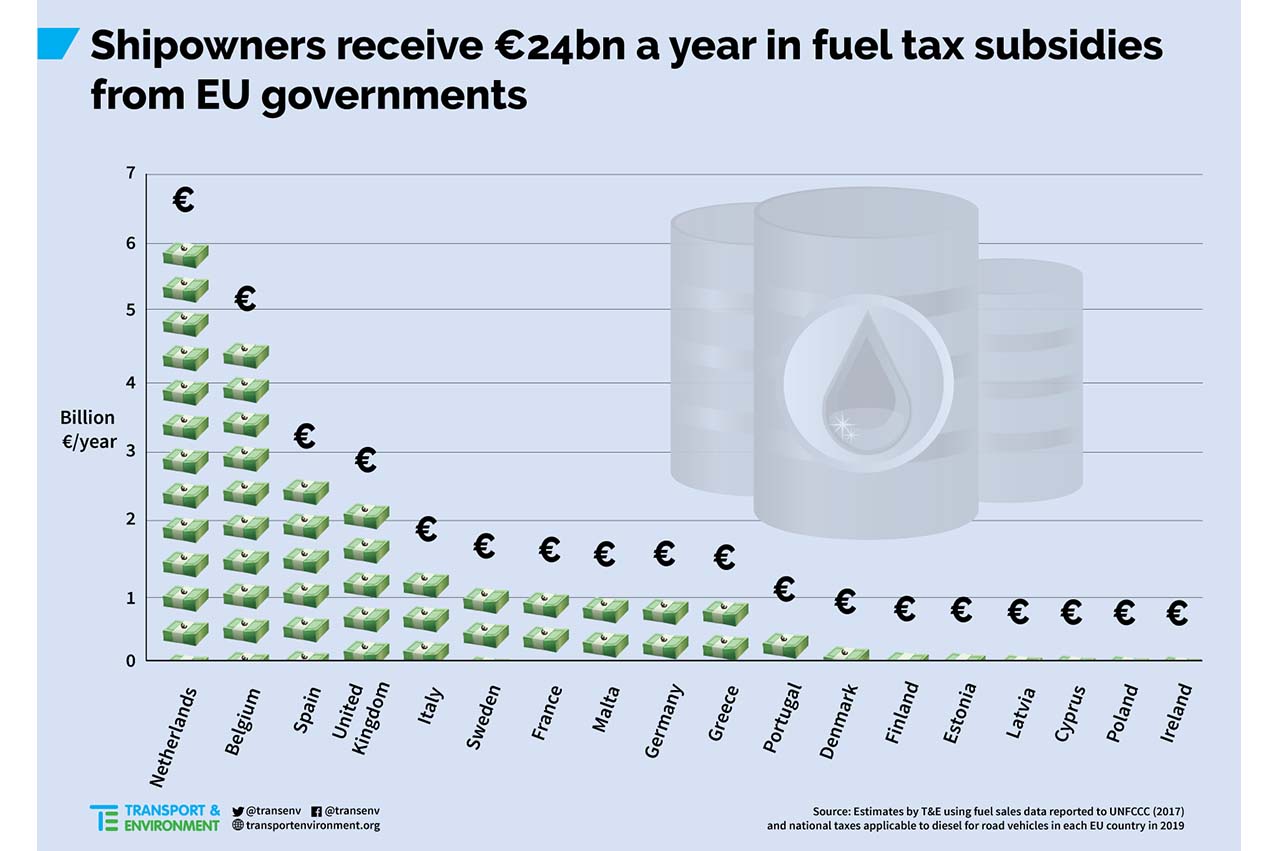
Europe's leading clean transport campaign group Transport & Environment (T&E) on Tuesday (1 October) published a paper which estimates the EU giving more than EURO 24 billion per year in subsidies to maritime sector in the form of fossil fuel tax exemptions under the European Energy Tax Directive (ETD) and national tax legislation.

T&E believes there are no ethical or environmental grounds to treat the maritime industry more leniently in European environmental regulation. In the context of the continent’s climate objectives, this is not only an anachronism but also a perverse incentive for climate pollution.

The organisation’s full statement on the development is as follows:

One of the most polluting forms of transport is benefiting from what is effectively a fossil fuel subsidy of €24 billion a year, according to a new report by T&E. Shipping, which still runs largely on dirty heavy fuel oil, is outright exempt from energy taxes under the EU’s Energy Tax Directive (ETD). T&E described it as ‘a perverse incentive for climate pollution’ and recommended including shipping in the EU emissions trading system (ETS) to end this historical anachronism.

Shipping has not only survived, but also boomed in an era of aviation and high-speed rail largely because of the enormous cost savings it offers companies which transport consumer products and heavy goods. This is largely due to cheap and untaxed maritime fuel and a total lack of climate regulation in the sector. Shipping fuel – heavy fuel oil – is not only the cheapest fuel on the planet, but also the dirtiest one. It emits large quantities of sulphur and other pollutants, as well as greenhouse gases. As a result, shipping is now recognised as one of the dirtiest means of freight transport.

By signing the Paris agreement, the EU committed to ‘economy wide’ decarbonisation efforts; as the only sector that is not yet subject to mandatory CO2 reduction measures in Europe, international shipping stands in the way of the EU fulfilling its Paris commitment. Due to this and the dysfunctionality of the International Maritime Organisation (IMO) in regulating the sector, sea-borne transport is likely to become a big issue for the 2019-2024 term of the European Commission. And with the nominees for the new Commission due to have their hearings over the next couple of weeks, T&E is attempting to force maritime transport’s environmental performance up the EU agenda.

Its study on fossil fuel tax breaks for international shipping in the EU highlights the subsidies ship owners enjoy via tax exemptions. Article 14 of the ETD bans taxation of maritime fuel when sold to ships on EU territory. So, while a tonne of CO2 from a ship makes the same contribution to global warming as a tonne of CO2 from a diesel trucks, the diesel owner pays energy tax while the ship owner avoids it.

Based on marine fuel deliveries and national diesel tax rates in the EU’s 28 member states, T&E has calculated the total unpaid energy tax under the ETD shipping exemption as €24 billion. The biggest beneficiary is the Netherlands with just over €6 billion in lost tax from its approximately 12 million tonnes of maritime fuel sales, followed by Belgium with €4.5 billion Not surprisingly, landlocked countries and those with short coastlines come further down the list.

The obvious way to combat these invisible subsidies would be to remove the Article 14 exemption from the ETD, but this would need unanimity among all 28 member states. Also, even if the ban was lifted, it would still be up to individual member states whether tax the marine fuel or not. T&E therefore recommends shipping be included in the EU ETS, which would be easier to achieve as it would only require a majority vote.

T&E’s shipping manager, Faig Abbasov, said: ‘There are no ethical or environmental grounds for treating the shipping industry more leniently than road transport. We believe the right way of removing current subsidies is through emissions trading, and we note that the incoming Commission president Ursula von der Leyen has committed to deliver this. Including shipping in the ETS would generate some €3.6 billion a year with the current ETS CO2 price of €26 per allowance, and a CO2 multiplier could boost revenues still further. Given the EU’s climate commitments, the current situation is not only an anachronism but also a perverse incentive for climate pollution.’

T&E’s study also looks at the likely impact of including shipping in the ETS on the cost of some consumer goods typically transported by sea – bananas, iPads, a kilogram of grain. Even with a €50/tonne charge for CO2 which is passed on to the consumer, the impact on final prices would be less than €0.01 per item.

The EU’s shipping sector is responsible for around 140 million tonnes of CO2 emissions a year, larger than the total national emissions of the bottom 20 EU member states (individually). This figure is expected to grow in coming years.

Source: Transport & Environment 
Published: 2 October, 2019


Continue Reading

Legal

Singapore withdraws remaining 127 charges against Hin Leong founder OK Lim

Lim Oon Kuin, also known as OK Lim, was issued a stern warning and a district court granted him a discharge amounting to an acquittal for these charges on 17 July.

Admin

Published

on

By

RESIZED Sora Shimazaki on Pexels

Founder of collapsed oil trader Hin Leong Trading, Lim Oon Kuin, also known as OK Lim, has had the remaining 127 charges against him withdrawn, according to The Straits Times on Monday (20 July). 

OK Lim was issued a stern warning and a district court granted him a discharge amounting to an acquittal for these charges, including those for cheating, on 17 July. The discharge means Lim cannot be prosecuted again for the same offences.

Lim, 84, is currently serving a 13½-year prison sentence after the High Court reduced his original 17½-year jail term in March 2026. He was convicted in 2024 on two cheating charges and one count of abetting forgery in a case prosecutors described as one of Singapore’s most serious trade finance frauds.

Lim was convicted in May 2024 of two charges of cheating the Hongkong and Shanghai Banking Corporation (HSBC) and one count of abetting forgery that proceeded to trial out of a total of 130 criminal charges.

He was first charged in court on 14 August 2020, and was subsequently handed further charges in court on 25 September 2020, 30 April 2021 and 24 June 2021 for his role in perpetuating fraud on various financial institutions. 

A total of 130 charges were eventually brought against him for cheating and forgery-related offences.

Related: Singapore: Hin Leong Founder OK Lim gets jail term slashed to 13.5 years


Photo credit: Sora Shimazaki
Published: 21 July, 2026

Continue Reading

Winding up

Singapore: Coastal Logistics Pte Ltd to be wound up voluntarily

Coastal Logistics was reportedly affiliated with troubled Singapore bunker player Coastal Oil (Singapore) Pte Ltd.

Admin

Published

on

By

RESIZED Drew Beamer

Several resolutions for Coastal Logistics Pte Ltd were made during an extraordinary general meeting held on 14 July, according to a notice in the Government Gazette on Friday (4 July).

The following resolutions were duly passed during the meeting:

As Special Resolution

  • That it has been proved to the satisfaction of the meeting that the Company cannot by reason of its liabilities continue its business and accordingly the Company be wound up voluntarily pursuant to Section 160(1)(b) of the Insolvency, Restructuring and Dissolution Act 2018 (No. 40 of 2018);

As Ordinary Resolutions

  • that Mr. Wong Pheng Cheong Martin and Ms. Koay May Yee, both care of FTI Consulting (Singapore) Pte Ltd, One Raffles Quay, #27-10 South Tower, Singapore 048583 be appointed as the joint and several Liquidators of the Company for the purpose of such winding up; and
  • that the Liquidators be at liberty to open, maintain and operate any bank account(s) or account(s) for monies received by them as Liquidators with such bank(s) as they deem fit; and
  • that a Committee of Inspection will not be formed.

Manifold Times previously reported Nicholas James Gronow, director of Heng Tong Fuels & Shipping and Coastal Logistics, filed statutory declarations for both companies stating the firms cannot continue their businesses due to liabilities.

Both companies were reportedly affiliated with troubled Singapore bunker player Coastal Oil (Singapore) Pte Ltd. 

In 2019, several vessels owned by both firms entered the sale & purchase (S&P) market in Singapore.

Related: Singapore: Director declares Heng Tong Fuels & Shipping’s inability to continue business
Related: Heng Tong Fuels & Shipping in court over DBS Bank bunker tanker loan
Related: Singapore: Bunker tanker “Coastal Neptune” arrested
Related: Heng Tong Fuels & Shipping, Coastal Logistics tankers enter S&P market


Photo credit: Drew Beamer
Published: 21 July, 2026

Continue Reading

LNG Bunkering

PIL’s LNG dual-fuel boxship “Kota Elok” arrives in Singapore on maiden call

As the first of 13 new 13,000 TEU vessels joining its fleet, Kota Elok is equipped to operate on LNG and low-sulphur fuel oil that helps reduce our greenhouse gas emissions.

Admin

Published

on

By

PIL's LNG dual-fuel boxship “Kota Elok” arrives in Singapore on maiden call

Singapore-based Pacific International Lines Pte Ltd on Monday (20 July) said its first 13,000 TEU LNG dual-fuel container vessel, Kota Elok, recently made her maiden call to Singapore on 15 July.

As the first of 13 new 13,000 TEU vessels joining its fleet, Kota Elok is equipped to operate on liquefied natural gas (LNG) and low-sulphur fuel oil that helps reduce our greenhouse gas emissions. 

The vessel also incorporated energy-saving features and digital technologies to reduce fuel consumption and enhance operational performance, as well as a bow windshield to improve aerodynamics, contributing to improved fuel efficiency and lower emissions over the course of long-haul voyages.

“Following Singapore, Kota Elok will continue her voyage on our East Coast Service 1 (ES1) route to South America, calling at ports in Brazil, Uruguay, and Argentina before returning to Asia,” the company said in a social media post. 

Kota Elok also became PIL’s first vessel to receive Lloyd’s Register certification for compliance with the IACS UR E26 and UR E27 cyber security requirements.

Developed by the International Association of Classification Societies (IACS), UR E26 and UR E27 are mandatory cyber resilience requirements for newbuild vessels contracted from 1 July 2024. 


Photo credit: Pacific International Lines
Published: 21 July, 2026

Continue Reading

Trending