Connect with us

Bunker Fuel

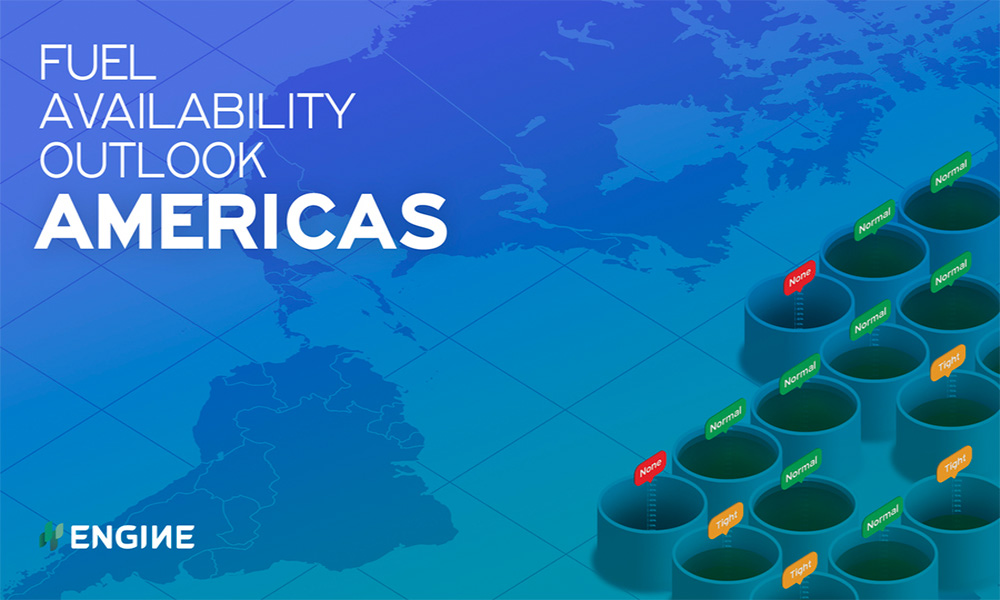
ENGINE: Americas Bunker Fuel Availability Outlook (24 Sep 2026)

Bunker demand strong in Houston; LSMGO avails dry up in Santos; bunkering suspended in Zona Comun.

Admin

Published

on

RESIZED ENGINE Americas

The following article regarding bunker fuel availability in the Americas region has been provided by online marine fuel procurement platform ENGINE for post on Singapore bunkering publication Manifold Times:

  • Bunker demand strong in Houston
  • LSMGO avails dry up in Santos
  • Bunkering suspended in Zona Comun

North America

Bunker demand in the US Gulf port of Houston is strong, and prompt availability of all three conventional fuel grades is tight. HSFO and LSMGO require notice of 6-8 days, while VLSFO needs around five days, a source said.

At the Galveston Offshore Lightering Area (GOLA), conditions are forecast to remain manageable, with wind gusts of up to 18 knots and waves below 1m between 24-27 September. Deliveries are currently ongoing on a first-come, first-served basis, subject to weather.

Prompt availability is tight at the anchorage, where HSFO and VLSFO require lead times of at least five days. LSMGO can be delivered within three days, by at least two suppliers.

The sea fog threat across US Gulf Coast ports is forecast to stay “low” through most of the coming week, before rising to “moderate” at Corpus Christi, Freeport, Galveston, Port Arthur, Marsh Island, Port Fourchon, New Orleans, Venice, Pascagoula and Mobile Bay on 30 September.

Venice and Mobile Bay could see moderate fog from 29 September, while Brownsville faces a moderate threat on 24-25 September. Lake Charles faces a high fog threat early on 30 September.

On the East Coast, bunker demand at the port of New York has ticked up, a source said. Availability of all three conventional grades is normal. LSMGO requires lead times of 3-6 days, and premiums for the grade are currently high, a trader said. VLSFO and HSFO require lead times between 5-7 days this week.

High wind gusts could disrupt bunker operations at New York between 24-27 September, with gusts forecast to peak at around 30 knots on 26 September, alongside rain.

Suppliers may require standby tugs during high winds, and operations could be suspended, a source tells ENGINE.

On the US West Coast, availability of all three conventional grades is normal at the ports of Los Angeles and Long Beach, where suppliers are recommending lead times of 5-7 days.

Bunker demand has picked up at Canada’s Vancouver, a trader said. Availability is decent at the port, where VLSFO and LSMGO require lead times of 4-7 days and HSFO needs 5-6 days, a source said.

The hurricane season is currently ongoing. The US National Hurricane Center (NHC) has issued advisories on Tropical Storm Fay in the Atlantic, Hurricanes Odalys and Polo in the Eastern Pacific, and Tropical Storm Nolo in the Central Pacific, with marine warnings in effect for the Atlantic and Eastern Pacific.

Latin America and the Caribbean

Bunker demand at Panama’s Balboa and Cristobal has been moderate, with VLSFO drawing more interest than HSFO and LSMGO this week.

Availability of all three conventional grades is good, with VLSFO and LSMGO deliverable within 3-4 days and HSFO requiring 5-7 days of lead time, a source said.

In the Bahamas, cruise ships are given priority for bunker deliveries at Freeport, and gusts of up to 16 knots and light rain are forecast on 25 September.

At St. Eustatius, deliveries are done at anchorage, and cruise ships take priority. Winds are forecast to stay moderate, with gusts of up to 14 knots.

Off Trinidad, deliveries are done while vessels are underway. Gusts of up to 22 knots and waves of up to 1.2m are forecast, but no major disruption is expected.

Bunker fuel availability is good at Colombia’s key ports of Cartagena, Santa Marta and Barranquilla, where VLSFO and LSMGO can be delivered within 3-4 days.

HSFO availability is limited across the country’s ports, though the grade can sometimes be booked at the larger ports, with the earliest deliveries possible in around four days, a trader said.

In Brazil, VLSFO availability is okay at Santos, with lead times of 4-7 days, though the port remains congested. LSMGO is not available at the port at the moment, a trader said.

Supply of VLSFO and LSMGO is very tight in Rio de Janeiro, Paranagua and Rio Grande, where both grades are offered under prior consultation and require lead times of over a week to 10 days.

Earlier this week, Petrobras halted bunker deliveries at Rio Grande earlier this week after a tropical storm knocked out power at the terminal. Operations resumed earlier today, a trader tells ENGINE.

Belem and Vila do Conde have okay availability of VLSFO and LSMGO, with lead times of 4-7 days.

Bunker operations at Zona Comun are currently suspended, and prolonged delays are expected due to winds above 20 knots. High wind gusts of up to 29 knots are forecast between 25-27 September.

Availability at the anchorage is very tight, with both grades of VLSFO and LSMGO available only under prior consultation, a source said.

By Gautamee Hazarika


Photo credit and source: ENGINE
Published: 25 September, 2026

Continue Reading

Bunker Fuel

Seascale Energy names Gaetan Perret co-CEO as Olivier Josse prepares to retire

Gaetan Perret, Head of Marine Fuel Procurement, West, will succeed him as Vice President, Marine Fuels at Cargill and as co-CEO of Seascale Energy, alongside Peter Grünwaldt, effective on 14 December.

Admin

Published

on

By

Seascale Energy names Gaetan Perret co-CEO as Olivier Josse prepares to retire

Seascale Energy, the marine fuel procurement joint venture between Cargill’s Ocean Transportation business and Hafnia, on Monday (21 September) announced that co-CEO Olivier Josse (OJ) will retire from Cargill on 14 December 2026 after 36 years. 

Gaetan Perret, Head of Marine Fuel Procurement, West, will succeed him as Vice President, Marine Fuels at Cargill and as co-CEO of Seascale Energy, alongside Peter Grünwaldt, effective the same date. 

Olivier Josse joined Cargill in 1990 and has held leadership roles across the company’s trading and chartering activities, joining Ocean Transportation in 2006 and serving on its leadership team since 2010. He led the establishment of Seascale Energy in 2025 and has served as co-CEO since the joint venture began operations. 

 “OJ has spent 36 years building businesses and developing people at Cargill, most recently through Seascale Energy,” said Jan Dieleman, President of Cargill’s Ocean Transportation business. “He leaves the platform in a strong position and with a successor who helped build it. Gaetan knows this market, knows our customers and knows what Seascale was set up to do.” 

“Seascale was built to give the market scale and transparency, and that remains the job,” said Olivier Josse.

“After 36 years, the timing is right for me personally. Deciding to retire says everything about the strength of the platform, the direction of the business, and the wonderful people in it. The volumes, the membership and the pipeline all point in the same positive direction – and as a co-founder, I would not be stepping back at this time if I thought otherwise. It is now time for my close colleague Gaetan Perret to take on the baton, and I congratulate him, and wish both him and Peter all the best in taking Seascale onto its next steps. It has been a fantastic experience working with both and the wider team.” 

“OJ and I started this venture together with an amazing team, and I am grateful for his partnership and friendship in the last years, where we have gone from peers to competitors to now colleagues and friends. On behalf of the full team at Seascale, we wish OJ all the best and will miss his contributions following his retirement,” said Peter Grünwaldt, co-CEO of Seascale Energy.

“Customers and suppliers will see continuity in the same team, same model, same commercial terms, with a handover that runs through to December. In this, I would also like to congratulate Gaetan on his upcoming appointment and look forward to working more closely with him as my counterpart.” 

Seascale Energy was launched in May 2025 by Cargill’s Pure Marine Fuels and the Hafnia Bunker Alliance. It procures approximately 8 million metric tonnes (mt) of marine fuel annually to more than 50 third-party members, operating from Singapore, Copenhagen, Geneva and Houston.  

The joint venture remains equally owned by Cargill and Hafnia, and its governance, dual-CEO structure and board composition are unchanged. 

On taking on the new role in December 2026, Gaetan Perret brings more than two decades of experience across shipping, trading and bunkering. He has been closely involved in building Cargill’s Pure Marine Fuels business and in the establishment of Seascale Energy and currently leads marine fuels purchasing in the West.


Photo credit: Seascale Energy
Published: 25 September, 2026

Continue Reading

Decarbonisation

DNV: New research shows how regulation could reshape shipping

DNV summarizes findings of its latest Maritime Forecast to 2050, exploring how future scenarios could affect marine fuel demand, technology uptake, fleet investments, and competitiveness.
Admin

Published

on

By

DNV flag

Classification society DNV on Thursday (24 September) released a new article summarizing findings of its latest Maritime Forecast to 2050, exploring how future scenarios could affect marine fuel demand, technology uptake, fleet investments, and competitiveness: 

Shipping’s energy transition has entered a new phase. The technology options are increasingly well understood. LNG, methanol, biofuels, wind-assisted propulsion, and emerging ammonia solutions are no longer concepts but commercial realities. Yet despite this progress, shipowners face a more difficult challenge than ever: making investment decisions amid unprecedented regulatory uncertainty.

The 2026 edition of DNV’s Maritime Forecast to 2050 argues that uncertainty itself is now becoming one of the most important drivers of fleet strategy. 

“Decisions taken today on vessel design, retrofits, and fuel capability will determine competitiveness for decades, while the outcome of ongoing regulatory negotiations could significantly reshape the economics of shipping’s energy transition,” says Øyvind Sekkesæter, Senior Consultant at DNV and lead author of this year’s report. “Maritime Forecast to 2050 aims to assist that decision-making with our latest core insights and case study examples.”

Four regulatory scenarios could shape shipping very differently

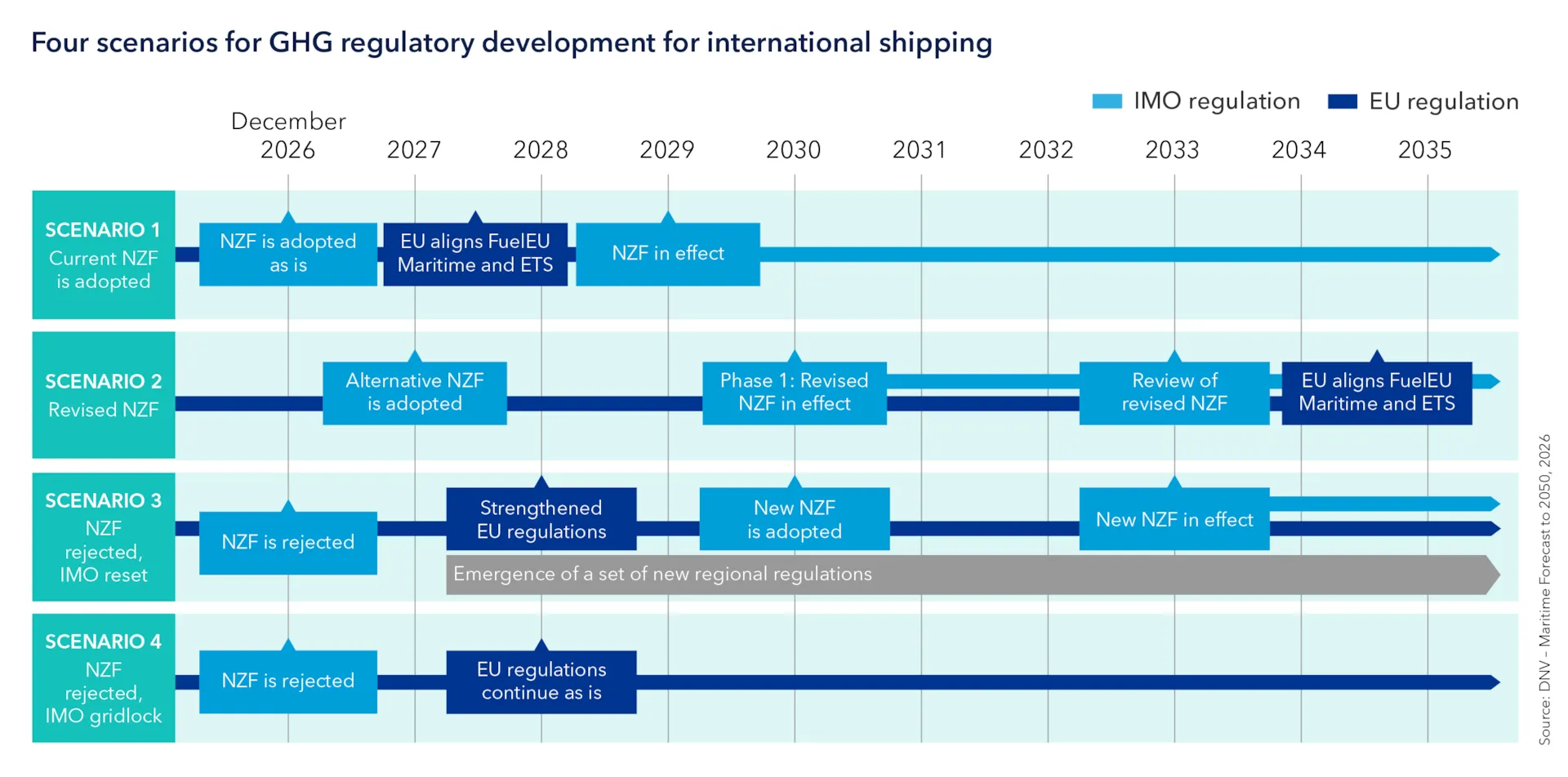
This year’s Maritime Forecast takes a scenario-based approach, presenting four possible regulatory futures for shipping. These range from the full adoption of IMO’s initially approved Net-Zero Framework (NZF) to its rejection and prolonged political gridlock, while also exploring several intermediate outcomes, including a delayed or revised NZF and scenarios where regional regulations play a more prominent role in driving decarbonization. Rather than predicting which outcome is most likely, the scenarios illustrate how different regulatory futures could affect fuel demand, energy-efficiency uptake, investment signals, and fleet competitiveness.
t1 ind 673 scenarios

Stronger global regulation accelerates demand for low-GHG fuels and increases the attractiveness of energy-efficiency measures, while the absence of such regulation slows market development. The result is a transition whose pace may vary significantly depending on future policy decisions.

“For shipowners, this means the challenge is no longer identifying a single fuel pathway that fits the operational profile of their fleet. Instead, it is preparing fleets that remain competitive across multiple possible futures,” Sekkesæter concludes.

Tapping the fleet’s efficiency potential

Fully realizing the fleet’s energy-saving potential requires improvements not only to newbuilds but also to existing ships through retrofits.

Installing energy-saving devices during scheduled dry-docking can be a highly cost-effective decarbonization strategy, as illustrated by the Maritime Forecast’s case study of a hypothetical 15-year-old 5,000 TEU containership (built in 2013).

This envisages USD 2.35 million being invested to retrofit the ship with hydrodynamic enhancements including a bow retrofit, propeller upgrade, and a propeller boss cap fin.

The vessel can achieve estimated fuel savings of around 16% under the modelling assumptions. Evaluating the investment under three price scenarios for low sulphur heavy fuel oil (LSHFO) results in payback periods from 1.4 years to 4.2 years.

Note: The full Maritime Impact article by DNV can be found here. 


Photo credit: DNV
Published: 25 September, 2026

Continue Reading

Newbuilding

Stena Line orders two new hybrid ferries for Sweden – Denmark route

Vessels will feature the latest hybrid propulsion technology, allowing them to operate on both conventional fuel and electricity and will be prepared for conversion to 100% electric operation.
Admin

Published

on

By

Stena Line orders two new hybrid ferries for Sweden – Denmark route

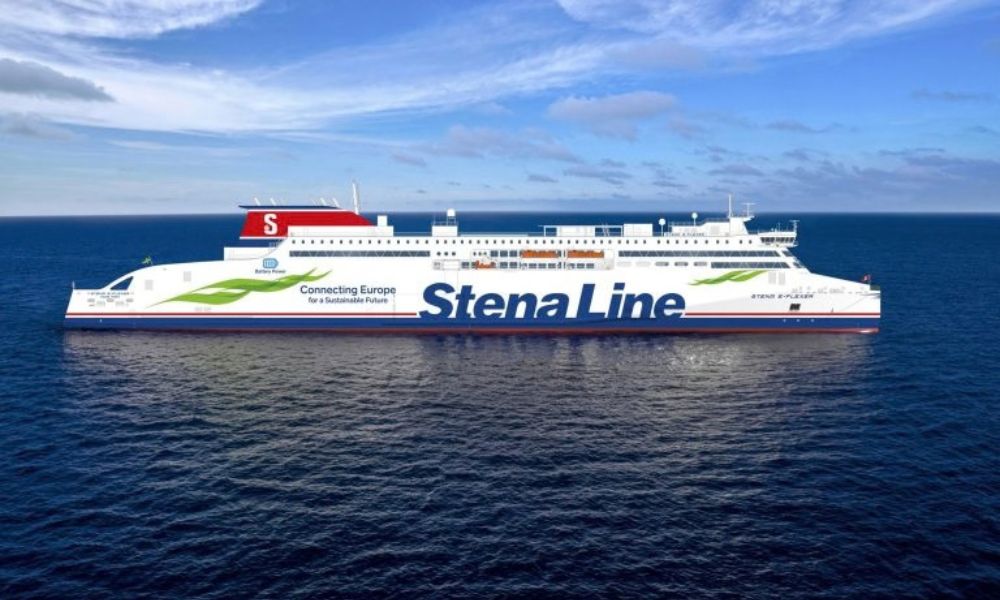
Stena Line on Wednesday (23 September) said it is renewing its fleet and has placed an order for two new hybrid E-Flexer ferries, scheduled to enter service in 2030.

Both vessels will be built at the China Merchants Industry Weihai Shipyard in China, which has so far built 15 E-Flexers.

The vessels will feature the latest hybrid propulsion technology, allowing them to operate on both conventional fuel and electricity. 

They will also be prepared for conversion to 100% electric operation once the necessary charging infrastructure is in place.

The two RoPax ferries will have capacity for 1,500 passengers and 2,750 lane metres of freight. Designed as day ferries, they are intended to operate on the Gothenburg–Frederikshavn route.

The two new vessels will become the sixth and seventh E-Flexers in Stena Line’s fleet. The first entered service in 2019, and today three E-Flexers operate on the Irish Sea and two between Sweden and Poland.

“This is a historic investment for Stena Line, giving us the opportunity to take further steps towards the sustainable modernisation of our fleet,” said Niclas Mårtensson, CEO of Stena Line.

“The two new ferries will strengthen our customer offering by taking the travel experience to a new level. At the same time, we are future-proofing our own CO₂ reduction targets while preparing for the stricter environmental requirements ahead.”

The vessels currently operating on Stena Line’s Gothenburg–Frederikshavn route, Stena Danica and Stena Jutlandica, have served the route for many years. Stena Danica entered service on the route as early as 1984, while Stena Jutlandica followed in 1996.


Photo credit: Stena Line
Published: 25 September, 2026

Continue Reading

Trending