Connect with us

EU ETS

EmissionLink warns shipowners of growing financial risk from delayed EUA transfers

Philippos Ioulianou warns shipowners and operators that waiting until September to secure and transfer EUAs is creating unnecessary financial, commercial and compliance risk as EU ETS enters its next phase.


Admin

Published

on

Philippos Ioulianou, EmissionLink

Emissions compliance specialist EmissionLink on Friday (11 September) has warned shipowners and operators that waiting until September to secure and transfer EU Allowances (EUAs) is creating unnecessary financial, commercial and compliance risk as the EU Emissions Trading System (EU ETS) enters its next phase.

Philippos Ioulianou, Managing Director of EmissionLink, said: “The problem is not the September deadline itself, but the industry’s habit of waiting until the last possible moment. This can push critical funding and compliance decisions to the brink and leave owners, managers and compliance providers carrying significant exposure.”

Following the first FuelEU Maritime compliance cycle, operators must also surrender EUAs covering their verified emissions before the end of September. However, EmissionLink said current practices between owners, charterers, managers and intermediaries can leave significant exposure unresolved until shortly before the deadline.

Many charter parties, including those incorporating BIMCO emissions trading provisions, allow charterers to transfer EUAs relatively close to the surrender date. While commercially flexible, EmissionLink said this can leave the party responsible for compliance exposed if allowances arrive late or are not transferred at all.

“Owners may be reluctant to buy allowances because the charterer is contractually liable, while charterers may delay because the contract permits them to”, added Mr Ioulianou. 

“In the meantime, the company responsible for compliance remains accountable to the regulator so that mismatch creates avoidable market risk.”

The issue is becoming increasingly significant as the EU ETS phase-in accelerates. The scheme covered 40% of shipping’s verified emissions for 2024, rising to 70% for 2025 and 100% for 2026. EmissionLink recommends verified emissions reports should therefore be treated as an early financial risk indicator rather than simply part of an annual administrative process.

Once verified emissions are known, owners and operators should quantify their EUA exposure, agree the allocation with charterers and establish clear transfer dates well ahead of September. The company is also calling for charter-party arrangements to move away from a last day approach to EUA transfers, with earlier milestones and clearer remedies for late delivery and associated costs.

Owners should also identify and purchase any known residual exposure at an early stage. This can include allowances arising from off-hire periods, operational adjustments or disputes, even where the owner’s eventual share represents only a small proportion of the vessel’s total liability. Delaying these purchases can expose companies not only to counterparty risk but also to movements in EUA prices.

Mr Ioulianou concluded: “EUAs now need to be treated as a core part of voyage economics, counterparty management and liquidity planning, not as a September administrative task. As exposure reaches 70% and then 100%, earlier allocation, earlier transfers and proactive purchasing will become essential to credible carbon compliance.”

By centralising emissions exposure, allowance allocation and transfer tracking, operators can gain earlier visibility of potential shortfalls and reduce the risk of a last-minute compliance scramble. As EU ETS exposure moves towards 100%, EmissionLink is calling for earlier allocation, earlier transfers and proactive purchasing as essential elements of effective carbon compliance and commercial risk management.


Photo credit: EmissionLink
Published: 14 September, 2026

Continue Reading

Alternative Fuels

APPEC 2026: Panellists navigate maritime decarbonisation and alternative marine fuel strategies

Experts discuss maritime decarbonisation, emphasising global regulatory clarity, crew training, and collaborative strategies for adopting sustainable alternative marine fuels.
Admin

Published

on

By

IMG 9319 MT

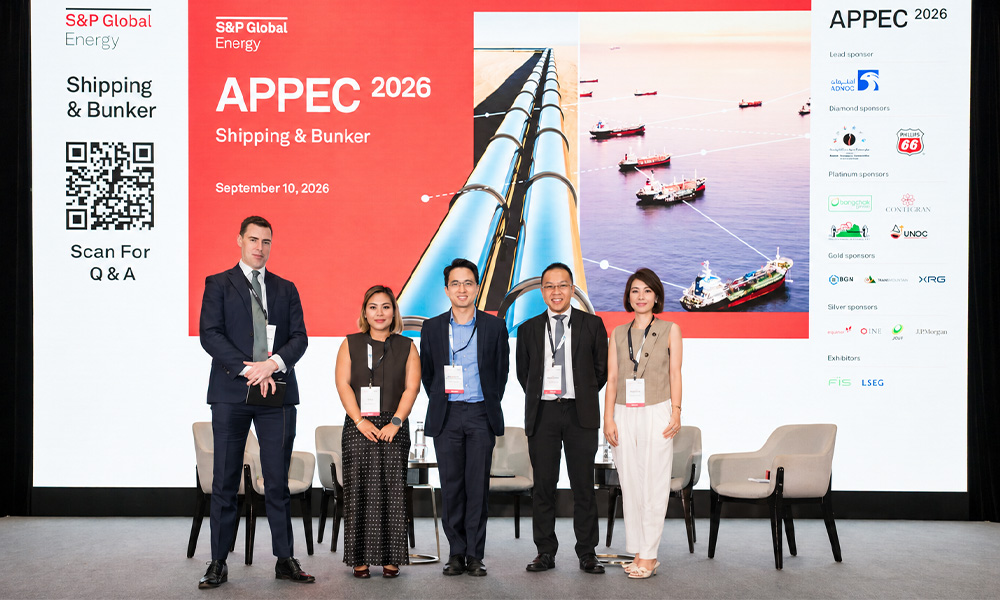
Panel members consisting of Singapore’s maritime and port regulator Maritime and Port Authority of Singapore (MPA), legal firm Rajah & Tann, bunker trading firm Sing Fuels, and the International Bunker Industry Association (IBIA) discussed the complexities of maritime decarbonisation at APPEC 2026 on Thursday (10 September).

The panel Balancing the Bunker Fuel Mix on the Path to Decarbonization moderated by John Morley, Global Director, Crude and Fuel Oil Markets, S&P Global Energy explored the complex landscape of maritime decarbonisation, sanctions fragmentation, and the transition to alternative marine fuels in Singapore.

Panellists broadly agree regulatory clarity – particularly from the International Maritime Organization (IMO) – is the single most critical enabler for large-scale investment, whilst highlighting regional fragmentation, crew competency gaps, and trade finance constraints pose significant near-term challenges.

Biofuels were seen as the most immediately scalable alternative marine fuel, with methanol and ammonia as longer-term prospects.

The following points were raised by panel members during discussion:

New Wei Siang, Director, Maritime Decarbonisation & Net-Zero Pathways, MPA, advocated for a global, IMO-led regulatory framework to guide shipping’s decarbonisation.

He believed regional patchwork regulations create unhelpful uncertainty, whereas a unified approach would be more helpful for long-term investment.

While acknowledging progress at recent IMO inter-sessional meetings held in September has been “slow but deliberate,” he remains focused on the upcoming MEPC 85 scheduled from November 30 to December 3, 2026.

To address the technical and safety challenges of new bunker fuels, he pointed out the MPA has established the Maritime Energy Training Facility (METF) to upskill crews on handling future marine fuels including methanol.

Furthermore, the MPA has launched ten green and digital shipping corridor partnerships to trial alternative fuels, exchange knowledge, and raise safety standards.

Mr New emphasised Singapore’s goal is to serve as a comprehensive maritime hub, balancing global regulatory engagement with practical, collaborative efforts to build competency for the future.

Nathanael Lin, Partner, Shipping & International Trade, Rajah & Tann Singapore, highlighted the significant legal and commercial challenges posed by regulatory fragmentation.

He argued regional environmental rules, such as those in the EU, force shipowners to make high-stakes gambles on trade routes and infrastructure until the IMO codifies standards into MARPOL Annex VI.

He also noted sanctions compliance has become dramatically more complex, with competing unilateral regimes replacing the previous era of UN consensus, creating immense operational risk for industry participants.

Furthermore, Mr Lin warned trade finance frameworks are currently ill-equipped to handle the complexities of blended alternative bunker fuels; he recommended banks to actively upskill their compliance functions to support the maritime energy transition.

Finally, he observed while claims regarding alternative marine fuels remained low due to the sophistication of early adopters, they will likely rise as adoption broadens. He also flagged the future migration of residual fuel demand as a critical, under-examined industry issue.

Juwita Setiawan, Trading Manager & New Fuels Lead, Sing Fuels, emphasised the energy transition has been making bunkering increasingly complex due to overlapping regulations.

She advocated for holistic voyage planning, where shipowners consider total emissions, costs, and marine fuel flexibility rather than evaluating port calls in isolation. She highlighted the critical role of high-quality data, fuel flexibility, including dual-fuel capabilities and fuel optimisation as essential tools for navigating the increasingly complex energy transition and supporting a practical pathway towards decarbonisation.

Regarding market structure, Ms Setiawan believed a symbiotic partnership between large integrated energy companies – which provide necessary capital and infrastructure – and agile, specialist suppliers is vital for success.

She identified biofuels and LNG as the most viable near-term maritime decarbonisation solutions, with methanol emerging as a mid-term option.

Ultimately, even though government incentives remain essential to help shipowners manage the high costs associated with adopting greener bunker fuels, regulatory clarity is the single most important factor to simplify market trading.

Looking ahead, she believes three things need to happen over the next three years:

  1. Clear and stable regulation – Shipowners and fuel suppliers need regulatory certainty and confidence to make long-term investments.
  2. Scale in supply and infrastructure – The industry needs to move beyond pilot projects towards reliable volumes, competitive pricing and stronger infrastructure across major bunkering hubs.
  3. Greater confidence in the fuels themselves – Common standards, proven technologies and reliable fuel performance will be essential to building trust and accelerating adoption.

“At Sing Fuels, we believe the transition is not about choosing one fuel for every vessel. It is about optimising the right fuel, at the right place, at the right cost, with the right emissions outcome – while keeping operational realities at the centre of the decision.

Siti Noraini Zaini, Regional Manager, Asia, IBIA, identified energy security and decarbonisation as objectives that need not be competing, noting that when energy security is under pressure, the immediate focus naturally shifts towards availability, reliability and affordability.

Over the longer term, however, a diversified marine fuel mix ultimately enhances industry resilience.

She stressed low carbon fuels alone is insufficient; shipowners need confidence that fuels will be available to meet the demand, where they are needed and at commercially manageable prices.

A critical focus for Ms Siti is the parallel development of standards. She warned the industry could not wait for the market to mature before establishing protocols. Standards for fuel quality measurement, green bunkering procedures, safety, and crew competency must be developed alongside the fuels themselves.

Looking ahead, she identified the upcoming MEPC 85 meeting as the industry’s primary regulatory watchpoint. Achieving clarity at the meeting is essential to enable the safe, financed, and commercially viable bunkering of new marine fuels, ensuring shipping’s decarbonisation transition remains both practical and sustainable.


Photo credit: S&P Global
Published: 14 September 2026

Continue Reading

EU ETS

KPI OceanConnect on EUAs: September is the deadline, but strategy is the bigger story

With 100% EU ETS exposure for 2026 emissions, an alternative fuels strategy can no longer be treated separately from carbon management, says Jesper Sørensen.

Admin

Published

on

By

Jesper Sørensen, Global Head of Alternative Fuels and Carbon Markets at KPI OceanConnect

Jesper Sørensen, Global Head of Alternative Fuels and Carbon Markets of KPI OceanConnect, on Wednesday (8 September) wrote that while the 30 September deadline to surrender EUAs is approaching, managing exposure to EU ETS is about more than how and when allowances are purchased.

He said fuel choice and alternative fuels strategy should also form part of companies’ broader carbon-management approach: 

EUAs: EU ETS surrender deadline highlights rising maritime carbon costs, as higher compliance obligations and EUA exposure increase the strategic importance of biofuels, fuel procurement and integrated carbon management ahead of full shipping inclusion in the EU ETS from 2026.

As the 30 September EU ETS surrender deadline approaches, the immediate message for shipowners, operators and charterers is straightforward: make sure your verified emissions position is understood, your exposure is calculated, and your allowance needs are settled in good time.

But this year’s deadline should also be seen as something more than an annual compliance event. It is a reminder that carbon costs are becoming an increasingly important part of vessel operating economics, and that the most effective response is not only to buy EUAs but also to think more strategically about how fuel choices influence overall compliance exposure.

This matters because the cost of the same level of emissions is rising even before we consider market volatility in EUA prices. The reason is the phase-in of the maritime EU ETS. For 2024 emissions, shipping companies were required to surrender allowances for 40% of in-scope CO₂ emissions. For 2025 emissions, that rises to 70%. From 2026 emissions onwards, the obligation moves to 100%.

In other words, even if the EUA price were to remain unchanged, the compliance bill for the same emissions profile becomes materially larger. That is an important shift. It means carbon exposure is no longer something to address only at the end of the reporting cycle. It increasingly needs to be considered when making fuel procurement and voyage-planning decisions.

The EUA market itself reinforces that point. Price volatility remains a feature of the market, and that makes planned procurement more important than ever. The objective is not to predict the perfect entry point. It is to understand the exposure, settle the near-term obligation in a timely manner, and develop a strategy to reduce future risk. But managing EUA exposure is increasingly about more than how and when allowances are purchased.

Over recent months, the economics of biofuels, particularly B100, have become increasingly compelling in several trading scenarios. When assessed only on a headline fuel price basis, the picture can appear mixed. But when viewed through the lens of total compliance cost, the economics can look materially different.

Qualifying sustainable biofuels can help reduce EU ETS exposure by reducing the number of allowances that need to be surrendered, while also improving compliance under FuelEU Maritime. In other words, a well-structured biofuel strategy can support compliance across both regulatory regimes simultaneously.

It does not follow that biofuel is automatically the most efficient solution for every vessel, voyage or trading pattern. In many cases, purchasing EUAs will remain the right answer. In others, alternative fuels can reduce exposure across multiple regulatory frameworks and materially change the overall economics.

That is why the September surrender deadline should be viewed as both a compliance event and a useful point to look forward.

With 100% EU ETS exposure for 2026 emissions, an alternative fuels strategy can no longer be treated separately from carbon management. Fuel procurement, EUA procurement, and FuelEU compliance increasingly need to be considered together before the bunker decision is made, rather than after emissions have already occurred.


Photo credit: KPI OceanConnect
Published: 10 September, 2026

Continue Reading

Alternative Fuels

Wirana: Marine fuel transition will redraw line between trading on and recycling of ships

With the transition, Hitesh Vyas of Wirana Shipping highlights a key question for owners of ageing ships: will another retrofit extend their commercial life or merely delay recycling?

Admin

Published

on

By

Hitesh Vyas of Wirana Shipping

As carbon rules tighten and alternative-fuel investment accelerates, owners of older ships will face a harder question: does another retrofit extend commercial life, or merely delay an inevitable recycling decision?

Hitesh Vyas, Vice President, Middle East and Green Recycling Coordinator at Wirana Shipping Corporation, examines the factors shaping this decision:

Shipping’s fuel transition is usually discussed as a technology race: which fuel will win, when supply will scale and how quickly new engines can be deployed. Yet the transition will also shape the other end of a vessel’s life. As emissions rules become progressively more demanding, fuel choice and carbon performance will increasingly determine whether an older ship remains commercially viable or is sent for responsible recycling.

The choices facing owners are becoming more complex. LNG, methanol, lower-carbon drop-in fuels and other alternatives each carry different implications for vessel design, fuel availability, tank capacity, operating costs and emissions performance. For newer ships, these considerations can be addressed during the design stage. For older vessels, the decision is more difficult because any investment must be recovered within a much shorter remaining economic life.

This will not happen as a sudden wave. The effect will be gradual, uneven and closely tied to freight markets, but it will compound. For a growing portion of the fleet, the decision to trade on will no longer depend principally on age and earnings. It will depend on whether the vessel can continue to meet regulatory, chartering and financing expectations without absorbing disproportionate capital and operating costs.

The market effect

If fuel and emissions performance are becoming so important, why has recycling supply remained relatively constrained?

The answer lies partly in geopolitics. Longer and less efficient trading patterns have increased tonne-mile demand, while the expansion of the shadow fleet has allowed many older vessels to remain gainfully employed. Higher charter rates have also given owners more room to respond. They can reduce speed, improve voyage planning or fund modifications whose cost can be recovered while earnings remain strong.

That breathing space should not be mistaken for a permanent solution. Slow steaming cannot erase a vessel’s technical limitations, while retrofits become harder to justify when a ship has little remaining life.

Carbon costs

The EU Emissions Trading System has brought carbon directly into voyage economics. It covers 100% of emissions between EU ports and 50% of emissions on voyages between EU and non-EU ports. The phase-in reaches 100% of the 2026 emissions covered at the 2027 surrender deadline, while methane and nitrous oxide are also included from 2026.

Two apparently similar ships may therefore carry materially different compliance costs. A vessel operating on conventional fuel may face a higher carbon exposure than a modern ship using a lower-emission alternative, but converting an existing vessel to LNG, methanol or another fuel can require tens of millions of dollars, depending on its design and the scope of work.

The owner must then consider fuel availability, methane slip in the case of LNG, reduced cargo capacity, time out of service and whether the investment can be recovered before the vessel reaches the end of its commercial life.

The commercial test is therefore not whether a retrofit is technically possible. It is whether the retrofit produces a credible return across the vessel’s remaining economic life.

CII will affect employability

Outside Europe, the Carbon Intensity Indicator is steadily tightening the link between operational efficiency and commercial access. A ship rated D for three consecutive years, or E for one year, must develop an approved corrective action plan. The required reduction against the 2019 reference line rises from 11% in 2026 to 21.5% in 2030.

Owners can respond through speed management, routing, maintenance and energy-saving technologies. But for an older vessel, the cumulative cost and loss of operating flexibility may outweigh the value of another trading year.

The consequences extend beyond regulatory paperwork. Charterers, financiers, insurers and cargo interests increasingly scrutinise environmental performance. A vessel permitted to trade may nevertheless become harder to charter, finance or insure on attractive terms.

The global framework is coming, even if the timetable moves

The IMO’s draft Net-Zero Framework points towards a global fuel-intensity standard and emissions-pricing mechanism calculated on a well-to-wake basis. Formal adoption was adjourned in October 2025, with talks scheduled to resume in 2026. The precise timetable may therefore change, but the direction of travel is clear: lifecycle emissions will increasingly carry a financial value.

That uncertainty should not encourage owners to postpone planning. They must test scenarios covering fuel prices, carbon exposure, trading patterns, retrofit cost and residual life rather than rely on a single forecast.

Some sectors will move first

Container ships and car carriers are likely to feel the transition earlier than several other segments. Their trading patterns, customer visibility and fleet-renewal programmes create stronger pressure to adopt alternative fuels and demonstrate emissions reductions.

As newer dual-fuel vessels enter service, older conventional ships may find themselves pushed towards less attractive employment before being released for recycling.

The decisive period is likely to emerge towards the end of this decade, when tighter CII requirements, regional carbon costs and the prospective global framework begin to overlap. A weaker freight market could accelerate the process by removing the earnings cushion that currently supports older tonnage.

Transition planning

Ship recycling should not be viewed as evidence that decarbonisation has failed. Properly planned and responsibly executed, it is part of fleet renewal. The danger lies in waiting until compliance costs, poor ratings or declining employment leave an owner with limited choices and little negotiating time.

Owners should assess recycling alongside retrofit and continued-operation scenarios well before a vessel reaches that point. The fuel transition will not send every older ship to the recycling yard at once. It will, however, steadily redraw the boundary between assets worth upgrading and those whose steel, equipment and materials can contribute more through safe and environmentally sound recycling.


Photo credit: Wirana Shipping
Published: 3 September, 2026

Continue Reading

Trending