Connect with us

Newbuilding

“K” Line orders four LNG dual-fuel car carriers from Chinese yard

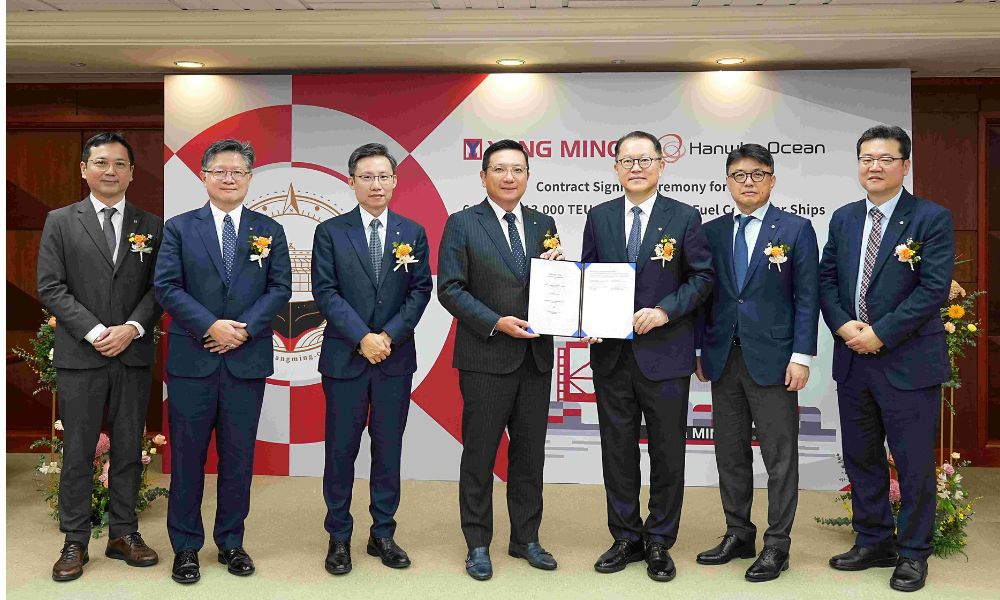
Firm says it has signed shipbuilding contracts with China Merchants Jinling Shipyard (Nanjing) for four 1,380-vehicle capacity LNG dual-fuel car carriers, designed for European short sea shipping operations.


Admin

Published

on

RESIZED scott graham

Japanese shipping giant Kawasaki Kisen Kaisha (“K” LINE) on Thursday (4 June) announced that it has signed shipbuilding contracts with China Merchants Jinling Shipyard (Nanjing) Co Ltd for four 1,380-vehicle capacity LNG dual-fuel car carriers. 

The vessels were ordered for “K” Line European Sea Highway Services GmbH (KESS), the “K” LINE’s European subsidiary.

The vessels are designed for the frequent transport of small lots in European short sea shipping. They are also designed to comply with size restrictions, which some European ports for imported cars have. “K” LINE is confident that these vessel specifications will give KESS a competitive advantage in its European short sea shipping operations.

The use of LNG fuel is expected to reduce emissions of carbon dioxide (CO2), a greenhouse gas (GHG), by 25% to 30% and emissions of sulfur oxides (SOx), which cause air pollution, by almost 100% compared to conventional vessels using heavy fuel oil. Additionally, to further reduce GHG emissions throughout the “K” LINE Group, the company will consider using bio-diesel and bio-LNG fuel, or liquefied bio methane, in addition to LNG fuel.

The vessels each use a high-pressure type ME-GI engine with a shaft generator, reducing emissions of methane slip (unburst gas), which is a greenhouse gas (GHG). While boil-off gas (BOG) generated from LNG tanks is generally used as fuel for generator engines on a vessel with a high-pressure main engine, these vessels are equipped with vacuum-insulated LNG tanks to reduce the generation of BOG. This enables a machinery configuration with lower methane slip emissions.

Under the Group’s long-term environmental policy, the “K” LINE Group set the target of achieving net-zero GHG emissions in 2050. In line with this, “K” LINE has been working to introduce and operate LNG-fuelled ships. The continuous use of bio-LNG is one of its key initiatives for achieving this target. 


Photo credit: Scott Graham
Published: 25 May, 2026

Continue Reading

LNG Bunkering

Chinese firms form pact for 20,000 cbm LNG bunkering vessel project

CM Energy Tech, Seacon Shipping Group and China Merchants Heavy Industry (Jiangsu) signed a joint venture agreement for 1+1 20,000 cubic meter LNG bunkering vessels.

Admin

Published

on

By

China Flag

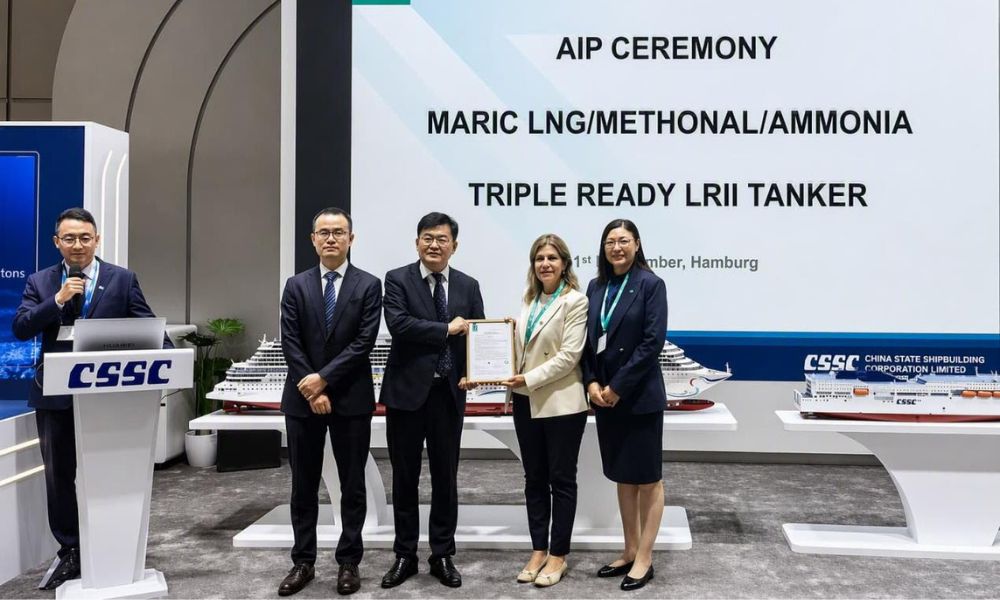
CM Energy Tech Co Ltd, Seacon Shipping Group Holdings Limited and China Merchants Heavy Industry (Jiangsu) Co Ltd on Tuesday (26 May) signed a joint venture agreement for the construction of 1+1 20,000 cubic meter liquefied natural gas (LNG) bunkering vessels. 

The parties also signed a shipbuilding contract for the first vessel, which will be constructed by China Merchants Heavy Industry.

The project combines CM Energy Tech’s access to the China Merchants Group ecosystem, Seacon Shipping Group’s expertise in ship management and operations, and China Merchants Heavy Industry’s shipbuilding capabilities. The partners said the initiative is intended to address the shortage of large-capacity LNG bunkering vessels in the Chinese market.

The newbuild LNG bunkering vessel will feature dual C-type independent cargo tanks and is designed with a boil-off rate of just 0.16% per day. It will also be capable of delivering LNG at a bunkering rate of up to 2,000 cbm per hour, enabling efficient refuelling of large LNG-fuelled vessels.

The vessel will be powered by Wärtsilä dual-fuel engines and will comply with IMO Tier III emissions requirements. The first vessel is scheduled for delivery in 2028.

The three companies said they plan to further expand cooperation across the LNG value chain, strengthen their presence in the marine energy sector and provide customers with integrated LNG bunkering services focused on safety, operational efficiency and lower carbon emissions.


Photo credit: David Yu from Pixabay
Published: 5 June, 2026

Continue Reading

Alternative Fuels

DNV data shows shift in alternative-fuelled vessel ordering patterns

DNV says shipowners are adopting more varied fuel strategies, reflecting a growing emphasis on optionality, regulatory compliance and risk management in long-life vessel investments.

Admin

Published

on

By

DNV data shows shift in alternative-fuelled vessel ordering patterns

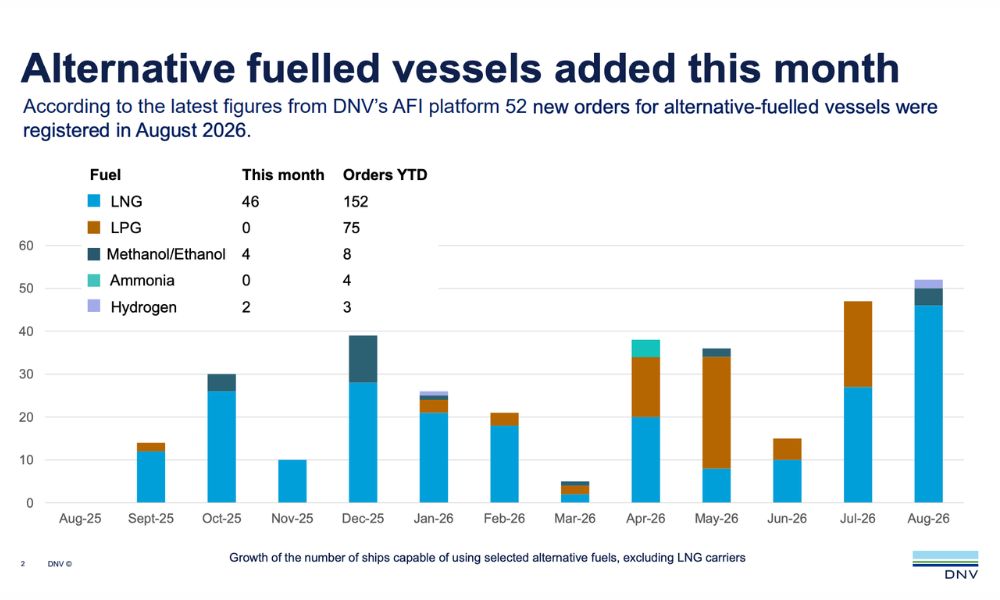
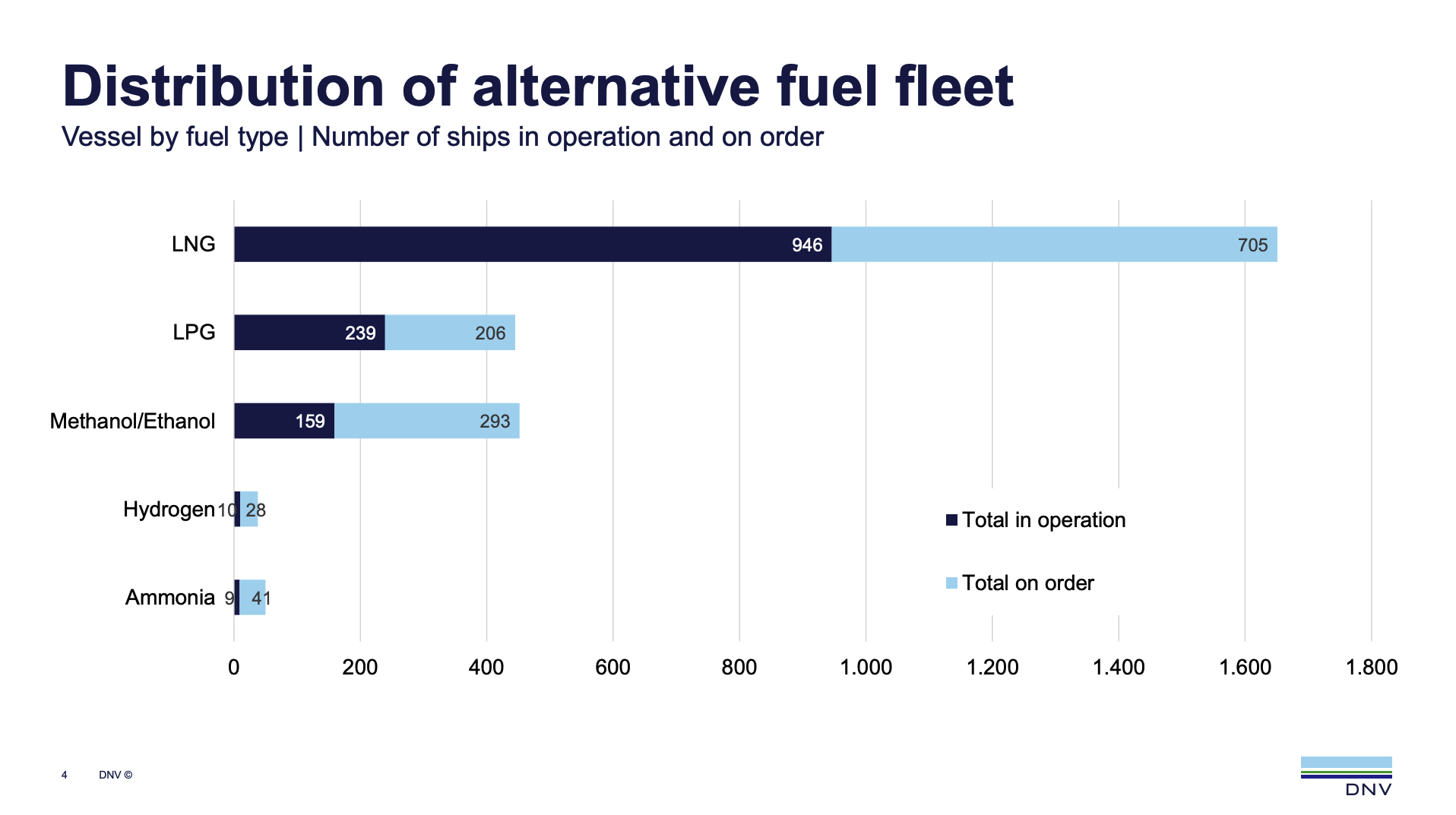
Latest data from classification society DNV’s Alternative Fuels Insight (AFI) platform showed a total of 36 new orders for alternative-fuelled vessels were placed in May 2026.

Activity was primarily driven by LPG/ethane carriers, which accounted for 26 of the orders. A further eight LNG-fuelled vessels were ordered, including six container vessels and two car carriers, alongside two ethanol-fuelled bulk carriers.

So far in 2026, a total of 119 orders have been placed for alternative-fuelled vessels. Of these, LNG-fuelled vessels (60) account for the largest share of the orderbook, with the majority of these (42) coming from the container segment, and a smaller share (12) from car carriers.  

A further 50 orders have been placed for LPG/ethane carriers, while activity in other fuel types remains limited, with orders for methanol/ethanol (4), ammonia (4), and hydrogen (1).  

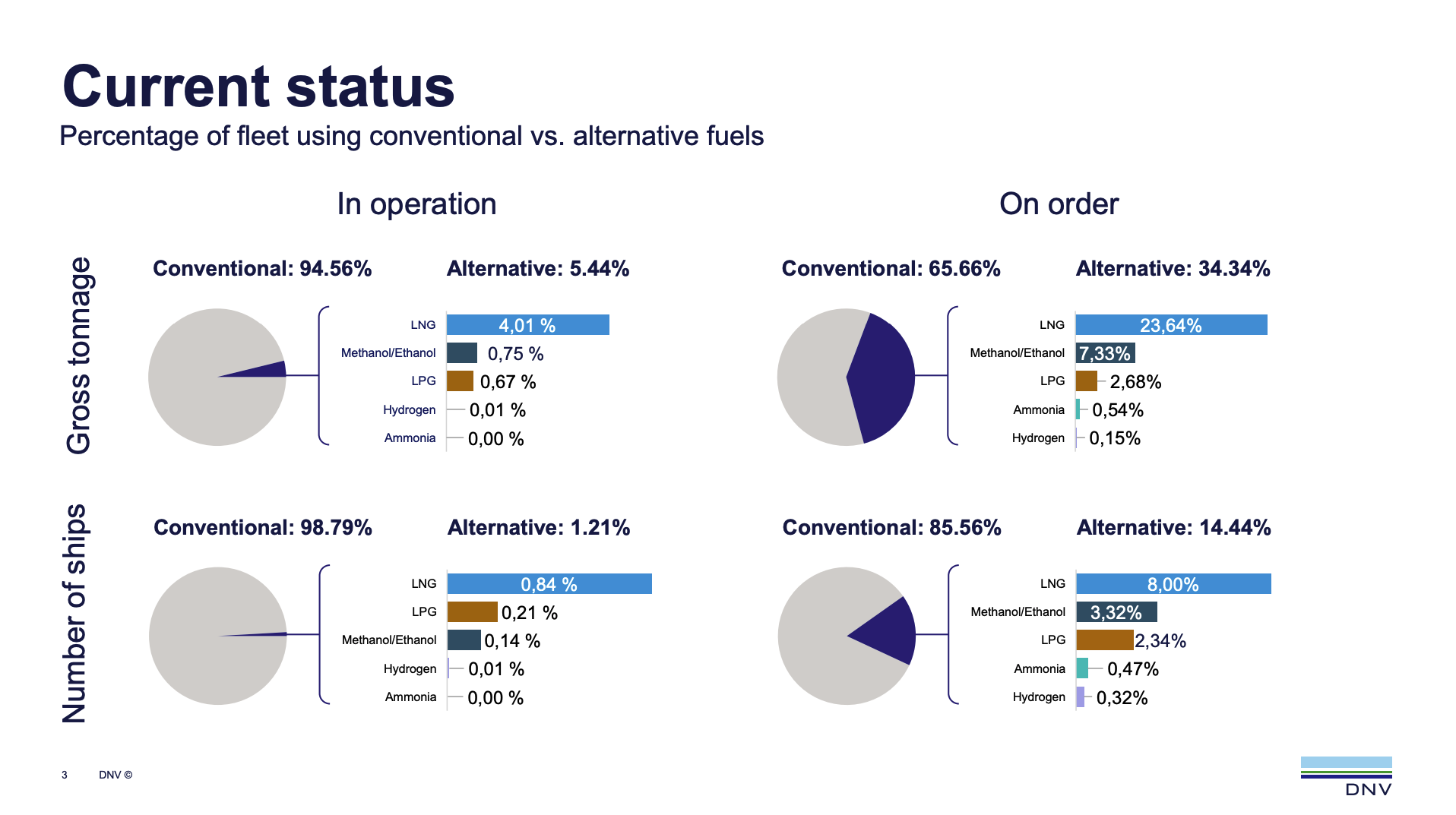
By the end of May, the share of alternative-fuelled vessels in total tonnage was notably lower than over the same period in 2025.

DNV data shows shift in alternative-fuelled vessel ordering patterns

Jason Stefanatos, Global Decarbonization Director at DNV Maritime, said: “While the pace of alternative-fuelled contracting has varied compared to 2025, the industry continues to move forward in its transition, with owners advancing fuel and technology decisions against a backdrop of evolving regulatory and market conditions.  

“As in previous years, ordering of alternative-fuelled vessels has been led by the container segment, but dynamics are shifting. While activity remains strong, the focus has moved towards smaller vessels, with fewer very large container ships, which are historically more likely to adopt alternative fuels, being ordered. At the same time, we are seeing increased activity in tanker and bulker segments.  

“What is also becoming clearer is that fuel choice is no longer approached as a single bet. Owners are increasingly treating it as a portfolio decision, managing fuel optionality, timing of investment, and exposure to future regulation as they navigate long-life asset decisions.

“This is reflected in more varied ordering patterns, reinforcing that the transition is not progressing in a straight line.”


Photo credit: DNV
Published: 25 May, 2026

Continue Reading

Alternative Fuels

Shipfinex: The green fleet transition has a financing problem

Capt. Vikas Pandey, Founder & CEO, Shipfinex argues green shipping progress is uneven: major carriers can finance alternative-fuel vessels, while smaller owners face capital constraints.

Admin

Published

on

By

Shipfinex: The green fleet transition has a financing problem

By Capt. Vikas Pandey, Founder & CEO, Shipfinex

The numbers on alternative-fuel orders look encouraging. Seventy-two percent of newbuild capacity ordered in the first ten months of 2025 was for alternative-fuel vessels, with LNG dual-fuel accounting for 60% of that figure. More than 1,369 LNG dual-fuel vessels are now in operation or on order globally. By most measures, the transition appears to be happening.

Look at who is actually placing those orders. MSC. Hapag-Lloyd. CMA CGM. Carriers with balance sheets large enough to absorb the cost premium of alternative-fuel newbuilds and relationships with Chinese leasing companies that extend leverage ratios unavailable to most of the industry. The Strait of Hormuz disruption this March accelerated that activity further: LNG tanker charter rates spiked above $200,000 per day and carriers with deep pockets moved to lock in fuel flexibility. Meanwhile, for vessels under 6,000 TEU, orders for conventionally fuelled tonnage rose to 28% of capacity ordered in 2025, up from 19% the year before. That is not a story of broad commitment to green fuels. It is a story about who has access to capital.

An alternative-fuel newbuild costs materially more than a conventional equivalent. Methanol-ready designs, ammonia-ready structures, LNG dual-fuel systems, each carries a cost premium above the base vessel price. For an independent shipowner financing through a traditional bank, that gap is increasingly difficult to bridge. Top-40 bank lending to shipping fell from $454.9 billion in 2011 to $284.3 billion by end-2023. The Chinese leasing companies that absorbed part of that contraction are structurally oriented toward Chinese-built vessels under long-term contracts with tier-one counterparties. Independent bulk owners, mid-tier tanker operators, feeder container companies: they are working with a materially shrunken pool of willing lenders at precisely the moment they are being asked to upgrade their fleets.

This bifurcation deserves more attention from the marine fuels industry than it currently receives. Bunkering infrastructure investment follows demand signals. Alternative-fuel bunkering at secondary ports, methanol at regional hubs, LNG outside the major transhipment centres, requires a broader fleet base of alternative-fuel vessels to justify the investment. If green fuel adoption stays concentrated among a handful of majors rather than spreading across the independent owner fleet, the economics of scaling bunkering supply infrastructure outside the primary corridors remain thin.

Capital market structure and marine fuel adoption are connected, and pretending otherwise slows both. Digital instruments representing economic exposure to vessel-owning Special Purpose Vehicles, structured within regulated frameworks like VARA in Dubai, can extend the base of capital available to shipowners below the tier-one threshold. That capital base does not replace bank lending. It reaches operators that bank lending currently does not.

The Hormuz disruption reminded the industry that fuel supply chains carry geopolitical risk. The financing gap raises a quieter but equally structural point: the demand side of the green fuel equation depends on shipowners being able to afford the vessels that create that demand. Alternative-fuel bunkering infrastructure will scale when the fleet ordering those vessels does. Right now, that fleet is smaller than the order book numbers suggest.

About the Author

Vikas Pandey is a Master Mariner with decades at sea across various vessel categories. He is Founder and CEO of Shipfinex FZCO, a maritime asset tokenization platform operating under VARA In-Principle Approval (IPA/26/01/002) in Dubai and registered as a Virtual Asset Service Provider in Poland.

Disclaimer: This article is for informational purposes only and does not constitute financial advice or a solicitation to buy or sell any financial instrument or virtual asset. Maritime Asset Tokens are virtual assets; values may decline materially below purchase price. VARA In-Principle Approval does not constitute a final licence.

Linkedin: https://ae.linkedin.com/in/capt-vikaspandey
Website: https://www.shipfinex.com/


Photo credit: Shipfinex
Published: 4 June, 2026

Continue Reading

Trending