Connect with us

Port & Regulatory

DNV on IMO MEPC 84: Revisiting Net‑Zero Framework

Highlights of IMO’s MEPC 84 include extensive discussions on framework, and agreement to further consider adjustments to ensure consensus as well as adopted amendments to MARPOL Annex VI.

Admin

Published

on

CHUTTERSNAP MT

Classification society DNV on Saturday (2 May) released a statutory news on the highlights of IMO’s MEPC 84 including extensive discussions on the Net-Zero Framework, and agreement to further consider adjustments to ensure consensus as well as adopted amendments to MARPOL Annex VI, designating the North-East Atlantic as an Emission Control Area (ECA) for SOx, PM and NOx. 

The following are excerpts of the article: 

The 84th session of the IMO’s Marine Environment Protection Committee (MEPC 84) held extensive discussions on the Net-Zero Framework (NZF). This was the first opportunity to do so following the adjournment of the extraordinary session in October 2025. Although there were divergent positions on key elements such as establishing a fund, MEPC 84 agreed to continue discussions on a revised framework to ensure consensus. MEPC 84 also progressed on key technical guidelines supporting the NZF. As part of the review of the Ballast Water Management (BWM) framework, amendments to the BWM Convention were approved, strengthening survey and other mandatory requirements.

Adoption of amendments to mandatory instruments

MEPC 84 adopted amendments to MARPOL Annex VI designating the North-East Atlantic as an Emission Control Area (ECA) for SOx, PM and NOx. This ECA covers the Exclusive Economic Zones (EEZs) and territorial seas of Greenland, Iceland, the Faroe Islands, Ireland, the UK, France, Spain and Portugal. The amendments also include clarification of DCS data reporting and data accessibility, and the use of multiple engine operational profiles for a marine diesel engine. The amendments will enter into force on 1 September 2027, with the 0.10% sulphur limit taking effect 12 months later. The requirement for NOx Tier III engine certification will apply to ships contracted on or after 1 January 2027, or in the absence of a building contract, constructed (keel-laid) on or after 1 July 2027, or delivered on or after 1 January 2031.

Energy efficiency

Review of the Ship Energy Efficiency Management Plan (SEEMP) and the Carbon Intensity Indicator (CII) MEPC 84 commenced the second phase of the review of the SEEMP and CII frameworks, to be completed in 2028. There was broad support to work towards a strengthened SEEMP framework to ensure continuous improvement of ships’ carbon intensity. The proposed elements include internal reviews, implementation logs and strengthened audit requirements, and will be further discussed and finalized at MEPC 86 in October 2027.

MEPC 84 could not agree on whether to replace the current CII metric for cruise passenger ships measuring emissions per gross ton-mile with a revised metric measuring emissions per hour. The matter will be further discussed at a later session.

EEDI/EEXI

MEPC 84 adopted amendments to the EEDI calculation and survey/certification guidelines to clarify the definition of the primary fuel for dual‑fuel engines operating on two liquid fuels, in particular methanol and ethanol. The amendments further specify that the determination of engine power and specific fuel consumption is to be based on the maximum continuous rating (MCR) as certified under the NOx Technical Code 2008.

Reduction of GHG emissions

Net-Zero Framework (NZF)

The GHG discussions at MEPC 84 primarily focused on the further development of the NZF in light of the adjournment of MEPC ES.2 in October 2025. Discussions were limited to a very extensive exchange of views, where previously known positions were largely reiterated. No decisions on NZF design features were expected or forthcoming at the meeting. MEPC 84 agreed on two additional intersessional meetings to continue negotiations, although no timeline was set for when a revised framework might be approved or adopted. MEPC 84 also finalized Terms of Reference for the 5th IMO GHG study, which is expected to commence later in 2026 and be completed in 2028.

Guidelines supporting the NZF

MEPC 84 and the preceding meeting of the Intersessional Working Group on Reduction of GHG Emissions from Ships (ISWG-GHG 21) continued the development of guidelines supporting the implementation of the NZF. MEPC 84 agreed using the following draft guidelines and documents as the basis for further work:

  • GFI calculation guidelines
  • Amendments to the 2022 Guidelines for Administration
  • Verification of Ship Fuel Oil Consumption Data and Operational Carbon Intensity
  • Guidance on how to monitor, report and verify the energy derived from wind propulsion systems
  • Guidelines on requirements and procedures for recognition of Sustainable Fuel Certification Schemes (SFCS) and reporting certification activities (SFCS guidelines)
  • Modules for possible inclusion in guidelines related to zero and near-zero GHG fuels, technologies and/or energy sources (ZNZs)

ISWG-GHG 21 also discussed governing provisions and possible disbursement of revenue of the proposed IMO Net-Zero Fund, as well as the development, management and operation of the IMO GFI Registry.

Note: The full statutory news can be found here


Photo credit: CHUTTERSNAP on Unsplash
Published: 5 May, 2026

Continue Reading

LNG Bunkering

Dan-Bunkering supports Sallaum Lines with LNG bunkering operation in China

“Ocean Express” is one of six newbuilds in the series and represents the fourth supply opportunity Dan-Bunkering has supported so far.

Admin

Published

on

By

Dan-Bunkering supports Sallaum Lines with LNG bunkering operation in China

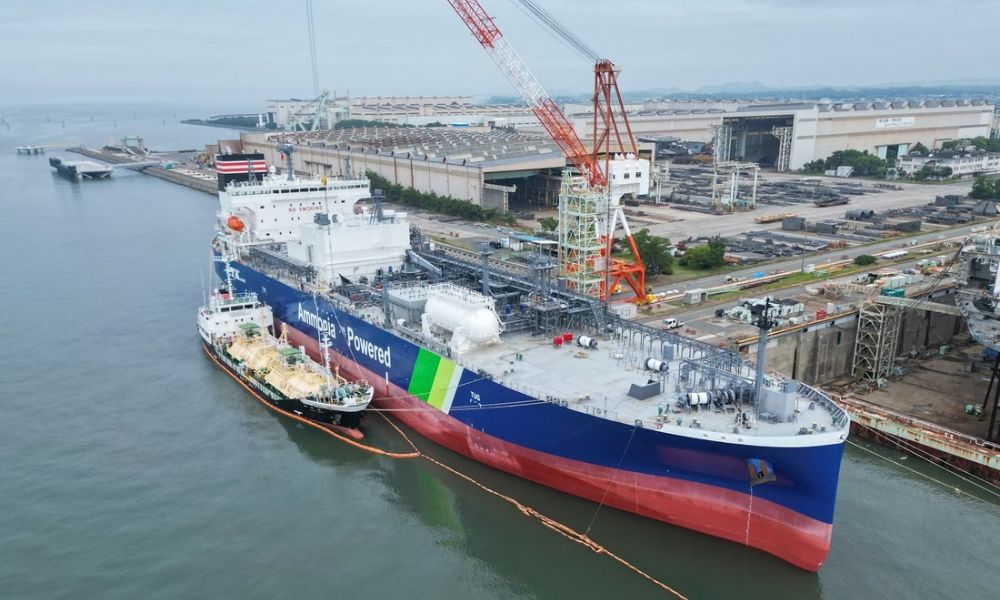
Global bunker supplier Dan-Bunkering on Friday (19 June) said it has recently concluded an LNG delivery in China for Sallaum Lines’ newbuild Pure Car and Truck Carrier (PCTC), Ocean Express

The delivery involved approximately 1,400 metric tonnes (mt) of LNG bunker fuel. 

This delivery is the outcome of a development process that began around April 2025, during which Dan-Bunkering worked with Sallaum Lines to evaluate several LNG supply opportunities in China linked to the company’s newbuild programme. 

Ocean Express is one of six newbuilds in the series and represents the fourth supply opportunity Dan-Bunkering has supported so far.

For this delivery, Dan-Bunkering said it secured a ship-to-ship supply solution aligned with the vessel’s operational requirements. The solution was made possible through close cooperation with supply partner SIPG Energy.

“This is a great example of what it takes to support clients in the transition to alternative fuels,” said James Shiller, Global Lead of New Fuels at Dan-Bunkering, and continues:

“LNG bunkering is not always straightforward, particularly during a first full bunker operation. Success depends on local knowledge and persistent cooperation across teams. Sallaum Lines trusted us and SIPG Energy to keep working the options, and we are proud that all involved teams turned a challenging situation into a successful delivery. We value the relationship and look forward to supporting their remaining newbuild deliveries.”

The company added that the delivery was made possible through close coordination across Dan-Bunkering and the wider Group, including Dan-Bunkering’s Netherlands office, Bunker Holding’s specialists and sourcing team.


Photo credit: Dan-Bunkering
Published: 22 June, 2026

Continue Reading

Alternative Fuels

Repsol launches commercial co-processed marine fuel supply in Algeciras

Firm said this marked the deployment of immediate solutions produced by integrating renewable content directly into conventional refinery processes.

Admin

Published

on

By

Repsol launches commercial co-processed marine fuel supply in Algeciras

Spanish energy company Repsol on Thursday (18 June) said it has started the commercial supply of co-processed marine fuels with renewable content in the port of Algeciras, one of the main bunkering hubs in the Mediterranean. 

The company said this marked the deployment of immediate solutions produced by integrating renewable content directly into conventional refinery processes, supporting the decarbonisation of maritime transport.

Last week, Repsol launched the first commercial voyage of its new generation bunkering vessel Bahía Candela. During this first voyage, the vessel loaded co-processed fuel at Repsol’s Petronor refinery in Bilbao, reinforcing the company’s end-to-end supply capability by integrating refining, logistics, and delivery.

Repsol reportedly chartered the bunkering vessel from shipowner Mureloil. 

Designed specifically for marine fuel supply, Bahía Candela features multiproduct capabilities and is prepared to operate with low-emission energy solutions. Its diesel-electric propulsion system and advanced energy storage enable optimised efficiency and reduced emissions during operations.

“This milestone marked Repsol’s entry into the supply of low-carbon marine fuels in Algeciras, leveraging its integrated value chain and expanding its multi-energy offering in the maritime sector, combining conventional products with low-carbon alternatives, thus, strengthening its ability to adapt to the diverse needs of its customers,” Repsol said in a statement. 

Co-processing enables the integration of renewable feedstocks, such as oils and residues, alongside conventional streams within refining processes. 

This generates fuels with a low-carbon footprint and supports a gradual transition towards solutions that will help to decarbonise the sector, providing a cost-efficient and scalable pathway to supply low-carbon fuels that are fully compatible with existing engines and infrastructure, without requiring changes to vessels or port assets, and using current industrial assets.

Related: Mureloil deploys hybrid chemical tanker for bunkering and terminal transport


Photo credit: Repsol
Published: 22 June, 2026

Continue Reading

Engine

Eight classification societies oversee successful TAT of Everllence ammonia engine

Everllence announced the successful Type Approval Test of its ME-LGIA ammonia-burning engine at its Research Centre Copenhagen.

Admin

Published

on

By

Eight classification societies oversee successful TAT of Everllence ammonia engine

Everllence recently announced the successful Type Approval Test (TAT) of its ME-LGIA ammonia-burning engine at its Research Centre Copenhagen (RCC). 

Eight classification societies oversaw the testing that took place from 10 to 12 June, marking the latest phase in the engine’s journey towards its market debut.  

Bjarne Foldager, Head of Two-Stroke Business, Everllence, said: “The TAT is yet another important step as we definitively move from concept development to seagoing engine operation. It confirms the Everllence B&W ME-LGIA as ready for on-board installation and is the last test before actual sea and gas trials. 

“This engine sets new benchmarks in zero-carbon propulsion and digitally connected performance, and has attracted great interest since its development was announced in 2019. It stands testament to Everllence’s unique ability to meet demands and bring innovative fuels to market.”

Everllence officially marketed the ME-LGIA engines at a two-day event in Copenhagen in November 2025. Using the Diesel principle and the well-known, dual-fuel Liquid Gas Injection concept, the engine has a proven track record of several hundred thousand operational hours.

Ole Pyndt Hansen, Senior Vice President, Head of Two-Stroke R&D, Everllence, said: “The TAT is also important in relation to maturing IMO ammonia regulations as it is vital that rules and guidelines are in line with reality to optimise safety onboard vessels. 

“This experience comes from industry and the first ammonia-driven ships, which are expected to operate at sea during 2026, will act as compelling input for the development of these guidelines.”

Everllence also noted that the ammonia TAT marked the end of an era with it being the final TAT at the RCC in Copenhagen before the company moves location to outside the city in late-2027.


Photo credit: Everllence
Published: 22 June, 2026

Continue Reading

Trending