Connect with us

Additives

Infineum shares findings of combustion improver fuel additive sea trials

Infineum’s Adrian Bourdeaux shares data from its combustion improver sea trials that demonstrate emissions and efficiency improvements along with additional benefits these additives can deliver.


Admin

Published

on

RESIZED venti views

International fuel additives company Infineum recently published an article on its Insight website on data from its combustion improver sea trials that demonstrate emissions and efficiency improvements along with a number of additional benefits these additives can deliver:

Ship operators are using fuel additives as a cost-effective way to help reduce fuel consumption as they work to cut running costs and emissions. But, their value goes way beyond these well-recognised attributes. In this article, Adrian Bourdeaux, Marine Fuels Technology Manager, shares the findings of recent evaluations at sea, carried out in a range of vessel types. These data not only confirm the emissions and efficiency improvement fuel additives can deliver to marine applications but also show how they can keep hardware clean and improve scrubber performance.

The maritime industry is working towards a net zero emissions future by 2050, where alternative fuels such as methanol, ammonia and hydrogen will be more widely used. However, in the transition period, conventional hydrocarbon fuels will continue to be the dominant marine fuel. To remain compliant with International Maritime Organization (IMO) regulations and to meet IMO net zero aspirations, while also cutting costs, ship operators and owners need to reduce emissions and improve efficiency today. These were some of the key drivers that prompted Infineum to develop novel combustion improver fuel additive technology.

Initially, our technologists put a significant amount of effort into static engine, no-harms, and field proof of concept testing – you can read more about the results here. This article goes on to describe how the results of this highly controlled development program have been replicated across multiple vessel and engine types and sizes in the last 18 months. In addition, it shows how this extensive testing has uncovered a number of other benefits combustion improver additives can deliver.

In our first trial, despite the adverse weather conditions encountered throughout the additised portion of the trial, we achieved a 1% specific fuel oil consumption (SFOC) saving and reduced emissions of nitrogen oxides (NOx), and sulphur oxides (SOx) by 4% and 12% respectively.

Our technology has received the first ever Lloyd’s Register Fuel Additive Statement of Fact for improved SFOC, reduced NOx, and carbon monoxide (CO) emissions.

To some readers a 1% fuel efficiency gain might not sound like a huge improvement. But, as an example, it would mean a single vessel consuming 100 MT of fuel per day could gain a net annual saving of some $3 to 4 million*.

Encouraged by this strong performance, we have completed a series of successful field evaluations across a wide range of vessel types, including cruise liners, container ships, and bulk carriers. Building on this foundation, the technology is now being adopted more broadly, with several ongoing commercial deployments and new collaborations underway. Many of these initiatives are being driven by the additional operational and environmental benefits that are now consistently being demonstrated in real-world applications.

Infineum works hard to ensure that each field evaluation is as operationally controlled as possible, maintaining consistent speed, load, and other key parameters between baseline and additised phases. While each field evaluation differs in terms of vessel type, engine configuration, fuel quality, and operating environment, this variability has proven valuable. It demonstrates that, across a wide range of real-world conditions, we consistently observe improvements in SFOC.

In all our various sea trials the improved combustion has helped to reduce specific fuel oil consumption by between 1 and 3%.

Both our technical teams and our sea trial partners have been really pleased with the results we have obtained. Why? Because not only have our additives provided the expected fuel efficiency improvements but also they have delivered a number of other valuable benefits.

Note: The full article by Infineum can be read here


Photo credit: Venti Views on Unsplash
Published: 1 August, 2025

Continue Reading

Additives

Singapore: Innospec technical talk discusses role of bunker fuel additives for shipping industry

Max Fok led the technical talk organised by The Joint Branch of RINA and IMarEST (Singapore) and sponsored by Innospec.
Admin

Published

on

By

Innospec presentation MT

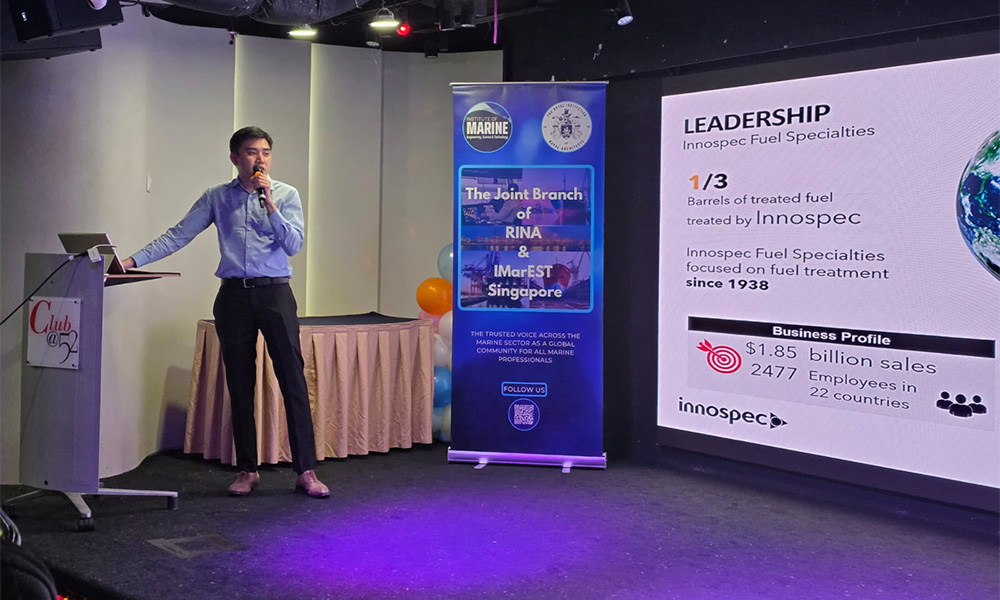
A technical talk titled The Role of Innospec Additives in Supporting Decarbonization in the Marine Sector organised by The Joint Branch of RINA and IMarEST (Singapore) and sponsored by Innospec was held at Club@52 on Friday (25 July).

Max Fok, China & Singapore Marine Sales Manager and Market Specialist at Innospec, focused on the role of fuel additives in the shipping industry, addressing decarbonisation, sludge reduction, and fuel stability in his presentation.

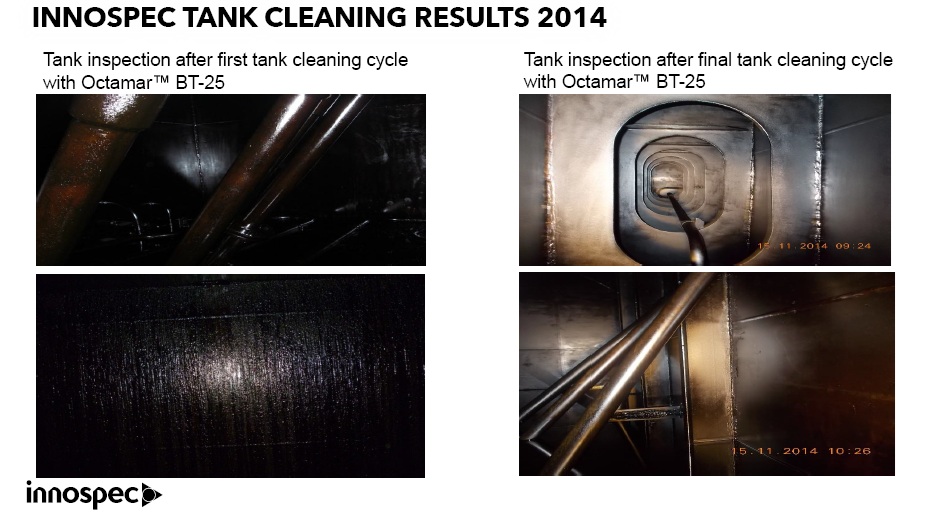
He detailed the benefits of Innospec’s Octamar BT-25, a heavy fuel dispersant, stabiliser, and combustion improver which offers up to 60% sludge reduction.

“Thanks to IMO 2020, many shipping companies got to know additives more through the bunker tank cleaning period,” explained Mr Fok.

“Octamar BT-25 is our pioneering product specialising in sludge reduction and tank cleaning. It is so effective, IMO mentioned in their circulars that this additive can be used as a marine fuel tank cleaning option.”
Innospec tank cleaning

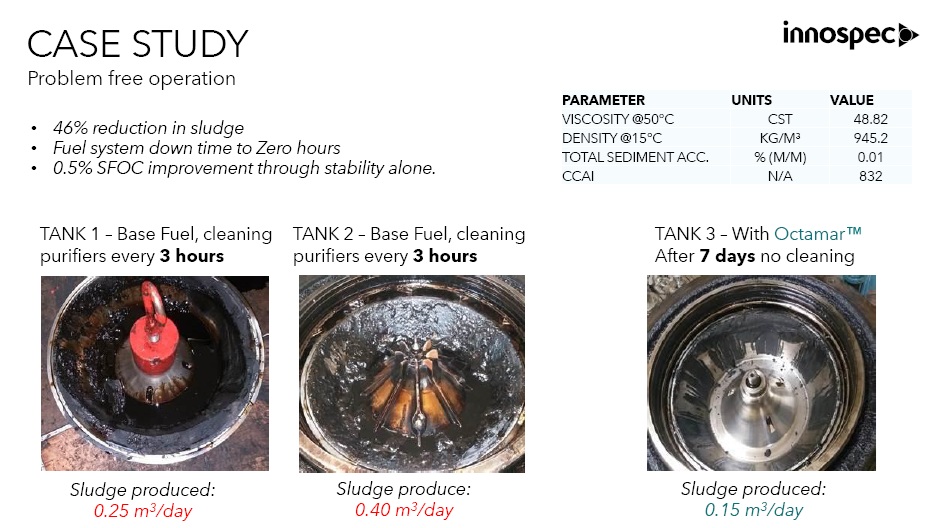
He shared a case study to show the sludge reduction properties of Octamar BT-25.

“Our product offers up to 60% sludge reduction; in this case study we recorded a 46% decrease in sludge which is equivalent to 0.5% of Specific Fuel Oil Consumption (SFOC) improvement through stability alone,” he said.

“You can see the sludge produced for the base fuel without additives. For example, tank one is producing 0.25 m3 of sludge per day, and tank two is giving 0.4 m3 e per day. But with our additive, the sludge produced on tank three is less than 0.15 m3 per day.”
Innospec sludge reduction

Moving forward, Mr Fok noted shipping’s decarbonisation has resulted in the increasing use of bio variants for Very Low Sulphur Fuel Oil (VLSFO) material as bunker fuel.

This development has resulted in different fuel behaviour of bio-VLSFO bunker stems due to varying feedstocks. Further, the situation could be even made worse due to suboptimal storage conditions.

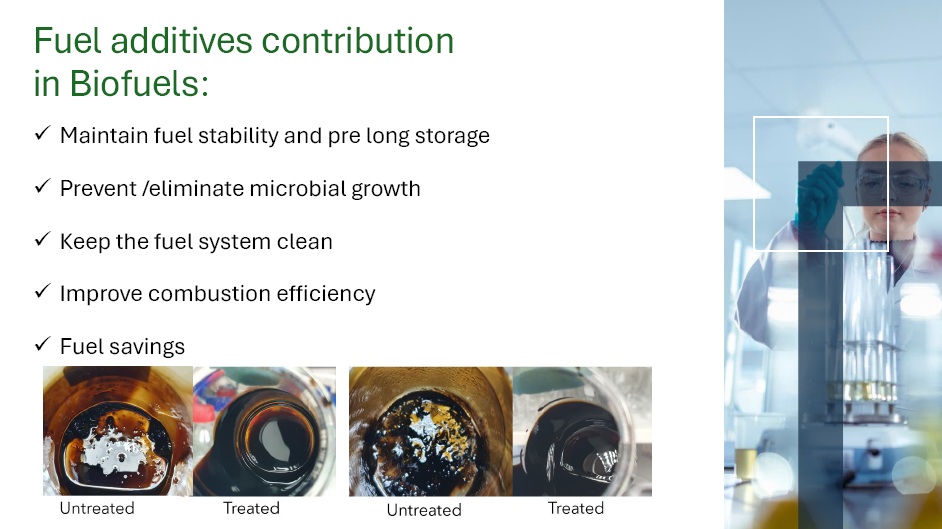
“Fuel additives help maintain the fuel stability and prolonged storage of bio bunker fuel by eliminating microbial growth to keep the fuel system clean while improving combustion efficiency and offering fuel savings,” shared Mr Fok.

“So, using additives for biofuel can also give you a peace of mind on your expensive asset.”
Innospec biofuels additives


Photo credit: Innospec
Published: 11 August 2025

Continue Reading

Interview

Innospec: Marine fuel additives the ‘low hanging fruit’ alternative energy saving technology solution

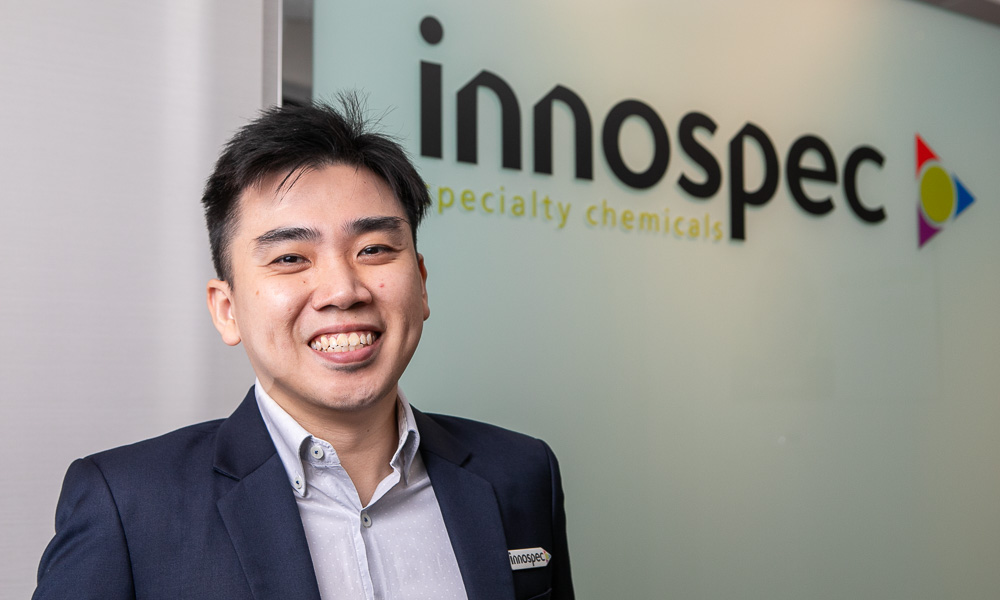
‘In our return on investment table, you only need a 0.5% fuel saving to break even on an additives investment with us,’ states the Area Sales Manager of Innospec Limited Branch Office Singapore.
Admin

Published

on

By

Max Fok Innospec

In an interview with Singapore-based bunkering publication Manifold Times, Max Fok, China & Singapore Marine Sales Manager and Market Specialist, explains how the use of marine fuel additives offer low-hanging fruit solutions for shipowners sailing towards maritime decarbonisation:

MT: Innospec recently released its Q1-25 Sustainability Newsletter, highlighting that 20,000,000 metric tonnes (mt) of carbon dioxide (CO2) emissions were avoided through the use of their fuel additives in 2024. Could you elaborate on this achievement?

Absolutely. By applying conservative estimates for fuel economy improvements ranging from  2.4 to 4.8%, depending on the type of fuel being treated, our analysis shows an avoidance of over 20,000,000 mt of CO2 for our customers in 2024. This figure is more than 200 times our total annual emissions from our site operations and is equivalent to taking 4.5 million gasoline-powered cars off the road for a year or the carbon sequestration achieved by 340 million tree seedlings over a decade. This highlights the vital role of chemical innovation in helping us utilise natural resources more efficiently while minimising our environmental impact.

MT: That’s impressive. How many shipping companies have benefited from using Innospec’s Octamar Technologies?

Today, over 50 shipping companies have benefited from using Innospec™ Octamar Technologies helping to reduce CO2 emissions and supporting shipping decarbonisation. In 2024, we successfully treated 4.8 million mt of marine fuels.

MT: There are some misconceptions about the role of additives as Energy Saving Devices (ESD). Can you address these misconceptions and explain how additives should be used correctly?

The misconception in the industry is that additives are only used for troubleshooting. However, fuel management involves ensuring fuel stability and compatibility, preventing fuel degradation, and ensuring proper engine reliability.

Performance applications of additives are widely used outside of marine applications, such as in the automotive industry, where premium-grade petrol is used for fleet performance, reducing consumption and emissions.

Fuel additives can improve engine efficiency on board vessels as an Energy Efficiency Technology Solution, reducing fuel usage, emissions, and costs. Compared to other ESD solutions, additives are the easiest to implement while operating the vessel and complying with stringent regulations.

MT: Is there a return on investment for using additives on a vessel? How can Innospec prove their product works, and can the product be trialled by owners before full commitment?

Innospec has proven the effectiveness of our marine additive’s technology. We are the only additives company in the marine industry with an Innovation Endorsement Certificate awarded by ClassNK in 2022, stating 2.1%-3.9% fuel savings.

Compared to other ESDs, the return on investment is immediate. It is one of the low-hanging fruit solutions in the market. We always welcome owners to trial our product before full commitment. With today’s measurement technologies, it is possible. We have supported various owners and proven the effectiveness since 1997. Moreover, additives are the only ESD that you can monitor as many times as you want.

MT: Do most shipowners use additives in their operations? If not, why? What are the challenges of adopting additives in shipowners’ operations, and how can they overcome them?

Marine additives have gained significant attention since the implementation of the IMO 2020 Sulphur Cap Regulation, as they have proven effective in addressing tank cleaning and VLSFO fuel issues. Most shipowners now include additives as part of their fuel management policy for treating bunker fuel. The challenge lies in who should bear the cost of these additives. Many shipowners tend to push this cost to charterers because it’s the charterers who pay for the fuel. However, this viewpoint is slowly changing due to regulatory requirements. For shipowners, it’s about compliance and machinery reliability, while for charterers, the emphasis is on achieving  fuel savings. Ultimately, the advantages of using fuel additives benefits both parties.

MT: How can additives help shipowners meet regulatory requirements? Are there any case studies or examples you can share?

Innospec has many case studies showing average fuel efficiency savings of 2%-4%. In addition to the CO2 emission reduction associated with fuel savings, which help to avoid penalties such as those under FuelEU Maritime regulation, these savings also improve the CII rating of a vessel which supports the vessel’s journey towards the future IMO Net-zero Framework. With rising fuel prices, these savings could grow significantly. In an era of new bunker fuels, such as biofuels, the same efficiency gains could also cut costs of new bunker fuel usage, and provide additional savings from reduced emissions costs. This strengthens the business case for using additives as ESDs while also improving the economics of low-carbon fuels by lowering overall operational expenses.

MT: Finally, some people believe that additives are too expensive to use regularly on vessels due to the high cost. What would you say to them?

That is a misconception in the industry. As the popularity of additives has grown, many  companies have entered the market, making promises on high fuel savings of up to 10%-20%, but with very-high treat rates and costs. However, in this scenario  the so-called ‘additive’ can no longer be named ‘an additive’ but rather a blending component for the fuel.

Can you imagine adding 6,000 litres of chemical into 6,000 mt of bunker fuel? It would be a nightmare to the crew(!).

At Innospec, our technology treat rate is only between 167 to 333ppm, which is a very small dose rate. To put that into context just 1,000 litres of our additive is sufficient to treat 6,000 mt of fuel.

Max Fok’s contact details are as follows:

Max Fok
Area Sales Manager
Innospec Limited Branch Office Singapore
47 Scotts Road, #06-01 Goldbell Towers,
Singapore 228233
E-mail:  [email protected]


Photo credit: Manifold Times
Published: 5 June, 2025

Continue Reading

Business

Singapore-based EPS to invest in SulNOx, adopt fuel conditioner on at least 30 vessels

EPS will adopt SulNOxEco on a minimum of 30 vessels for a minimum of 18 months use per vessel following an extensive eight-month successful evaluation of SulNOxEco on various EPS-managed vessels.

Admin

Published

on

By

Singapore-based EPS to invest in SulNOx, adopt fuel conditioner on at least 30 vessels

Maritime green tech firm SulNOx on Monday (13 January) said it has signed an agreement with Singapore-based Eastern Pacific Shipping, which encompasses both investment into SulNOx and a major new product supply contract for its SulNOxEcoTM fuel conditioner (SulNOxEco).

The agreement follows an extensive eight-month successful evaluation of SulNOxEco on various EPS-managed vessels including container ships, tankers, bulk and gas carriers. EPS Ventures Pte. Ltd. (EPSV) will also become a strategic shareholder in SulNOx. 

Under the agreement, EPS, which manages a diverse fleet of over 300 vessels on water and on order, will adopt SulNOxEco on a minimum of 30 vessels for a minimum of 18 months use per vessel. 

EPS will also provide information in relation to the results of the evaluation, which the Company will be able to use in its marketing activities, along with the ongoing support of EPS. 

In addition, EPS will also collaborate with and act as an introducer for SulNOxEco, to some of the world’s largest shipping companies. The agreement itself will generate significant revenue and secure committed minimum product volumes of 250,000 litres. Further, the Board anticipates attracting additional customers and driving substantial further revenue growth.

Cyril Ducau, Chief Executive Officer of EPS, said, “This partnership with SulNOx is a significant step towards achieving EPS’s long-term sustainability objectives. By enhancing our operational efficiency and reinforcing our commitment to meeting global environmental standards, this collaboration further solidifies our position as a proactive leader in sustainable shipping practices.”

Radu Florescu, Chairman of SulNOx, said, “Signing the marquee shipping name of EPS after an extensive evaluation period proves the effectiveness of SulNOx products beyond doubt at a time when the industry is crying out for solutions to reduce fuel consumption and associated emissions against a backdrop of increasing regulation.”

“With this partnership, not only have we secured substantial, committed revenues, but there is also significant additional potential revenue from EPS’ introductions to some of the world’s largest fleets. This transaction marks a new and transformative era for the SulNOx Group, and we look forward to a long and mutually beneficial partnership with EPS, delivering the energy transition together.”

Related: SulNOx gains new patent in Singapore, reports ‘record’ first quarter


Photo credit: SulNOx
Published: 14 January, 2025

Continue Reading

Trending