Connect with us

Business

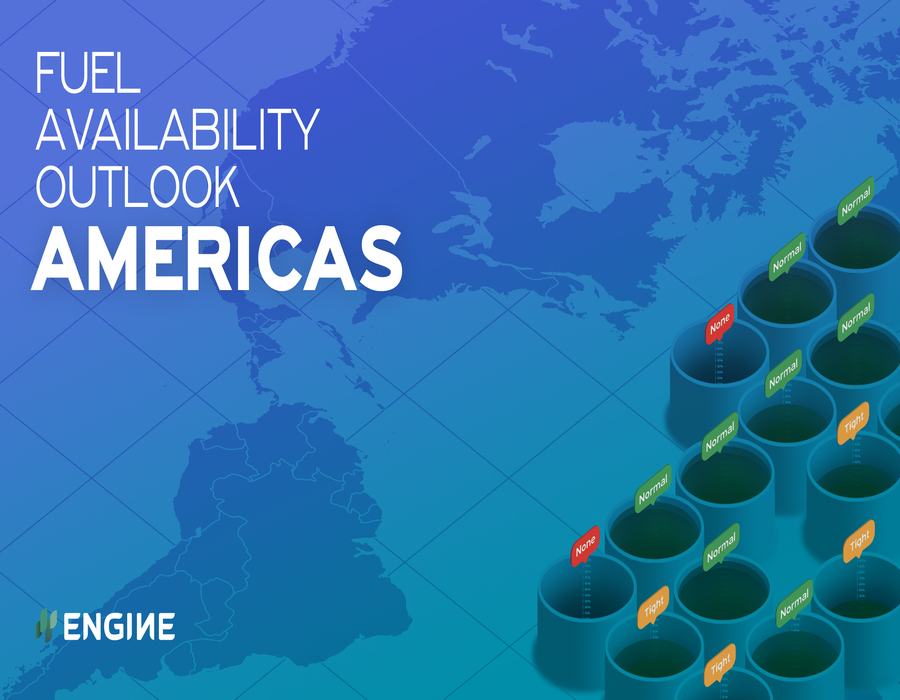
ENGINE: Americas Bunker Fuel Availability Outlook

Prompt supply tight in Houston and LA/LB; US fuel oil stocks and production fall despite higher refinery utilisation; Zona Comun VLSFO and LSMGO tight amid refinery turnaround.

Admin

Published

on

Resized Americas Bunker Fuel Availability Outlook image for Manifold Times

The following article regarding bunker fuel availability in the Americas region has been provided by online marine fuel procurement platform ENGINE for post on Singapore bunkering publication Manifold Times:

  • Prompt supply tight in Houston and LA/LB
  • US fuel oil stocks and production fall despite higher refinery utilisation
  • Zona Comun VLSFO and LSMGO tight amid refinery turnaround

Prompt delivery dates can be tight in the Houston area, with some suppliers unable to deliver VLSFO and LSMGO prompt and others citing their earliest dates 3-5 days ahead.

A supplier is out of all fuel grades in Houston and is uncertain when its stocks will get replenished. HSFO380 is generally tighter than VLSFO and LSMGO and may require longer lead times.

All grades are tight for prompt dates in Los Angeles and Long Beach, with LSMGO particularly tight with one supplier.

A supplier in New York has announced a barge surcharge increase from 1 April. Its new surcharge means that 51% of the cost of fuel is now added on top to cover barging costs.

Other suppliers in New York and other US East Coast ports raised surcharges to 22% earlier this month, after not previously having had any surcharges. They will be updated on a monthly basis.

US fuel oil stocks fell last week as a build on the Gulf Coast was countered by East Coast and West Coast draws, according to EIA government data.

The country’s stocks have shed 3% from a high of 27.54 million bbls at the start of the month.

Stocks have been drawn amid a 7% boost in supply out to refiners, blenders and bulk terminals on a weekly average in March compared to February, and a 6% drop in imports.

Refinery production has been steady between the months even as total refinery utilisation has risen to seven-year highs in the two most recent weeks. Higher refinery utilisation should normally yield more fuel oil as a by-product, but refiners have been eager to maximise distillate yields amid low stocks and soaring prices.

VLSFO and LSMGO availability ranges between normal to tight for prompt dates in Panama, with around four days of lead time required with certain suppliers in Balboa.

Prompt VLSFO and LSMGO supply remains tight in Zona Comun. The earliest delivery dates vary between suppliers, ranging from 4-5 days to 11 days.

VLSFO has been tight in Argentina since the PAE Campana refinery shut for planned maintenance, shipping agent Antares says, and expects product flows from the refinery to normalise towards the end of March.

Campana shipped some low sulphur fuel oil cargoes intermittently in the months before the maintenance, especially to Buenos Aires, with the last cargo going there in late January, Vortexa cargo data shows.


Photo credit and source: ENGINE
Published: 25 March, 2022

Continue Reading

Biofuel

BHP and GCMD trial multi-feedstock B100 bio bunker fuel on bulk carrier

Bio-blend in the BHP and GCMD pilot is being used on a BHP-chartered bulk carrier “Berge Lyngor”, which was bunkered in Singapore in early May.

Admin

Published

on

By

BHP and GCMD trial multi-feedstock B100 bio bunker fuel on bulk carrier

BHP and the Global Centre for Maritime Decarbonisation (GCMD) on Wednesday (3 June) said they have blended biofuels from two distinct feedstocks—used cooking oil and waste animal fats —and introduced the lower-emissions marine fuel into a BHP-chartered bulk carrier as part of a pilot project.

The bio-blend in the BHP and GCMD pilot is being used on a BHP-chartered bulk carrier Berge Lyngor, owned and operated by Berge Bulk, transporting BHP iron ore from Western Australia to China. When run on bio-blend, the vessel has the potential to reduce well-to-wake greenhouse gas emissions by approximately 79 per cent per voyage compared to sailing on very low sulphur fuel oil (VLSFO).

The vessel bunkered in Singapore in early May with a B100 bio-blend comprising 50 percent tallow-derived biodiesel, sourced and supplied by HAMR Energy, and 50 per cent used cooking oil (UCOME) supplied by Mitsui & Co Energy Trading Singapore (METS).

Mitsui also blended the fuel and Dan-Bunkering coordinated and executed the bunkering operation, which was performed by Global Energy’s barge MT Maple.

The BHP and GCMD pilot will assess how biofuels from multiple feedstocks can be blended, handled, and introduced under real-world operating conditions using existing used cooking oil bunkering infrastructure.

At the same time, insights from this pilot will help identify solutions to challenges related to fuel quality, handling, traceability, and onboard vessel performance.

Biofuels for global shipping today rely heavily on used cooking oil – a feedstock whose availability is approaching its projected limits. Biofuel from waste animal fats presents a promising option to expand the supply of lower-emissions marine fuels.

The outcomes of the pilot are expected to shed light on the practical steps to integrate biofuel blends from different feedstocks into existing supply chains. The diversity of biofuels will provide shipowners and operators with greater flexibility to optimise fuel procurement based on cost, availability, and lifecycle emissions performance.

Biofuels derived from different feedstocks can exhibit varying properties that may impact operations, including potential corrosion from oxidation, fuel system clogging caused by wax formation, which this pilot aims to assess.

The pilot will trace and verify the biofuel blend’s integrity aimed at bolstering confidence in emissions reductions reporting. The pilot will also provide insights into how robust tracing can support future marine fuel supply chains where biofuels from multiple feedstocks with varying lifecycle greenhouse gas emissions footprints are blended together.

This project is co-funded by the Maritime and Port Authority of Singapore under the Maritime Innovation and Technology Fund (MINT).


Photo credit: Global Centre for Maritime Decarbonisation
Published: 3 June, 2026

Continue Reading

Biofuel

NYK starts one-year B100 bio bunker fuel trial on car carrier

In this trial, NYK will operate a car carrier continuously on B100 for one year to evaluate the impact on engines, fuel supply systems, and operational practices.

Admin

Published

on

By

NYK starts one-year B100 bio bunker fuel trial on car carrier

Japanese shipping firm NYK on Tuesday (2 June) said it has commenced a one-year long-term trial involving the continuous use of 100% biofuel (B100) on an NYK-operated car carrier. 

In this trial, NYK will operate a car carrier continuously on B100 for one year to evaluate the impact on engines, fuel supply systems, and operational practices. High-purity biofuels such as B100 are known to be susceptible to degradation from oxygen, light, and heat, raising concerns about the stability of such fuels during long-term use.

In this trial, the biofuel primarily comprises FAME (Fatty Acid Methyl Ester) derived from used cooking oil and similar feedstocks.

The initiative is designed to evaluate the fuel’s effects on the vessel’s equipment and verify operational safety under real-world conditions. 

Through this effort, NYK seeks to accumulate technical expertise that will support the broader use of high-purity biofuels and further accelerate efforts to reduce greenhouse gas (GHG) emissions.

NYK has been advancing the use of biofuels through various initiatives. In 2024, the company conducted a trial using biofuel blend B24 and subsequently expanded practical usage to B30. However, the company said there remains limited global experience with the long-term continuous use of B100.

“By collecting long-term operational data through this trial, NYK aims to accumulate valuable technical insights to support both the safe operation of vessels and the wider adoption of high-purity biofuels,” it said. 


Photo credit: NYK
Published: 3 June, 2026

Continue Reading

Ammonia

AM Green plans to build green ammonia plant at Indian port

Initiative also includes development of green ammonia handling, storage and bunkering infrastructure, pilot bunkering operations, safety procedures and training programmes, says VOC Port Authority.

Admin

Published

on

By

india flag

VO Chidambaranar (VOC) Port Authority on Friday (29 May) said it has signed a Memorandum of Understanding (MoU) with India’s ammonia producer AM Green Ammonia to collaborate in the development of a green ammonia production plant.

The plant will have a capacity of one million tonnes per annum (MTPA) at Tuticorin.

The initiative also includes development of green ammonia handling, storage and bunkering infrastructure, pilot bunkering operations, safety procedures and training programmes. 

The project is expected to support the development of green fuel corridors connecting VOC Port with major ports in Europe and Asia, thereby strengthening India’s position in the global green fuels value chain.

VOC Port also signed a Memorandum of Understanding (MoU) with Bureau Veritas (India) Pvt. Ltd., to collaborate on Green Port certification, emissions accounting, ESG reporting, safety validation, development of green bunkering practices, and establishment of a Centre of Excellence for green fuels and sustainability.

The port also plans for an upcoming 750 m³ green methanol bunkering facility.


Photo credit: Naveed Ahmed on Unsplash
Published: 3 June, 2026

Continue Reading

Trending