Connect with us

Business

TECO 2030 and UiT cooperate on maritime hydrogen and fuel cells research and education

TECO 2030 will give UiT researchers and students the opportunity to use fuel cell element testing facilities at the TECO 2030 Innovation Center.

Admin

Published

on

TECO2030 UniversityOfNorway

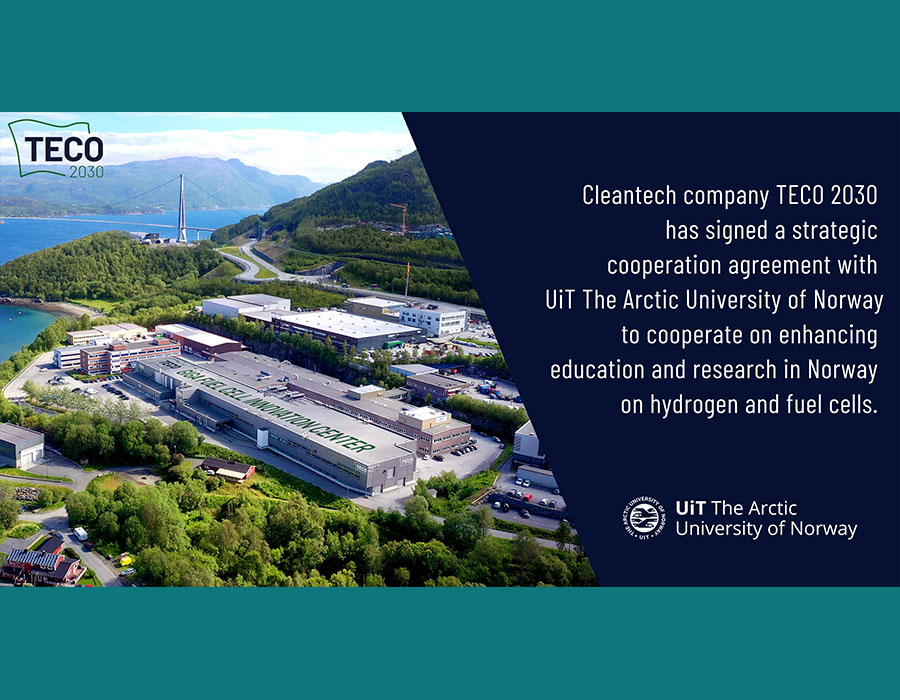
Marine cleantech company TECO 2030 on Thursday (21 October) said it has signed a strategic cooperation agreement with UiT, The Arctic University of Norway to cooperate on enhancing hydrogen and fuel cell research and education in Norway.  

The agreement was signed between TECO 2030 and UiT’s Faculty of Engineering Science and Technology. 

The faculty offers courses in hydrogen and fuel cells, and is based in Narvik in northern Norway, in the same city where TECO 2030 is currently working to set up Norway’s first large-scale production of hydrogen fuel cells.

The TECO 2030 Innovation Center in Narvik will be a combined factory and innovation centre. TECO 2030 will produce hydrogen fuel cells that are specifically designed for use on ships and other heavy-duty applications.

Will contribute to increased value creation in northern Norway

“Contributing to the development of sustainable energy solutions for land and sea transport is central in the research and development work we do at our faculty, and for us, fuel cell solutions that use hydrogen as an energy carrier are of particular interest,” says Professor Bjørn-Reidar Sørensen, Head of the Department of Building, Energy and Material Technology at the UiT.

“We are looking forward to cooperating with TECO 2030. Our goal is that we, through our cooperation with TECO 2030, can also contribute to increase the value creation in the north,” says Sørensen.

“We have extensive experience in working closely together with business and industry, and we are today providing students with an education that can be used directly in TECO 2030’s work. We will also be able to adapt our study offer according to the specific needs of TECO 2030,” he adds.  

As part of the agreement, TECO 2030 will contribute to improving UiT’s research and education in the field of hydrogen fuel cells. TECO 2030 will give UiT researchers and students the opportunity to use the fuel cell element testing facilities at the TECO 2030 Innovation Center during periods when they are not used in the production of fuel cells.

TECO 2030 and UiT will together also identify and cooperate on creating hydrogen-related projects for marine and land-based applications. Both parties will jointly conduct research projects and will cooperate on increasing the efficiency of the fuel cell production equipment at the TECO 2030 Innovation Center.

Will improve access to highly qualified, potential future employees

“We are very happy to be cooperating with UiT on enhancing the education in northern Norway for the use of hydrogen and fuel cells, and we are looking forward to welcoming students and researchers at the university to our new Innovation Center in Narvik,” says Tore Enger, CEO of TECO 2030 ASA.

“Our cooperation with UiT will contribute to increasing Norwegian competence on fuel cell development and will at the same time improve our access to highly qualified, potential future employees who already live in the region,” Enger adds.

The production of hydrogen fuel cells for use within the maritime industry is still in early stages, and it is currently limited competence in Norway on the development of fuel cells.

Will produce the engine of tomorrow

TECO 2030 is developing fuel cells together with the Austrian powertrain technology company AVL, and it took over the building that will become home to the TECO 2030 Innovation Center in summer. TECO 2030 is now in the process of making detailed plans for the factory and its production lines.

Hydrogen fuel cells are the engines of tomorrow and convert hydrogen into electricity while emitting nothing but water vapour and warm air. By installing fuel cells, ships and other heavy-duty applications can switch from fossil fuels to hydrogen and reduce its emissions to zero.

Fuel cells can enable ships to sail emissions-free either on the whole journey or on shorter distances, such as when sailing into and out of ports. It can also be used during port-stay, loading and discharging, enabling zero-emission operation at berth, without having to connect the ship to an onshore power supply.

Related: TECO 2030 receives USD 5.9 mn funding from Innovation Norway to develop hydrogen fuel cells
Related: TECO 2030 receives AiP from DNV for marine hydrogen fuel cell system and modules
Related: TECO 2030 and Greenstat enter agreement to develop complete hydrogen value chain
Related: TECO 2030 to establish large-scale production of fuel cells for hydrogen-powered ships
Related: TECO 2030 inks second partnership with AVL to develop hydrogen fuel cells for maritime


Photo credit: TECO 2030
Published: 28 October, 2021

Continue Reading

Mass Flowmeter

MFM-equipped CPN barge first listed under Hong Kong quality bunker scheme

Chimbusco Pan Nation’s bunker barge “Zhong Ran 23” has become the first vessel in Hong Kong listed on Marine Department’s official List of Quality Bunker Vessels, under a newly-launched scheme.

Admin

Published

on

By

MFM-equipped CPN barge first listed under Hong Kong quality bunker scheme

Hong Kong-based marine fuel supplier Chimbusco Pan Nation (CPN) on Tuesday (16 June) announced that its bunker barge Zhong Ran 23 has become the first vessel in Hong Kong listed on the Marine Department’s official List of Quality Bunker Vessels.

The list under the Quality Bunker Operator Scheme launched on 3 June.

“The Scheme is a voluntary initiative designed to raise the standard of bunkering accuracy, transparency, and service quality in Hong Kong,” CPN said in a social media post.

“To be listed, a bunker vessel must have its Mass Flow Meter (MFM) system independently certified under ISO 22192, the international benchmark for mass flow metering in bunkering operations.”

CPN added it has operated the MFM system across our fleet of fuel oil barges since 2015. 

Manifold Times previously reported Hong Kong’s Marine Department (MD) launching the Quality Bunker Operator Scheme to encourage bunker operators to install and use mass flow meter systems (MFM systems) on their bunker vessels.

MD said the scheme aims to enhance Hong Kong’s bunkering service quality and the competitiveness of Hong Kong ports, thereby further consolidating Hong Kong’s position as an international maritime centre and a major bunkering port.

Under the Scheme, bunker operators of traditional maritime fuel and biodiesel that install and use MFM systems on their bunker vessels, with the MFM systems inspected and certified by an accredited body in accordance with the International Organization for Standardization’s ISO 22192 Standard or equivalent requirements, can apply to the MD for inclusion in the scheme’s “List of Quality Bunker Vessels”, provided they meet the relevant technical and operational requirements. 

Related: Hong Kong backs MFM adoption with voluntary scheme to boost bunkering competitiveness


Photo credit: Chimbusco Pan Nation
Published: 17 June, 2026

Continue Reading

Financial Result

Bunker Holding exceeds FY2025/26 forecast despite geopolitical headwinds

Bunker Holding delivered a gross profit of USD 424 million and a profit before tax of USD 73 million, exceeding the Group’s expectations for the year.

Admin

Published

on

By

RESIZED bunker holding

Bunker Holding on Tuesday (16 June) said it delivered a strong performance in the financial year 2025/2026 despite continued uncertainty across global markets. 

The year was shaped by geopolitical developments, evolving trade flows, periods of heightened market volatility, and strong competition.

These conditions were further amplified by developments in the Middle East, which added complexity across global energy markets and shipping routes. 

In response, Bunker Holding focused on getting closer to customers and understanding the different challenges faced across shipping segments. This enabled faster decision-making, greater agility under pressure, and allowed the Group to respond effectively while continuing to support customers reliably.

Against this backdrop, Bunker Holding delivered a gross profit of USD 424 million and a profit before tax of USD 73 million, exceeding the Group’s expectations for the year. Equity increased to USD 342 million.

Revenue amounted to USD 13.1 billion, a decrease of 4% compared to the previous year. The decline primarily reflected lower average oil prices during the financial year, despite periods of heightened market volatility and stronger pricing towards the end of the period.

“This year, we have taken important steps to strengthen Bunker Holding for the future. We have simplified parts of the organisation, brought teams closer together, and made the changes needed to make us more focused and efficient. Our markets remained challenging and unpredictable, but I am pleased with both the result we have delivered and the progress we have made,” said Peder Møller, CEO of Bunker Holding.        

Looking ahead to 2026/27, Bunker Holding anticipates intense market competition alongside continued investments in low- and zero-carbon fuel projects and partnerships.

Changes to the Board of Directors

Bunker Holding said the company is strengthening its Board of Directors with the appointment of several new members and a new Chairman of the Board.

Nina Østergaard, CEO and co-owner of USTC, will assume the role of Chairman of the Board, while Henrik Andersen, Group President and CEO of Vestas Wind Systems A/S, will join as Vice Chairman. Tina Revsbech, CEO of Maersk Tankers, and Kenneth Steengaard, Chairman of the Board of Global Risk Management, will join the Board as new members.

At the same time, current Chairman Klaus Nyborg and Board member Peter Frederiksen will step down from the Board.

Nina Østergaard, incoming Chairman of the Board, said: “I am excited to take on the role as Chairman of Bunker Holding at an important time in the company’s development. Bunker Holding has a strong market position, a clear strategic direction, and significant opportunities ahead. I am also pleased to welcome Henrik Andersen, Tina Revsbech, and Kenneth Steengaard to the Board. They each bring valuable experience and perspectives, and I am particularly pleased that we have attracted such strong international profiles as Henrik and Tina, whose leadership experience from Vestas and Maersk Tankers will further strengthen the Board and support the company’s continued development.”

The addition of Kenneth Steengaard moves Bunker Holding closer to its sister-company Global Risk Management and adds important insight into risk management.

Bunker Holding founder and co-owner Torben Østergaard-Nielsen thanked the departing Board members for their contributions to the company.


Photo credit: Bunker Holding
Published: 17 June, 2026

Continue Reading

Business

Oilmar establishes Board of Directors amid international expansion

Three directors are Chief Executive Officer Yusif Mammadov, Chief Finance Officer Nain Shafi, and Legal, Credit and Compliance Head Taira Shikhiyeva.

Admin

Published

on

By

Oilmar formalises Board of Directors amid international expansion

UAE-based marine fuel and petroleum products trader Oilmar on Tuesday (16 June) announced the formal establishment of its Board of Directors, marking an important milestone in the company’s evolution.

The three directors are Chief Executive Officer Yusif Mammadov, Chief Finance Officer Nain Shafi, and Legal, Credit and Compliance Head Taira Shikhiyeva.

The formation of the Board was first communicated during Oilmar’s Q1 2026 Townhall as part of a wider governance enhancement initiative and has now been formally implemented.  

The Board has been established to provide strategic direction, oversee risk management and governance matters, and support the company’s continued growth across its global operations.

“At inception, the Board comprises three Directors with extensive international experience across the energy, maritime, shipping, and commodity trading sectors. Together, they bring a wealth of industry knowledge and strategic expertise to support the company’s continued growth and development,” the company said.

“The Board is expected to be further strengthened through the appointment of additional Executive and Non-Executive Directors as the company continues to expand its international footprint.”

As part of the enhanced governance framework, strategic direction, risk appetite, and key business objectives will be determined at Board level, while regional management teams will remain responsible for execution within their respective markets. This structure strengthens accountability, promotes effective decision-making, and supports the Company’s long-term growth and succession objectives.

CEO Yusif Mammadov, said: “The establishment of the Board marks the next stage in Oilmar’s development as a global energy and marine fuels business. It creates a governance framework that will support our future growth, strengthen oversight across the organisation, and ensure that our strategic decisions are guided by long-term value creation and responsible risk management.”


Photo credit: Oilmar
Published: 17 June, 2026

Continue Reading

Trending