
Alternative Fuels
China Classification Society awards first type approval for hydrogen marine fuel cell
Certificate was issued by CCS’ Wuhan branch to Troowin Power System, and CCS now plans to test the fuel cell in real time on a purpose-built bulk carrier.

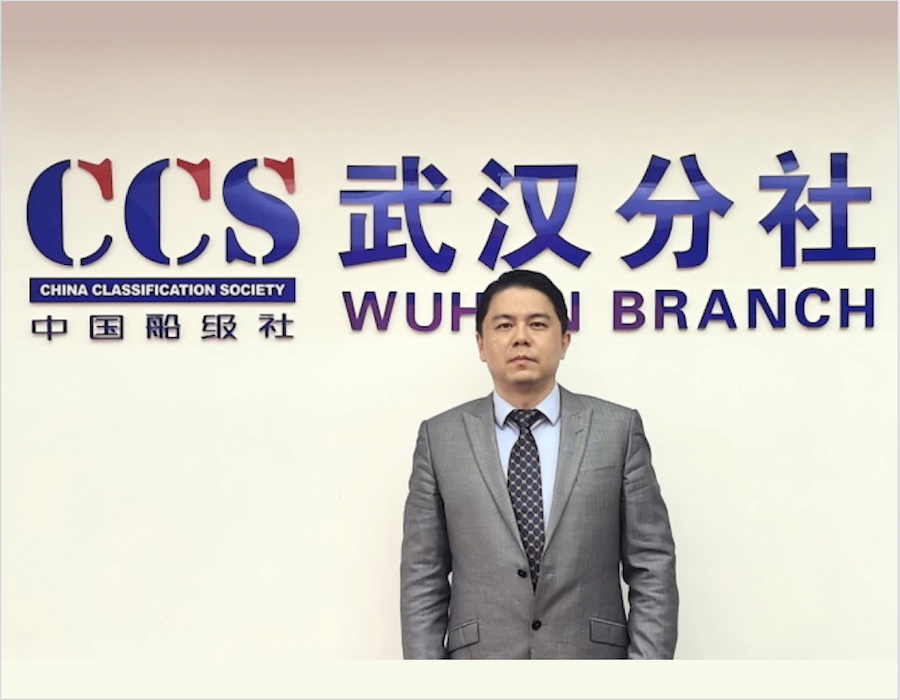
China Classification Society (CCS) on Tuesday (20 April) said it has awarded China’s first certificate of type approval for a marine fuel cell to Wuhan-based PEM fuel cell supplier Troowin Power System Technology Co.
The certificate was issued by CCS’ Wuhan branch following more than a year of reviews and on-site tests. The approval marks a major milestone in China’s pursuit of commercially viable alternative fuels and provides a new channel for the use of hydrogen fuel cells on ships.
Jia Siqing, General Manager of Industrial Products for CCS Wuhan branch, said it is a significant moment for the Chinese maritime industry as it works towards a zero-carbon future in line with President Xi’s announcement, to the United Nations in September 2020, that China will reach carbon neutrality before 2060 and ensure its greenhouse gas emissions peak in the next decade.
“CCS is working hard to develop the use of hydrogen fuel cells, “noted Jia. “Hydrogen is abundant and is an ideal candidate as a zero-emission fuel for combustion engines.
“This certificate is the culmination of many years of work. CCS published its first guidelines on harnessing hydrogen as a commercial marine fuel in 2015 with the guidelines updated in 2017 and 2020.
“The detailed research found a hydrogen-enabled ship could ultimately be as safe as one powered by conventional fuels such as diesel.”
Jia said the next phase of hydrogen development will see CCS undertake a series of real time tests on a purpose-built bulk carrier of 2,100DWT. The ship is currently at the design stage but is expected to be powered by four 130kW hydrogen fuel cells.
Once completed, the ship will be trialed along the Pearl River in Guangdong province, where it will carry operational cargoes. Reinforcing the data from these tests will be feedback from other sectors, such as the Chinese electric automotive sector.
CCS is looking to be able to store enough hydrogen to take a ship on a deep sea voyage. CCS is researching ways to store hydrogen in large quantities and combine it with other fuel sources to extend range.
“Since hydrogen is the lightest natural element, more space is needed to store it,” explained Jia.
“We are looking at methods to create hydrogen at sea, such as the use of methanol or ammonia, which can be transported easily and cheaply.
“But the main focus of our work is carrying enough bulk hydrogen, for an entire voyage. We think liquid hydrogen would be a good contender for this. In the meantime high-pressure gas cylinders would be a reasonable solution.”
Luo Xiaofeng the Director of CSS Rules & Research Institute in Wuhan said a prime objective of the Pearl River tests would be to test safety procedures.
“Hydrogen is clearly the future and is a very hot topic in China,” commented Luo.
“CCS is working with other hydrogen-use sectors and universities to share the research notably the automotive industry. Safety is absolutely key to developing a commercial case, and these are the prime factors we will be testing on the Pearl River project.”
Luo added that for the short-term, low-carbon and hybrid systems are better forms of propulsion for deep sea voyages.
In addition to conducting research on various forms of marine hydrogen fuel storage technology, CCS has also jointly carried out special research on the application of hydrogen fuel on ships with China State Shipbuilding Corporation (CSSC).
The research includes risk assessment, ventilation and fire-fighting. The studies evaluate the feasibility, reliability and safety of hydrogen fuelled ships and provide support for the development of technical regulations.
CCS is further now mandated by the China Maritime Safety Administration to research and develop the first domestic technical regulations for ships using hydrogen as fuel, which is scheduled to be released at the end of 2021.

Marine Fuel Cell

Luo Xiaofeng, Director of CCS Rules & Research Institute in Wuhan
Photo credit: China Classification Society
Published: 22 April, 2021
Methanol
World Fuel and partners complete first green methanol bunkering of car carrier in Shanghai
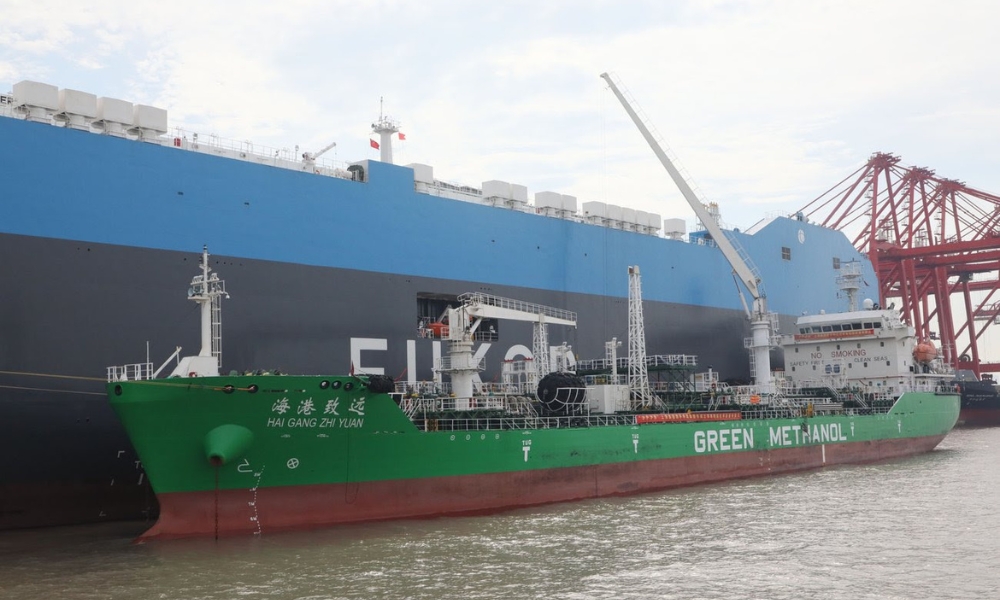
Operation involved the delivery of approximately 2,800 MT of green methanol to “Arctic Tern” via a ship-to-ship transfer using SIPG Energy’s dedicated methanol bunkering vessel “M/V Hai Gang Zhi Yuan”.
Ammonia
HPA and MB Energy develop safety concept for STS ammonia bunkering
HPA says the Port of Hamburg will become “bunker ready” for ammonia, laying the groundwork for safe and reliable ammonia bunkering in the future.
LNG Bunkering
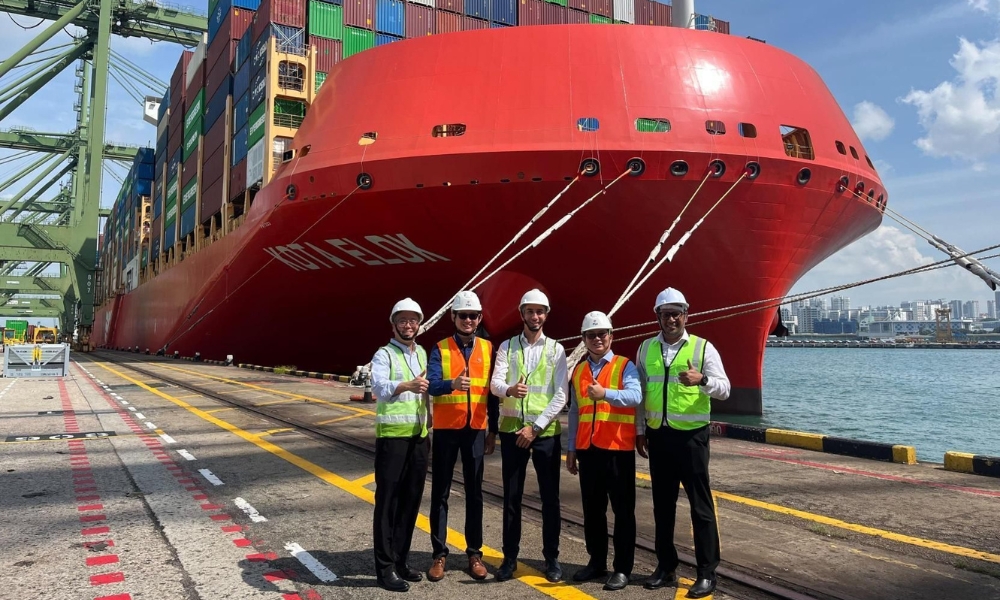
PIL’s LNG dual-fuel boxship “Kota Elok” arrives in Singapore on maiden call
As the first of 13 new 13,000 TEU vessels joining its fleet, Kota Elok is equipped to operate on LNG and low-sulphur fuel oil that helps reduce our greenhouse gas emissions.

OUR INDUSTRY PARTNERS

Singapore: High Court to hear Norvic Shipping Asia winding up application on 31 July

World Fuel and partners complete first green methanol bunkering of car carrier in Shanghai

HPA and MB Energy develop safety concept for STS ammonia bunkering

GCMD: Project CAPTURED achieves two regulatory milestones for onboard captured CO2

Alkagesta highlights key insights of Malta bunkering market in 2026

ENGINE: East of Suez Fuel Availability Outlook (22 July 2026)

Singapore: Ofiniti, ONE trial direct platform integration to streamline bunker workflows

ENGINE: Europe and Africa Fuel Availability Outlook (8 July 2026)

Malaysia: Maharani Freeport to implement MFM and e-BDN technologies for enhanced bunkering transparency

Evergreen Marine director questioned, offices searched in Taiwan insider trading probe

Singapore retains world’s leading maritime centre ranking in 2026 ISCD Index

Singapore: MPA issues circular on resolutions adopted by IMO MEPC 84

Singapore: Bunker fuel sales up by 1.6% on year in June 2026

Malaysia: MMEA detains tugboat with undocumented 10,000 litres of diesel in Kuala Langat
-
 Bunker Fuel Availability2 weeks ago
ENGINE: Europe and Africa Fuel Availability Outlook (8 July 2026)
-
 Technology1 week ago
Malaysia: Maharani Freeport to implement MFM and e-BDN technologies for enhanced bunkering transparency
-
 Legal2 weeks ago
Evergreen Marine director questioned, offices searched in Taiwan insider trading probe
-
 Business2 weeks ago
Singapore retains world’s leading maritime centre ranking in 2026 ISCD Index
-
 Port & Regulatory1 week ago
Singapore: MPA issues circular on resolutions adopted by IMO MEPC 84
-
 Bunker Fuel1 week ago
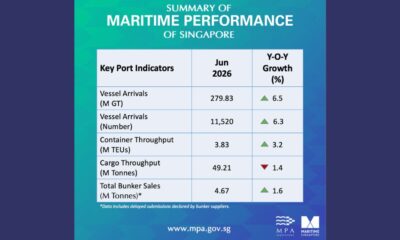
Singapore: Bunker fuel sales up by 1.6% on year in June 2026
-
 Vessel Arrest1 week ago
Malaysia: MMEA detains tugboat with undocumented 10,000 litres of diesel in Kuala Langat
-
 Alternative Fuels1 week ago
Port of Santos hosts Brazil’s first bioethanol bunkering of deep-sea containership