Connect with us

Business

IBIA ‘Bunkering & Shipping in Transition’ conference on 12-13 April to discuss maritime market developments

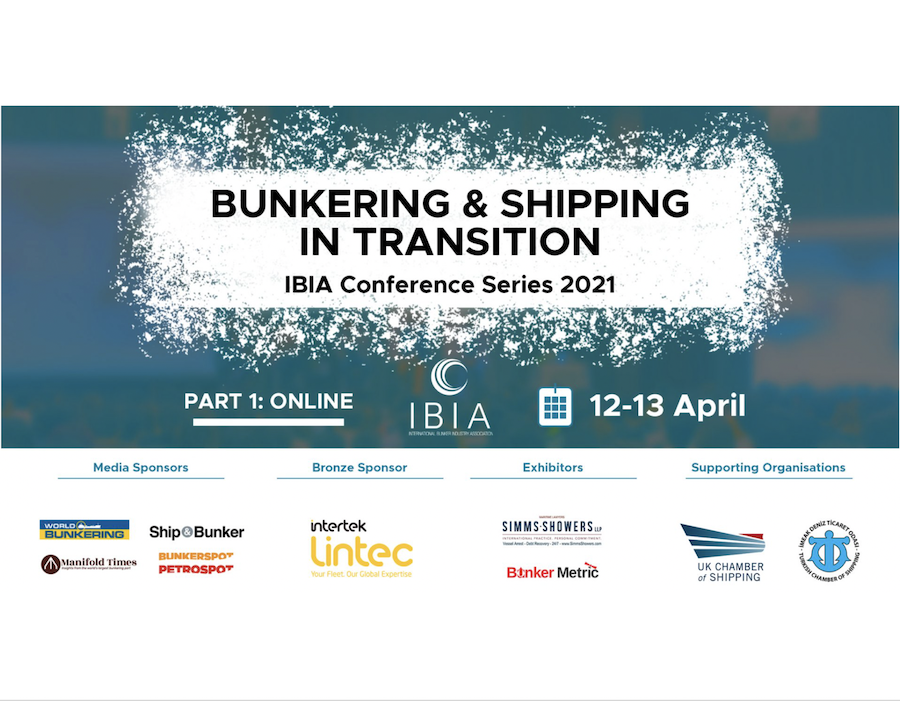
IBIA’s Director will present the latest updates from the International Maritime Organization, alongside industry experts and leaders sharing important industry developments and experiences.

Admin

Published

on

Screen Shot 2021 04 07 at 1.58.32 PM

The International Bunker Industry Association (IBIA) will be organising the first of its ‘Bunkering & Shipping in Transition’ series of conferences for 2021 from Monday, 12 to 13 April.

The digital event aims to bring together the global bunkering and shipping industry for networking. Delegates will have the opportunity to join panellists for a live Q&A.

Notably, IBIA’s Director, Unni Einemo will present the latest updates from the IMO, alongside industry experts and leaders sharing important industry developments and experiences.

The official agenda for the event is as follows:

Day 1: Monday 12 April 2021

10:00 SESSION ONE: IMO Regulatory Changes

Gain first-hand insights of the latest updates from the IMO and what it means for our industry as well as the highlights of what exactly is changing in Annex VI to progress the IMO’s initial GHG strategy.

11:00 SESSION TWO: Coping with Covid-19

Is COVID-19 is still preventing the world from returning to normal. What is the impact on the bunkering & shipping industry? Are business models changing in 2021 and are we doing things differently? Our expert panel will discuss any specific trends for 2021 due to the effects of COVID-19.

12:00 SESSION THREE: Shipping & Freight Markets

What can we expect from the Shipping & Freight Markets as 2021 is already on course, but with many unknowns? We have a clearer picture of the year that just passed, where does that leave us in terms of what to expect for the year ahead?

13:00 SESSION FOUR: Understanding VLSFO

2020 saw the induction of VLSFO blends, which are very different from the HSFOs that dominated the market previously. Our expert panel will discuss the impact on fuel quality and operational issues, and whether theISO:8217 specification is still sufficient.

Day 2: Tuesday 13 April 2021

10:00 SESSION FIVE: Alternative fuels for Shipping

The need to reduce emissions of air pollutants like SOx and NOx has already been driving the industry toward new types of cleaner-burning fuels. Going forward, the decarbonisation drive will have an even bigger impact. Join industry experts introducing what we should expect in the years ahead.

11:30 SESSION SIX: Bunkering and Digitisation

Before the COVID-19 pandemic reshaped global commerce, there was an increase in digital activity within the bunkering space. New ways of working have been developed. In this panel discussion, join new and established players in the online bunker procurement space to discuss what digital bunkering has to offer the industry.

12:30 SESSION SEVEN: Credit Risk

As banks pull their financing against a backdrop of bankruptcies and fraudulent activity, understanding and dealing with credit and risk management has never been more critical. Get the insights you need by joining industry heavyweights for this panel discussion.

13:30 Closing Remarks Unni Einemo – IBIA Director and IMO Representative


Photo credit: IBIA
Published: 7 April, 2020

Continue Reading

Methanol

OOCL dual-fuel boxship completes first green methanol bunkering op at Qingdao Port

“OOCL Wisdom” completed its first green methanol bunkering and commenced its maiden voyage to Europe at Qingdao Port on 3 July.

Admin

Published

on

By

OOCL dual-fuel boxship completes first green methanol bunkering op at Qingdao Port

​International container transportation and logistics company Orient Overseas Container Line (OOCL) on Friday (3 July) said its first methanol dual-fuel containership, OOCL Wisdom, completed its first green methanol bunkering and commenced its maiden voyage at Qingdao Port.

OOCL Wisdom is the first in a series of seven methanol dual-fuel container vessels. With a maximum capacity of 24,168 TEU, it is currently the world’s largest methanol dual‑fuel container vessel and is deployed on the Asia – North Europe Loop 1 (LL1) service.

Mr. Peter Pan, Director of Trades of OOCL, said: “OOCL Wisdom completed its first green methanol bunkering and commenced its maiden voyage to Europe at Qingdao Port, representing a significant achievement of the deepening collaboration between OOCL and Shandong Port Group, and reflecting OOCL’s steadfast commitment to green and low‑carbon development, digital intelligence and sustainability.”


Photo credit: Orient Overseas Container Line
Published: 6 July, 2026

Continue Reading

LNG Bunkering

Zhejiang Province wraps up first cross-regional bonded LNG bunkering operation

“Hai Yang Shi You 302” supplied container ship “MSC Maria Laura” with 3,500 cubic meters of bonded LNG at Chuanshan Port Area, after the bunkering vessel received bonded LNG in Zhoushan.

Admin

Published

on

By

Zhejiang Province wraps up first cross-regional bonded LNG bunkering operation

Zhejiang Province on Saturday (27 June) completed its first cross-regional bonded LNG bunkering operation at Chuanshan Port Area of ​​Ningbo-Zhoushan Port, according to Hangzhou Customs. 

Bunkering vessel Hai Yang Shi You 302 travelled to ENN Zhoushan LNG receiving terminal to load bonded LNG. The vessel then supplied container ship MSC Maria Laura with 3,500 cubic meters of bonded LNG at Chuanshan Port Area. 

Zhejiang Province wraps up first cross-regional bonded LNG bunkering operation

Compared with the traditional single-port bunkering model, the cross-regional operation removes the geographical barriers between Zhoushan’s gas supply and bunkering demand in Ningbo’s core port area, enabling cross-port LNG transfer within the province.

“The new operating model addresses longstanding constraints associated with the geographical limitations of LNG supply reloading and tight operational time windows,” said Chen Bangkui, Business Manager at CNOOC Zhejiang New Energy Co Ltd. 

“We can now flexibly source bonded LNG from both Zhoushan and Ningbo, significantly improving operational flexibility and efficiency.”


Photo credit: Hangzhou Customs
Published: 6 July, 2026

Continue Reading

Battery

ICCT: China’s electric cargo ship fleet grows 950% in three years

In its latest blog, ICCT says vessel sizes for electric cargo ships have grown significantly, indicating that China is testing the feasibility of electrification for increasingly larger ships.

Admin

Published

on

By

CHUTTERSNAP MT

The International Council on Clean Transportation (ICCT) recently said China’s fleet of electric cargo ships has grown by 950%, from just four vessels in 2022 to 42 in 2025.

According to its latest blog, electrification is rapidly expanding along inland waterways in the country, offering a pathway to cut emissions, improve air quality, and lower operating costs.

ICCT said electric cargo ships are entering real-world operation at a rapidly growing pace

“Ship types have diversified, from bulk carriers and container ships to multi-purpose cargo ships. At the same time, vessel sizes have grown significantly, with the maximum deadweight tonnage (DWT) rising from around 3,000 tonnes in 2022 to approximately 14,000 tonnes in 2025,” it said.

“This indicates that China is testing the feasibility of electrification for increasingly larger ships.”

Although battery capacity constraints continue to limit sailing range per charge—which typically hovered between 150 km and 400 km from 2022 to 2025—trends show steady improvement; by 2025, electric cargo ships with a range of up to 500 km were already in operation in China.

Inland waterways have become the primary testing ground for electric cargo ship deployment. 

By the end of 2025, 86% of electric cargo ships in China were operating on internal rivers. 

“Nine provinces and municipalities have already launched pilot projects, covering major waterways such as the Yangtze River, the Pearl River, and the Beijing-Hangzhou Grand Canal,” ICCT added.

The blog also explored the opportunities, challenges, and policy actions that could accelerate the shift to electric inland shipping.

“Developing an enhanced subsidy that favors electric vessels, on top of the current vessel trade-in subsidy program, could help reduce the upfront investment burden for electric vessel adoption,” it recommended.

ICCT added that tightening ship engine emission standards toward world-leading levels could increase the compliance costs of conventional-fuel vessels and improve the relative competitiveness of electric ships.

“The electrification of inland shipping in China is already underway; what is needed now is smart policy to accelerate the transition,” it said.


Photo credit: CHUTTERSNAP on Unsplash
Published: 6 July, 2026

Continue Reading

Trending