Connect with us

Business

SSY: Implications on shipping from MEPC75 and market uncertainties

The combination of low newbuilding deliveries and a potential rebound in demand suggests the shipping industry cannot deliver a reduction in emissions by 2030, it said.

Admin

Published

on

Screen Shot 2020 11 27 at 2.19.37 PM

World’s largest independent shipbrokerage Simpson Spence Young (SSY) on Thursday (26 November) said Newbuilding orderbooks have dipped to historically low levels relative to existing fleets, with the dry bulk carrier sector one of the most extreme examples.

“The current bulker orderbook of 56.1 Mdwt represents just 6.3% of the existing capacity, the lowest percentage in almost 30 years,” said Derek Langston, Head of Research at leading shipbrokers SSY.

“At the same time, the dry bulk carrier fleet is ageing: the ratio of 15+ year old vessels to the orderbook is the highest since 2003.”

SSY noted while these trends are partly due to uncertainties over the direction of the market, they also reflect doubts over the speed at which financially viable designs for new low carbon ships can be developed.

Last week’s draft approvals at the IMO’s Marine Environment Committee (MEPC) could compound, rather than reverse, these trends for several more years as there seems little prospect of an immediate regulatory-driven acceleration in demolition (and replacement newbuilding demand), added SSY.

SSY listed the following implications for both the dry bulk sector’s supply/demand balance and CO2 emissions due to such developments:

  • Alongside limited scrapping activity until enforcement takes effect, the new IMO measures raise the prospect of continued slow steaming by much of the existing dry bulk carrier fleet.
    • This is at a time when a ‘middle-age spread’ is developing in the fleet’s age profile.
    • The biggest five-year concentration of dwt capacity was built in the years 2009-13 and will, therefore, be 13-17 years of age when IMO enforcement measures could begin to bite in 2026.
    • Without sharply increased anticipatory newbuilding orders, or a decline in dry bulk trade volumes, in the intervening years, a large portion of the middle-aged fleet will have to continue trading towards the end of the decade (at potentially slower speeds) in order to avoid a squeeze in cargo carrying capacity.

  • Carbon emissions, meanwhile, could continue to trend up.
    • A recent report by Marine Benchmark showed a net increase in maritime greenhouse gas emissions since 2011 as the effects of an expanding global fleet have exceeded efficiency gains.
    • In the case of dry bulk carriers, Marine Benchmark estimates annual average growth in emissions of close to 3% p.a. since 2011.

“The combination of low newbuilding deliveries, a potential rebound in demand and an ageing fleet implies that CO2 emissions are more likely to track fleet growth this decade, which suggests that the shipping industry cannot deliver an absolute reduction in CO2 emissions by 2030,” cautioned Torbjorn Rydbergh, Managing Director of Marine Benchmark.


Photo credit: Simpson Spence Young
Published: 27 November, 2020

Continue Reading

FuelEU

GTT Marine partners with BetterSea on FuelEU trading, pooling integration

Integration will enable GTT Marine customers and platform users to execute FuelEU trading and pooling end-to-end, directly from the Vesper Insights platform.
Admin

Published

on

By

GTT Marine partners BetterSea to integrate FuelEU trading, pooling into Vesper Insights

BetterSea, provider of a FuelEU compliance platform and marketplace, and GTT Marine, a business unit of the GTT Group, on Monday (21 September) announced a white-label integration partnership to accelerate FuelEU Maritime compliance for shipping companies.

Under the partnership, GTT Marine will integrate BetterSea’s platform into its own Vesper Insights platform offering, enabling GTT Marine customers and platform users to execute FuelEU trading and pooling end-to-end, directly from the Vesper Insights platform. 

Through this white-label integration, customers will gain access to BetterSea’s full FuelEU infrastructure, including marketplace access, simulation tools, pooling and post-trade workflows, as well as streamlined Thetis reporting capabilities, all within the Vesper Insights environment. 

This creates a uniquely aligned offering for customers seeking a single, trusted route to FuelEU compliance and execution.

As FuelEU Maritime moves into operational reality, shipping companies need more than visibility into compliance exposure. They need the ability to assess options, execute transactions, and complete workflows reliably and at scale. 

The BetterSea-GTT Marine partnership addresses that need by combining BetterSea’s execution-ready FuelEU platform with GTT Marine’s strong position in vessel performance and maritime innovation.

Through the BetterSea-GTT Marine partnership, customers will gain:

  • access to FuelEU trading and pooling execution directly within GTT Marine Vesper Insights platform
  • access to BetterSea’s FuelEU marketplace
  • simulation tools to compare compliance pathways across different regulations and evaluate cost exposure
  • pooling and post-trade workflows supported by standardized legal and financial structures
  • pool tracking and Thetis reporting capabilities to support the full FuelEU execution process
  • fully streamlined and connected route to end-to-end FuelEU compliance

Maximilian Schroer, Co-CEO, BetterSea, said: “This partnership with GTT Marine marks an important step in our mission to make FuelEU compliance and pooling easier to access and execute, while underlining BetterSea’s position as the market leading FuelEU marketplace. 

“By embedding our platform into GTT Marine Vesper Insights offering, we are giving customers a seamless and efficient path from compliance understanding to full trading and pooling execution, all within an environment they already know and use.”

Christian Treu, VP Revenue, GTT Marine, said: “At GTT Marine, we are committed to equipping our customers with practical and high-value solutions for the decarbonisation transition. 

“Through this partnership with BetterSea, we can offer our users direct access to a complete FuelEU execution framework, from simulation to trading, pooling, and reporting, directly via our platform.” 


Photo credit: GTT Marine
Published: 22 September, 2026

Continue Reading

Alternative Fuels

DNV on IMO CCC 12: Revised guidelines for methanol as marine fuel

CCC 12 finalized the revision of the interim guidelines for use of methyl/ethyl alcohol as fuel while work continued on guidelines for low-flashpoint oil fuels and onboard carbon capture and storage systems.
Admin

Published

on

By

RESIZED Chris Pagan

Classification society DNV on Monday (21 September) highlighted progress made on several regulatory and technical matters at the 12th session of the IMO Sub-Committee on Carriage of Cargoes and Containers (CCC 12), held from 14 to 18 September. 

This includes alternative fuels, cargo securing, onboard carbon capture systems, and battery carriage: 

Amendments to the IGF Code and development of guidelines for alternative fuels and related technologies

Methyl/ethyl alcohols

CCC 12 finalized the revision of the Interim Guidelines for the Safety of Ships Using Methyl/Ethyl Alcohol as Fuel (MSC.1/Circ.1621). The amendments revise all sections of the existing guidelines, taking into account experience gained to date.

The revised guidelines:

  • provide more flexibility in fuel tank placement and leakage-handling arrangements;
  • introduce a new concept for ventilation of fuel spaces;
  • expand guidance on the design of bunkering stations and fire extinguishing; and
  • add new guidance on bunkering operations and personal protective equipment.

Low-flashpoint oil fuels

CCC 12 continued work on the interim guidelines for ships using low-flashpoint oil fuels (fuel with a flashpoint between 52°C and 60°C). It was agreed not to develop detailed provisions for the “temperature-controlled engine room concept” but focus on a safety concept more aligned with the existing guidelines under the IGF code, however with major simplifications of the safety barriers. Work on the interim guidelines will continue in a Correspondence Group aiming for finalization at CCC 13 in 2027.  

Fuel cell power installations and IGF Code amendments

The revision of the Interim Guidelines for the Safety of Ships Using Fuel Cell Power Installations (MSC.1/Circ.1647), and other proposals for amendments to the IGF Code were not discussed in detail, but work will continue in a Correspondence Group reporting to CCC 13 in 2027.  

Development of a safety regulatory framework to support the reduction of GHG emissions from ships using new technologies and alternative fuels

Onboard carbon capture and storage (OCCS)

CCC 12 started the discussion to develop guidelines for the safety of ships fitted with OCCS. The guidelines should contain a technology-neutral main body for common ship-level requirements, while technology-specific safety requirements will be placed in individual annexes. Work on the guidelines will continue in a Correspondence Group reporting to CCC 13 in 2027. The guidelines are expected to be finalized in 2028.

Note: The full technical and regulatory news by DNV can be found here


Photo credit: Chris Pagan on Unsplash
Published: 22 September, 2026

Continue Reading

Biofuel

Petrochina International blends over 30,000 mt of marine biofuel since March

Company has been developing marine biofuel blending operations at China (Zhejiang) Pilot Free Trade Zone, leveraging storage and logistics facilities at its Aoshan base.
Admin

Published

on

By

Zhoushan completes China’s first batch of marine biofuel blending under pilot programme

Petrochina International Co Ltd recently said it has blended more than 30,000 metric tonnes (mt) mt of biofuel since completing the country’s first biofuel marine fuel blending operation on 13 March.

The company said the milestone demonstrates its ability to conduct continuous and large-scale biofuel marine fuel blending operations.

The company has been developing marine biofuel blending operations at China (Zhejiang) Pilot Free Trade Zone, leveraging storage and logistics facilities at its Aoshan base.

Its latest product, B24 marine fuel containing 24% biofuel component, meets relevant International Maritime Organization (IMO) requirements and marine fuel standards, according to the company. It said the product can be supplied for bunkering vessels operating on international routes.

It has used its global trading network to secure feedstock supplies and support cost control and supply security for the blending operations, it added.

The company said the large-scale blending of its marine biofuel products marks a development in China’s marine biofuel blending market.

It plans to work with upstream and downstream businesses within its group to support the development of Zhoushan Port as a major bonded marine fuel bunkering hub and contribute to its parent group’s transition towards lower-carbon energy.

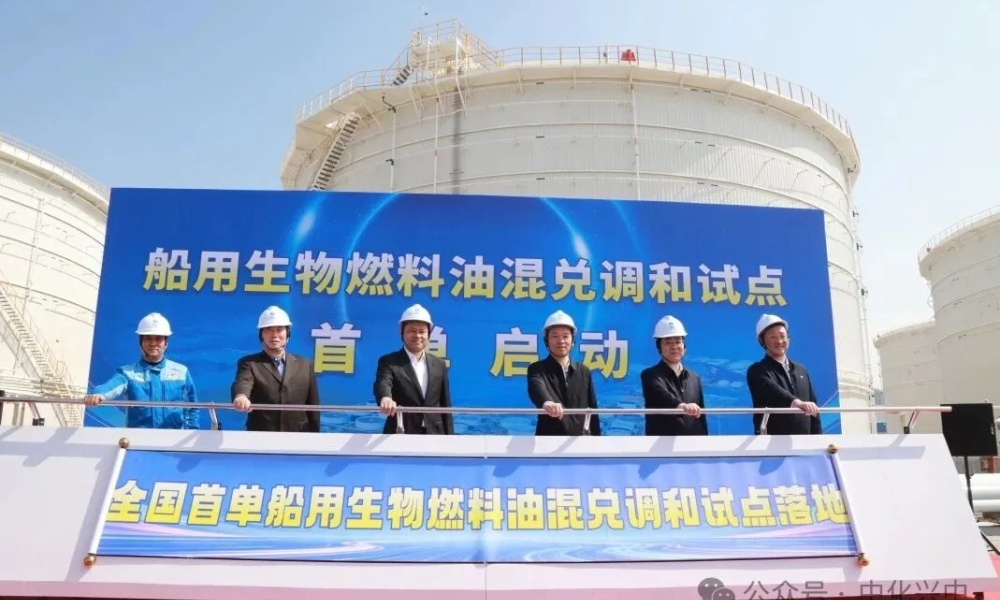
Manifold Times previously reported China (Zhejiang) Pilot Free Trade Zone launching the first pilot programme for marine biofuel blending in China with the completion of the first batch of B24-HSFO. 

The launch was marked with the blending of 2,000 mt of biodiesel and 6,300 mt of high sulphur fuel oil (HSFO) in storage tank F-02 of Sinochem-Xingzhong Oil Staging (Zhoushan), producing 8,300 mt of B24-HSFO. 

Manifold Times also reported the first cross-regional bonded bunkering operation of blended biofuel in East China was successfully completed at the Meishan Port Area of ​​Ningbo-Zhoushan Port. 

The B24-HSFO used in the bunkering operation was supplied by the Aoshan Petroleum Base in Zhoushan from the first pilot programme for marine biofuel blending in China. 

Related: Zhoushan completes China’s first batch of marine biofuel blending under pilot programme
Related: Ningbo wraps up East China’s first cross-regional biofuel blending and bunkering
Related: China debuts first marine biofuel blending pilot programme in Zhoushan
Related: China’s first batch of domestically blended marine biofuel delivered to Qingdao for bunkering


Photo credit: Sinochem-Xingzhong Oil Staging (Zhoushan)
Published: 21 September, 2026

Continue Reading

Trending