Connect with us

Business

Clyde & Co reviews sanctions and the maritime industry from the OFAC & OFSI advisories

In contrast to earlier guidance, the OFAC Advisory now sets out in detail what it expects in terms of sanctions risk management from a myriad of industry stakeholders.


Admin

Published

on

legal 1143114 1920

Patrick Murphy and John Keough, partners at international law firm Clyde & Co on Wednesday (5 August) published an article analysing some details found in the recently released OFAC sanctions “Advisory” directed at the maritime industry and compares it to a similar advisory released by OFSI in the UK.

The shipping and commodities industries have found themselves at the forefront of sanctions developments in recent months.  In May 2020, the US Departments of State and Treasury (the latter of which includes OFAC) and the US Coast Guard provided a sanctions “Advisory” directed at the Maritime, Energy and Metals Sectors and Related Communities (the OFAC Advisory).  The UK’s Office of Financial Sanctions Implementation produced a similar advisory on 27 July 2020 (the OFSI Advisory).  It is no coincidence that these key sanctions bodies are looking closely at the maritime sector.

OFAC has historically leveraged its reach by co-opting critical elements of the global economy into enforcing its sanctions objectives.  It has traditionally looked to the banking industry to spearhead compliance given its gateway involvement in financial transactions, requiring it to filter out transactions that might be related to sanctioned persons or jurisdictions.  Now, as the United States continues its “maximum pressure” campaign of sanctions against Iran, North Korea, Syria and Venezuela in particular, OFAC is ratcheting up its intense focus on the maritime and commodities industries to require sanctions compliance.

OFAC’s growing focus on due diligence in shipping surfaced in a series of advisory notes issued to the maritime industry from 2018 onwards – in respect of North Korea (February 2018 and March 2019), Iran (September 2019) and Syria (November 2018 and March 2019).  But the OFAC Advisory of May 2020 is far more comprehensive in both its scope and detail than any of the earlier notes. 

Firstly, it is not limited to guidance in respect of specific sanctions targets such as North Korea or Iran (although it does update earlier advisory notes for each of those regimes).  Rather, it is expressed to be comprehensive sanctions compliance guidance to the maritime community generally – as well as to the energy and metals sectors which were not so obviously targeted in the earlier notes.  In this regard the OFAC Advisory can be seen as an industry specific development of an earlier OFAC guidance, its “Framework for OFAC Compliance Commitments” published in May 2019, which set out OFAC’s expectations to the world at large of what it expected the essential components of a Sanctions Compliance Program to look like.  

Secondly, in contrast to the briefer earlier guidance notes, the OFAC Advisory sets out detailed guidance of what OFAC expects from a host of key industry participants in terms of sanctions risk management and due diligence – from flag states, port state control authorities and insurers, to owners, charterers, crewing companies and even ship captains.  This more prescriptive guidance illustrates how OFAC expects each industry participant to expand its role in sanctions compliance.  It also highlights a laundry list of what it terms “deceptive shipping practices” that it encourages industry participants to be vigilant against,  and business practices to help identify sanctionable behaviour.  

Whilst the OFAC Advisory repeatedly states in footnotes that “is not intended to be, nor should it be interpreted as, comprehensive or as imposing requirements under U.S. law or otherwise addressing any particular requirements under applicable law,” those in the shipping industry are well-advised to read the OFAC Advisory to mean that OFAC expects the maritime and commodities industries to be aware of the guidance and for industry participants to factor it into their sanctions compliance programs.  The adoption of some, or all, of the measures recommended by OFAC will no doubt be factors that OFAC would consider as mitigating any penalties if a violation occurred.  Over time, as industry participants adopt more stringent sanctions compliance measures, it will be difficult (and risky) for others not to do the same.

The OFAC Advisory reflects a heightened awareness of the shipping industry’s interest in cooperation measured with a balance of realism: The OFAC Advisory language reflects a measured approach based on feedback from ongoing discussion with industry sectors, including marine insurers among others.  However, it did not contain any list of questionable vessels and companies, as had been set forth in a prior Advisory, which caused confusion among marine insurers, flag states, shipowners and charterers alike, in assessing whether to continue business with such “suspect” entities.

OFSI is a much newer body than OFAC; it has only existed in its current form since 2016 when it replaced HM Treasury’s Asset Freezing Unit.  Like OFAC, OFSI has until now primarily focused on the financial services sector in leveraging private sector assistance to enforce sanctions.  It has produced helpful general guidance notes on financial sanctions as well as guidance for the charities and the import / export sectors.  But it has not, until now, turned its attention to the maritime industry.    

In common with the OFAC Advisory, OFSI identifies a number of what it terms “illicit and suspicious shipping practices,” some of which are referred to by OFAC (AIS disablement, ship to ship transfers, falsified shipping documentation) and some of which are not (e.g. the use of cryptoassets).  Again, similarly to OFAC, it highlights country specific risk factors for the industry in relation to Iran, North Korea and Syria (although the Iran risks identified are notably different to OFAC’s given the UK’s continued commitment to the JCPOA). And, again similar to the OFAC Advisory, it sets out its views on what due diligence looks like for the industry, albeit at a high level: a proper understanding of the sanctions against high risk jurisdictions if you operate there, the appropriate use of AIS screening and “AIS switch off clauses”, enquiries into ownership structures of counterparts and checks on suspected fraudulent documents.  

It is true to say that the OFSI Advisory is, overall, less specific and detailed than the OFAC Advisory.  For example, it does not provide the detailed lists of risk mitigation measures and due diligence protocols that the OFAC Advisory does for each specific industry participant, or as much detail on the structure of a sanctions compliance program for industry participants. 

But the overall thrust of the two Advisories is unmistakable: both governments expect the maritime and commodities industries to do their part in tackling sanctions evasion by the application of appropriate due diligence that identifies bad actors and acts on suspicious or deceptive shipping practices in much the same way as banks and insurers have borne the burden of identifying bad actors using the financial services industry.  The reach of the two enforcement bodies is extensive: OFSI has jurisdiction over a number of key maritime insurers who are based in the UK.  OFAC is responsible for the enforcement of US secondary sanctions that have the capacity to block and designate as sanctioned persons anywhere in the world, not just US persons.  The fact that these two notes have followed each other in short order is instructive: the industry has been put on notice that the two enforcement bodies are looking closely at it.  If the industry continues to aid sanctions evasion by not implementing the risk mitigation tools identified by OFAC and OFSI, the business can expect the sort of attention that the banking industry have received in recent years – – and had to improve their level of due diligence and compliance to match the regulators’ expectations. 

Further notes in this series will look in more depth at particular aspects of the two advisories and the latest developments on the sanctions front lines, including an analysis of what might constitute a reasonable risk-based program for sanctions compliance and due diligence in shipping sectors in light of OFAC and OFSI’s focus on deceptive shipping practices, the evolving impact of US sanctions on non-US persons and companies, how to use (and not use) sanctions clauses in maritime agreements and marine insurance policies, and how AIS switch off clauses might (and might not) work.


Photo credit:
Fathromi Ramdlon
Published: 7 August, 2020

Continue Reading

Bunker Fuel

Singapore: Bunker fuel sales drops by 6.8% on year in May 2026

4.55 million mt of various marine fuel grades were delivered at the world’s largest bunkering port in May, down from 4.88 million mt recorded during the similar month in 2025, according to MPA data.

Admin

Published

on

By

Singapore: Bunker fuel sales drops by 6.8% on year in May 2026

Sales of marine fuel at Singapore port dropped by 6.8% on year in May 2026, according to data from the Maritime and Port Authority of Singapore (MPA).

In total, 4.55 million metric tonnes (mt) (exact 4,548,000 mt) of various marine fuel grades were delivered at the world’s largest bunkering port in May, down from 4.88 million mt (4,878,100 mt) recorded during the similar month in 2025.

Deliveries of marine fuel oil, low sulphur fuel oil, ultra low sulphur fuel oil, marine gas oil and marine diesel oil in May (against on year) recorded respectively 1.79 million mt (-5.3% from 1.89 million mt), 2.29 million mt (-6.5% from 2.45 million mt), zero (-100% from 1,200 mt), 600 (35.2% from 1,700 mt) and zero (from zero).

Singapore: Bunker fuel sales drops by 6.8% on year in May 2026

Bio-blended variants of marine fuel oil, low sulphur fuel oil, ultra low sulphur fuel oil, marine gas oil and marine diesel oil in May, (against on year) recorded respectively 11,600 mt (-71.6% from 40,900 mt), 36,400 mt (-62.1% from 96,100 mt), zero (from zero), zero (from zero) and zero (from zero). B100 biofuel bunkers, introduced in February last year, recorded 12,800 mt (+573.7% from 1,900 mt). 

LNG and methanol sales were 70,300 mt (+56.2% from 45,000 mt) and zero (from zero) respectively. There were no recorded sales of ammonia for the month and so far since 2025.


Photo credit: Maritime and Port Authority of Singapore
Published: 15 June, 2026

Continue Reading

Bunker Fuel Quality

Bunker flash: High concentrations of catalytic fines, elevated acid numbers found in Singapore

Maritec-Naias issued an alert regarding high levels of catalytic fines and elevated acid numbers present in multiple VLSFO bunker samples from deliveries in the Singapore port.

Admin

Published

on

By

RESIZED Hans Reniers on Unsplash

Bunker fuel testing and marine surveying business Maritec-Naias on Friday (12 June) issued an alert regarding high levels of catalytic fines and elevated acid numbers present in multiple VLSFO bunker samples from deliveries in the Singapore port: 

During the period of 20 May 2026 and 02 June 2026, Maritec Pte. Ltd. (hereafter referred to as Maritec-Naias) conducted testing on five samples representing Very Low Sulphur Fuel Oil (VLSFO) deliveries from two suppliers in the Singapore port. The analyses revealed Aluminium and Silicon (Al+Si) concentrations ranging from 61 mg/kg to 68 mg/kg.

It is important to note; these values exceed the ISO 8217:2010/2017 specification limit of 60 ppm but remain within the permissible tolerance limit of 72 ppm under ISO 4259 for a single test result. In this regard, Catalytic Fines content, (Aluminium+Silicon), above 60 ppm is regarded as high. Of the five samples, three originated from one supplier, while the remaining two were from another.

Aluminium and Silicon constitute the principal classes of abrasive solids in fuels. Elevated concentrations of such particles at the engine inlet can precipitate abnormal wear and tear of fuel system components, piston rings, and cylinder liners. To safeguard against this, many engine manufacturers stipulate a maximum threshold of 15 mg/kg Al+Si at the engine inlet.

The primary method of mitigating Catfines is through an efficiently operating fuel purification system. Monitoring Aluminium and Silicon levels both before and after centrifugation provides a reliable measure of the system’s effectiveness in removing these contaminants.

During a similar period, Maritec-Naias also tested fifteen bunker fuel samples representing VLSFO that exhibited elevated Acid Numbers, ranging from 2.0 mg KOH/g to 2.5 mg KOH/g. While these values remain within specification limits, they are nonetheless considered at higher side. Elevated Acid Numbers may stem from contamination with acidic compounds such as Phenolic compounds and Alkyl Resorcinols, often associated with Estonian Shale Oil. Such contaminants can lead to operational complications including sludge formation, fuel pump seizures, and compromised injection equipment cleanliness.

Maritec-Naias Recommendations

  • High Catfines monitoring: Maritec-Naias advises collecting samples at critical points within the fuel system — including the fuel oil tank transfer pump, before and after centrifuge, service tank, and after fine-filter — to evaluate the efficiency of fuel cleaning.
  • Elevated Acid Numbers: For fuels with elevated Acid Numbers, Maritec-Naias recommends conducting Gas Chromatography-Mass Spectrometry (GC-MS) using the Solid Phase Extraction (SPE) method to identify the specific acidic compounds present or upgrading your marine fuel testing package to MFTP Plus, which enables pre-emptive monitoring to detect major harmful substances prevalent in the market, such as Cashew Nut Shell Liquid (CNSL), Phenolic compounds and Alkyl Resorcinols that cause damage to equipment.

Maritec-Naias states, while all data and findings presented in this document are true, it does not reflect on the overall quality of fuel being supplied in Singapore region. If you intend to bunker at this region, please request for a Certificate of Quality (CoQ) prior to loading.


Photo credit: Hans Reniers on Unsplash
Published: 15 June, 2026

Continue Reading

Incident

Three dead after supply boat sinks following collision off Pasir Panjang Terminal

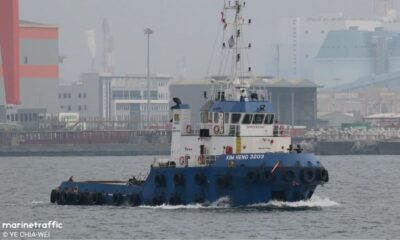
PCG recovered three bodies from the waters after a supply boat sank off Pasir Panjang Terminal on 12 June 2026 at about 9.30am following a collision with a landing craft.

Admin

Published

on

By

RESIZED bunker tanker singapore

The Maritime and Port Authority of Singapore (MPA) on Friday (12 June) said a supply boat sank off Pasir Panjang Terminal at about 9.30am after colliding with a landing craft. 

MPA, Police Coast Guard (PCG), and SCDF Marine Division, immediately activated their crafts to the incident site and commenced search and rescue operations.

“The landing craft is stable with no reported injury to crew on board,” MPA said in a statement. 

PCG has recovered three bodies from the waters, believed to be deceased crew members of the sunken supply boat. Search and rescue operations, including diving operations, are ongoing to determine if there are other crew members from the supply boat missing.

“Port operations have not been affected. Navigational broadcasts have been issued advising vessels to keep clear of the incident area,” it added.

“Investigations into the incident are ongoing.” 


Photo credit: Manifold Times
Published: 15 June, 2026

Continue Reading

Trending