Connect with us

Environment

IMO pushes forward with work to meet ship emission reduction targets

IMO shares summary of Intersessional Working Group on Reduction of GHG Emissions from Ships meeting.

Admin

Published

on

5dd37376a89b9 1574138742

The following of the recent IMO Intersessional Working Group on Reduction of GHG Emissions from Ships has been provided by the International Maritime Organization:

The IMO Intersessional Working Group on Reduction of GHG Emissions from Ships has made significant progress in pushing forward with work to help achieve the ambitious targets set out in the initial IMO strategy on reduction of GHG emissions from ships, which aims, as a matter of urgency, to decarbonise international shipping in this century. 

IMO is committed to working to combat climate change, in line with the United Nations Sustainable Development Goal (SDG) 13 on climate action.

National Action Plans – draft MEPC resolution agreed

The working group agreed the draft text of a resolution to be put forward to the next Marine Environment Protection Committee (MEPC) for adoption. The text would urge Member States to develop and update a voluntary National Action Plan (NAP) with a view to contributing to reducing GHG emissions from international shipping.

It suggests such National Action Plans could include but are not limited to: (a) improving domestic institutional and legislative arrangements for the effective implementation of existing IMO instruments, (b) developing activities to further enhance the energy efficiency of ships, (c) initiating research and advancing the uptake of alternative low-carbon and zero-carbon fuels, (d) accelerating port emission reduction activities, consistent with resolution MEPC.323(74), (e) fostering capacity-building, awareness-raising and regional cooperation and (f) facilitating the development of infrastructure for green shipping.

The resolution would invite Member States to elaborate those arrangements (legal, policy, institutional, etc.) that they put in place or plan to do so to support emission reduction from ships, in accordance with their national conditions, circumstances and priorities.

The resolution would encourage those States which had already adopted national action plans to share their experiences with IMO.

The draft resolution will be submitted to the next Marine Environment Protection Committee session, MEPC 75 (30 March to 3 April 2020) with a view to its adoption.  

Candidate measures to further reduce GHG emissions

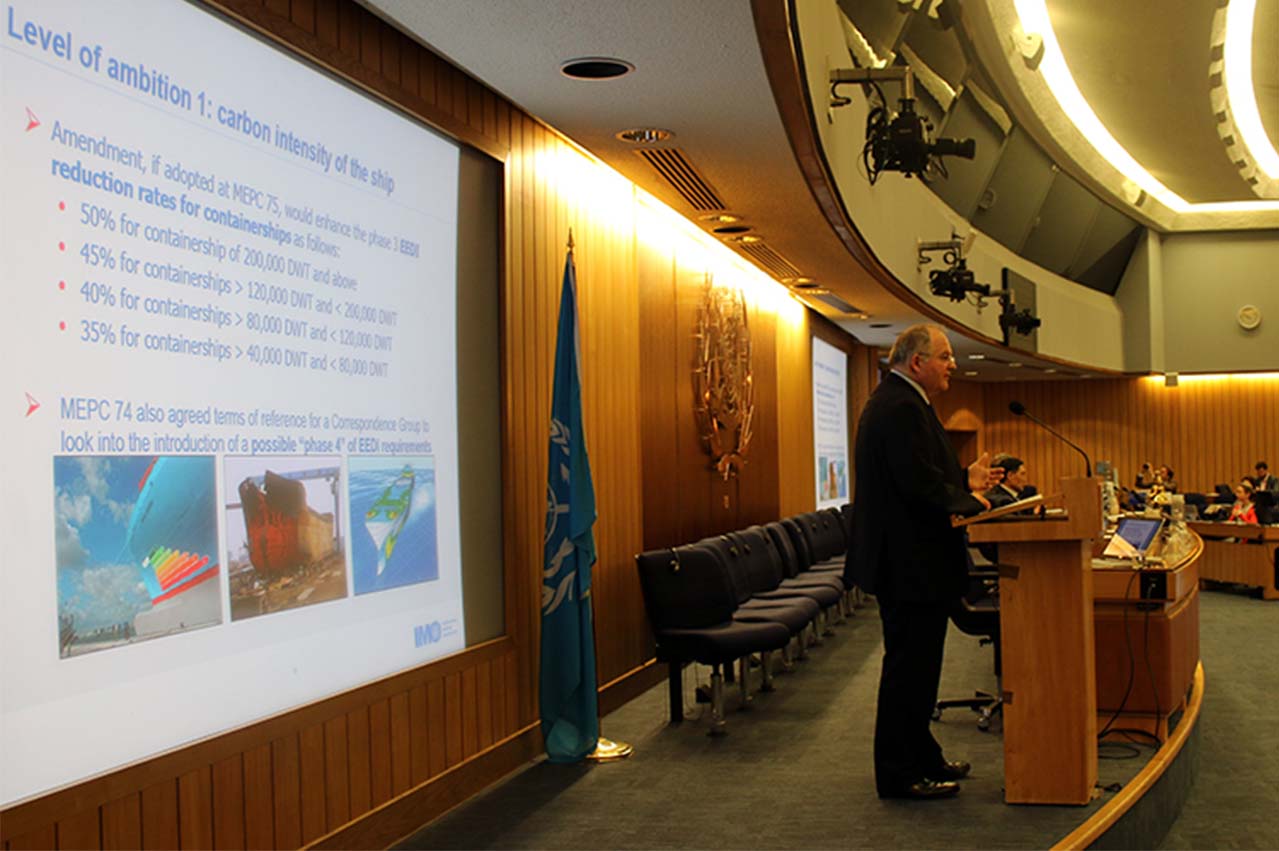
IMO has already adopted mandatory technical and operational measures to improve the energy efficiency of ships and reduce GHG emissions, including the energy Efficiency Design Index (EEDI) for new ships and the Ship Energy Efficiency Management Plan (SEEMP) for all ships of 400 GT and above (read more here). The initial strategy lists a number of candidate measures which could also be considered to further reduce emissions and help achieve the targets in the strategy, in particular 40% reduction of carbon intensity from shipping by 2030.  Short-term measures could be measures finalized and agreed by the Committee between 2018 and 2023, although in aiming for early action, priority should be given to develop potential early measures with a view to achieving further reduction of GHG emissions from international shipping before 2023. Dates of entry into force and when the measure can effectively start to reduce GHG emissions would be defined for each measure individually. A procedure for assessing the impact on States of a measure has been approved.

During the working group session, a number of proposals were discussed.

The group noted that the proposals discussed fell into two goal-based approaches, a technical approach and an operational approach. Further discussion would be needed at the next intersessional working group meeting to develop such proposals further.

Technical approach

Proposals for a technical approach which were discussed included an Energy Efficiency Existing Ship Index (EEXI), which could require ships to meet set energy efficiency requirements after the measure taking effect. Other technical proposals relate to mandatory power limitation on ships.

Operational approach 

Operational approaches would include focusing on strengthening the ship energy efficiency management plan, as required in SEEMP. This include proposals for mandatory carbon intensity reduction targets. Operational proposals also include measures to optimize speed for the voyage. Proposals to limit ship speed were also discussed.

There was general agreement in the group that a mandatory goal-based approach for both the technical and operational approaches would provide the needed flexibility and incentive for innovation (a goal-based approach would set the objective to be achieved, while leaving room for a range of methods or innovation to achieve the set goal).

The group agreed that the technical and operational approaches should be further developed in parallel, with informal coordination before the next intersessional meeting.

Assessment of impacts on States

Proponents of the various proposals were invited to provide further details on the initial impact assessment of their proposal, with a view to identifying the remaining issues to be further considered, including whether the proposed measure may generate disproportionately negative impact on some States. Key underlying issues identified by the chair for further consideration included, inter alia: the vital role of shipping for food security and disaster response; the impact on cost of transport and if cost change can be passed on to the customer or not; and special challenges faced by some remote areas.

Alternative fuels

With a longer-term perspective, and in order to encourage the uptake of alternative low- and zero-carbon fuels in the shipping sector, the Working Group also agreed on the establishment of a dedicated workstream for the development of lifecycle GHG/carbon intensity guidelines for all relevant types of fuels. This could include, for example, biofuels, electro-/synthetic fuels such as hydrogen or ammonia, etc. Many participants to the meeting highlighted the importance of undertaking this work as soon as possible, in order to pave the way for the decarbonization of the shipping industry.

Next meetings

The sixth session of the Intersessional Working Group on Reduction of GHG Emissions from Ships met 11-15 November at IMO Headquarters in London, United Kingdom. It was attended by nearly 400 representatives from nearly 70 Member States, as well as from the UNFCCC, the European Commission, the League of Arab States and around 30 non-governmental organizations.

To keep up the momentum, a further seventh meeting of the Intersessional Working Group on Reduction of GHG Emissions from Ships will be held 23-27 March 2020. This is just before and back to back with the next Marine Environment Protection Committee session, MEPC 75 (30 March to 3 April 2020). The MEPC is the decision-making body. 

The MEPC is also expected to establish a Working Group on Reduction of GHG Emissions from Ships, to meet during the MEPC session. 

MEPC 76 is scheduled to meet 19-23 October 2020. MEPC 76 is expected to receive the completed Fourth IMO GHG Study.

Fourth IMO GHG Study

The Fourth IMO GHG Study will include the following:

  • Inventory of current global emissions of GHGs and relevant substances emitted from ships of 100 GT and above engaged in international voyages. The inventory should include total annual GHG emission series from 2012 to 2018, or as far as statistical data are available. 
  • GHGs are defined as the six gases initially considered under the UNFCCC process: carbon dioxide (CO2), methane (CH4), nitrous oxide (N2O), hydrofluorocarbons (HFCs), perfluorocarbons (PFCs) and sulphur hexafluoride (SF6). The inventory should also include other relevant substances that may contribute to climate change, including Black Carbon (BC).
  • Estimates of carbon intensity (estimates of world fleet's CO2 emissions per transport work, from 2012 to 2018, or as far as statistical data are available).
  • Possible estimates of carbon intensity of international shipping for the year 2008 (the baseline year for the levels of ambition identified in the Initial Strategy). 
  • Scenarios for future international shipping emissions 2018-2050

Photo credit: International Maritime Organization
Published: 19 November, 2019


Continue Reading

Emissions reporting

StormGeo and OceanScore link emissions data, compliance workflows

Cooperation combines StormGeo’s expertise in operational vessel and emissions data with OceanScore’s expertise in emissions compliance workflows across EU ETS, FuelEU Maritime and UK ETS requirements.

Admin

Published

on

By

StormGeo and OceanScore link emissions data, compliance workflows

Weather intelligence and decision support solutions provider StormGeo and Hamburg-based technology platform OceanScore on Wednesday (3 June) said they have deepened their ongoing cooperation through the signing of a collaboration agreement during Posidonia 2026 in Athens on 2 June.

The cooperation combines StormGeo’s expertise in operational vessel and emissions data with OceanScore’s expertise in emissions compliance workflows across EU ETS, FuelEU Maritime and upcoming UK ETS requirements.

Together, the companies aim to help shipping companies seamlessly navigate increasing regulatory complexity more efficiently — from emissions reporting and data validation to compliance exposure management, pooling and financial settlement.

As emissions regulation becomes an increasingly important part of commercial shipping operations, the need for reliable operational data and streamlined compliance processes continues to grow. The cooperation between StormGeo and OceanScore is designed to support shipping companies with more connected, transparent and actionable processes across operational and commercial teams.

“From the outside, companies like StormGeo and OceanScore may sometimes be perceived as competitors because both operate around emissions and compliance workflows,” said Albrecht Grell, Managing Director at OceanScore. 

“But in reality, the industry increasingly needs both perspectives working together: trusted operational emissions data on one side and commercial compliance execution on the other. Our cooperation reflects that shipping companies are no longer looking for isolated solutions — they need connected processes, automated across different systems and reliable decision-making throughout the full compliance chain.”

By connecting validated operational emissions data with commercial compliance management, the cooperation supports workflows across:

  • emissions reporting and validation 
  • compliance management across EU ETS, FuelEU Maritime and upcoming UK ETS requirements
  • exposure visibility and cost transparency
  • pooling, settlement and financial processes 

The cooperation also aims to improve commercial transparency and coordination across operational and commercial stakeholders.

“StormGeo plays a central role in helping shipping companies turn operational vessel and emissions data into trusted, decision-ready insights,” said Espen Martinsen, Chief Commercial Officer at StormGeo. 

“As emissions regulations become more complex, this data is essential for transparent and efficient compliance management. By working with OceanScore, we can help customers connect StormGeo’s validated operational data with commercial compliance processes, creating a more integrated and practical approach to emissions management.”

The signing ceremony took place at the StormGeo booth during Posidonia 2026 in Athens and was attended by representatives from both companies.

Both companies expect the cooperation to continue evolving alongside upcoming regulatory developments, including FuelEU Maritime, EU ETS, the upcoming UK ETS and future emissions-related frameworks affecting global shipping.


Photo credit: StormGeo
Published: 4 June, 2026

Continue Reading

Methanol

Seaspan and Hapag-Lloyd complete first of five methanol vessel retrofit

Following “Seaspan Yangtze”, the remaining vessels planned for retrofit under the methanol retrofit programme are “Seaspan Amazon”, “Seaspan Ganges”, “Seaspan Thames”, and “Seaspan Zambezi”.

Admin

Published

on

By

Seaspan and Hapag-Lloyd complete first of five methanol vessel retrofit

Seaspan Corporation (Seaspan) and Hapag-Lloyd on Wednesday (3 June) announced the successful completion of the first of the five vessel conversions under their methanol retrofit programme with the delivery of Seaspan Yangtze.

From the early SAVER (Seaspan Action for Vessel Energy Reduction) programme to today’s CleanBlue initiative, Seaspan has committed over USD 230 USD million across 86 vessels, executing more than 550 efficiency and retrofit projects.

Following Seaspan Yangtze, the remaining vessels planned for retrofit under the programme are Seaspan Amazon, Seaspan Ganges, Seaspan Thames, and Seaspan Zambezi. Each retrofit is expected to reduce well-to-wake CO₂e emissions by approximately 30,000 to 50,000 metric tonnes per vessel annually when operating on low-carbon methanol, while also extending vessel lifespan and enhancing fuel flexibility.

“Decarbonisation is not just about building the fleet of tomorrow, it is also about unlocking the full potential of the fleet we have today. Retrofitting and upgrades on existing fleets play a practical, immediate, and economical role in accelerating shipping’s decarbonization journey,” said Bing Chen, Chairman, President and CEO of Seaspan. 

“Project SAVER CleanBlue highlights Seaspan’s strong customer partnerships, deep technical expertise, and unique platform integrated with JV partners, such as WattSpan Maritime Technology, in executing complex and large-scale retrofit projects.”

“The successful conversion of the Seaspan Yangtze together with the planned retrofit of its four sister vessels is another important step on our ambitious path towards net-zero fleet operations by 2045,” said Silke Lehmköster, Managing Director, Fleet, Hapag-Lloyd. 

“Together with Seaspan, we are demonstrating that retrofitting existing vessels for low-carbon methanol can be a practical way to reduce emissions in shipping.”


Photo credit: Seaspan
Published: 4 June, 2026

Continue Reading

LNG Bunkering

MOL and Seaspan sign annual LNG bunkering deal for car carriers in Port of Vancouver

MOL says North America is one of the key trade lanes for car carriers, and with recent delivery of new LNG-fuelled vessels, securing a stable LNG fuel supply in the area has become increasingly important.

Admin

Published

on

By

MOL and Seaspan sign annual LNG bunkering deal for car carriers in Port of Vancouver

Mitsui O.S.K. Lines, Ltd. (MOL) on Thursday  (21 May) announced that MOL and Seaspan Energy have signed the first annual contract for LNG bunkering for car carriers at the Port of Vancouver, Canada. 

On 29 April, MOL completed the first LNG bunkering under this contract. Since completing the first LNG bunkering on the West Coast of North America on 1 March 2025 – the first by a Japanese shipping company – MOL has conducted several additional LNG bunkering operations in the region. 

North America is one of the key trade lanes for car carriers, and with the recent delivery of new LNG-fuelled vessels, securing a stable LNG fuel supply in the area has become increasingly important. This contract underscores the company’s commitment to establishing a stable and seamless regional LNG fuel procurement framework.

Seaspan expanded its LNG bunkering capabilities in 2026 from Vancouver to Long Beach, California, and continues to proactively support the growth of a clean marine supply chain.

Seaspan Energy President Harly Penner, said: “The relationship between Seaspan Energy and MOL is highly valued. MOL was the first car carrier operator to receive LNG bunkering services in the Port of Vancouver, and we are proud to continue supporting their operations in Vancouver through this annual LNG bunkering agreement. 

“This partnership reflects our shared commitment to advancing lower-emission marine transportation and supporting the industry’s transition toward net-zero GHG emissions.”

Marine Fuel GX Division General Manager Daisuke Fujihashi, said: “We are very pleased to further strengthen our partnership with Seaspan Energy through this contract for LNG fuel procurement. 

“Looking ahead, we will continue to deepen our collaboration with Seaspan Energy in the field of clean fuels, including bio LNG, and remain committed to offering our customers more pathways toward cleaner supply chains.”


Photo credit: MOL
Published: 22 May, 2026

Continue Reading

Trending