Connect with us

Alternative Fuels

U.S. Department of Energy announces USD 61 million fund for low-cost biofuel tech

‘Biofuels are one of our most promising paths to zero-carbon aviation and shipping, so it’s time to […] R&D and begin to deploy these technologies at scale,’ said Secretary.

Admin

Published

on

1920px Seal of the United States Department of Energy

The U.S. Department of Energy (DOE) on Thursday (8 April) announced more than USD 61 million for technologies and processes that produce low-cost, low-carbon biofuels.

Biofuels are made up of renewable resources and can power heavy-duty vehicles that are difficult to electrify with current technologies—including airplanes and ships—to help accelerate America’s path to a net-zero emissions economy by 2050.

“Biofuels are one of our most promising paths to zero-carbon aviation and shipping, so it’s time to double down on R&D and begin to deploy these technologies at scale,” said Secretary of Energy Jennifer M. Granholm.

“This funding is critical for decarbonizing the transportation sector as a whole —the largest source of our nation’s greenhouse gas emissions—and delivering good-paying union jobs and clean air and water to American communities.”

Biofuels are produced by converting biomass—made up of recently-living organic materials like crop waste, food waste, and algae—and other waste resources into a liquid fuel, which can serve as a low-carbon equivalent to fossil-based fuels such as gasoline, jet, and diesel fuel.

Topic areas for the “Bioenergy Technologies Office Scale-Up and Conversion” funding opportunity include high-impact biotechnology research, development, and demonstration (RD&D) to bolster the body of scientific and engineering knowledge needed to produce low-carbon biofuels at lower cost.

DOE’s Bioenergy Technologies Office (BETO) is focused on developing technologies that convert domestic biomass and other waste resources into low-carbon biofuels and bioproducts.

This research has led to cost reductions of the processes by approximately 45% to date. BETO is turning its attention to reducing risk of commercialization by partnering with industry to demonstrate technologies at large scale.

The application process will include two phases: a concept paper and a full application. Concept papers are due on April 30, 2021, and full applications are due on June 21, 2021.


Photo credit: Wikimedia
Published: 14 April, 2021

Continue Reading

LNG Bunkering

DNV awards AiP to HD HHI for 12K LNG bunkering ship design tailored to cruise ships

New concept has been specifically designed for bunkering cruise ships, including removal of bridge wings to avoid interference with cruise ships’ lifeboats during operations.
Admin

Published

on

By

DNV awards AiP to HD HHI for 12K LNG bunkering ship design tailored to cruise ships

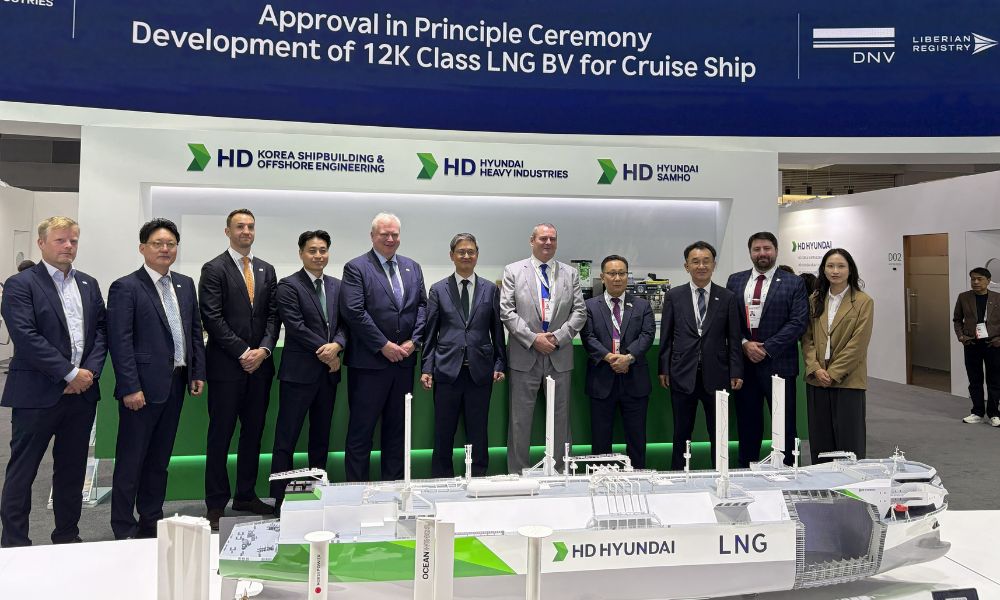
Classification society DNV and the Liberian International Ship and Corporate Registry (LISCR) on Tuesday  (15 September) have awarded an Approval in Principle (AiP) certificate to South Korea’s HD Hyundai Heavy Industries (HD HHI) for a new 12K LNG Bunkering Vessel design, tailored to the needs of cruise ships. 

The AiP was presented to Mr. Ryu Hong Ryeul, CTO / HD HHI, by Vidar Dolonen, Regional Manager for Korea & Japan at DNV, during a ceremony at Gastech 2026 yesterday.

The new concept, a dedicated LNG bunkering vessel (LNGBV) for the cruise segment, has been developed to address the unique operational challenges associated with refueling cruise ships. In particular, unlike conventional designs, the concept removes the bridge wings to avoid interfering with cruise ships’ lifeboats during bunkering operations.

To compensate for the reduced side visibility resulting from the removal of the bridge wings, the vessel is equipped with a CCTV system. In addition, side visibility safety and efficient bunkering operations have been enhanced through the addition of the HiNAS SVM (Hyundai Intelligent Navigation Assistant System Surround view monitoring system), which shows a 360-degree top-view AR image converted from inputs from multiple fish-eye cameras installed around the ship.

Mr. Ryu Hong Ryeul, CTO at HD HHI, said: “By enabling ship-to-ship (STS) LNG bunkering operations without the need for a floating pontoon, this 12K LNGBV bunkering vessel is expected to make LNG bunkering for cruise vessels more efficient and flexible. If this type of LNGBV becomes more widely adopted in the market, this could bring about significant changes in the demand structure and operating models of the LNGBV market because this new type of LNGBV is able to carry out bunkering more freely and flexibly, not only for cruise ships but also for conventional merchant vessels.”

Alfonso Castillero, Chief Executive Officer, Liberian Registry, said: “The Liberian Registry is pleased to support this Joint Development Project, which addresses the specific operational and safety considerations associated with LNG bunkering for cruise ships. The AiP represents an important milestone in advancing a practical and flexible vessel concept while maintaining a strong focus on safety, regulatory compliance and operational reliability.”

Vidar Dolonen, Regional Manager for Korea & Japan at DNV, added: “The transition to lower-emission shipping depends not only on vessels, but also on the supporting infrastructure that enables alternative fuels to be used safely and efficiently. With LNG continuing to play a leading role both the cruise sector and the maritime industry’s decarbonization efforts more broadly, this LNG bunkering vessel concept represents an important step toward building the capabilities needed for the maritime energy landscape.”

An Approval in Principle (AiP) is an independent assessment of a concept within a defined framework of requirements. It confirms the feasibility of the design and verifies that no significant technical barriers exist to its implementation.


Photo credit: DNV
Published: 17 September 2026

Continue Reading

Alternative Fuels

Hanwha Power obtains ABS AiP for 22,000-cbm LNG bunkering vessel concept design

A key feature of the concept design is its LNG-ammonia multi-cargo capability, which enables the vessel to transport not only LNG but also ammonia, an emerging next-generation bridge fuel.
Admin

Published

on

By

Hanwha Power obtains ABS AiP for 22,000-cbm LNG bunkering vessel concept design

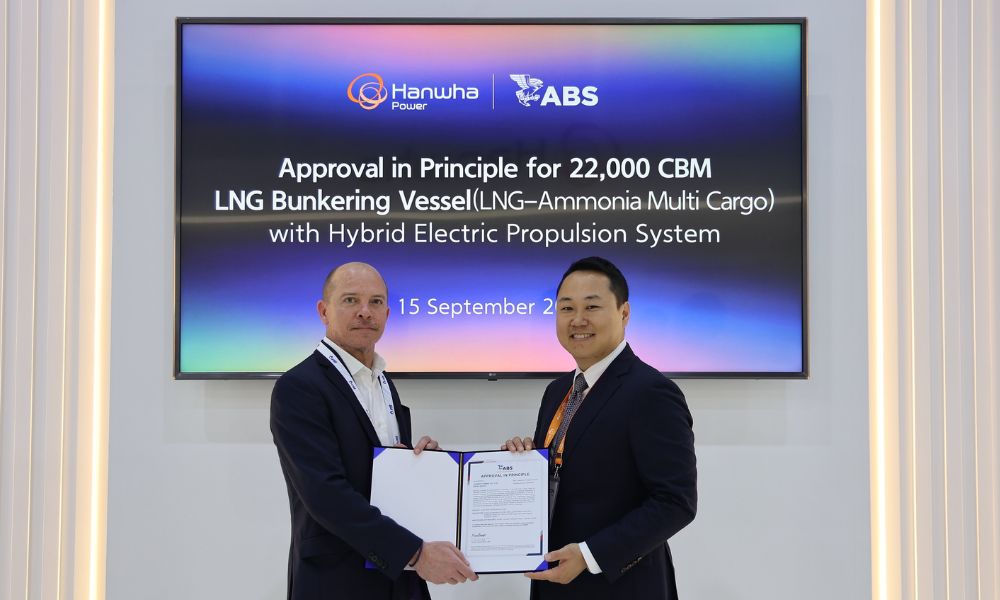
South Korea’s Hanwha Power on Wednesday (16 September) said that it has obtained approval in principle (AiP) from the American Bureau of Shipping (ABS) for the concept design of a 22,000-cubic-meter LNG bunkering vessel at Gastech 2026 held in Bangkok, Thailand.

The certificate presentation ceremony was held on September 15 local time, with Hanwha Power Marine Solution Business Division Head Hoon-min Kim, Vice President Jong-kyu Hwang, who oversees Technical Solutions, and key ABS representatives in attendance.

With the latest AiP, Hanwha Power has completed its lineup of medium- and large-scale LNG bunkering vessels, ranging from 7,500-cubic-meter to 22,000-cubic-meter.

A key feature of the concept design is its LNG-ammonia multi-cargo capability, which enables the vessel to transport not only LNG but also ammonia, an emerging next-generation bridge fuel. 

The design incorporates high-manganese steel cargo containment technology, Mc-C, allowing the vessel to adapt to the future transition to alternative fuels with minimal design modifications. This provides shipowners with greater long-term technological flexibility and competitiveness.

Considering the operating characteristics of bunkering vessels, which primarily operate in coastal waters, Hanwha Power has also applied a hybrid electric propulsion system that integrates an onshore power supply (OPS) system with an energy storage system (ESS). The system is designed to minimize harmful emissions while the vessel is berthed or operating in coastal areas, while also improving operational efficiency and economic performance.

In addition, Hanwha Power has incorporated the Group’s core technologies, including dual-fuel generator sets, ESS, electrical power system integration, integrated automation system, and cargo handling system. By integrating these technologies, the company aims to maximize the competitiveness and business synergies of its integrated engineering and procurement (EP) package, covering both engineering and procurement capabilities.

“This ABS AiP marks another important milestone demonstrating Hanwha Power’s technological reliability and commercial viability in the global eco-friendly vessel market,” said Hoon-min Kim, Head of Hanwha Power’s Marine Solution Business Division. 

“Building on the Hanwha Group’s differentiated clean-technology capabilities, we will continue to provide global shipowners with optimized integrated solutions for the transition to more sustainable marine transportation.”


Photo credit: Hanwha Power
Published: 17 September 2026

Continue Reading

Biofuel

IMO issues shipboard checklist for FAME-based biofuel blends

Checklist is intended to help vessel operators navigate some of the practical considerations involved when bunkering and consuming biofuel blends, particularly when using them for the first time.

Admin

Published

on

By

RESIZED IMO Building

The International Maritime Organization (IMO) on Wednesday (16 September) said the Shipboard Biofuel Blend Checklist for FAME-based biofuels has now been issued as an annex to document MEPC 85/INF.10.

The checklist was developed by the IBIA Technical Working Group as part of the ongoing update of the IBIA/BIMCO Shipmaster’s Bunkering Manual and is intended to help vessel operators navigate some of the practical considerations involved when bunkering and consuming biofuel blends, particularly when using them for the first time. 

It covers a range of areas, including fuel assessment, compatibility checks, tank preparation, water management, bunkering operations, storage and machinery performance monitoring.

As the use of biofuel blends continues to grow, IMO said having clear and practical guidance for crews and operators is increasingly important. 

The checklist is based on the CIMAC Guideline 04|2024, Marine fuels containing FAME, and is intended as a practical tool to support good fuel management onboard.

“It’s great to see the work now formally included in an IMO document and available to its membership,” IMO said. 

Note: The checklist can be viewed here


Photo credit: International Maritime Organization
Published: 17 September, 2026

Continue Reading

Trending