Connect with us

LNG Bunkering

Titan LNG develops novel tank concept for future European Inland Waterway bunker barges

Works with HB Hunte Engineering to introduce multiple 1000 m3 internal tank partitions into a single tank structure, meeting European safety criterion.

Admin

Published

on

Titan LNG develops novel tank concept for future European Inland Waterway bunker barges

Titan LNG on Wednesday (22 December) shared a social media post stating it has developed the ‘Hyperion’ series of tank concepts for future Inland Waterway (IWW) bunker barges operating in both seagoing and inland conditions:

As part of its current fleet of bunkering assets, Titan LNG operates the LNG bunker barges FlexFueler 001 and 002. The one-of-a-kind “FlexFueler” concept was developed in-house by Titan LNG and represents the first generation of LNG bunker assets tailor-made for the Antwerp-Rotterdam-Amsterdam area. Through concept development and operation of these barges, Titan LNG has gained a lot of experience with the European Inland Waterway (IWW) regulations, specifically their impact on LNG storage and handling systems.

Continued market growth and the higher tank capacity of the global fleet of LNG-fueled vessels is leading to more and larger IWW-dedicated bunker barges. However, scaling up to meet the market requirements efficiently is made difficult by a particular rule in the European code for carriage of dangerous goods. Namely, a tank capacity limit of 1,000 m3 per tank onboard bunkering barges. Which – when conventionally interpreted – leads to a multiple of 1,000 m3 cylindrical tanks. Though certainly valid from a safety perspective, the rule is a challenge when scaling up liquefied gas carriers as it tends to lead to designs with many small – and relatively expensive – tanks.

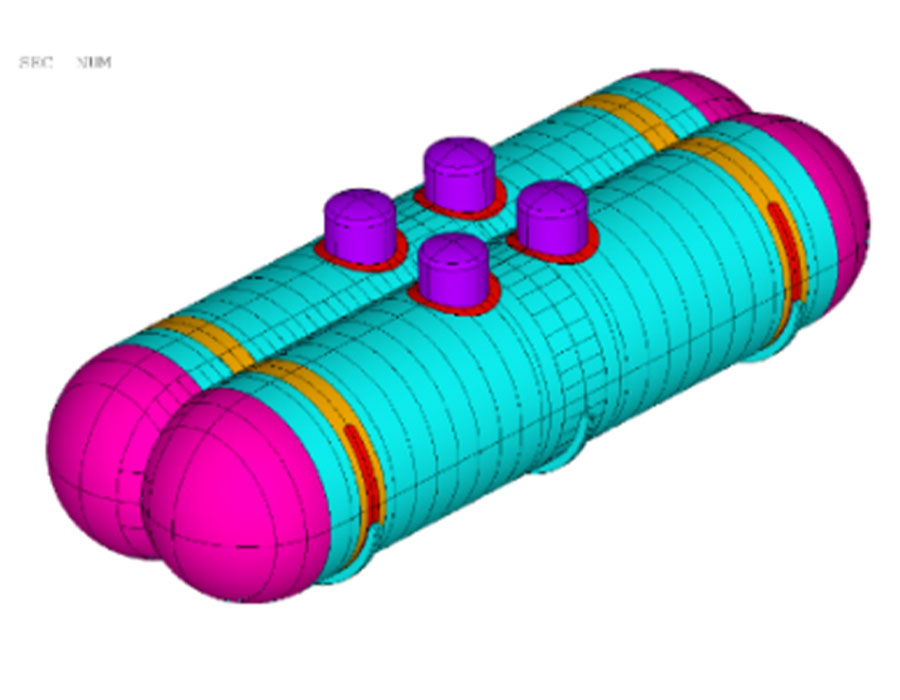
Titan LNG has devised a way to meet this safety criterion by introducing the principle of multiple 1000 m3 internal tank partitions into a single tank structure. The main benefit is that more fuel can be put into a single tank structure. As a result, the tanks take up less space, thus reducing the total footprint of the vessel while maintaining the cargo capacity. The internal partitions maintain their individual structural integrity in case of tank damage to a single partition. This solution has been patented as well as technically validated for one of the more challenging types of pressure vessel; a bilobe tank.

Fleet development director Douwe de Jong commented: “As more LNG and LBM fuelled vessels are built, innovations like this will become increasingly important to efficiently meet demand and effectively scale up supply infrastructure. By investing in the in-house development of its fleet, Titan LNG has managed to introduce the economies of scale associated with large LNG tanks found in seagoing vessels into IWW gas carrier vessel design. “

The design impact was investigated within Titan LNG’s “Hyperion” IWW bunker vessel design series. At a total capacity of 8,000 m3, the vessel’s length and breadth were reduced by 10-20%, compared to the individual tank approach. Fuel consumption, steel weight, outfitting costs and overall environmental impact of constructing and operating the vessel were reduced by similar percentages. The larger tank size also opened the possibility of using lighter and cheaper foam-insulated tanks instead of the vacuum-insulated pressure tanks that are more common in the <1,000cbm tank size range. It was also found that the resulting vessel lay-out and dimensions could work as both a seagoing and inland vessel. As a result, the “Hyperion” series currently features both seagoing and inland design versions, making it ready for the next decade and beyond.

Titan LNG cooperated with HB Hunte Engineering, who proved the structural feasibility of the tank concept. HB Hunte Engineering is also working with Titan LNG’s on the 4,500cbm bunker vessel design “Krios”.


Photo credit: HB Hunte
Published: 23 December, 2021

Continue Reading

Alternative Fuels

Report: MSC Cruises ships operated on over 9,800 mt of bio-LNG and biofuels in 2025

MSC Group’s Cruise Division used 9,839 mt of renewable marine fuels in 2025 across its fleet, according to its 2025 Sustainability Report published last week.

Admin

Published

on

By

Report: MSC Cruises ships operated on over 9,800 mt of bio-LNG and biofuels in 2025

MSC Group’s Cruise Division used 9,839 metric tonnes (mt) of renewable fuels in 2025 across its fleet, according to its 2025 Sustainability Report published last week. 

The company used a combination of bio-LNG and biofuels across its fleet, resulting in emissions reduction of 48,714 mtCO2e compared to equivalent fossil fuels. 

Based on the Energy Transition Plan, the report showed that MSC Cruises and Explora Journeys remain on track to achieve net-zero greenhouse gas (GHG) emissions for marine operations by 2050. In 2025, MSC Group’s Cruise Division achieved the International Maritime Organization’s (IMO) 2030 carbon intensity reduction target five years ahead of schedule. 

The report said the MSC Cruises demonstrated a net-zero voyage using biomethane was possible with the launch of MSC Euribia in 2023. 

Since then it has actively engaged with fuel producers and suppliers to secure affordable high quality renewable fuels and in 2026, it began blending them into its operations at scale. 

The bio-LNG it sourced in 2025 was produced from a variety of different sustainable feedstocks, including food waste, sewage sludge, organic municipal waste and, most notably, manure. 

As most of its fleet remains conventionally powered, biodiesel represents the only drop-in solution available for these vessels today. 

In 2025, MSC Europa ran on a total of 6,856 mt of bio-LNG while MSC Opera used 1,727 mt of hydrotreated vegetable oil (HVO). MSC Seaview sailed using 572 mt of HVO and 684 mt of a B24-VLSFO blend. 


Photo credit: MSC Cruises
Published: 3 June, 2026

Continue Reading

LNG Bunkering

Roatán marks first STS LNG bunkering operation with Carnival cruise ship

According to Francesco Scarso, Senior First Engineer of Carnival Cruise Line, the event marked the first-ever ship-to-ship LNG bunkering operation to take place in Roatán.

Admin

Published

on

By

Roatán marks first STS LNG bunkering operation with Carnival cruise ship

Carnival Cruise Line’s LNG-powered flagship, Carnival Jubilee, recently bunkered LNG marine fuel in Roatán, Honduras.

According to Francesco Scarso, Senior First Engineer of Carnival Cruise Line, the event marked the first-ever ship-to-ship (STS) LNG bunkering operation to take place in Roatán.

“​I recently acted as the Person in Charge (PIC) for the inaugural Ship-to-Ship (STS) LNG bunkering operation ever to take place in Roatán, Honduras—fueling Carnival Cruise Line’s beautiful LNG-powered flagship, the Carnival Jubilee,” he said in a social media post. 

“Executing a cryogenic transfer for an Excel-class vessel in a brand-new location brings immense responsibility. From coordinating with port authorities to managing strict safety zones, ensuring ESD link integration, the operation required total focus and zero room for error.”

He added that ​this successful operation marked a giant leap forward for sustainable shipping and the expansion of LNG fueling options.


Photo credit: Francesco Scarso
Published: 2 June, 2026

Continue Reading

Business

Hercules Tanker Management acquires five product and chemical tankers

Acquisitions form part of a broader and ongoing fleet development programme at Hercules; programme also includes investing in the construction of an 18,000 cbm LNG bunkering vessel at Hyundai Mipo.

Admin

Published

on

By

Hercules Tanker Management plans fleet expansion with new chemical bunker tankers

Hercules Tanker Management (HTM) on Monday (1 June) announced the acquisition of five product and chemical tankers as part of its continued fleet expansion.

HTM is the shipping venture launched by John A. Bassadone, founder and CEO of independent marine fuel supplier Peninsula.

The company acquired STI Madison (2014 LR2), STI Brooklyn (2015 MR2) and STI Black Hawk (2015 MR2) – acquired from Scorpio Tankers; and Nord Marvel (2020 MR2) and Nord Maverick (2020 MR2) – acquired from Norden.

 The acquisitions represent a combined investment of approximately USD 225 million, with all vessels secured on long-term commercial charters, reinforcing Hercules’ strategy of pairing asset ownership with contracted earnings visibility.

“The acquisitions have been completed against the backdrop of a firm tanker asset market, with second-hand values continuing to trade at historically elevated levels due to strong freight markets, constrained fleet growth and limited shipyard availability,” the company said. 

 All five vessels enter the Hercules fleet with long-term commercial employment already secured, consistent with the company’s strategy of combining asset-backed exposure to tanker markets, with downside protection through contracted earnings, and operational flexibility to serve the growing global cargo flows of its partners and affiliates.

The acquisitions form part of a broader and ongoing fleet development programme at Hercules. 

The company continues to progress its newbuilding programme with Jiangmen Hangtong Shipyard in China, where it has committed to a series of up to 10 ‘ultra-spec’ chemical tankers, designed with flexibility to supply conventional fuels, biofuels and methanol, alongside enhanced efficiency and emissions performance. 

In parallel, Hercules is also investing in next-generation energy infrastructure through the construction of an 18,000 cbm LNG bunkering vessel at Hyundai Mipo, scheduled for delivery in 2027.

Market benchmarks indicate vessels of this type are currently contracting at approximately USD 90–95 million per unit, underlining the strategic and capital commitment behind this segment.

John A. Bassadone, Founder and CEO of Hercules Tanker Management, said: “This is another step in building Hercules carefully and deliberately. We are not trying to grow for growth’s sake. Our focus is on acquiring the right assets, at the right time, with the right commercial backing.

“These vessels come with strong employment already in place, which provides stability, while still allowing us to participate in a market we believe has solid fundamentals over the medium term. We are fortunate to be in a position where global cargo flows can underpin our investments, and we remain mindful that discipline is critical in this cycle.

“Additionally, we are currently engaged in negotiations for newbuilds of all sizes including LR2s, MRs, and Handys, as well as additional ultra spec vessels.”

Related: Peninsula founder launches shipping firm Hercules Tanker Management
Related: Hercules Tanker Management plans fleet expansion with new chemical bunker tankers
Related: Hercules Tanker Management orders LNG bunkering vessel from Hyundai Mipo


Photo credit: Hercules Tanker Management
Published: 2 June, 2026

Continue Reading

Trending