Connect with us
DNV Decarbonization Insight Series August 2026 - What maritime professionals should know about AI Training

Technology

TFG Marine taps eBDNs for USD300 million working capital facility from DBS

Supported by TFG Marine’s collaboration with both ZeroNorth and SGTraDex, eBDNs will be provided to support efficient and reliable audit and verification of transactions financed by the facility.

Admin

Published

on

TFG Marine taps eBDNs for USD300 million working capital facility from DBS

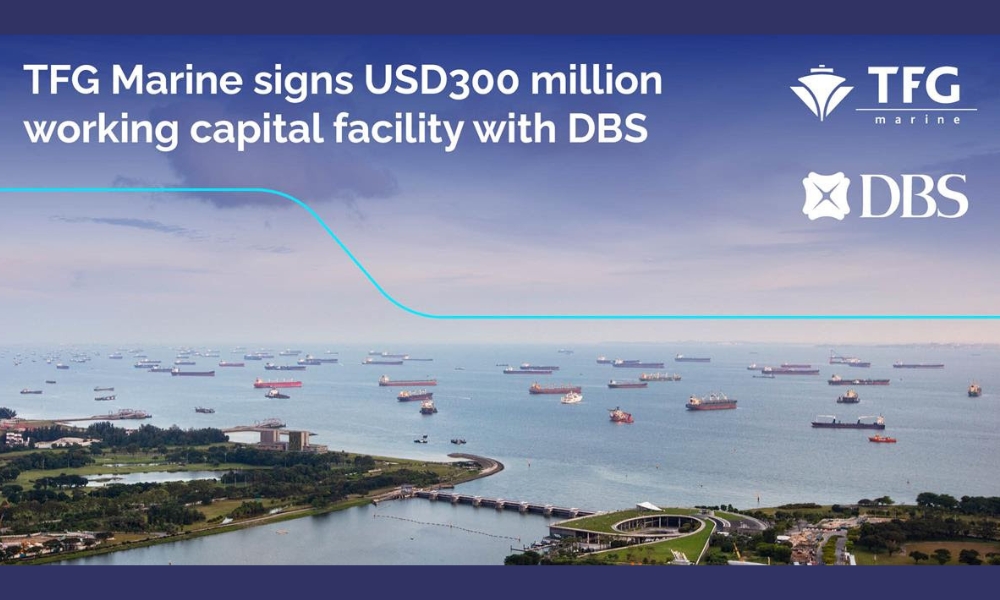
Global marine fuel supply and procurement firm TFG Marine on Wednesday (6 May) said it has signed a working capital financing facility of up to USD300 million with DBS Bank (DBS). 

The facility will contribute to funding TFG Marine’s working capital requirements, further strengthening the company’s liquidity position and underpinning its operations as one of the world’s leading physical suppliers of marine fuels.

Supported by TFG Marine’s collaboration with both ZeroNorth and Singapore Trade Data Exchange Services Pte. Ltd. (SGTraDex), electronic bunker delivery notices (eBDNs) will be provided to support efficient and reliable audit and verification of transactions financed by the facility.

The use of eBDNs, facilitated through the ZeroNorth and SGTraDex platforms, provides a verifiable, real-time digital record of bunker deliveries and builds on TFG Marine’s existing collaboration with ZeroNorth in the deployment of this technology. The two companies have worked together to roll out digital bunker delivery solutions across multiple regions, including the first deployment of an eBDN solution in the Middle East at the Port of Sohar, Oman.

Bennett Pekkattil, Chief Financial Officer of TFG Marine, said: “We are grateful for DBS’ support and encouraged by their recognition of the greater need for digital transparency in the marine fuels industry. We hope that more financial institutions will follow their lead, and we look forward to continuing to develop our digital capabilities in support of more efficient and resilient supply chains. By deploying electronic bunker delivery notices through our collaboration with ZeroNorth and SGTraDex, we continue to advance our transparency and data integrity objectives.”

Terence Yong, Global Head of Sales, Global Transaction Services at DBS Bank, said: “Through this deal with TFG Marine, we are proud to have championed a further benchmark in digital trade financing, now for the marine fuel industry. This digital financing solution provides expanded trade capacity, improves transparency and operational efficiency, reduces trade risk and eliminates friction. 

“This is especially relevant to Singapore as the world’s leading bunkering hub. We are grateful to have once again advanced business impact through innovation, underscoring a success factor of the longstanding strategic relationship between DBS and TFG Marine.”

Nicolas Queru, Chief Growth Officer at ZeroNorth, said: “This transaction is a great example of the growing financial value of trusted data. Greater transparency can strengthen confidence across the transaction chain and improve access to capital. We are proud to support TFG Marine in demonstrating the tangible financial value digital infrastructure can create.”

Jefferson Wong, CEO of SGTraDex Services and COO of DEX, said: “We congratulate TFG Marine and DBS on this landmark facility. As early participants of the data exchange utility, both organisations have been instrumental in digitalising the marine fuels sector. 

“This collaboration marks a shift from on-request use of eBDNs to a model where banks can access eBDNs on-demand, paving the way for the digital document to become integral to marine fuel financing. SGTraDex and DEX remain focused on providing the neutral, secure data infrastructure necessary to scale such initiatives and invite more players to onboard this interoperable ecosystem.”

Related: TFG Marine to launch of ZeroNorth e-BDNs at Port of Sohar after Singapore success


Photo credit: TFG Marine
Published: 7 May, 2026

Continue Reading

Interview

Exclusive: Caroline Yang takes helm on future of IBIA Asia

The newly appointed Chair of IBIA’s Regional Board – Asia, shares her plans to strengthen bunkering standards while promoting transparency and industry collaboration across key Asian maritime hubs.

Admin

Published

on

By

Exclusive: Caroline Yang takes helm on future of IBIA Asia

Caroline Yang, CEO of Hong Lam Marine Pte Ltd, outlines her plans for IBIA Asia in her first interview with Manifold Times since becoming Chair of the Regional Board – Asia:

MT: Why is IBIA important to the bunkering market in Asia?

IBIA Asia is amongst five regional boards operating under the umbrella of London-based IBIA Global. Its presence in Asia is vital because the region, excluding the Middle East, accounts for more than 50% of global bunkering volume.

While Singapore continues to maintain its strong lead as the world’s busiest bunkering port with almost 56 million mt of marine fuel delivered in 2025, several ports in China are showing to be strong bunkering ports as well; these developments take place on the back of a forecast for China to be amongst the leading suppliers of green fuels such as methanol.

Based on this alone, IBIA Asia has to play an important role in raising and addressing issues of suppliers and shipowners and the other parties in the regional bunkering eco-system.

MT: What is the overall state of bunkering standards at major Asian ports and how can IBIA elevate this?

Singapore is the clear leader in standards, acting as a “flag bearer” with established protocols including SS 600 for bunkering, SS 648 for bunker mass flow metering, SS 524 for quality management of bunker supply chain, TR 56 for LNG bunkering, and TR 80 for meter verification using master MFM.

While other Asian ports are adopting mass flow meters – a positive step – IBIA Asia’s role is to disseminate these best practices while maintaining deep respect for local operational realities and regulatory environments.

MT: As Chair of the Regional Board – Asia, what are your plans to make this happen? Are there any topics you will be focusing on?

The IBIA Asia regional board of 10 members from comes from a diverse group of suppliers, shipowners, bunker buyers, fuels testers and bunker tanker owners. Backed by a strong secretariat, we are committed to move the needle for bunkering in Asia.

Our initial strategy is outreach-driven, progressing beyond a Singapore-centric approach. For starters, the board will be concentrating on Hong Kong, Zhoushan, and Shanghai, with potential expansion to Japan and South Korea.

The core objective is to promote the quality, transparency, and integrity of bunkers lifted in Asia. This includes building on existing MOUs such as the collaboration with Hong Kong Shipowners Association (HKSOA) to explore alternative bunker fuels, and participation in regional maritime week programmes.

MT: Do you expect to encounter any challenges? What do you think are the solutions?

Challenges, without a doubt; these include macro-level standards and topical quality issues, such as those highlighted in a recent FOBAS report.

We are aware most solutions will not have instant results, but produce short-term, mid-term and long-term responses.

The solution lies in structured communication and feedback loops involving industry, regulators, and experts. Success requires an altruistic approach where stakeholders prioritise the health of the bunkering ecosystem to achieve win-win outcomes, even at the compromise of individual sectors.

MT: Is participation of local/regional IBIA members included within your plan? How will they be involved?

Member participation is the foundation of an association’s strength. The plan involves active outreach – meeting members where they operate and integrating them into meetings to ensure the board’s positions reflect representative industry views. We must push out credible, strong messages to encourage active engagement. If there is anyone in the maritime bunkering in these areas and reading this interview, reach out to us so we can start our conversations!

The Secretariat and some board members have scheduled to visit and attend bunkering events in Hong Kong and China. In November 2026, IBIA will participate in the Hong Kong Maritime Week by organising a one-day conference. We hope to be also participating in the Shanghai Pudong Maritime Conference and the 9th International Petroleum and Natural Gas Enterprises Conference (IPEC 2026), also known as the “Zhoushan Bunker Oil conference”, in late October.

MT: How will previous experience gained at SSA, ICS, MPA, SMF, and Hong Lam Marine contribute to your role at IBIA?

As CEO of Hong Lam Marine, our bunker tankers supply about 10% of bunkering volume in Singapore, so we are an involved and relevant stakeholder. My experiences in the above-mentioned organisations have taught me how to crystallise and articulate important issues, engage effectively with diverse stakeholders, and leverage on pre-existing professional connections to engage more effectively for IBIA Asia.

Related: IBIA announces Caroline Yang as new Regional Board Chair for Asia
Related: IBIA and Hong Kong Shipowners Association to collaborate on alternative bunker fuels
Related: FOBAS report warns of growing operational risks from ISO-compliant bunker fuels


Photo credit: Manifold Times
Published: 6 August 2026

Continue Reading

Technology

ZeroNorth debuts new agentic AI partner for maritime operations

Propel will ultimately operate across voyage, vessel and fuel workflows, monitoring operations continuously, and handling actions within the boundaries operators define.

Admin

Published

on

By

ZeroNorth debuts new agentic AI partner for maritime operations

Maritime technology solutions provider ZeroNorth on Tuesday (4 August) introduced Propel by ZeroNorth, a new agentic AI partner for maritime operations. 

Propel uses AI agents to take action on repetitive manual tasks in operations, freeing operators to focus on decisions that require their judgement.

The launch comes as shipping faces growing operational complexity from geopolitical disruption, regulatory change and volatile fuel prices. Operators coordinate decisions across multiple vessels and disconnected systems, and better coordination can compound into meaningful time and fuel savings across a fleet.

At the same time, agentic AI is now making it possible for software to move beyond insight and recommendation. It can understand intent, respond to changing conditions and help carry out work across complex operational processes. Propel is designed to do exactly that.

Today, Propel takes on repetitive manual tasks related to voyage optimisation that were previously handled by operators. It generates a voyage plan, manages the communication with the master, incorporates feedback into the plan and updates it, while keeping the operator in the loop throughout.

It is always on duty and responds as conditions change, helping operators act sooner on voyage opportunities while saving hours of manual coordination across organisations’ operations teams and fleets.

The voyage optimisation agent has been in use by ZeroNorth’s Professional Services team over the past three months and ZeroNorth is now giving early-access to key customers Cargill, Ultrabulk and CMB.TECH.

New agents will be released on an ongoing basis. ZeroNorth is testing each new capability with its partners so Propel is shaped by real operational conditions across different shipping segments from the start. Propel will ultimately operate across voyage, vessel and fuel workflows, monitoring operations continuously, and handling actions within the boundaries operators define. Wider commercial availability is planned for later in 2026.

Søren Andersen, CEO of ZeroNorth, said: “Our ambition with Propel is to help change the way shipping works by changing what technology can do inside maritime operations. There is immense potential to move towards operations that are more connected, continuous and precise, where technology takes on more of the coordination work and people can focus their judgement where it creates the greatest value.”

“Cargill, Ultrabulk and CMB.TECH were among our very first customers and helped build ZeroNorth from the beginning. Now, they are partnering with us again to shape what comes next for shipping. Their experience will be invaluable in ensuring that Propel is grounded in the realities of the industry today, while helping transform how maritime operations work tomorrow.”


Photo credit: ZeroNorth
Published: 5 August, 2026

Continue Reading

Engine

Japan’s first WinGD methanol dual-fuel marine engine passes FAT at MITSUI E&S

Company successfully completed the Factory Acceptance Test of the DU-WinGD 6X82DF-M-1.0 LP-SCR, the first methanol dual-fuel WinGD large marine engine built in Japan.

Admin

Published

on

By

MITSUI E&S completes FAT of Japan's first WinGD methanol dual-fuel engine

MITSUI E&S on Monday (3 August) announced that Mitsui E&S DU, a group company of MITSUI E&S, has successfully completed the Factory Acceptance Test (FAT) of the DU-WinGD 6X82DF-M-1.0 LP-SCR, the first methanol dual-fuel WinGD large marine engine built in Japan.

The engine is also the first WinGD large marine engine manufactured at MITSUI E&S Tamano Works.

“The engine is scheduled to be installed on the first vessel in a series of four vessels being built for a domestic shipowner,” the company said on its website. 

By utilising green methanol as fuel, it will contribute to a substantial reduction in greenhouse gas (GHG) emissions from shipping operations.

“To meet the expected increase in marine engine demand under the Japanese government’s Shipbuilding Industry Revitalisation Roadmap, the MITSUI E&S Group is working to enhance production efficiency for large marine engines through integrated operation at MITSUI E&S Tamano and Mitsui E&S DU Aioi,” the company added.


Photo credit: MITSUI E&S
Published: 4 August, 2026

Continue Reading

Trending