Connect with us

Alternative Fuels

Study shows South Africa is well placed to lead the production of zero carbon bunker fuels

Country’s location, economic development and vast renewable energy sources make it well suited to be a hub for green maritime fuel, says report.

Admin

Published

on

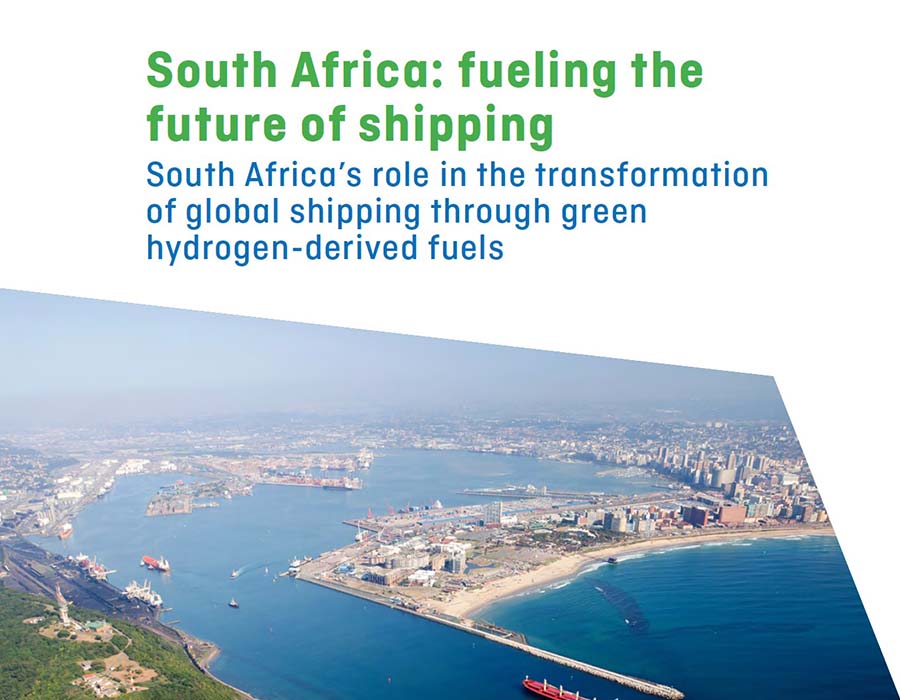
South Africa fueling the future of shipping frontpage

A study by Ricardo and Environmental Defense Fund for the P4G Getting to Zero Coalition Partnership finds that South Africa holds an untapped opportunity to supply the global shipping industry with zero carbon bunker fuels, according to the Global Maritime Forum on Thursday (24 June).

The production of green hydrogen-derived fuels can help to meet decarbonisation targets and act as a catalyst for the country’s economy – opening new export markets, supporting an equitable transition, and creating the jobs of the future.

The study explores the economic and environmental potential for the implementation of zero carbon shipping fuels through the shipping sector of South Africa. South Africa has vast renewable energy sources, and the country has committed to reach net zero emissions by 2050.

“Our study shows that South Africa has an abundance of renewable energy potential. It is enough to supply the country’s domestic electrical demand as well as the production of zero carbon fuels to supply commercial vessels refuelling in its international ports,” says Aoife O’Leary, Director, International Climate, Environmental Defense Fund.

“The adoption of zero carbon propulsion technologies at South Africa’s ports could attract investment of between 122 and 175 billion Rand in onshore infrastructure by 2030. All that is needed to unlock this investment are the right policy incentives set at the International Maritime Organization.”

The report finds that South Africa’s geographical location and economic development make it particularly well suited to distribute zero carbon fuels for the South African shipping sector, and export to international markets.

“South Africa has the opportunity feed into the growing global demand for decarbonized materials, products and services by offering bunkering capability for zero carbon fuels to vessels of all types,” states Olivia Carpenter-Lomax, future energy specialist and project lead, Ricardo.

“With access to busy shipping routes, abundant renewable energy potential, and experience handling these and other fuels, South Africa is in a great position to produce the shipping fuels of the future, access a growing global market, and thus catalyze a new low carbon economy.”

Several zero carbon fuels can potentially be used in shipping. The abundance of renewable energy resource in South Africa means that shipping fuels can be derived from renewable electricity generation.

It highlights the ports of Saldanha Bay, Ngqura (Coega) and Richards Bay as great examples of how South African can capitalize on a zero carbon fuel transition due to established shipping routes and significant port export hubs.

“Zero carbon shipping presents South Africa with the opportunity to usher in ‘a new economy in a new global reality’, to quote President Ramaphosa in our national Economic Reconstruction and Recovery Plan,” says Kaashifah Beukes, Chief Executive Officer, Saldanha Bay Industrial Development Zone.

“For this, the SBIDZ supports this research in its efforts to stimulate solutions and investment into a global megatrend that is becoming the agenda of our time. It will require sustainable capital investment into new technologies, new vessel designs, new landside infrastructure and a shake-up of the services and logistics sub-sectors.

“This is exactly the work the SBIDZ is vested in as a catalyst for economic growth and transformation, and the unique potential of the Port of Saldanha Bay as the first Freeport in South Africa.”

Note: Download the full report South Africa: fuelling the future of shipping – South Africa’s role in the transformation of global shipping through green hydrogen-derived fuels here.


Photo credit: South Africa: fuelling the future of shipping
Published: 25 June, 2021

Continue Reading

Alternative Fuels

Singapore-based ONE celebrates maiden voyage of methanol-and-ammonia ready boxship

Following the successful deployment of “ONE Singapore” and its sister vessels, “ONE Solidarity” will be deployed on the Mediterranean Pacific South 2 (MS2) service.

Admin

Published

on

By

Singapore-based ONE celebrates maiden voyage of methanol-and-ammonia ready boxship

Singapore-based container shipping company Ocean Network Express (ONE) on Thursday (3 July) said it celebrated the maiden voyage of containership ONE Solidarity as the ship made its first-ever arrival in Shekou, China. 

“As one of our S-series methanol and ammonia ready container vessels, ONE Solidarity is another demonstration of ONE’s commitment to sustainable shipping,” the company said in a social media post. 

Following the successful deployment of ONE Singapore and its sister vessels, ONE Solidarity will be deployed on the Mediterranean Pacific South 2 (MS2) service. 

“Her deployment will boost our service capacity, ensuring faster, more reliable, and highly efficient shipping offerings across key global trade lanes,” the company added.


Photo credit: Ocean Network Express
Published: 3 July, 2026

Continue Reading

Alternative Fuels

“Lucia Cosulich” enters final preparation ahead of bunkering operations

Following delivery of the ship in China, it will now enter the final preparation phase ahead of its next operational steps, strengthening Fratelli Cosulich’s ability to provide reliable bunkering solutions.

Admin

Published

on

By

“Lucia Cosulich” enters final preparation ahead of bunkering operations

Fratelli Cosulich Marine Energy on Thursday (2 July) celebrated the delivery of Lucia Cosulich at Taizhou Maple Leaf Shipyard in China.

The vessel is the second of four sister methanol-ready IMO II bunker tankers developed within the Group’s fleet expansion programme and follows the launching ceremony held on 2 May 2026.

Designed to support the Group’s bunkering operations and future fuel requirements, Lucia Cosulich is part of the new generation of vessels developed by Fratelli Cosulich Marine Energy to combine operational reliability, safety and fuel flexibility.

Lucia Cosulich will now enter the final preparation phase ahead of its next operational steps, further strengthening the Group’s ability to provide reliable bunkering solutions.

“We wish Lucia Cosulich and her crew fair winds on the next stage of her journey,” the company said. 

Related: Fratelli Cosulich launches second methanol-ready bunker tanker in China


Photo credit: Fratelli Cosulich
Published: 3 July, 2026

Continue Reading

Alternative Fuels

DNV: Alternative-fuelled vessel orders down 11.6% in H1 2026

In total, 137 alternative-fuelled vessels were ordered in the first half of 2026 compared to 155 in the same period in 2025.

Admin

Published

on

By

DNV: Alternative-fuelled vessel orders down 11.6% in H1 2026

Latest data from classification society DNV’s Alternative Fuels Insight (AFI) platform showed a total of 15 new orders for alternative-fuelled vessels were placed in June 2026.

This consisted of 10 orders for LNG-fuelled vessels, nine of which were car carriers and one a CO2 carrier. The remaining five orders were for LPG/ethane carriers.

Two LNG-bunker vessels were also ordered in June, bringing the total in this segment to seven so far in 2026.

In total, 137 alternative-fuelled vessels were ordered in the first half of 2026, down 11.6% from 155 in the same period in 2025. 

Over half of these (73) were for LNG-fuelled vessels, with most coming from the container (42) and car carrier (21) segments. LPG/ethane carriers were also prominent, with 55 new orders, a significant uptick compared to the first half of 2025 (15). The remaining orders were for vessels fuelled by methanol (2), ethanol (2), ammonia (4), and hydrogen (1).

Deliveries in the first half of the year point to continued uptake of alternative-fuelled tonnage across several segments, with 61 LNG-fuelled vessels and 38 methanol-fuelled vessels delivered so far in 2026.

More recently, Exmar took delivery of what it described as the first oceangoing dual-fuel ammonia vessel, marking a step beyond earlier ammonia-fuelled deliveries, which have largely been associated with pilot or demonstration projects rather than commercial deployment.

DNV: Alternative-fuelled vessel orders down 11.6% in H1 2026

Jason Stefanatos, Global Decarbonization Director at DNV Maritime, said: “What we can take away from the first half of 2026, in terms of the alternative-fuels orderbook, is that we have a market progressing at different speeds depending on segment economics, fuel availability, and the regulatory landscape. Shipowners and other stakeholders are pursuing different pathways based on their individual priorities and requirements.

“LNG remains the leading near-term fuel option, with order activity continuing to be led by containers and car carriers. LPG and ethane carriers have also accounted for a significant share of activity in the first half of the year, while developments in areas such as ammonia and ethanol show that multiple pathways continue to be explored.”


Photo credit: DNV
Published: 3 July, 2026

Continue Reading

Trending