Connect with us

Alternative Fuels

SMW 2021: Penguin Shipyard receives Bureau Veritas certification for first hybrid vessel

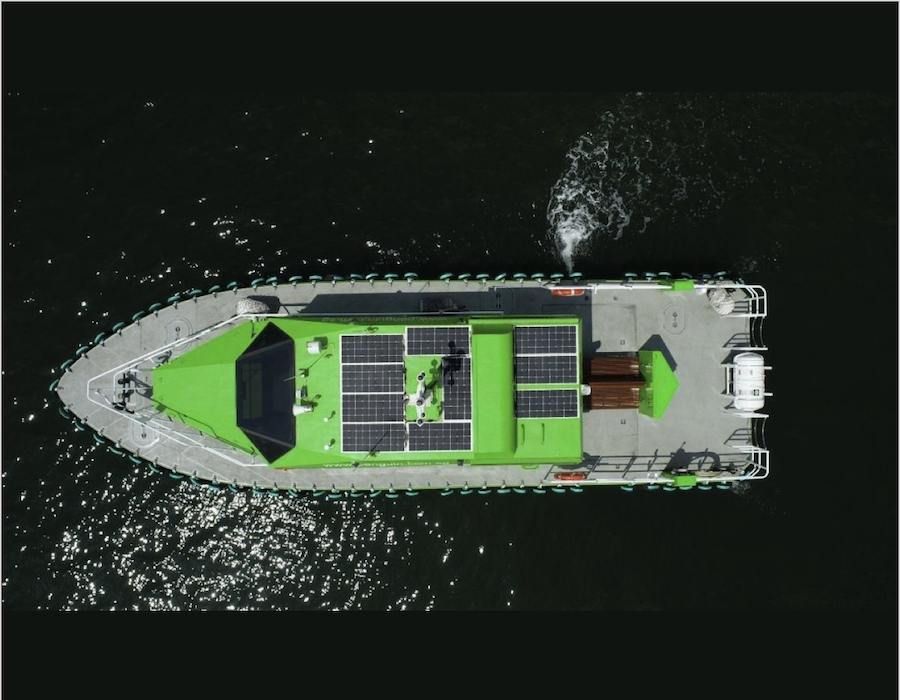
Penguin Tenaga is classed under BV with the notation Electric Hybrid and Zero Emission mode, which provides operational and environmental benefits.

Admin

Published

on

Screen Shot 2021 04 22 at 12.27.09 PM

French classification society Bureau Veritas (BV) on Wednesday (20 April) said it has certified and classed Singapore’s first hybrid-powered ship.

Built, owned and operated by Singapore-based Penguin Shipyard International, a subsidiary of Penguin International Limited (Penguin), Penguin Tenaga is a 15-meter, 12-passenger aluminum pilot boat capable of entirely running in electric mode at five knots for more than 30 minutes, and in conventional diesel mode can reach a maximum speed of 24 knots.

The vessel design is based on the same hull form as two of Penguin’s existing monohull pilot boats that are currently operating for Shell Eastern Petroleum in Singapore. 

Penguin Tenaga is classed under BV with the notation Electric Hybrid and Zero Emission (“ZE”) mode. This notation provides operational and environmental benefits. It helps to ensure the systems operate safely and efficiently, as well as reduce fuel consumption, local air emissions and noise when in proximity to centers of population.

BV assisted Penguin by providing guidance on the BV rules and advice to Sea Forrest Power Solutions Pte Ltd (a subsidiary of BH Global Corporation Limited) towards certification of the equipment on board, such as the hybrid electric propulsion systems installed on the vessel. 

In addition, solar panels installed on the roof of Penguin Tenaga provide electrical energy that is used to recharge mobile devices on board and supplement the vessel’s “hotel load”.

Singapore, one of the world’s largest and busiest ports, has pledged to reduce greenhouse emissions by 36% by 2030, when compared to 2005 levels. In a bid to reduce emissions, Singapore is taking a lead in developing hybrid-electric propulsion technology for offshore support and harbor vessels.

Currently, there are limited applications for pure electric vessels in Singapore due to the lack of charging infrastructure. However, this could change in coming years as the country electrifies its maritime eco-system to meet the IMO sustainability targets as well as its own sustainability goals.

“This project is a fantastic step in our industry’s decarbonization journey and continues to demonstrate the innovative strategy being adopted throughout the Singapore Marine Cluster,” said David Barrow, Marine & Offshore, Vice-President South Asia and Pacific, Bureau Veritas.

“We have been delighted to support Penguin and the other stakeholders in the unique project. Working in a truly collaborative way, we have all ensured a successful project delivery. The forward looking strategy by Penguin has to be a leading example of what we can achieve in meeting our sustainability goals and targets.”

“In the early days, when we were still in the conceptual phase of this hybrid project, we were faced with many variables and uncertainties. However, one thing that we were certain about was the choice of Bureau Veritas as our classification partner,” added James Tham, Penguin’s Managing Director. 

This landmark project is a collaboration of Penguin, Danfoss Power Solutions Pte Ltd, Durapower Technology (Singapore) Pte Ltd, ZF Asia Pacific Pte. Ltd., BH Global Corporation Ltd and BV.

Related: SMW 2021: Shell, MPA & Sembcorp Marine to trial hydrogen fuel cell with RoRo vessel retrofit


Photo credit: Bureau Veritas
Published: 22 April, 2021
Continue Reading

Alternative Fuels

MOL inks bio-LNG bunker fuel supply deals with Titan and Axpo for car carriers in Europe

Titan, part of Amsterdam-based Molgas, will continue to supply bio-LNG fuel in Northwest Europe, while Axpo will take charge of supply in the Mediterranean region.

Admin

Published

on

By

MOL inks bio-LNG bunker fuel supply deals with Titan and Axpo for car carriers in Europe

Mitsui OSK Lines (MOL) on Thursday (18 July) said it has signed new supply agreements in Northern Europe and the Mediterranean region to expand the use of bio-LNG marine fuel on MOL-operated LNG-fuelled car carriers.

Titan, part of Amsterdam-based Molgas, will continue to supply bio-LNG fuel in Northwest Europe, while Axpo will take charge of supply in the Mediterranean region.

MOL said the agreement makes it possible for its company to supply bio-LNG fuel for automobile carriers in the Mediterranean region, specifically Port of Malaga and Barcelona in Spain, following the bio-LNG fuel supply agreement in Western Europe, which commenced in March last year.

The bio-LNG fuel to be supplied in this initiative has a lifecycle carbon intensity (carbon dioxide emissions per unit of energy consumption) of -15 g-CO2/MJ or less, from production through consumption. Furthermore, this bio-LNG fuel has obtained International Sustainability and Carbon Certification (ISCC-EU). 

“Through this supply agreement, MOL has established a framework that ensures a continuous and stable supply of bio-LNG fuel not only in Northern Europe but also in the Mediterranean,” the company said.

As part of the group’s efforts to adopt alternative fuels and achieve net-zero greenhouse gas (GHG) emissions, it is utilising LNG-fuelled vessels as a bridge solution to facilitate the transition to carbon-neutral fuels such as bio-LNG and synthetic LNG (e-methane).

In 2025, MOL signed a bio LNG fuel supply agreement in Northwest Europe with Titan, part of the Molgas, and MOL has continued this bio LNG fuel supply agreement with the same company in 2026 as well.


Photo credit: Mitsui OSK Lines
Published: 19 June, 2026

Continue Reading

Biofuel

Kvasir Technologies lands EUR 10 million to scale bio bunker fuel production

The Danish biofuel startup raised the fund in a Series A investment round, which will provide capital to develop and design a new commercial production plant and scale climate-neutral drop-in marine fuel.

Admin

Published

on

By

Kvasir Technologies lands EUR 10 million to scale bio bunker fuel production

Danish biofuel startup Kvasir Technologies on Thursday (18 June) said it has raised EUR 10 million (USD 11.4 million) in a Series A investment round with participation from European Energy as a new investor, alongside existing investors EIFO, Maersk Growth and Footprint Fund. 

The Series A round provides capital to develop and design a new commercial production plant and scale climate-neutral drop-in fuel to be used in existing vessels.

At the same time, European Energy and Kvasir Technologies are entering into a strategic partnership by establishing the company KVEEN Biofuels, which is working towards the construction of a commercial-scale plant to produce biofuels using Kvasir Technologies’ patented technology.

“This investment round enables us to take the next crucial steps in developing and scaling our technology. At the same time, it underlines that there is still strong support for solutions that can deliver real climate impact in the maritime sector,” said Joachim Bachmann Nielsen, Ph.D. in Chemical Engineering and CEO of Kvasir Technologies.

Kvasir Technologies, a spin-out from research at the Technical University of Denmark (DTU), has developed a new technology to convert a wide range of non-edible lignin- based residues from agriculture and forestry into refined biofuels for shipping.

The climate-neutral biofuel can serve as an immediate replacement for fossil marine fuel without the need to modify ship engines or change existing infrastructure.

The new funding will be used, among other things, to scale the technology at Kvasir Technologies’ test facility in Fredericia, which can produce up to 2 metric tonnes (mt) of biofuel per day.

At the same time, development work will begin on the first commercial plant in the city of Aabenraa in the southern part of Jutland, which will demonstrate the technology on an industrial scale.


Photo credit: Kvasir Technologies
Published: 19 June, 2026

Continue Reading

Engine

BeHydro secures LR’s first class approval for 100% hydrogen marine engine

Engine has been developed and tested at ABC Engines’ facility in Ghent and is designed to operate entirely on hydrogen, without the need for pilot fuels.

Admin

Published

on

By

BeHydro secures LR’s first class approval for 100% hydrogen marine engine

Classification society Lloyd’s Register (LR) on Wednesday (17 June) said it has issued the first Type Approval Certificate for a 100% hydrogen-fuelled, spark-ignited marine engine.

The approval has been awarded to the hydrogen engine developed by BeHydro and confirms the design meets LR’s requirements for safety, performance and reliability in marine applications.

The engine has been developed and tested at ABC Engines’ facility in Ghent and is designed to operate entirely on hydrogen, without the need for pilot fuels. This simplifies system design and removes onboard carbon emissions at source, positioning the technology as a practical option for operators exploring zero-carbon propulsion.

Claudene Sharp-Patel, Global Technical Director, Lloyd’s Register, said: “The issue of this Type Approval Certificate demonstrates that hydrogen-fuelled internal combustion engine technology is continuing to mature as a viable option for maritime applications.

“For shipowners and operators, independent certification is essential in building confidence that emerging fuel technologies can meet the industry’s expectations for safety, reliability and operational performance.”

Tim Berckmoes, CEO at ABC Engines, said: “This LRS type approval of our BeHydro 100% hydrogen engines with zero emissions is a confirmation of the future proof technology that BeHydro can offer to innovative shipowners worldwide.

“The 100% hydrogen engine range is available from 900 kW till 2670 kW for different marine applications.”

LR previously awarded Type Approval to BeHydro for its hydrogen-powered dual-fuel engine in 2023, which was the first Type Approval for a dual-fuel hydrogen engine. 


Photo credit: Lloyd’s Register
Published: 19 June, 2026

Continue Reading

Trending