Connect with us
DNV Decarbonization Insight Series August 2026 - What maritime professionals should know about AI Training

LNG Bunkering

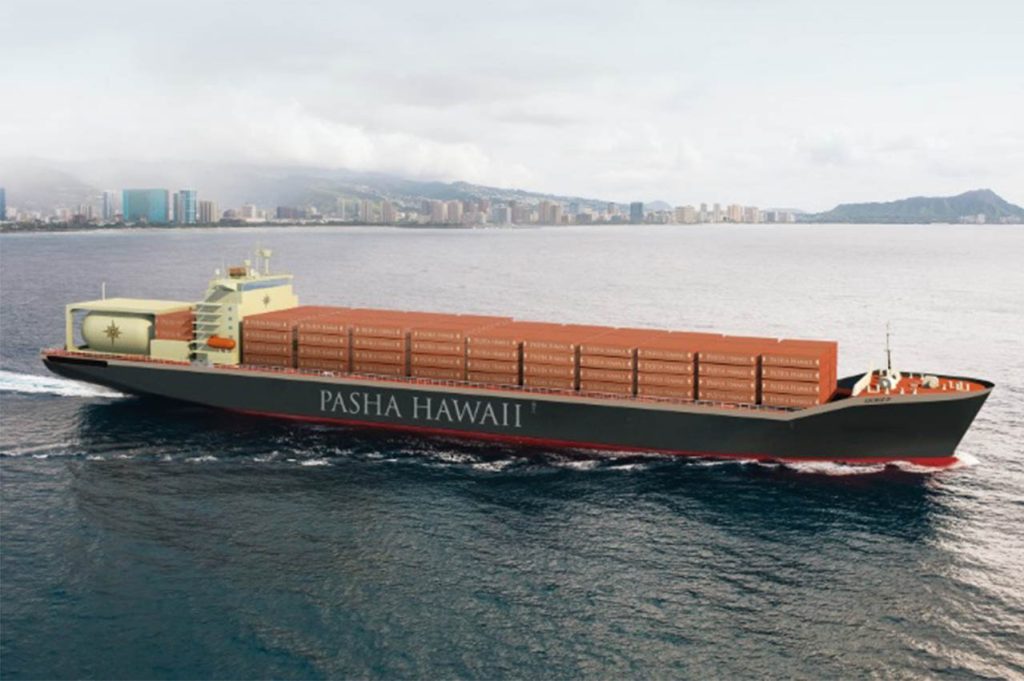
Pasha Hawaii orders LNG-fuelled newbuilds

Two 2,525 TEU capacity box vessels will use engines developed by MAN Diesel & Turbo.

Admin

Published

on

5b45a1297f19d 1531289897

Domestic US shipping firm Pasha Hawaii, a subsidiary of The Pasha Group, has placed an order for two 2,525 TEU capacity containership newbuildings that will be powered by liquefied natural gas (LNG).

The vessels will be constructed at the Keppel AmFELS yard in Brownsville, Texas to Keppel’s proprietary design and use propulsion systems designed by MAN Diesel & Turbo.

Each system comprises of a 7S80ME-GI Mk 9.5 main engine, 3 × MAN 6L35/44DF GenSets and an MAN Alpha FPP propeller system.

“With some 200 engines on order or already in service, the ME-GI's popularity continues to grow. This is yet another order within the container segment and cements the ME-GI concept,” says Bjarne Foldager – ‎Vice President, Sales & Promotion, Two-Stroke Business at MAN Diesel & Turbo.

“More so, the project at hand shows how our customers pick up on offers of complete propulsion systems beyond just the main engine. This confirms our strategic path to develop into a system provider.”

According to MAN Diesel & Turbo, Doosan Engine will build the main engines in Korea, which will meet Tier III emission standards by use of an Exhaust Gas Recirculation system.

Similarly, MAN Diesel & Turbo's Augsburg works will build the auxiliary engines which will meet Tier III with the aid of a Selective Catalytic Reduction system.
Engine delivery is scheduled for 2019 with the two vessels, respectively, due for launch in Q1 and Q3 of 2020.

Photo credit: MAN Diesel & Turbo
Published: 11 July 2018
 

Continue Reading

LNG Bunkering

Somtrans launches new 20,000 cbm LNG bunkering barge in China

Barge is now one step closer to joining Somtrans’ fleet in January next year and beginning its journey at sea.

Admin

Published

on

By

Somtrans launches new 20,000 cbm LNG bunkering barge

Tanker shipping company Somtrans on Saturday (8 August) said its new 20,000 m³ LNG bunkering barge has successfully been launched at China’s Nantong CIMC Sinopacific Offshore & Engineering Co Ltd (CIMC SOE).

The company said the barge is now one step closer to joining its fleet in January next year and beginning its journey at sea.

“From the first plans to seeing the barge enter the water, this project has involved years of expertise, teamwork and dedication from many people,” it said in a social media post. 

Separately, RensenDriessen Shipbuilding, which acted as a broker in the project, said the vessel was built by CIMC SOE, with newbuilding supervision carried out by EXMAR.  


Photo credit: Somtrans
Published: 11 August, 2026

Continue Reading

Alternative Fuels

Peninsula: Bio-LNG offers practical route to shipping decarbonisation

Company outlines why bio-LNG is emerging as a key fuel pathway in the maritime energy transition including playing a role in helping operators manage their emissions profile.

Admin

Published

on

By

Peninsula

Marine fuels supplier Peninsula recently published an article on why bio-LNG is emerging as a key fuel pathway in the maritime energy transition:

As the maritime industry accelerates its decarbonisation journey, operators face a growing challenge: reducing emissions while maintaining operational efficiency and commercial viability. While no single fuel offers a universal solution, Bio-LNG is increasingly attracting attention as a practical pathway for LNG-fuelled vessels seeking immediate emissions reductions without major infrastructure changes. 

The conversation around alternative fuels often focuses on future technologies and long-term investments. However, for many operators, the more pressing question is how to reduce emissions today using solutions that can be implemented within existing operations. This is where Bio-LNG presents a compelling proposition. 

“As operators look to balance compliance, cost and operational performance, Bio-LNG offers a practical solution that can be integrated into existing LNG infrastructure today. Increasing availability across key bunkering locations is helping turn decarbonisation ambitions into operational reality.” Cristina Danes, LNG Supply Trader, Peninsula. 

Building on Existing LNG Infrastructure 

BioLNG is a renewable marine fuel produced from certified biogenic waste feedstocks. While its origin differs from conventional LNG, it remains chemically equivalent, allowing it to be used within existing LNG infrastructure and dual-fuel engines. This compatibility eliminates the need for costly vessel modifications or extensive retrofitting programmes, reducing both complexity and investment requirements. 

For operators that have already invested in LNG-capable vessels, bioLNG offers a clear route to further improve environmental performance while leveraging existing assets and supply chains. 

The increasing availability of bioLNG across key bunkering hubs is helping remove barriers to adoption. Recent supply operations, including Peninsula’s first Bio-LNG delivery in the Port of Cadiz, illustrate how renewable marine fuels are becoming more accessible through existing LNG supply chains. 

Delivering Meaningful Emissions Reductions 

As regulatory requirements continue to evolve, the ability to demonstrate measurable emissions reductions is becoming increasingly important. BioLNG can achieve lifecycle greenhouse gas emissions reductions of up to 90% compared with conventional marine fuels when produced from certified waste-based feedstocks. 

These reductions represent a significant opportunity for vessel operators looking to improve their environmental performance while balancing commercial considerations and operational requirements. 

Supporting Regulatory Compliance 

Alongside emissions reduction targets, compliance is becoming an increasingly central consideration in fuel procurement decisions. 

Frameworks such as FuelEU Maritime are creating new incentives for lower-carbon fuel adoption while introducing additional complexity into compliance planning. In this environment, BioLNG can play an important role in helping operators manage their emissions profile and support broader compliance strategies, including participation in mechanisms such as FuelEU pooling. 

As regulations continue to develop, flexibility will become an increasingly valuable asset. Fuels that can deliver both environmental and compliance benefits are likely to play a growing role in operators’ fuel strategies. 

A Practical Step Forward 

The maritime energy transition will require a mix of solutions, technologies and fuel pathways. While longer-term alternatives continue to develop, BioLNG provides an immediately available option for LNG-fuelled vessels seeking to reduce emissions and prepare for a more carbon-conscious operating environment. 

For many operators, the transition to lower-carbon shipping will not be defined by a single transformational change, but by a series of practical steps. BioLNG represents one such step: leveraging existing infrastructure, supporting regulatory compliance and helping bridge the gap between today’s operations and the future of shipping.


Photo credit: Peninsula
Published: 11 August, 2026

Continue Reading

Alternative Fuels

ENGINE on Fuel Switch Snapshot: Flat pooling leaves fuel economics largely unchanged

Rotterdam B100 discount to LSMGO widens by $36/mt; Singapore B100 back to premium over LSMGO; biofuel blending fears mostly overstated – Prima.

Admin

Published

on

By

3 1

Once a week, bunker intelligence platform ENGINE will publish a snapshot of alternative and conventional bunker fuel prices in the world’s two biggest bunkering hubs. The following is the latest snapshot:

10 August 2026

  • Rotterdam B100 discount to LSMGO widens by $36/mt
  • Singapore B100 back to premium over LSMGO
  • Biofuel blending fears mostly overstated – Prima

Rotterdam’s B100 price has edged $7/mt lower and its liquefied biomethane (LBM) price has dropped $1-2/mt over the past week.

With the OceanScore FuelEU pooling index unchanged, the EU compliance-adjusted benchmarks have been weighed down by a $1/mt rise in B100’s pooling value, driven by a firmer euro.

B100’s premium over VLSFO has widened by $6/mt to $47/mt.

6a79e41970f7c1b350cde6e1 6da62a94 c0ca 4499 9d54 783b407a0318 1200w

LBM’s discounts to VLSFO in Rotterdam have narrowed by $11-12/mt. Its discounts to LSMGO have widened by $30-31/mt over the same period.

Liquid fuels

Rotterdam’s HSFO and LSMGO prices have gained $18-29/mt, while its VLSFO price has declined by $12/mt over the past week.

B100’s discount to LSMGO in Rotterdam has widened by $36/mt to $453/mt.

Singapore’s VLSFO and HSFO prices have gained $31/mt and $41/mt, respectively, while its LSMGO benchmark has declined by $14/mt.

The port’s B100 price has edged $2/mt higher, flipping back to a $10/mt premium over LSMGO from a $6/mt discount the previous week. Meanwhile, its premium over VLSFO has narrowed by $29/mt to $260/mt.

The Dutch ZRE A price has remained unchanged over the past week. Prima Markets said no market participants were able to confirm any ZRE A trading activity during the week, reflecting illiquidity in the market.

One market participant told Prima that concerns over insufficient biofuel blending to meet this year’s Dutch maritime quota were “likely exaggerated”.

Liquid gases

Rotterdam’s LNG prices have gained $9-10/mt, depending on engine type. LNG’s premiums over LBM have widened by $10/mt to $301-308/mt over the past week.

Singapore’s LNG prices have declined by $24-25/mt over the same period.

By Konica Bhatt


Photo credit and source: ENGINE
Published: 11 August, 2026

Continue Reading

Trending