Connect with us
DNV Decarbonization Insight Series August 2026 - What maritime professionals should know about AI Training

Bunker Fuel

JLC China Bunker Fuel Market Monthly Report (July 2026)

China’s bonded bunker fuel sales dropped in July, as typhoons hindered port operation in East and South China and bonded bunker fuel supply tightened in northern ports.

Admin

Published

on

JLC China Bunker Fuel Market Monthly Report (July 2026)

Beijing-based commodity market information provider JLC Network Technology Co. recently shared its JLC China Bunker monthly report for July 2026 with Manifold Times through an exclusive arrangement:

China’s bonded bunker fuel sales drop in July

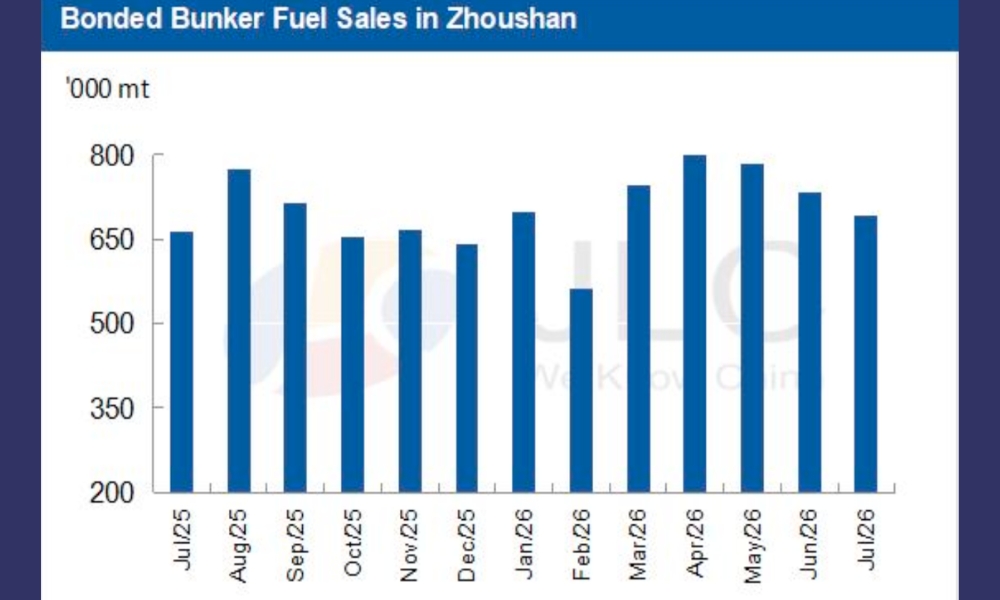
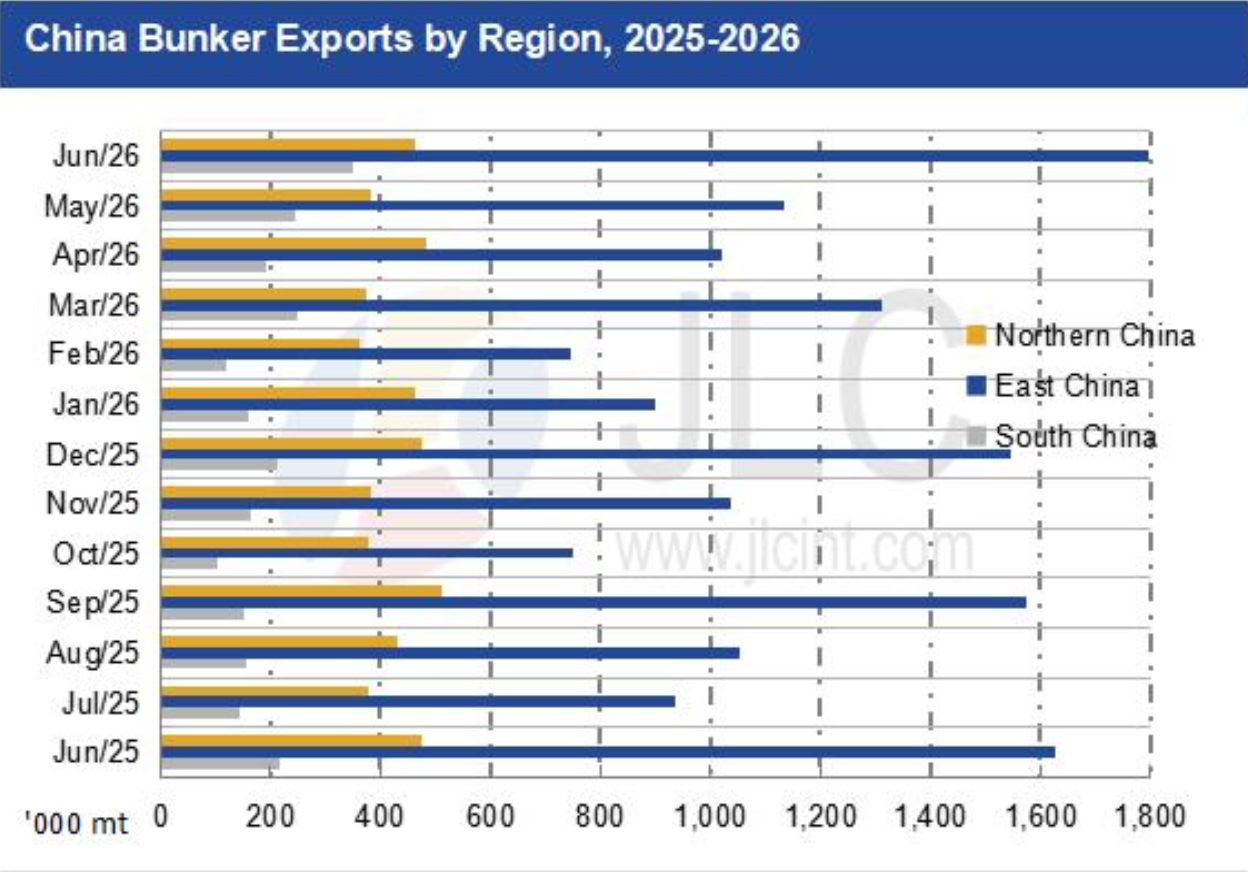
China’s bonded bunker fuel sales dropped in July, as typhoons hindered port operation in East and South China and bonded bunker fuel supply tightened in northern ports. Meanwhile, some shipowners became more cautious about bunkering when geopolitical tensions persisted.

China sold about 1.78 million mt of bonded bunker fuel in the month, with the daily sales at 57,503 mt, down by 10.12% month on month, JLC’s data shows.

Regarding the sales by supplier, the sales by Chimbusco, Sinopec (Zhoushan), SinoBunker, and China Changjiang Bunker (Sinopec) respectively settled at 380,000 mt, 600,000 mt, 60,000 mt, and 10,000 mt in the month, while those by suppliers with regional bunkering licenses settled at 732,600 mt.

China’s LSFO output retreats in July

China’s low-sulfur fuel oil (LSFO) output retreated in July , as refineries lacked production enthusiasm when their margins weakened.

Chinese refiners produced about 1.29 million mt of LSFO in the month, with the daily output at 41,613 mt, down by 4.48% month on month, JLC’s data shows.

Specifically, Sinopec witnessed an obvious decline in its output. ZhongKe (Guangdong) Refinery & Petrochemical lowered its output amid unit maintenance. Qingdao Petrochemical also cut its output, but it was still high. By contrast, Shengli Petrochemical boosted its production.

Meanwhile, CNOOC’s LSFO output slid in July , with T aizhou Petrochemical suspending production.

Zhoushan Petrochemical and Huizhou Refinery maintained stable production, while Zhongjie Petrochemical did not produce any LSFO in the month.

On the other hand, PetroChina recorded an increase in its LSFO output, with Dalian WEPEC, Jinzhou Petrochemical, Jinxi Petrochemical, Huabei (North China) Petrochemical, and Dagang Petrochemical raising output.

ZPC and Sinochem did not produce any LSFO in the month, but the latter produced and exported 10,000 mt of MGO.

Screenshot 2026 08 12 at 1.36.44 PM

Screenshot 2026 08 12 at 2.02.30 PM

Domestic-trade bunker fuel demand shrinks in July

Domestic-trade heavy bunker fuel demand shrank in July when inland and coastal shipping was seasonally weak.

The demand settled at 300,000 mt in July, with the daily demand at 9,677 mt, slipping by 6.35% month on month, JLC’s data shows.

Shipowners just made deals for rigid demand, with a strong wait-and-see attitude and no intention of stockpiling.

Meanwhile, domestic-trade light bunker fuel demand settled at 140,000 mt in the month, with the daily volume at 4,516 mt, down by 9.68% month on month, the data shows. The decline was mainly due to the bad impact of continuous typhoons.

Bunker Fuel Supply

China’s bonded bunker fuel imports rebound in June

China’s bonded bunker fuel imports rebounded in June, after hitting a 16-month low in the previous month.

The country imported 515,300 mt of bonded bunker fuel in the month, soaring by 86.77% month on month, calculations show, based on data from the General Administration of Customs of PRC (GACC).

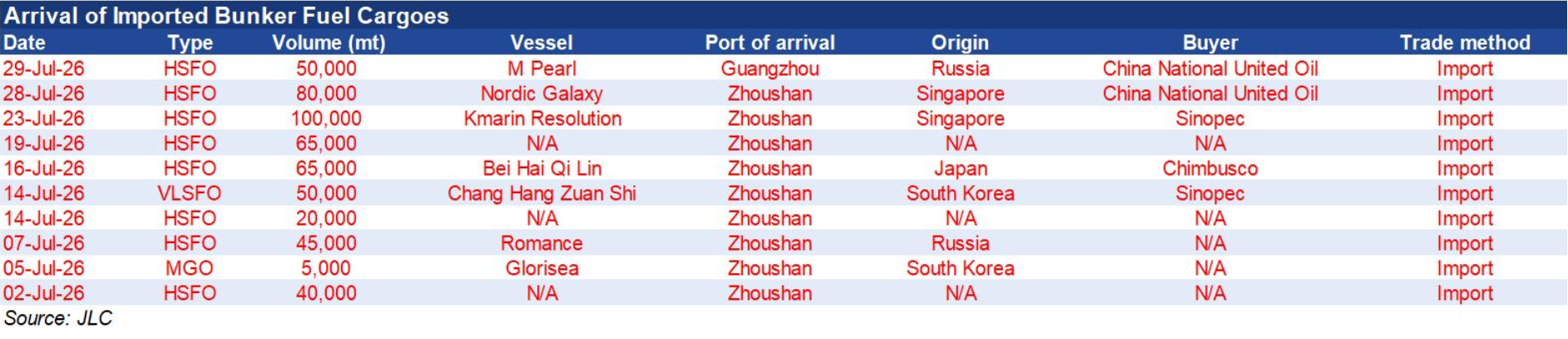
Bonded bunker suppliers boosted their purchases of imported high-sulfur fuel oil (HSFO) as premiums retreated amid easing conflicts between the U.S. and Iran. Meanwhile, downstream HSFO bunkering demand was relatively good, which also aroused suppliers’ import interest.

The arrivals of imported marine gas oil (MGO) also increased in June.

However, these bunker suppliers did not import any LSFO in the month, given sufficient domestic supply.

On a year-on-year comparison, China’s bonded bunker fuel imports declined by 5.50% in June.

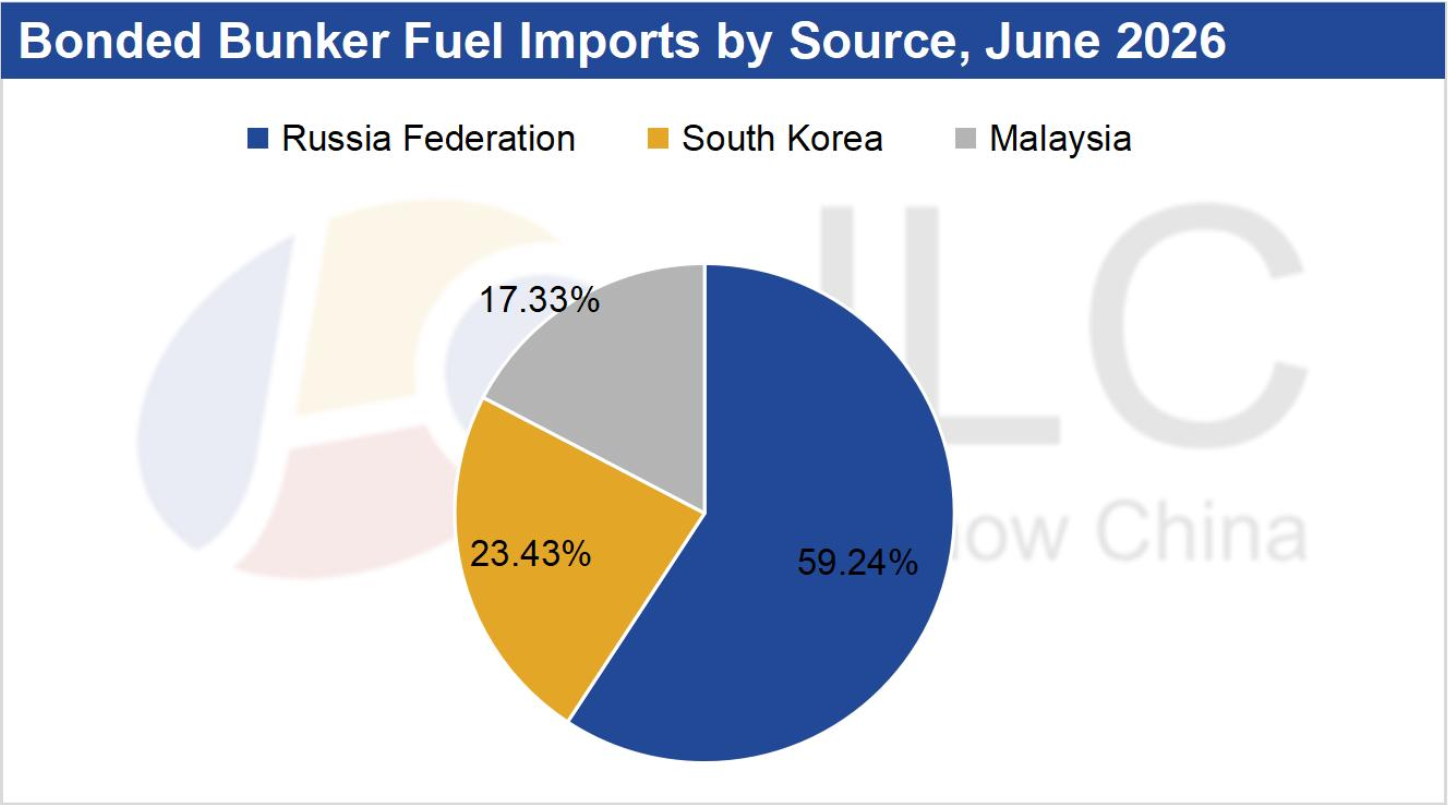
Regarding the imports by source, Russia was still the largest supplier with 305,300 mt, accounting for 59.24% of China’s total imports. South Korea climbed to the second place with 120,700 mt, accounting for 23.43%, while Malaysia slipped to the third place with 89,300 mt, accounting for 17.33%.

China’s bonded bunker fuel imports totaled 3.38 million mt in the first half of this year, an increase of 5.54% from the same period of time in 2025, calculations also indicate.
Screenshot 2026 08 12 at 2.02.45 PM

Domestic-trade bunker fuel supply tightens further in July

Chinese blenders supplied 270,000 mt of domestic-trade heavy bunker fuel in July , with the daily supply at 8,710 mt, a decline of 9.90% month on month, JLC’s data shows.

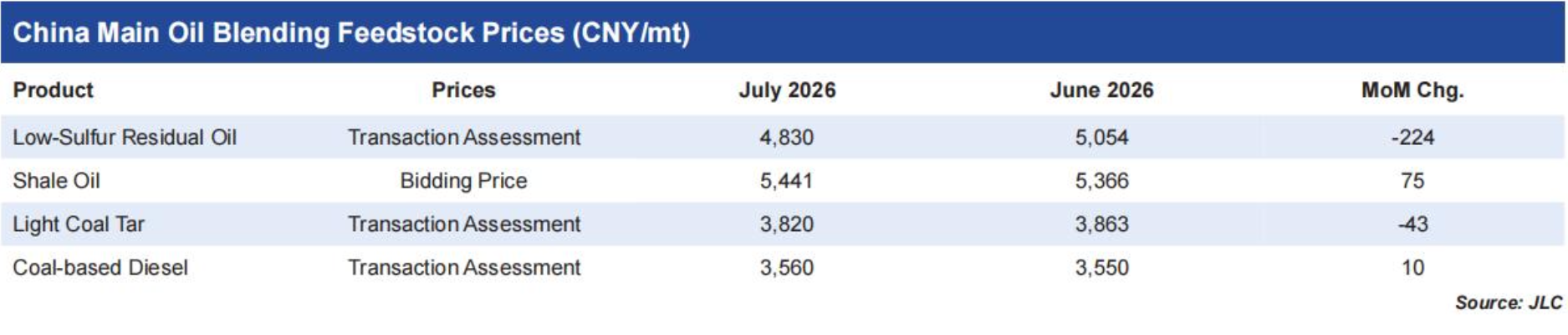
Low-sulfur residual oil supply continued to tighten despite restarts of some refineries, which forced blenders to cut their bunker fuel production. Meanwhile, supply of consumption-tax-included bunker fuel decreased with tax inspections becoming regular.

In the meantime, domestic-trade MGO supply settled at 170,000 mt, with the daily supply at 5,484 mt, down by 8.60% from a month earlier, the data shows.
Screenshot 2026 08 12 at 2.02.57 PMScreenshot 2026 08 12 at 1.36.44 PM Screenshot 2026 08 12 at 2.02.30 PM Screenshot 2026 08 12 at 2.02.45 PM Screenshot 2026 08 12 at 2.02.57 PM Screenshot 2026 08 12 at 2.03.15 PM Screenshot 2026 08 12 at 2.03.28 PM Screenshot 2026 08 12 at 2.03.41 PM

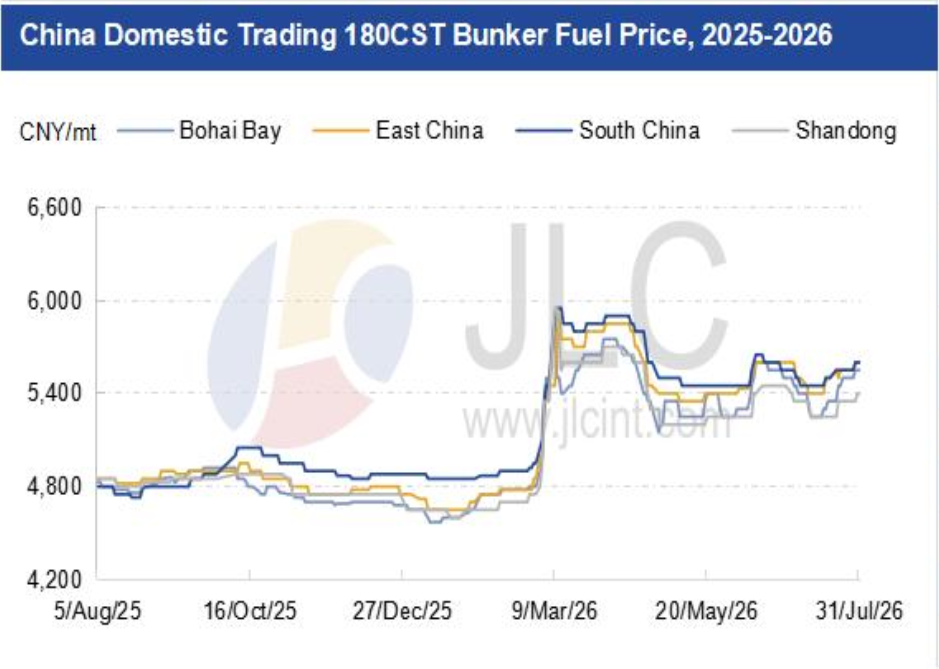
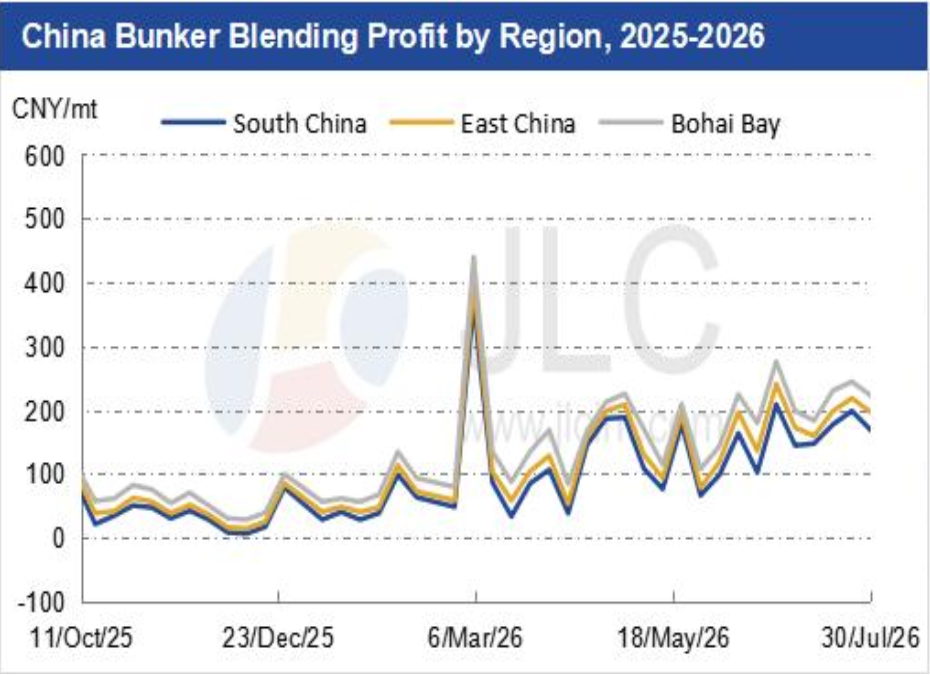
Bunker Prices, Profits

Screenshot 2026 08 12 at 2.03.28 PM

Screenshot 2026 08 12 at 2.03.41 PM

Editor
Yvette Luo
+86-020-38834382
[email protected]  

Sales (Beijing)
Tony Tang
+86-10-84428863
[email protected]  

Sales (Singapore)
Ginny Teo
+65-31571254
[email protected]
[email protected]  

JLC Network Technology Co., Ltd is recognised as the leading information provider in China. We specialise in providing the transparent, high-value, authoritative market intelligence and professional analysis in commodity market. Our expertise covers oil, gas, coal, chemical, plastic, rubber, fertilizer and metal industry, etc.

JLC China Bunker Fuel Market Monthly Report is published by JLC Network Technology Co., Ltd every month on China bunker market, demand, supply, margin, freight index, forecast and so on. The report provides full-scale & concise insight into China bunker oil market.

All rights reserved. No portion of this publication may be photocopied, reproduced, retransmitted, put into a computer system or otherwise redistributed without prior authorization from JLC.

Related: JLC China Bunker Fuel Market Monthly Report (June 2026)
Related: JLC China Bunker Fuel Market Monthly Report (May 2026)
Related: JLC China Bunker Market Monthly Report (April 2026)
Related: JLC China Bunker Market Monthly Report (March 2026)
Related: JLC China Bunker Fuel Market Monthly Report (February 2026)
Related: JLC China Bunker Market Monthly Report (December 2025)
Related: JLC China Bunker Market Monthly Report (November 2025)
Related: JLC China Bunker Fuel Market Monthly Report (October 2025)
Related: JLC China Bunker Fuel Market Monthly Report (September 2025)
Related: JLC China Bunker Fuel Market Monthly Report (July 2025)
Related: JLC China Bunker Fuel Market Monthly Report (June 2025)
Related: JLC China Bunker Fuel Market Monthly Report (May 2025)
Related: [Updated 15 May] JLC China Bunker Market Monthly Report (April 2025)
Related: JLC China Bunker Market Monthly Report (February 2025)
Related: JLC China Bunker Fuel Market Monthly Report (January 2025)
Related: JLC China Bunker Fuel Market Monthly Report (December 2024)
Related: JLC China Bunker Fuel Market Monthly Report (November 2024)
Related: JLC China Bunker Fuel Market Monthly Report (October 2024)
Related: JLC China Bunker Fuel Market Monthly Report (September 2024)
Related: JLC China Bunker Fuel Market Monthly Report (August 2024)
Related: JLC China Bunker Fuel Market Monthly Report (July 2024)
Related: JLC China Bunker Fuel Market Monthly Report (June 2024)
Related: JLC China Bunker Fuel Market Monthly Report (May 2024)
Related: JLC China Bunker Market Monthly Report (April 2024)
Related: JLC China Bunker Market Monthly Report (March 2024)
Related: JLC China Bunker Fuel Market Monthly Report (February 2024)
Related: JLC China Bunker Market Monthly Report (January 2024)

Note: China-based commodity market information provider JLC Technology has been providing Singapore bunkering publication Manifold Times China bunker volume data since 2020. Data from earlier periods are available here.


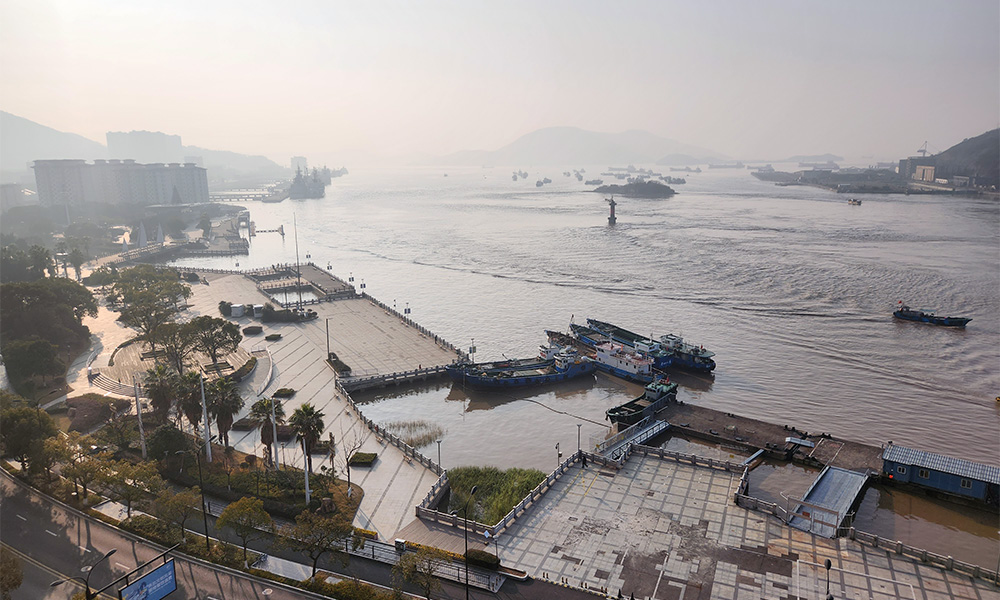
Photo credit: JLC Network Technology
Published: 12 August, 2026
Continue Reading

Business

IBT Bunkering & Trading appoints Kevin Döhmen to lead Singapore expansion

Döhmen will lead the new Singapore office, with responsibility for managing and developing the operation and strengthening relationships with customers and partners.

Admin

Published

on

By

IBT Bunkering & Trading appoints Kevin Döhmen to lead Singapore expansion

Hamburg-based marine fuels firm IBT Bunkering & Trading on Wednesday (12 August) said it has appointed Kevin Döhmen as Executive Vice President to lead the company’s new Singapore office. 

Manifold Times previously reported the company announcing that it is opening its doors in Singapore and will be running a trading desk in the city-state after trading bunkers out of Hamburg since 1976.

The company said Kevin Döhmen will lead the new Singapore office, with theresponsibility for managing and developing the operation and strengthening relationships with customers and partners.

IBT said the Singapore office represents an important first step in strengthening its presence in Asia.

“At the same time, we are actively exploring further opportunities to expand our activities and establish new partnerships in this key maritime hub,” the company said. 

Döhmen said: “Singapore is the heartbeat of global bunkering. Bringing IBT’s Hamburg roots — 50 years of them — onto the ground in this hub is a real privilege, and I couldn’t be more ready for it.”

IBT said it will maintain the service approach established through its Hamburg operations while building its activities in Singapore.

The company described the move as bringing together its Hamburg roots and Singapore presence through a global bunker network. 

Related: German firm IBT Bunkering & Trading establishes Singapore presence, adds second trading desk


Photo credit: IBT Bunkering & Trading
Published: 13 August, 2026

Continue Reading

Bunker Alerts

Low flashpoint found in Indonesia bunker fuels, alerts Maritec-Naias

Firm tested eight bunker samples representing LSMDO and B40 fuel grade from vessels that took fuel oil /bunkered in Indonesia ports, which indicated flashpoints as low as 39.5°C.

Admin

Published

on

By

RESIZED Shaah Shahidh on Unsplash

Bunker fuel testing and marine surveying business Maritec-Naias on Wednesday (12 August) issued an alert regarding bunker samples from vessels that took fuel oil/bunkered in Indonesia showing flashpoints as low as 39.5°C:

During the period of 21 July to 04 August 2026, Maritec-Naias tested eight bunker samples representing Low Sulfur Marine Distillate Oil (LSMDO) and B40 fuel grade from vessels that took fuel oil /bunkered in Indonesia ports, which indicated Flashpoints as low as 39.5°C.

All eight fuel samples tested were sourced from a single supplier.

Regulatory Implications:

Based on the results of the eight samples tested, the fuels do not comply with the minimum flashpoint requirement of 60 °C set by SOLAS and ISO 8217.

As per SOLAS requirements, the minimum flashpoint of any fuel carried in the tanks of a ship should be not less than 60 °C (with exception of fuel for lifeboats, which can be grade DMX with a flash point min of 43 °C).

ISO 4259 interpretation for tested flashpoint temperature is not taken into consideration here as the safety of onboard crew and vessel is of higher precedence.

Since 01 May 2024, it has been a MARPOL Annex VI requirement that the Bunker Delivery Note (BDN) includes either the actual flashpoint of a fuel as supplied or a declaration that its flashpoint has been determined as being at or above 70°C.

From 1 January 2026, SOLAS amendments clarified that the flashpoint requirement applies to fuels, which were specifically intended to have a flashpoint not less than 60°C as required under SOLAS II‑2/2.1.1 These amendments now align with MARPOL by requiring flashpoint details to be recorded on the BDN. Additionally, prior to bunkering, suppliers must provide the ship’s representative with a signed declaration confirming that the fuel meets the SOLAS flashpoint standard.

MARITEC-NAIAS RECOMMENDATIONS

When ordering fuels from Indonesia it is advised to insist on getting the actual flash point values from the supplier. If your vessel has bunkered a low flashpoint fuel it is prudent to observe/implement the precautions below:

  • Flame screens on tank vents should be maintained in good condition and there should be no sources of ignition in the vicinity of the vents. This will assist in safe natural ventilation of volatile components in the fuel.
  • No Smoking, no naked flame and no hot work must be allowed at any areas near to tank air vents.
  • Send additional tank(s) samples upon arrival in port to check the fuel properties and flash point results especially if there has been co-mingling of fuels in bunker tanks
  • If the vessel is out at sea, it may be possible to obtain dispensation from your Flag State Administration up to the next arrival port.
  • Put the supplier on notice promptly and notify your P&I club.


Photo credit: Shaah Shahidh on Unsplash
Published: 13 August, 2026

Continue Reading

Methanol

China: Xiamen issues safety guidelines for methanol bunkering operations

New guidelines establish safety requirements across the full methanol bunkering process, supporting the expansion of green marine fuel supplies at Xiamen Port.

Admin

Published

on

By

Xiamen, China

Xiamen Free Trade Zone on Monday (10 August) said its Administrative Committee recently jointly issued the Safety Guidelines for Marine Methanol Fuel Bunkering in Xiamen Waters with Xiamen Port Authority and Xiamen Maritime Safety Administration, establishing a framework for methanol bunkering operations in the port.

The guidelines are the first safety operating standard in Fujian province specifically covering marine methanol fuel bunkering. They apply to methanol bunkering operations conducted by bunker vessels in Xiamen waters and set out safety requirements covering the entire operation, from preparation through completion.

The guidelines specify requirements for bunkering companies, equipment and materials used on bunker vessels, hose inspection intervals, personnel certification and personal protective equipment.

They also require operators to conduct dedicated risk assessments and prepare emergency response plans before operations begin. During bunkering, operators must maintain continuous monitoring and comply with specified weather restrictions. After completion, pipelines must undergo procedures including purging and inerting.

Xiamen Port has previously carried out ship-to-ship bunkering of biofuels and LNG. The new guidelines provide a regulatory framework and operational basis for methanol bunkering and are intended to support the safe and orderly conduct of such operations.

The move is also expected to help Xiamen Port expand its market and bunkering capacity for green marine fuels. 


Photo credit: Woo Winter on Unsplash
Published: 13 August, 2026

Continue Reading

Trending