
Alternative Fuels
MPA: Multi-agency exercise to test Singapore’s ferry mishap readiness and response
Highlights included the demonstration of the rescue capabilities of MPA’s newest hybrid diesel-electric patrol craft “MPA Guardian” for specialised rescue ops.

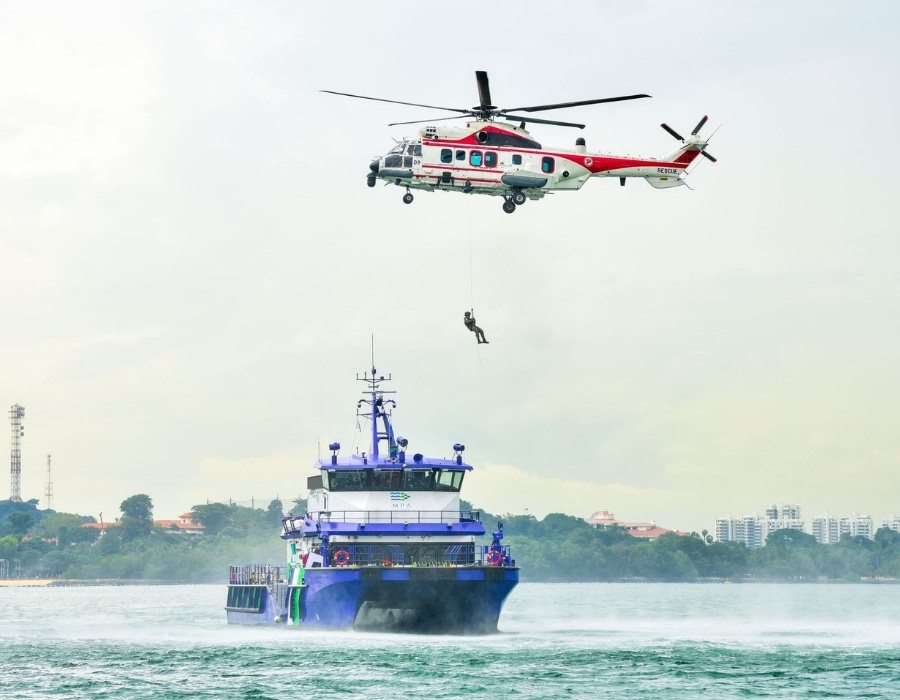
The Maritime and Port Authority of Singapore (MPA) on Monday (29 August) said it held its annual ferry rescue exercise (FEREX) to test Singapore’s operational readiness in the event of a ferry mishap.
The FEREX was held in conjunction with the annual International Safety at Sea conference held from 30 August to 2 September 2022.
One of the main highlights of the exercise included the demonstration of the rescue capabilities of MPA’s newest hybrid diesel-electric patrol craft, MPA Guardian.
Nine vessels, a helicopter and more than 200 personnel from various agencies and private sector partners were deployed for the seaward exercise off the western coast of Sentosa and landward exercise at HarbourFront Passenger Ferry Terminal (HFPT). These included the Immigration & Checkpoints Authority (ICA), Ministry of Health (MOH), Singapore Police Force (SPF), the Republic of Singapore Air Force (RSAF), the Republic of Singapore Navy (RSN), Singapore Civil Defence Force (SCDF), Singapore Cruise Centre Pte Ltd, and ferry operator Batam Fast Ferry Pte Ltd.
The exercise was observed by Mr S Iswaran, Minister for Transport, Singapore, together with key personnel from the various government agencies and private sector Partners.
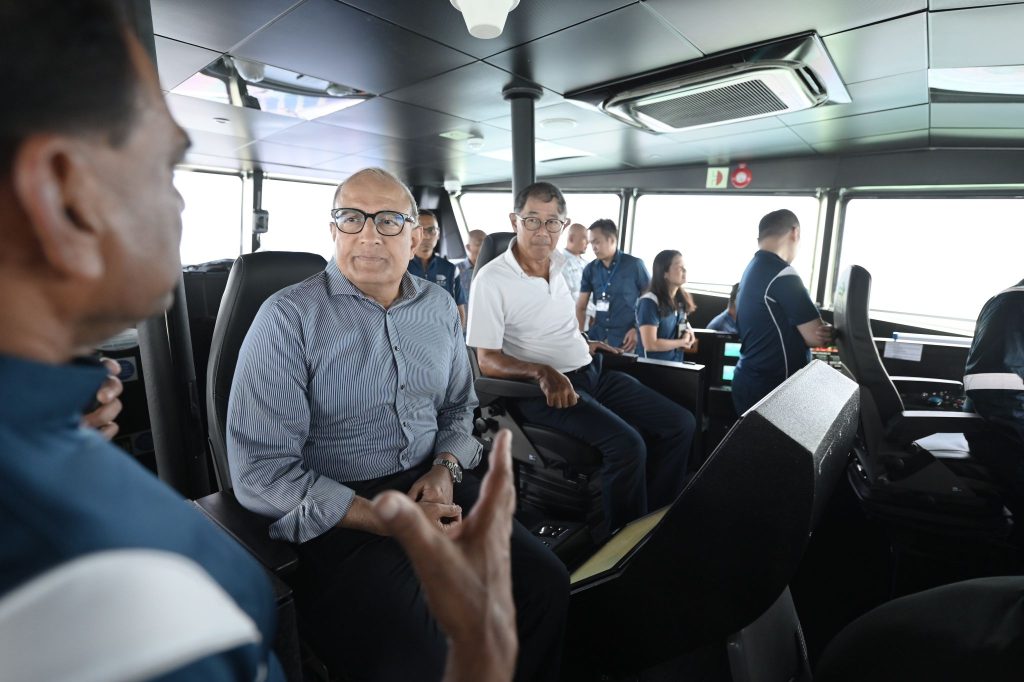
Exercise scenario
The exercise scenario was based on a collision between a ferry by Batam Fast Ferry and a harbour craft which resulted in a main engine failure and ingress of water onboard the ferry due to hull damage. This led to a precarious situation that necessitated an immediate evacuation of the passengers on board the “stricken” ferry. The captain of the ferry sent out a distress call requesting for immediate help from MPA and initiated onboard evacuation procedures.
Seaward rescue operations
MPA’s Ferry Mishap Contingency Plan was activated to test the agencies’ operational readiness to the incident and various seaward resources were deployed to secure the area of operations and evacuate the passengers. These included three MPA patrol crafts, a Police Coast Guard 5th Generation PT class patrol craft, an RSAF H225M Medium Lift helicopter, an RSN Independence-class Littoral Mission Vessel, and a SCDF Heavy Rescue Vessel.
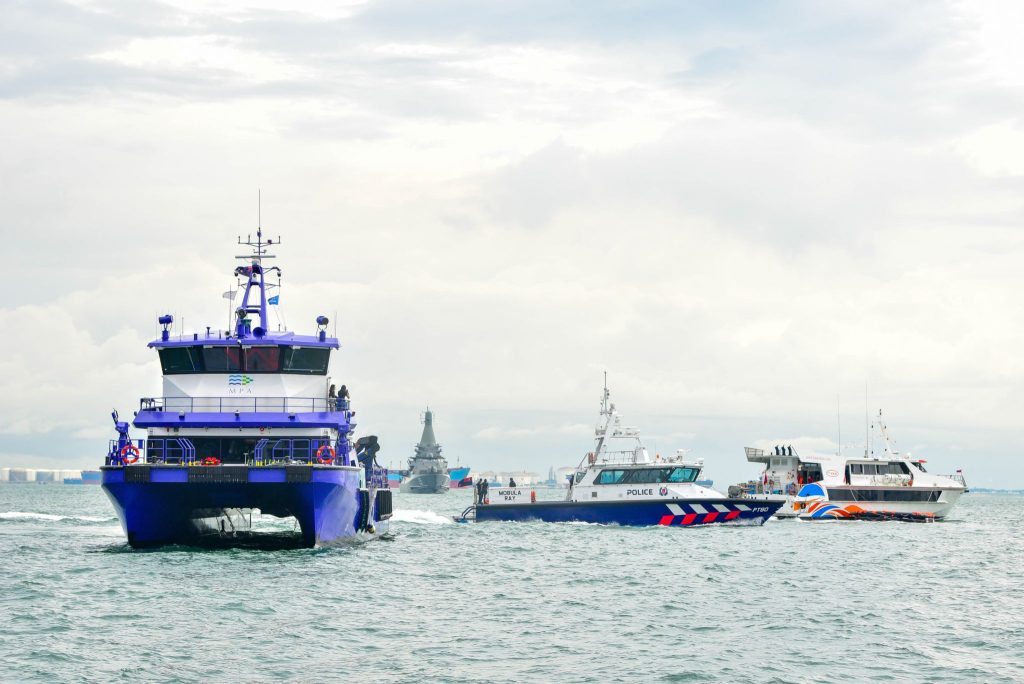
MPA Guardian provides an edge in rescue operations
Developed in collaboration with the Defence Science and Technology Agency and Penguin Shipyard International, MPA Guardian is a hybrid diesel-electric patrol craft that is equipped with a comprehensive suite of capabilities which allows specialised rescue operations.
To demonstrate the rescue capabilities of MPA’s newest patrol craft, rescued passengers were transferred onto MPA Guardian to receive simulated medical attention in the vessel’s First Aid Room.
MPA Guardian is equipped with a command operations room to manage rescue operations, a Rigid-Hulled Inflatable Boat that can be deployed within 10 minutes to conduct shallow water rescue missions, and a 10-metre wide deck that is able to facilitate drone and heli evacuation operations.
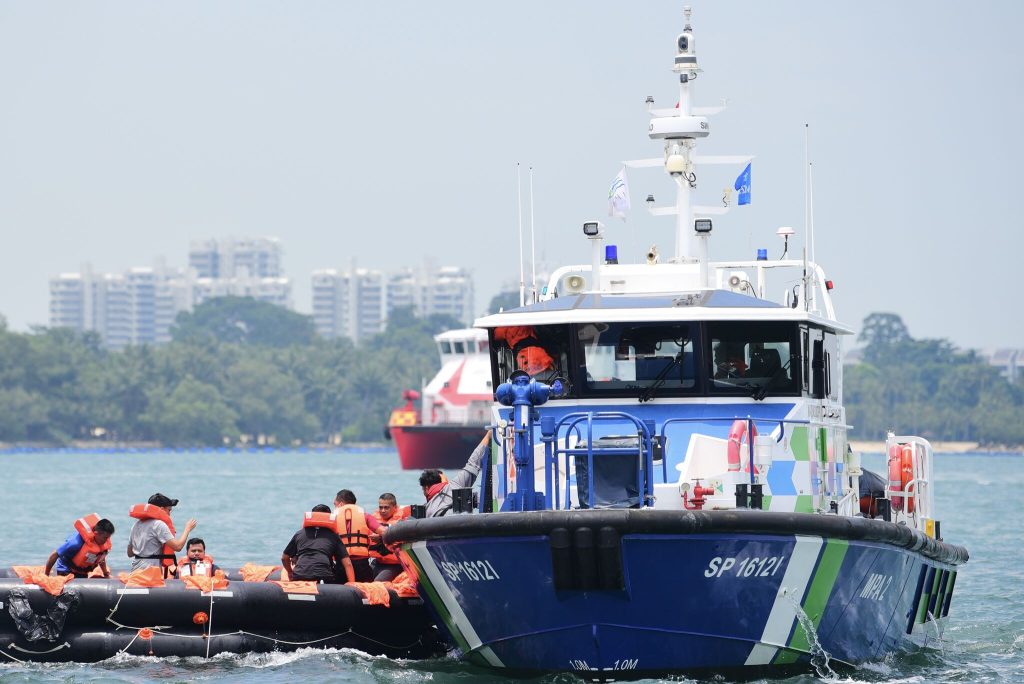
To demonstrate MPA Guardian’s heli evacuation capabilities and crew readiness, RSAF deployed their H225M helicopter to heli winch a “critically injured” dummy passenger from the vessel.
Harnessing drone technology
This year’s exercise also saw the deployment of unmanned aerial drones from MPA’s patrol crafts for aerial surveillance and remote monitoring with “live” feed to MPA Guardian’s command operations room to enhance situational awareness and incident management response.
Landward rescue operations
The readiness of the landward rescue operation was also tested in this year’s exercise. Medical personnel and triage facilities by SCDF and MOH were deployed at HPFT to manage and treat injured passengers prior to hospital conveyance. SPF and ICA officers were also deployed to provide security coverage and immigration clearance as part of the rescue efforts.
“With the resumption of regional ferry services that have been disrupted by COVID-19, it is important for us to resume both the seaward and landward rescue components of the exercise to test and enhance the operational readiness and contingency preparedness of government agencies and private sector partners in dealing with such mishaps,” said Capt Daknash Ganasen, Senior Director of Operations and Marine Services, MPA.
“It also gives us the opportunity to deploy new rescue capabilities and technologies, while raising public awareness on how passengers are safeguarded and cared for during a ferry rescue operation.”
Photo credit: Maritime and Port Authority of Singapore
Published: 30 August, 2022
Decarbonisation
DNV: New research shows how regulation could reshape shipping
DNV summarizes findings of its latest Maritime Forecast to 2050, exploring how future scenarios could affect marine fuel demand, technology uptake, fleet investments, and competitiveness.
Classification society DNV on Thursday (24 September) released a new article summarizing findings of its latest Maritime Forecast to 2050, exploring how future scenarios could affect marine fuel demand, technology uptake, fleet investments, and competitiveness:
Shipping’s energy transition has entered a new phase. The technology options are increasingly well understood. LNG, methanol, biofuels, wind-assisted propulsion, and emerging ammonia solutions are no longer concepts but commercial realities. Yet despite this progress, shipowners face a more difficult challenge than ever: making investment decisions amid unprecedented regulatory uncertainty.
The 2026 edition of DNV’s Maritime Forecast to 2050 argues that uncertainty itself is now becoming one of the most important drivers of fleet strategy.
“Decisions taken today on vessel design, retrofits, and fuel capability will determine competitiveness for decades, while the outcome of ongoing regulatory negotiations could significantly reshape the economics of shipping’s energy transition,” says Øyvind Sekkesæter, Senior Consultant at DNV and lead author of this year’s report. “Maritime Forecast to 2050 aims to assist that decision-making with our latest core insights and case study examples.”
Four regulatory scenarios could shape shipping very differently
This year’s Maritime Forecast takes a scenario-based approach, presenting four possible regulatory futures for shipping. These range from the full adoption of IMO’s initially approved Net-Zero Framework (NZF) to its rejection and prolonged political gridlock, while also exploring several intermediate outcomes, including a delayed or revised NZF and scenarios where regional regulations play a more prominent role in driving decarbonization. Rather than predicting which outcome is most likely, the scenarios illustrate how different regulatory futures could affect fuel demand, energy-efficiency uptake, investment signals, and fleet competitiveness.
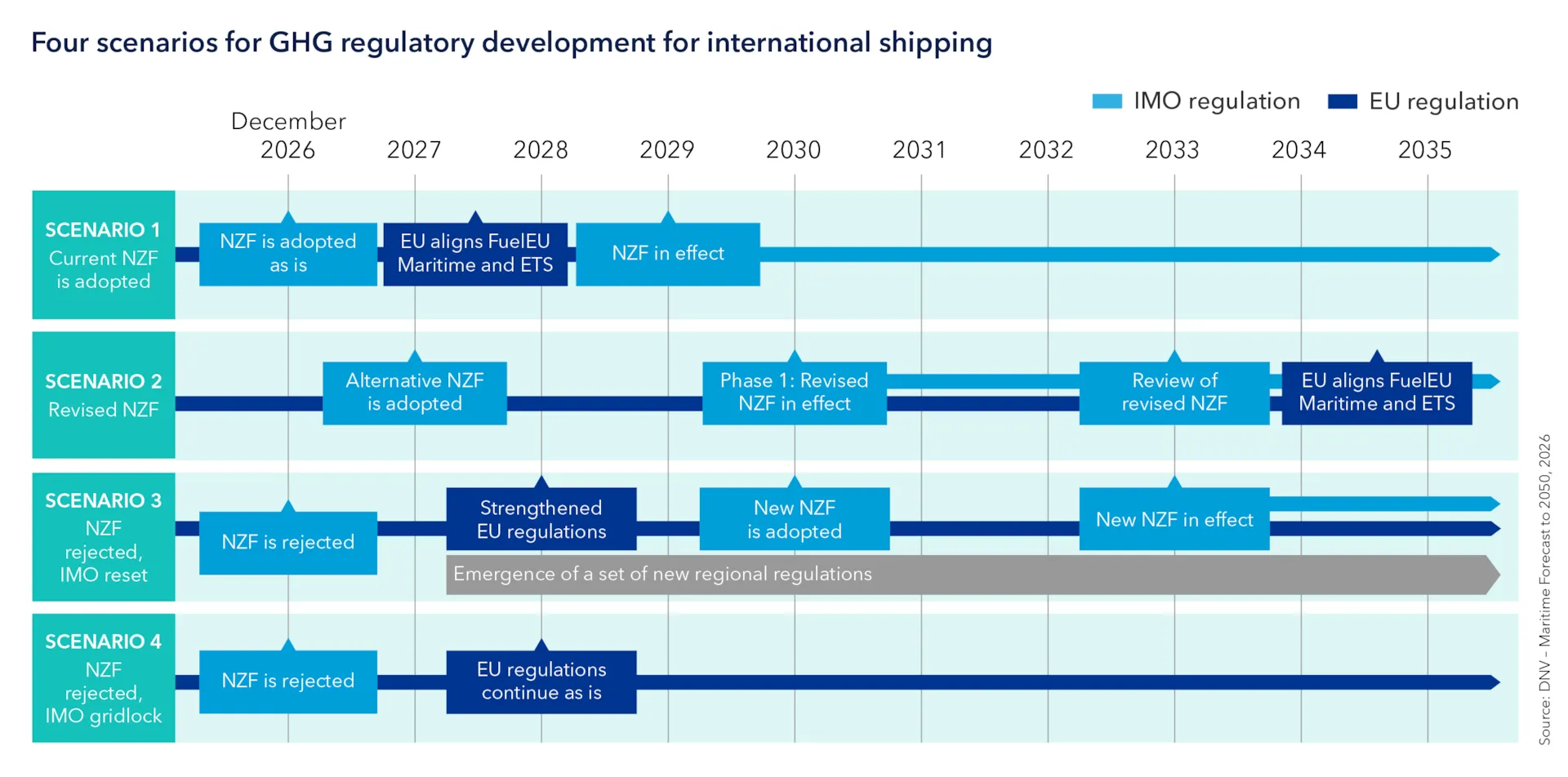
Stronger global regulation accelerates demand for low-GHG fuels and increases the attractiveness of energy-efficiency measures, while the absence of such regulation slows market development. The result is a transition whose pace may vary significantly depending on future policy decisions.
“For shipowners, this means the challenge is no longer identifying a single fuel pathway that fits the operational profile of their fleet. Instead, it is preparing fleets that remain competitive across multiple possible futures,” Sekkesæter concludes.
Tapping the fleet’s efficiency potential
Fully realizing the fleet’s energy-saving potential requires improvements not only to newbuilds but also to existing ships through retrofits.
Installing energy-saving devices during scheduled dry-docking can be a highly cost-effective decarbonization strategy, as illustrated by the Maritime Forecast’s case study of a hypothetical 15-year-old 5,000 TEU containership (built in 2013).
This envisages USD 2.35 million being invested to retrofit the ship with hydrodynamic enhancements including a bow retrofit, propeller upgrade, and a propeller boss cap fin.
The vessel can achieve estimated fuel savings of around 16% under the modelling assumptions. Evaluating the investment under three price scenarios for low sulphur heavy fuel oil (LSHFO) results in payback periods from 1.4 years to 4.2 years.
Note: The full Maritime Impact article by DNV can be found here.
Photo credit: DNV
Published: 25 September, 2026
Alternative Fuels
Höegh Autoliners orders six more ammonia, methanol-ready Aurora class PCTCs
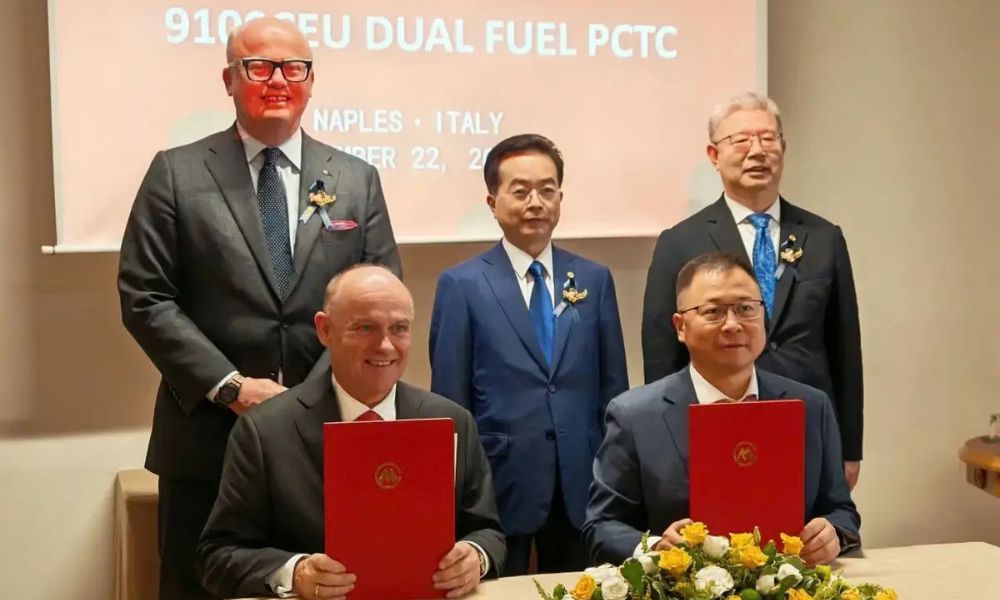
Höegh Autoliner inked a contract with China Merchants Group for six additional Aurora class PCTCs, which will be built by China Merchants Heavy Industry (Jiangsu) and delivered between 2029 and 2031.
Newbuilding
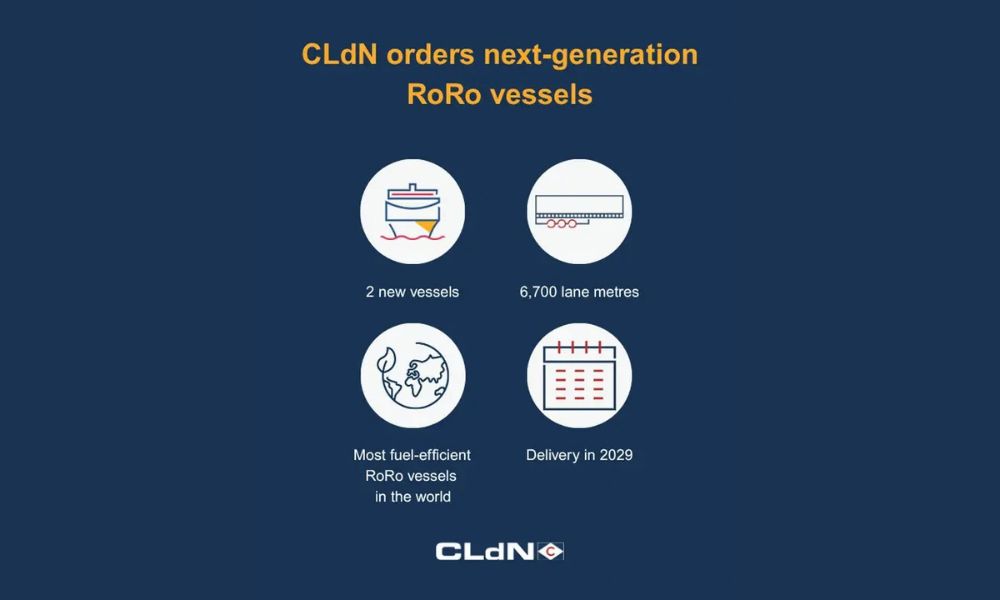
CLdN orders two LNG dual-fuel RoRo vessels from HD Hyundai Heavy Industries
New vessels will be built with space reserved for the future addition of larger electric shaft generators and batteries as the technology matures.

OUR INDUSTRY PARTNERS

Shell Singapore charged over Pulau Bukom oil leaks, reporting delays

MPA probes Singapore Strait collision involving fishing vessel, bulk carrier

TFG Marine deploys first MFM-equipped bunker barge in Jamaica

Seascale Energy names Gaetan Perret co-CEO as Olivier Josse prepares to retire

DNV: New research shows how regulation could reshape shipping

Stena Line orders two new hybrid ferries for Sweden – Denmark route

ENGINE: Americas Bunker Fuel Availability Outlook (24 Sep 2026)

Singapore: Marine fuel testing firm CCIC Singapore faces winding up application

High Court of Singapore issues winding up order against Hengli Petrochemical International

APPEC 2026: Digitalisation in bunkering not merely a ‘paper-to-screen’ swap, states panellists

APPEC 2026: Panellists navigate maritime decarbonisation and alternative marine fuel strategies

LDA’s methanol-powered “Spirit of Toulouse” gets Norsepower rotor sail in Shanghai

Goldwind green methanol facility completes trial production, ships first 500 mt

Singapore: Bunker fuel sales down by 4% on year in August 2026
-
 Winding up2 weeks ago
Singapore: Marine fuel testing firm CCIC Singapore faces winding up application
-
 Winding up2 weeks ago
High Court of Singapore issues winding up order against Hengli Petrochemical International
-
 Technology2 weeks ago
APPEC 2026: Digitalisation in bunkering not merely a ‘paper-to-screen’ swap, states panellists
-
 Alternative Fuels2 weeks ago
APPEC 2026: Panellists navigate maritime decarbonisation and alternative marine fuel strategies
-
 Wind-assisted2 weeks ago
LDA’s methanol-powered “Spirit of Toulouse” gets Norsepower rotor sail in Shanghai
-
 Methanol2 weeks ago
Goldwind green methanol facility completes trial production, ships first 500 mt
-
 Alternative Fuels2 weeks ago
Singapore: Bunker fuel sales down by 4% on year in August 2026
-
 Bunker Fuel2 weeks ago
APPEC 2026: Equatorial and Kuwait Petroleum Corporation discuss Middle East bunker market dynamics