Connect with us

Bunker Fuel

Antwerp-Bruges biofuel bunker sales plunge 50.6% on year in Q1 2026, LNG soars 214%

Biofuel recorded 20,726 mt in Q1 2026, down from 41,973 mt recorded in the same period the year before while port data showed 90,038 mt of LNG being delivered in Q1 2026, up from 28,670 mt.

Admin

Published

on

Port of Antwerp-Bruges

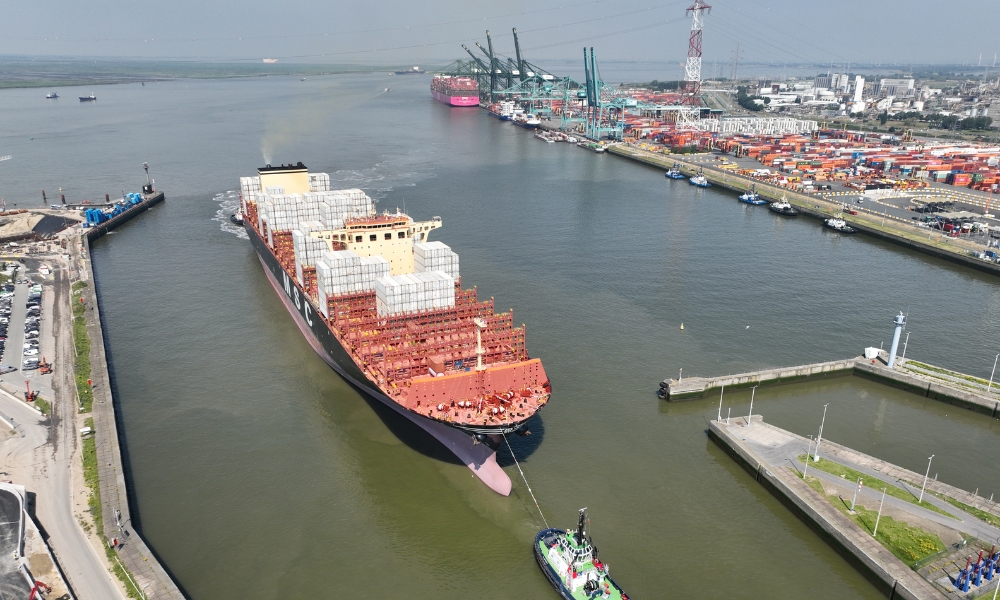
The Port of Antwerp Bruges recently published bunker fuel sales data for the first quarter (Q1) of 2026.

Total bunker sales at the port was 2.52 million metric tonnes (mt) in Q1 2026, compared to sales of 2.17 million mt (+16.1%) during the similar period in 2025.

Deliveries of ultra low sulphur fuel oil, very low sulphur fuel oil, high sulphur fuel oil and marine gas oil in Q4 2025 (against on year) recorded respectively 164,114 mt (+38.6%  from 118,447 mt), 955,032 mt (+34.8% from 708,410 mt), 718,016 mt (+8.57% from 661,352 mt) and 338,364 (-4.1% from 352,867 mt).

Biofuel recorded 20,726 mt in Q1 2026 with 41,973 mt (-50.6%) recorded in the same period the year before. 

Port data showed 90,038 mt of liquefied natural gas (LNG) being delivered as a marine fuel in Q1 2026, up by 214% from 28,670 mt in Q1 2025. Meanwhile, there has been no deliveries of methanol at the port for the year so far. 


Photo credit: Port of Antwerp Bruges
Published: 24 April, 2026

Continue Reading

Bunker Fuel

Peninsula: Red Sea hostilities drive bunker supply crunch and MedECA compliance challenges

As Red Sea hostilities continue to force widespread maritime diversions around the Cape of Good Hope, bunker company Peninsula warns of a “perfect storm” for global tanker operators.
Admin

Published

on

By

Peninsula

As Red Sea hostilities continue to force widespread maritime diversions around the Cape of Good Hope, bunker company Peninsula on Friday (24 July) warned of a “perfect storm” for global tanker operators.

The unprecedented surge in tonne-mile demand is now intersecting with stringent Mediterranean emissions regulations, threatening to more than double operational costs and severely tighten bunker supply at alternative key ports.

With the Bab el-Mandeb Strait increasingly bypassed, vessels are exiting the Red Sea via the Suez Canal and navigating westbound through the Mediterranean to reach Asia.

Peninsula noted that this detour could more than double the normal tonne-mile demand of a Bab el-Mandeb eastbound exit. For a typical Suezmax tanker, the diversion will require around 1,500 metric tonnes (mt) of additional fuel, at a cost of circa USD 800,000, and an emissions cost of roughly 3,800 mt of CO2.

Spot rates for Suezmax vessels – the largest tankers that can transit the Suez Canal fully laden – are already increasing, causing a scramble to cover the cargoes before the tonne-mile effect kicks in.

Kenny MacLean, Chief Operations Officer at Peninsula, said: “The industry could be dealing with a sudden, significant increase in fuel consumption. This is more complex than simply plotting a longer course – it will require a fundamental recalibration of voyage economics that will squeeze global bunker supply at a time when demand already outstrips supply.”

Beyond the raw cost of fuel, Peninsula is highlighting a critical regulatory blind spot for rerouted vessels – the Mediterranean Emissions Control Area (MedECA). Under these rules, vessels transiting the entire Mediterranean must burn fuel with a maximum sulphur content of 0.1%, rendering standard Very Low Sulphur Fuel Oil (VLSFO) non-compliant.

With European authorities increasingly deploying “sniffer drones” to remotely analyse vessel emissions in real-time, operators must switch to compliant Marine Gas Oil (MGO) or suitable biofuels before entering the region. Failure to secure compliant fuel risks severe fines and costly vessel detentions.

The sudden shift in maritime traffic could redraw the global bunkering map. Peninsula expects significantly increased demand in alternative physical supply ports along the revised route, including Port Said, Malta, Gibraltar, Algeciras, Las Palmas, Algoa Bay, and Port Louis.

Richard Alvarez, Global Head of Sales at Peninsula, added: “Operators are navigating a regulatory and logistical minefield. Securing compliant fuel conveniently, in the right location, in a rising price environment is now the defining challenge of these deviated voyages.

“As supply tightens at alternative bunker hubs, the ability to rely on suppliers with a globally integrated supply network and deep access to multi-product cargos will prove critical to minimise disruption and avoid the costs of non-compliance.”


Photo credit: Peninsula
Published: 27 July, 2026

Continue Reading

Sanctions

EU sanctions target bunkering vessels supporting Russia’s shadow fleet

EU is extending scope of the existing rules also to cover vessels supporting the shadow fleet, by providing bunkering and other services, and listing 41 more vessels on top of the 632 already sanctioned.

Admin

Published

on

By

Guillaume Périgois on Unsplash

The European Union (EU) on Thursday (23 July) adopted the 21st package of restrictive measures against Russia, targeting bunkering vessels for the first time. 

The EU is continuing to target the shadow fleet by extending the scope of the existing rules also to cover vessels supporting the shadow fleet, by providing bunkering and other services, and listing 41 more vessels on top of the 632 already sanctioned.

“The criteria for vessels listings are expanded to target for the first time ships that provide services to these vessels. Five bunkering vessels that have regularly refuelled already-designated tankers are also designated,” the EU said. 

The package also introduced a notification obligation for the sales of LNG tankers and a possibility to introduce new restrictions on the sale of LNG tankers to Russian citizens and companies and introduces other contractual obligations to mitigate the risk of reselling to Russia or for use in Russia.

The measures in the package focus on the sectors with the greatest impact: energy; financial services, including crypto; trade; and the Russian military-industrial complex. 


Photo credit: Guillaume Périgois on Unsplash
Published: 27 July, 2026

Continue Reading

Sanctions

US pushes Lukoil foreign assets sale talks deadline to 22 August

General licence allows companies to negotiate with Russian oil company Lukoil for the sale of Lukoil International GmbH or any of LIG’s majority-owned subsidiaries.

Admin

Published

on

By

Moscow, Russia

The US Treasury Department’s Office of Foreign Assets Control (OFAC) on Friday (24 July) issued a general licence to extend the deadline for certain transactions involving Lukoil International until 12.01am on 22 August. 

The general licence allows companies to negotiate with Russian oil company Lukoil for the sale of Lukoil International GmbH (LIG) or any of LIG’s majority-owned subsidiaries.

“For purposes of this general license, the term ‘contingent contracts’ includes executory contracts, executory pro forma invoices, agreements in principle, executory offers capable of acceptance such as bids or proposals in response to public tenders, binding memoranda of understanding, or any other similar agreement,” the licence noted.

On 27 October, the Russian company announced its intention to sell its international assets following new sanctions imposed by the US. OFAC has since extended the deadline multiple times. 

According to its website, Lukoil also supplies marine fuels and lubricants to Russian sea and river ports, has a bunker fleet, and has a wide network of representative offices across the world. 

Manifold Times previously reported Lukoil signing an agreement with US investment company Carlyle on sale of Lukoil International GmbH, a 100% subsidiary of Lukoil which owns international assets of Lukoil Group. 

Related: Russian oil company Lukoil ink deal with Carlyle on sale of international assets
Related: US extends license allowing sale of Lukoil’s overseas assets until 28 February
Related: Russian oil company Lukoil to sell international assets following US sanctions


Photo credit: Artem Shuba on Unsplash
Published: 27 July, 2026

Continue Reading

Trending