Connect with us
DNV Decarbonization Insight Series August 2026 - What maritime professionals should know about AI Training

Bunker Fuel

JLC China Bunker Market Monthly Report (April 2026)

China’s bonded bunker fuel sales continued to grow in April, as the country’s LSFO supply increased and its bonded bunker fuel prices were still competitive, according to JLC.

Admin

Published

on

JLC China Bunker Market Monthly Report (April 2026)

Beijing-based commodity market information provider JLC Network Technology Co. recently shared its JLC China Bunker monthly report for April 2026 with Manifold Times through an exclusive arrangement:

Bunker Fuel Demand

China’s bonded bunker fuel sales continue to grow in April

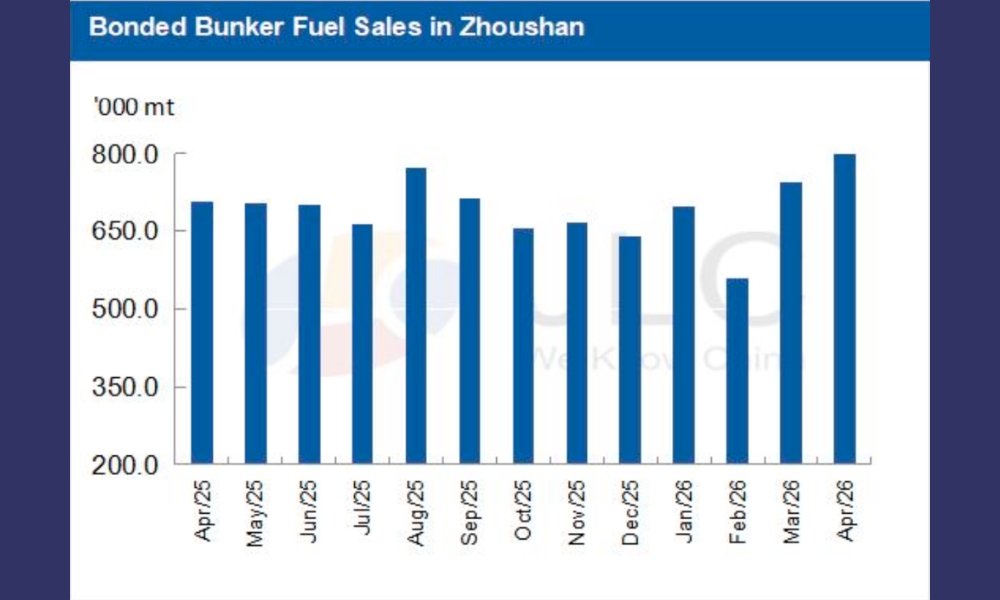
China’s bonded bunker fuel sales continued to grow in April, as the country’s low-sulfur fuel oil (LSFO) supply increased and its bonded bunker fuel prices were still competitive.

The country sold about 1.88 million mt of bonded bunker fuel in April, with the daily sales at 62,700 mt, up by 4.93% month on month and 6.71% year on year, JLC’s data shows.

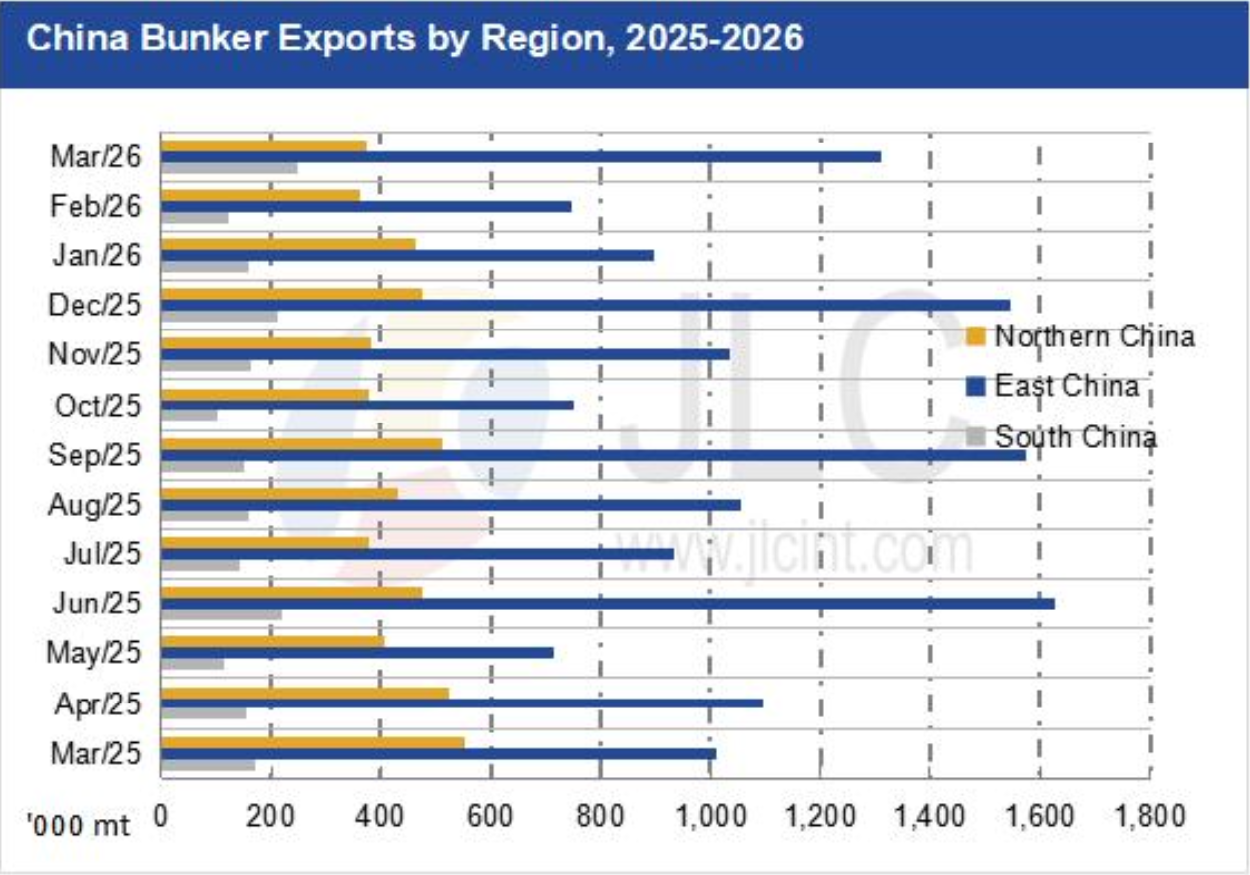
Specifically, the sales of the ports in East China, including Zhoushan Port and Shanghai Port, increased significantly amid price advantages and good weather, while those of northern ports slipped as their bonded bunker fuel prices were relatively high.

Regarding the sales by supplier, the sales by Chimbusco, Sinopec (Zhoushan), SinoBunker, and China Changjiang Bunker (Sinopec) respectively settled at 470,000 mt, 570,000 mt, 85,000 mt, and 15,000 mt in the month, while those by suppliers with regional bunkering licenses settled at 741,000 mt. China’s LSFO output surges in April

China’s LSFO output surged in April, as global bunkering demand improved and domestic refiners saw considerable production margins.

Chinese refiners produced roughly 1.22 million mt of LSFO in the month, with the daily output at 40,733 mt, surging by 27.55% month on month and 17.16% year on year, JLC’s data shows.

The ongoing conflict in the Middle East forced many ships to continue detours, pushing up their consumption of bunker fuels. Meanwhile, more shipowners chose to refuel in Chinese ports where bonded bunker fuel prices were more competitive. In addition, domestic refiners showed higher production enthusiasm amid considerable margins.

Sinopec’s LSFO output climbed in the month. Most refineries, including Qingdao Petrochemical, Shengli Oilfield, Shanghai Petrochemical, Shanghai Gaoqiao Petrochemical, Maoming Petrochemical, and ZhongKe (Guangdong) Refinery & Petrochemical, ramped up their production.

PetroChina’s LSFO output increased as well, with Liaohe Petrochemical, Jinzhou Petrochemical, Jinxi Petrochemical, and Dagang Petrochemical boosting output. CNOOC’s Daxie Petrochemical resumed normal LSFO production and delivery in April, while Taizhou Petrochemical raised its output. Meanwhile, Huizhou Petrochemical maintained stable production. Zhongjie Petrochemical did not produce any LSFO in the month.

ZPC and Sinochem did not produce any LSFO in April, but the latter produced and exported 10,000 mt of MGO.

Screenshot 2026 05 13 at 11.07.00 AM

Screenshot 2026 05 13 at 11.07.09 AM

Domestic-trade heavy bunker fuel demand weakens in April

Domestic-trade heavy bunker fuel demand slid to 320,000 mt in April, with the daily demand at 10,667 mt, down by 2.75% month on month, JLC’s data shows.

Shipowners stood on the sidelines as bunker fuel prices continued to rise and downstream transportation demand was weak. Meanwhile, trade in North China was tepid as the operation of local ports was hindered to some extent.

On the other hand, domestic-trade light bunker fuel demand settled at 140,000 mt in April, with the daily demand at 4,667 mt, a rally of 11.28% month on month, the data shows. Bunkering demand from marine diesel engines increased amid warmer weather and more active coastal shipping.

Bunker Fuel Supply

China’s bonded bunker fuel imports continue to rise in March

Chinese bunker suppliers continued to increase their bonded bunker fuel imports in March.

They imported 823,000 mt of bonded bunker fuel in the month, a boost of 8.48% month on month and 23.61% year on year, calculations show, based on data from the GACC.

The arrivals of imported high-sulfur fuel oil (HSFO) increased as the economic efficiency of HSFO bunkering remained high, while those of imported LSFO decreased amid larger domestic production.

China’s bonded bunker fuel imports mainly came from Asian countries, and the impact of the geopolitical conflicts in the Middle East on the overall imports was relatively limited. In addition, most import orders were made in early to mid-February, before the outbreak of the conflict.

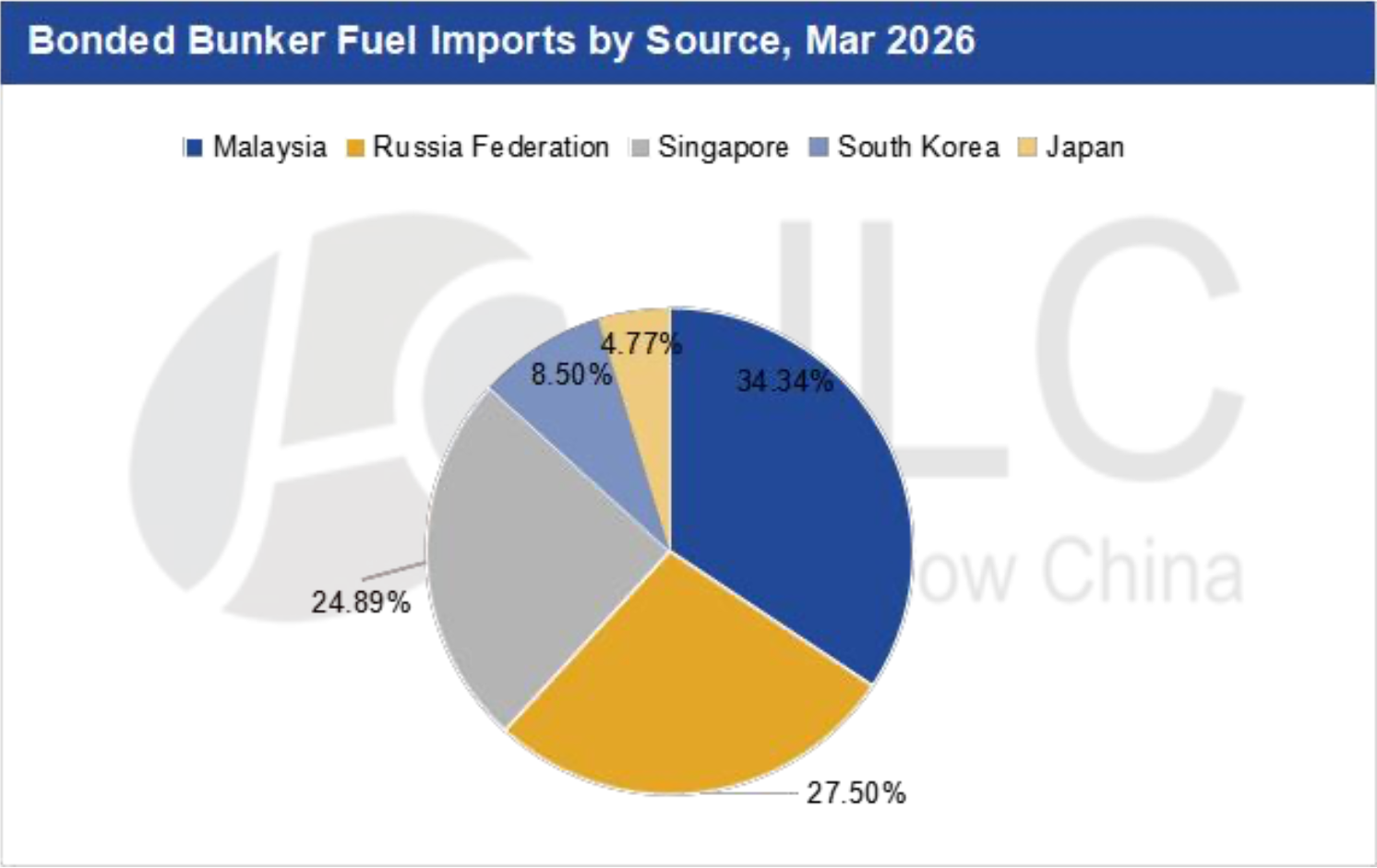
Regarding the imports by source, Malaysia became the largest supplier by shipping 282,600 mt of bonded bunker fuel to China, accounting for 34.34% of the latter’s total imports. Russia climbed to the second place with 226,300 mt, accounting for 27.50%, while Singapore slipped to the third place with 204,800 mt, representing 24.89%. The imports from South Korea and Japan settled at 70,000 mt and 39,300 mt, accounting for 8.50% and 4.77%, respectively.

China’s bonded bunker fuel imports totaled 2.04 million mt in the first quarter of this year, a surge of 33.64% year on year, calculations show.
Screenshot 2026 05 13 at 11.07.25 AM

Domestic-trade heavy bunker fuel supply tightens in April

Chinese blenders supplied 350,000 mt of domestic-trade heavy bunker fuel in April, with the daily supply at 11,667 mt, a decline of 4.82% month on month, JLC’s data shows.

Downstream buying interest in heavy bunker fuel was low, coupled with high blendstock prices, limiting blenders’ production enthusiasm.

By contrast, domestic-trade marine gas oil (MGO) supply settled at 180,000 mt in April, with the daily supply at 6,000 mt, soaring by 16.25% from the previous month, the data shows. Downstream demand improved, and refineries raised their MGO yields.

Screenshot 2026 05 13 at 11.08.09 AM

Bunker Prices, Profits

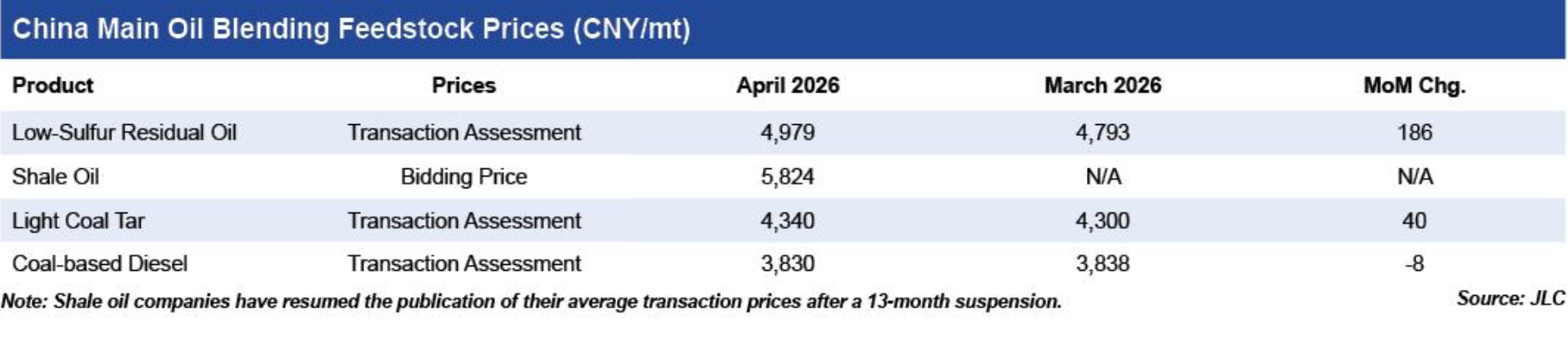
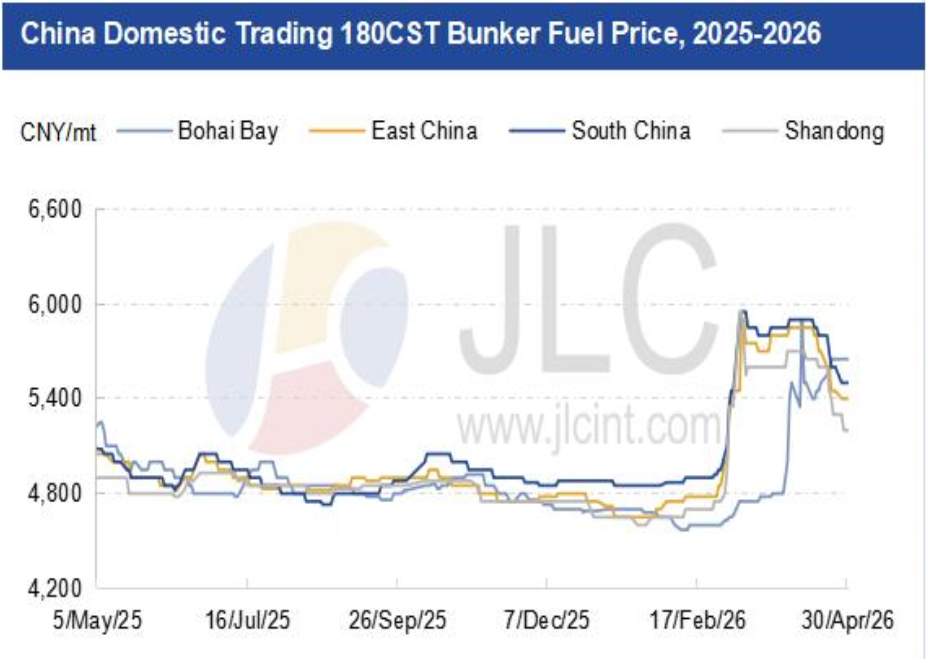
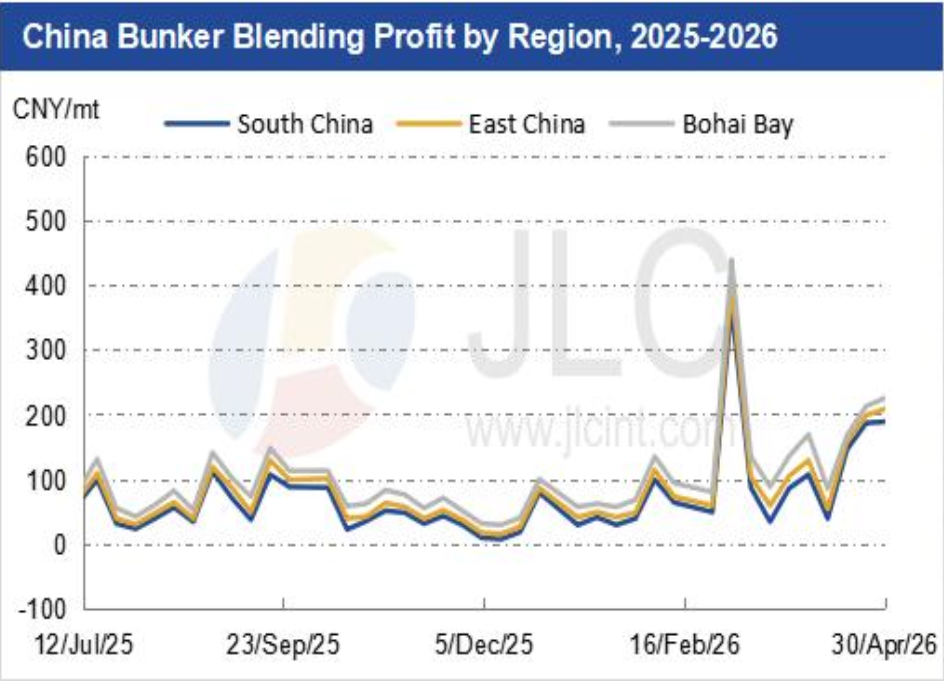
Screenshot 2026 05 13 at 11.08.26 AM

Screenshot 2026 05 13 at 11.08.38 AM

Screenshot 2026 05 13 at 11.08.48 AM

Editor
Yvette Luo
+86-020-38834382
[email protected] 

Sales (Beijing)
Tony Tang
+86-10-84428863
[email protected] 

Sales (Singapore)
Ginny Teo
+65-31571254
[email protected]
[email protected] 

JLC Network Technology Co., Ltd is recognised as the leading information provider in China. We specialise in providing the transparent, high-value, authoritative market intelligence and professional analysis in commodity market. Our expertise covers oil, gas, coal, chemical, plastic, rubber, fertilizer and metal industry, etc.

JLC China Bunker Fuel Market Monthly Report is published by JLC Network Technology Co., Ltd every month on China bunker market, demand, supply, margin, freight index, forecast and so on. The report provides full-scale & concise insight into China bunker oil market.

All rights reserved. No portion of this publication may be photocopied, reproduced, retransmitted, put into a computer system or otherwise redistributed without prior authorization from JLC.

Related: JLC China Bunker Market Monthly Report (March 2026)
Related: JLC China Bunker Fuel Market Monthly Report (February 2026)
Related: JLC China Bunker Market Monthly Report (December 2025)
Related: JLC China Bunker Market Monthly Report (November 2025)
Related: JLC China Bunker Fuel Market Monthly Report (October 2025)
Related: JLC China Bunker Fuel Market Monthly Report (September 2025)
Related: JLC China Bunker Fuel Market Monthly Report (July 2025)
Related: JLC China Bunker Fuel Market Monthly Report (June 2025)
Related: JLC China Bunker Fuel Market Monthly Report (May 2025)
Related: [Updated 15 May] JLC China Bunker Market Monthly Report (April 2025)
Related: JLC China Bunker Market Monthly Report (February 2025)
Related: JLC China Bunker Fuel Market Monthly Report (January 2025)
Related: JLC China Bunker Fuel Market Monthly Report (December 2024)
Related: JLC China Bunker Fuel Market Monthly Report (November 2024)
Related: JLC China Bunker Fuel Market Monthly Report (October 2024)
Related: JLC China Bunker Fuel Market Monthly Report (September 2024)
Related: JLC China Bunker Fuel Market Monthly Report (August 2024)
Related: JLC China Bunker Fuel Market Monthly Report (July 2024)
Related: JLC China Bunker Fuel Market Monthly Report (June 2024)
Related: JLC China Bunker Fuel Market Monthly Report (May 2024)
Related: JLC China Bunker Market Monthly Report (April 2024)
Related: JLC China Bunker Market Monthly Report (March 2024)
Related: JLC China Bunker Fuel Market Monthly Report (February 2024)
Related: JLC China Bunker Market Monthly Report (January 2024)

Note: China-based commodity market information provider JLC Technology has been providing Singapore bunkering publication Manifold Times China bunker volume data since 2020. Data from earlier periods are available here.


Photo credit: JLC Network Technology
Published: 13 May, 2026

Continue Reading

Bunker Fuel

JLC China Bunker Fuel Market Monthly Report (July 2026)

China’s bonded bunker fuel sales dropped in July, as typhoons hindered port operation in East and South China and bonded bunker fuel supply tightened in northern ports.

Admin

Published

on

By

JLC China Bunker Fuel Market Monthly Report (July 2026)

Beijing-based commodity market information provider JLC Network Technology Co. recently shared its JLC China Bunker monthly report for July 2026 with Manifold Times through an exclusive arrangement:

China’s bonded bunker fuel sales drop in July

China’s bonded bunker fuel sales dropped in July, as typhoons hindered port operation in East and South China and bonded bunker fuel supply tightened in northern ports. Meanwhile, some shipowners became more cautious about bunkering when geopolitical tensions persisted.

China sold about 1.78 million mt of bonded bunker fuel in the month, with the daily sales at 57,503 mt, down by 10.12% month on month, JLC’s data shows.

Regarding the sales by supplier, the sales by Chimbusco, Sinopec (Zhoushan), SinoBunker, and China Changjiang Bunker (Sinopec) respectively settled at 380,000 mt, 600,000 mt, 60,000 mt, and 10,000 mt in the month, while those by suppliers with regional bunkering licenses settled at 732,600 mt.

China’s LSFO output retreats in July

China’s low-sulfur fuel oil (LSFO) output retreated in July , as refineries lacked production enthusiasm when their margins weakened.

Chinese refiners produced about 1.29 million mt of LSFO in the month, with the daily output at 41,613 mt, down by 4.48% month on month, JLC’s data shows.

Specifically, Sinopec witnessed an obvious decline in its output. ZhongKe (Guangdong) Refinery & Petrochemical lowered its output amid unit maintenance. Qingdao Petrochemical also cut its output, but it was still high. By contrast, Shengli Petrochemical boosted its production.

Meanwhile, CNOOC’s LSFO output slid in July , with T aizhou Petrochemical suspending production.

Zhoushan Petrochemical and Huizhou Refinery maintained stable production, while Zhongjie Petrochemical did not produce any LSFO in the month.

On the other hand, PetroChina recorded an increase in its LSFO output, with Dalian WEPEC, Jinzhou Petrochemical, Jinxi Petrochemical, Huabei (North China) Petrochemical, and Dagang Petrochemical raising output.

ZPC and Sinochem did not produce any LSFO in the month, but the latter produced and exported 10,000 mt of MGO.

Screenshot 2026 08 12 at 1.36.44 PM

Screenshot 2026 08 12 at 2.02.30 PM

Domestic-trade bunker fuel demand shrinks in July

Domestic-trade heavy bunker fuel demand shrank in July when inland and coastal shipping was seasonally weak.

The demand settled at 300,000 mt in July, with the daily demand at 9,677 mt, slipping by 6.35% month on month, JLC’s data shows.

Shipowners just made deals for rigid demand, with a strong wait-and-see attitude and no intention of stockpiling.

Meanwhile, domestic-trade light bunker fuel demand settled at 140,000 mt in the month, with the daily volume at 4,516 mt, down by 9.68% month on month, the data shows. The decline was mainly due to the bad impact of continuous typhoons.

Bunker Fuel Supply

China’s bonded bunker fuel imports rebound in June

China’s bonded bunker fuel imports rebounded in June, after hitting a 16-month low in the previous month.

The country imported 515,300 mt of bonded bunker fuel in the month, soaring by 86.77% month on month, calculations show, based on data from the General Administration of Customs of PRC (GACC).

Bonded bunker suppliers boosted their purchases of imported high-sulfur fuel oil (HSFO) as premiums retreated amid easing conflicts between the U.S. and Iran. Meanwhile, downstream HSFO bunkering demand was relatively good, which also aroused suppliers’ import interest.

The arrivals of imported marine gas oil (MGO) also increased in June.

However, these bunker suppliers did not import any LSFO in the month, given sufficient domestic supply.

On a year-on-year comparison, China’s bonded bunker fuel imports declined by 5.50% in June.

Regarding the imports by source, Russia was still the largest supplier with 305,300 mt, accounting for 59.24% of China’s total imports. South Korea climbed to the second place with 120,700 mt, accounting for 23.43%, while Malaysia slipped to the third place with 89,300 mt, accounting for 17.33%.

China’s bonded bunker fuel imports totaled 3.38 million mt in the first half of this year, an increase of 5.54% from the same period of time in 2025, calculations also indicate.

Screenshot 2026 08 12 at 2.02.45 PM

Domestic-trade bunker fuel supply tightens further in July

Chinese blenders supplied 270,000 mt of domestic-trade heavy bunker fuel in July , with the daily supply at 8,710 mt, a decline of 9.90% month on month, JLC’s data shows.

Low-sulfur residual oil supply continued to tighten despite restarts of some refineries, which forced blenders to cut their bunker fuel production. Meanwhile, supply of consumption-tax-included bunker fuel decreased with tax inspections becoming regular.

In the meantime, domestic-trade MGO supply settled at 170,000 mt, with the daily supply at 5,484 mt, down by 8.60% from a month earlier, the data shows.

Screenshot 2026 08 12 at 2.02.57 PMScreenshot 2026 08 12 at 1.36.44 PM Screenshot 2026 08 12 at 2.02.30 PM Screenshot 2026 08 12 at 2.02.45 PM Screenshot 2026 08 12 at 2.02.57 PM Screenshot 2026 08 12 at 2.03.15 PM Screenshot 2026 08 12 at 2.03.28 PM Screenshot 2026 08 12 at 2.03.41 PM

Bunker Prices, Profits

Screenshot 2026 08 12 at 2.03.28 PM

Screenshot 2026 08 12 at 2.03.41 PM

Editor
Yvette Luo
+86-020-38834382
[email protected]  

Sales (Beijing)
Tony Tang
+86-10-84428863
[email protected]  

Sales (Singapore)
Ginny Teo
+65-31571254
[email protected]
[email protected]  

JLC Network Technology Co., Ltd is recognised as the leading information provider in China. We specialise in providing the transparent, high-value, authoritative market intelligence and professional analysis in commodity market. Our expertise covers oil, gas, coal, chemical, plastic, rubber, fertilizer and metal industry, etc.

JLC China Bunker Fuel Market Monthly Report is published by JLC Network Technology Co., Ltd every month on China bunker market, demand, supply, margin, freight index, forecast and so on. The report provides full-scale & concise insight into China bunker oil market.

All rights reserved. No portion of this publication may be photocopied, reproduced, retransmitted, put into a computer system or otherwise redistributed without prior authorization from JLC.

Related: JLC China Bunker Fuel Market Monthly Report (June 2026)
Related: JLC China Bunker Fuel Market Monthly Report (May 2026)
Related: JLC China Bunker Market Monthly Report (April 2026)
Related: JLC China Bunker Market Monthly Report (March 2026)
Related: JLC China Bunker Fuel Market Monthly Report (February 2026)
Related: JLC China Bunker Market Monthly Report (December 2025)
Related: JLC China Bunker Market Monthly Report (November 2025)
Related: JLC China Bunker Fuel Market Monthly Report (October 2025)
Related: JLC China Bunker Fuel Market Monthly Report (September 2025)
Related: JLC China Bunker Fuel Market Monthly Report (July 2025)
Related: JLC China Bunker Fuel Market Monthly Report (June 2025)
Related: JLC China Bunker Fuel Market Monthly Report (May 2025)
Related: [Updated 15 May] JLC China Bunker Market Monthly Report (April 2025)
Related: JLC China Bunker Market Monthly Report (February 2025)
Related: JLC China Bunker Fuel Market Monthly Report (January 2025)
Related: JLC China Bunker Fuel Market Monthly Report (December 2024)
Related: JLC China Bunker Fuel Market Monthly Report (November 2024)
Related: JLC China Bunker Fuel Market Monthly Report (October 2024)
Related: JLC China Bunker Fuel Market Monthly Report (September 2024)
Related: JLC China Bunker Fuel Market Monthly Report (August 2024)
Related: JLC China Bunker Fuel Market Monthly Report (July 2024)
Related: JLC China Bunker Fuel Market Monthly Report (June 2024)
Related: JLC China Bunker Fuel Market Monthly Report (May 2024)
Related: JLC China Bunker Market Monthly Report (April 2024)
Related: JLC China Bunker Market Monthly Report (March 2024)
Related: JLC China Bunker Fuel Market Monthly Report (February 2024)
Related: JLC China Bunker Market Monthly Report (January 2024)

Note: China-based commodity market information provider JLC Technology has been providing Singapore bunkering publication Manifold Times China bunker volume data since 2020. Data from earlier periods are available here.


Photo credit: JLC Network Technology
Published: 12 August, 2026

Continue Reading

Bunker Alerts

Maritec-Naias: High levels of Phenolic compounds in China bunker fuels

Firm tested multiple fuel oil bunker samples from vessels that took fuel/bunkered in China ports from 7 June to 28 July, which indicated the presence of high levels of Phenolic compounds.

Admin

Published

on

By

Louis Reed from Unsplash

Bunker fuel testing and marine surveying business Maritec-Naias on Friday (7 August) issued an alert regarding high levels of Phenolic compounds found after conducting testing on multiple fuel oil bunker samples from China ports:

During the period of 07 June to 28 July 2026 Maritec-Naias tested multiple fuel oil bunker samples from vessels that took fuel/bunkered in China ports, which indicated the presence of high levels Phenolic compounds.

Ten cases were found to have Phenolic compounds, and its derivatives, in the range of 5200 – 15750 PPM. Out of ten cases, the fuel samples tested were sourced as follows: four from Tianjin port, two from Qinhuangdao port, two from Rizhao port, one from Zhoushan port, and one from Shandong port.

The fuel samples containing Phenolic compounds in excess of 5000 PPM returned a marginally stable classification (P-value 1.00 to <1.30) under the SMS 1600 stability reserve test. Prolonged storage of these fuels carries the risk of reduced fuel stability and resulting operational issues. Operational issues like excessive sludge formation in purifiers, filter choking and fuel pump wear-and-tear have been observed and reported when similar levels of phenolic compounds were present in a vessel’s bunker fuel.

Phenolic compounds in the bunker fuel samples were precisely identified using Gas Chromatography-Mass Spectrometry (GC-MS) with both Direct Liquid Injection (DLI) and Solid Phase Extraction (SPE) methods, ensuring robust detection. The detected chemical compounds may have originated from the following sources:

1) liquid fuels derived from coal-tar
2) shale-derived oil

Regulatory Implications:

Due to the high levels of these chemical compounds the fuels render unacceptable under the section of general requirement in the standard ISO8217:2010 and MARPOL Annex VI regulation 18, irrespective of Table 2 compliance.

General requirements as per para 5 of ISO8217:2010 states below:

“5.2 The fuel shall be homogeneous blends of hydrocarbons derived from petroleum refining. This shall not preclude the incorporation of small amounts of additives intended to improve some aspects of fuel characteristics and performance. The fuels shall be free from inorganic acids and from used lubricating oils.

5.3 The fuel shall be free from any material that renders the fuel unacceptable for use in marine applications.

5.5 The fuel shall not contain any additive at the concentration used in the fuel, or any added substance or chemical waste that

  1. a) jeopardizes the safety of ships or adversely affects the performance of the machinery; or
  2. b) is harmful to personnel; or
  3. c) contributes overall to additional air pollution.”

MARITEC-NAIAS RECOMMENDATIONS

  • Closely observe the vessel fuel system/s for signs of filter clogging and purifier sludging and additionally, increase vigilance on the centrifuges to monitor overloading.
  • Increase frequency of their de-sludging cycle depending on the accumulated sludge.
  • Possibly reduce the mean time between bowl cleaning of the purifier and fuel system filters.
  • Avoid blending with other fuels, in particular marine diesel and gas oil and also other fuel oil as such mixing may well increase the sediment problem.


Photo credit: Louis Reed from Unsplash
Published: 12 August, 2026

Continue Reading

Financial Result

Fratelli Cosulich marine energy unit records EUR 7.1 million net profit in 2025

Bunker Trading revenue, the Group’s core activity, at the end of the year stood at approximately EUR 1.382 million compared to approximately EUR 1.638 million in 2024.

Admin

Published

on

By

Fratelli Cosulich marine energy unit records EUR 7.1 million net profit in 2025

Genoa-based international shipping and logistics company Fratelli Cosulich Group on Thursday (31 July) recorded EUR 58.6 million (USD 68 million) in EBITDA in 2025, substantially in line with the EUR 59.7 million recorded in 2024 and remaining close to its all-time highs. 

The company’s consolidated turnover reached EUR 1.877 billion, compared with EUR 2.128 billion in 2024.

“This decrease must be read considering the significant weight of Marine Energy and bunker trading activities, where turnover is naturally influenced by fuel prices, market dynamics and the euro dollar exchange rate,” the company said in its 2025 annual report. 

“For this reason, the reduction in revenues does not represent a proportional decrease in the Group’s operational strength.”

The Group recorded a net profit of EUR 20 million with its marine energy business unit delivering EUR 7.1 million. The unit also achieved EUR 16.8 million in EBITDA. 

In 2024, the company recorded a net profit of EUR 20.6 million with its marine energy business unit delivering EUR 5.6 million. The unit also achieved EUR 28.1 million in EBITDA. 

On the performance of its bunker trading activity, also during the year just ended, as in 2024, the company said margin stabilisation was recorded, remaining at levels similar to the average of previous years.

Bunker Trading revenue, the Group’s core activity, at the end of the year stood at approximately EUR 1.382 million compared to approximately EUR 1.638 million in 2024.

“In 2025, Marine Energy exceeded expectations in a more competitive market marked by lower prices, strengthening its results through a solid commercial structure, key account relationships and a focused approach to smaller bunkering hubs,” the company said.
 “Commercial development was supported by further expansion towards Asian customers, including the opening of a dedicated Japan desk, while the unit prepared the basis for a future local presence.”

The company added that the transition towards a multi-fuel offering continued to move from strategy to operations. 

In Singapore, the unit completed its first B100 biofuel bunker delivery through Marta Cosulich, demonstrating its ability to provide lower-carbon alternatives using its future-ready fleet. 

The Group also entered into a strategic cooperation with a “long-established shipping player” to explore opportunities in methanol, LNG and ammonia bunkering.

The company added that fleet development remained central. 

“Construction progressed on the new series of methanol-ready IMO II chemical bunker tankers, while Maya Cosulich was delivered in December,” it said.

“Designed for safe and efficient alternative fuel delivery, she represents another tangible step in expanding the unit’s physical capabilities for the evolving needs of maritime customers.”

Related: Fratelli Cosulich marine energy unit records EUR 5.6 million profit in 2024


Photo credit: Fratelli Cosulich
Published: 12 August, 2026

Continue Reading

Trending