
Business
Infospectrum launches ESG Desk, publishes whitepaper on key ESG developments
Whether viewed as regulatory compulsion, stakeholder activism or corporate mission, ESG compliance is the new frontier of the maritime and commodities sectors, it says.

Shipping industry credit reporting and risk management consultancy Infospectrum in late August released a blog entry entitled “The New ESG Paradigm” which highlights the launch of its ESG Desk and the availability of its first whitepaper:
As part of its integrated approach to risk assessment, Infospectrum has long recognised the potential impact that corporate strategies eschewing ESG compliance can have on operational, financial or reputational parameters.
However, today, maritime and commodities businesses worldwide are facing the added challenge of not only reviewing how to incorporate rapidly-evolving ESG regulations and norms into business processes and strategies, but also to execute these cost-effectively under tight time frames.
A report published by Bloomberg Intelligence (23 February 2021, see Figure 1 below) estimates that global ESG assets are expected to exceed USD 53 trillion by 2025, representing more than a third of the USD 140.5 trillion in projected total assets under management at that time, and a marked increase on the USD 22.8 trillion at the end of 2016.
We attribute this growth to a combination of trends – from investor expectations for potentially outsized ESG-compliant returns (although academic evidence for this remains inconclusive), to the need to cater to a growing class of ethical/impact investors on the one hand, while meeting the funding requirement for corporate ESG compliance strategies on the other.
For instance, research by PWC¹ suggests various sources as having estimated an investment requirement of circa USD 1 trillion alone to bring the shipping sector into compliance with the IMO’s 2050 strategy to bring emission levels down by 50% on a 2008 emission baseline.
This includes transition financing for research and development, testing of new technologies, modification of existing vessels, design and construction of newbuildings, and development of land infrastructure that will support the onboard/offshore efforts.
While estimates of the amount of investment needed to be channelled into the maritime and commodities sectors vary significantly, it is certain that incorporating ESG standards will not only require significant financial capital but also bring major strategic and operational changes.
Figure 1: ESG Global Projected Assets Under Management by Country
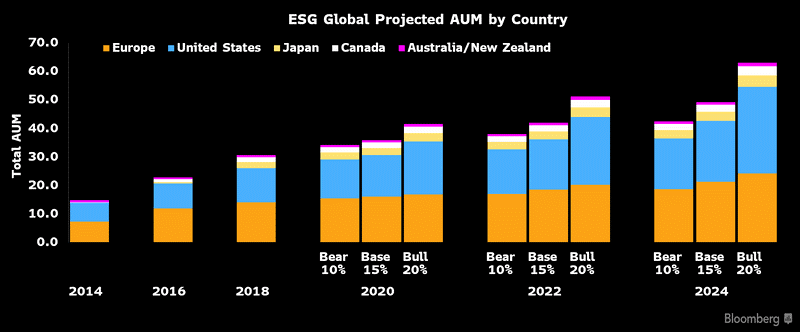
Source: Bloomberg Intelligence
Whatever the motivation, and notwithstanding the occasional political rollbacks or pockets of public resistance, there is little doubt that markets are transitioning to a more ESG-compliant equilibrium. Yet, it is important to acknowledge that this is indeed a transition period wherein good intentions and policies may exceed what is achievable given the technological developments and operational practicalities required for the safe adoption of market-funded cost-effective environmental solutions.
Furthermore, although progress is being made, the conceptual evolution for a reasonably high level of globally acceptable, regularly monitored and strictly enforceable social and governance standards is still some time away, not least due to regional variations in cultural differences.
Infospectrum’s rating methodology is designed to incorporate an assessment of a subject company’s track record in principled and sustainable stakeholder engagement, while also accounting for the impact of changing corporate strategies and regulations upon various factors (not least sector landscapes, operational exposures, expenditure and investments, competitive positioning, and financial performance), adhering throughout to a holistic approach to risk appraisal.
Accordingly, Infospectrum’s counterparty reports will, where relevant and ascertainable, outline the presence of a subject’s ESG strategies, in particular highlighting meaningful and innovative approaches.
In addition, to create awareness of the opportunities and challenges, concepts and trends, and accepted best practices in this rapidly evolving landscape, we have launched Infospectrum’s ESG Desk which will publish insights and whitepapers on key developments in the ESG sphere.
The objective is to give practical and actionable insights using our expertise and stakeholder engagement, with the firm expectation that ESG compliance will continue to gather momentum in delivering a viable and effective global standard.
Pre-register, by clicking below, to be the first to receive the initial paper, Emissions Reduction and Mitigation in Shipping:

Photo credit and source: Infospectrum
Published: 16 September, 2021
Incident
MPA: 25 crew rescued after abandoning “MSC HERMES III” east of Vietnam
MRCC Singapore coordinated the rescue after receiving a distress alert at about 8.45am as the vessel was within Singapore’s Maritime Search and Rescue Region.
Alternative Fuels
GCMD, Equinor to combine expertise on alternative bunker fuels, decarbonisation solutions
Equinor brings extensive experience to partnership as a vessel charterer and marine fuel supplier, including chartering dual-fuel LNG and methanol tankers, testing biofuels and supplying methanol.
Decarbonisation
Wah Kwong NatPower, AREL partner on maritime electrification in Hong Kong
Collaboration will examine opportunities to deploy shore power facilities, vessel charging infrastructure and battery energy storage solutions, alongside the development of electric vessels.

OUR INDUSTRY PARTNERS

MPA: 25 crew rescued after abandoning “MSC HERMES III” east of Vietnam

GCMD, Equinor to combine expertise on alternative bunker fuels, decarbonisation solutions

Wah Kwong NatPower, AREL partner on maritime electrification in Hong Kong

IMO technical seminar examines ammonia bunkering and infrastructure

Spring Marine to expand use of Sulnox Eco with four-year supply agreement

PortXchange: Rotterdam bunker volume shift offers warning as Spain adopts fuel law

ENGINE: East of Suez Fuel Availability Outlook (22 Sep 2026)

Singapore: Marine fuel testing firm CCIC Singapore faces winding up application

Peninsula confirms one fatality, crew member missing from bunker tanker “Hercules Star”

Singapore: MPA working with industry on next phase of digital bunkering, says Deputy CE

Amogy and LOTTE Fine Chemical to explore ammonia bunkering in South Korea

High Court of Singapore issues winding up order against Hengli Petrochemical International

Polaris Shipping orders WinGD engines capable of running on methanol, ethanol

APPEC 2026: Digitalisation in bunkering not merely a ‘paper-to-screen’ swap, states panellists
-
 Winding up1 week ago
Singapore: Marine fuel testing firm CCIC Singapore faces winding up application
-
 Incident2 weeks ago
Peninsula confirms one fatality, crew member missing from bunker tanker “Hercules Star”
-
 Technology2 weeks ago
Singapore: MPA working with industry on next phase of digital bunkering, says Deputy CE
-
 Ammonia2 weeks ago
Amogy and LOTTE Fine Chemical to explore ammonia bunkering in South Korea
-
 Winding up1 week ago
High Court of Singapore issues winding up order against Hengli Petrochemical International
-
 Engine2 weeks ago
Polaris Shipping orders WinGD engines capable of running on methanol, ethanol
-
 Technology1 week ago
APPEC 2026: Digitalisation in bunkering not merely a ‘paper-to-screen’ swap, states panellists
-
 Financial Result2 weeks ago
Singapore-based Uni-Fuels H1 2026 net income jumps 1,415% to USD 1.4 million