Connect with us

Business

ENGINE: East of Suez Bunker Fuel Availability Outlook

OPL bunkering suspended in Zhoushan; demand weak in Hong Kong; availability good across several Indian ports.

Admin

Published

on

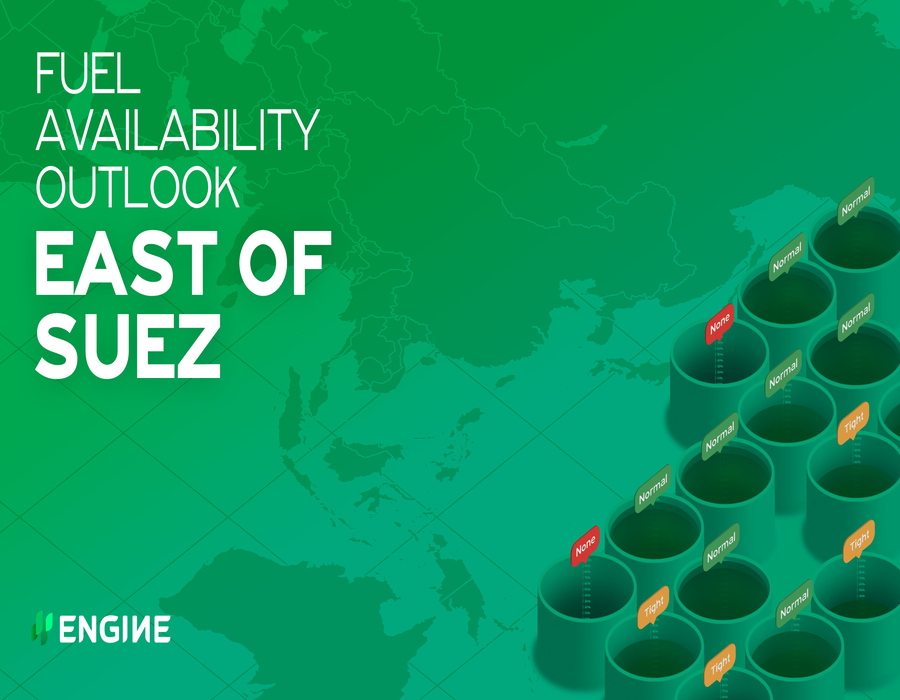
ENGINE East of Suez Bunker Fuel Availability Outlook

The following article regarding regional bunker fuel availability outlook for the East of Suez region has been provided by online marine fuels procurement platform ENGINE for publication on Singapore bunkering publication Manifold Times:

14 February 2023

  • OPL bunkering suspended in Zhoushan
  • Demand weak in Hong Kong
  • Availability good across several Indian ports


Singapore

Bunker demand has been normal in Singapore so far this week. Availability of VLSFO and HSFO grades has improved slightly, with lead times shortening from 8-10 days last week to 7-8 days for VLSFO and 6-9 days for HSFO now.

Prompt LSMGO availability has improved. Lead times of 2-3 days are now advised, down from 5-6 days last week.

Singapore’s residual fuel oil stocks have averaged 3% higher so far this month than in January, according to Enterprise Singapore. The build has come despite a 17% decline in net imports. Both imports and exports are down this month.

Meanwhile, Singapore’s middle distillate stocks have averaged 11% lower so far in February than on average in January.


East Asia

Bad weather has kept bunkering suspended in Zhoushan’s outer port limits (OPL) area since Monday, according to White Whale Shipping Agency.

Weather-related disruptions have led to bunker congestion in the Chinese bunkering hub. OPL bunkering is likely to resume in Zhoushan from Wednesday evening, when calmer weather is forecast.

Some suppliers in Zhoushan are running low on VLSFO and LSMGO, while others have stocks. However, this has not led to tightness as demand remains very low, a source says.

VLSFO and LSMGO stems require 3-5 days of lead time in the Chinese bunkering hub. Availability of HSFO remains normal in the port, with lead times of 5-7 days.

However, strong wind gusts of 19-26 knots and waves up to a metre are forecast to hit Zhoushan between Friday and Tuesday next week, which might trigger yet another bunker suspension.

Strong winds and swells are forecast in Hong Kong, which could hamper bunkering until the beginning of next week.

Availability remains normal across all grades in Hong Kong, while demand has weakened of late, a source says. Recommended lead times are seven days across all fuel grades in the port. While lead times for VLSFO and LSMGO have gone up from 3-4 days last week, lead times for HSFO have been unchanged at seven days in both weeks.

Lead times for all grades across southern South Korean ports vary widely, with the shortest requiring three days and the longest needing almost 11 days. However, lead times are short in western South Korean ports at four days but are priced at a premium, a source says.

A source says rough weather might impact bunkering across the South Korean ports of Ulsan, Onsan, Daesan, Taean and Yeosu between 14-15 February and from 19 February onwards.

Bad weather might disrupt bunker operations in the Philippine port of Subic Bay throughout the week.

Strong wind gusts between 39-40 knots are forecast to hit the Thai ports of Koi Sichang and Leam Chabang on 17 February, which might hamper bunkering operations.


South Asia

Mumbai has good availability of VLSFO and LSMGO, with prompt dates available.

VLSFO and LSMGO can be delivered with around 2-3 days of lead time in several Indian ports, including Kandla on the northwest coast, Cochin and Chennai on the southern coast, and Visakhapatnam on the southwestern coast.

Availability of grades are subject to enquiry in Tuticorin in the southeast coast and Haldia on the eastern coast of India.

LSMGO availability remains good across the Sri Lankan ports of Colombo and Trincomalee, with prompt dates available.


Middle East

Most suppliers in Fujairah have been clearing backlogs created due to bad weather last week. This has contributed to slight tightness in the UAE port’s bunker market, which might persist until 19 February. However, some suppliers can offer prompt dates, a source says.

Lead times of around 11 days are recommended for HSFO, six days for VLSFO and four days for LSMGO in Fujairah.

By Tuhin Roy


Photo credit and source: ENGINE
Published: 15 February, 2023

Continue Reading

Business

Hong Kong-based bunker trading firm E-Marine expands ops with new Shanghai branch office

The HONG KONG E-MARINE SHANGHAI BRANCH will assist E-Marine’s head office in handling bunker trading operations and increase overall bonded bunker trading volumes at China.

Admin

Published

on

By

E Marine Shanghai office front

Hong Kong-based marine fuel and lubricant trading company Hongkong E-Marine Supply Service Corporation Limited (E-Marine) on April 15 launched a branch office in Shanghai, learned Manifold Times.

The company HONG KONG E-MARINE SHANGHAI BRANCH will assist the head office in handling bunker trading operations and increase overall bonded bunker trading volumes at China, Managing Director Darcy Wang told the bunkering publication.

“The Shanghai office serves as our China business support and coordination centre. It enables us to stay close to our customers, suppliers and business partners, while also providing access to a deep pool of industry talent,” he shared.

This development is in line the target to significantly increase our annual bonded bunkering portfolio in China to 1 million metric tonnes (mt) by 2030.

“As we continue to expand our presence in China, we welcome capable and motivated individuals who share our long-term vision to join our Shanghai office.”

E-Marine’s new Shanghai office address is as follows:

Shanghai Xuhui District
Chang Ning Road No.889
Shanghai Yang Guang Bin Jiang Center
Unit 22-13

Candidates interested in growing together with E-Marine are invited to send their CV or profile to [email protected].

E Marine Shanghai office tea cups

Related: E-Marine raising China bonded bunker trading portfolio to 1 million mt by 2030, seeks talents
RelatedHong Kong-based bunker trading firm E-Marine obtains ISCC EU certification
RelatedHong Kong-based bunker trading firm E-Marine introduces Global Sales & Procurement Manager
RelatedHong Kong-based bunker trading firm E-Marine expands operations with Singapore branch
RelatedBunker and lube trading firm Hongkong E-Marine Supply Service to open Singapore branch by June


Photo credit: Manifold Times
Published: 4 June 2026

Continue Reading

Biofuel

BHP and GCMD trial multi-feedstock B100 bio bunker fuel on bulk carrier

Bio-blend in the BHP and GCMD pilot is being used on a BHP-chartered bulk carrier “Berge Lyngor”, which was bunkered in Singapore in early May.

Admin

Published

on

By

BHP and GCMD trial multi-feedstock B100 bio bunker fuel on bulk carrier

BHP and the Global Centre for Maritime Decarbonisation (GCMD) on Wednesday (3 June) said they have blended biofuels from two distinct feedstocks—used cooking oil and waste animal fats —and introduced the lower-emissions marine fuel into a BHP-chartered bulk carrier as part of a pilot project.

The bio-blend in the BHP and GCMD pilot is being used on a BHP-chartered bulk carrier Berge Lyngor, owned and operated by Berge Bulk, transporting BHP iron ore from Western Australia to China. When run on bio-blend, the vessel has the potential to reduce well-to-wake greenhouse gas emissions by approximately 79 per cent per voyage compared to sailing on very low sulphur fuel oil (VLSFO).

The vessel bunkered in Singapore in early May with a B100 bio-blend comprising 50 percent tallow-derived biodiesel, sourced and supplied by HAMR Energy, and 50 per cent used cooking oil (UCOME) supplied by Mitsui & Co Energy Trading Singapore (METS).

Mitsui also blended the fuel and Dan-Bunkering coordinated and executed the bunkering operation, which was performed by Global Energy’s barge MT Maple.

The BHP and GCMD pilot will assess how biofuels from multiple feedstocks can be blended, handled, and introduced under real-world operating conditions using existing used cooking oil bunkering infrastructure.

At the same time, insights from this pilot will help identify solutions to challenges related to fuel quality, handling, traceability, and onboard vessel performance.

Biofuels for global shipping today rely heavily on used cooking oil – a feedstock whose availability is approaching its projected limits. Biofuel from waste animal fats presents a promising option to expand the supply of lower-emissions marine fuels.

The outcomes of the pilot are expected to shed light on the practical steps to integrate biofuel blends from different feedstocks into existing supply chains. The diversity of biofuels will provide shipowners and operators with greater flexibility to optimise fuel procurement based on cost, availability, and lifecycle emissions performance.

Biofuels derived from different feedstocks can exhibit varying properties that may impact operations, including potential corrosion from oxidation, fuel system clogging caused by wax formation, which this pilot aims to assess.

The pilot will trace and verify the biofuel blend’s integrity aimed at bolstering confidence in emissions reductions reporting. The pilot will also provide insights into how robust tracing can support future marine fuel supply chains where biofuels from multiple feedstocks with varying lifecycle greenhouse gas emissions footprints are blended together.

This project is co-funded by the Maritime and Port Authority of Singapore under the Maritime Innovation and Technology Fund (MINT).


Photo credit: Global Centre for Maritime Decarbonisation
Published: 3 June, 2026

Continue Reading

Biofuel

NYK starts one-year B100 bio bunker fuel trial on car carrier

In this trial, NYK will operate a car carrier continuously on B100 for one year to evaluate the impact on engines, fuel supply systems, and operational practices.

Admin

Published

on

By

NYK starts one-year B100 bio bunker fuel trial on car carrier

Japanese shipping firm NYK on Tuesday (2 June) said it has commenced a one-year long-term trial involving the continuous use of 100% biofuel (B100) on an NYK-operated car carrier. 

In this trial, NYK will operate a car carrier continuously on B100 for one year to evaluate the impact on engines, fuel supply systems, and operational practices. High-purity biofuels such as B100 are known to be susceptible to degradation from oxygen, light, and heat, raising concerns about the stability of such fuels during long-term use.

In this trial, the biofuel primarily comprises FAME (Fatty Acid Methyl Ester) derived from used cooking oil and similar feedstocks.

The initiative is designed to evaluate the fuel’s effects on the vessel’s equipment and verify operational safety under real-world conditions. 

Through this effort, NYK seeks to accumulate technical expertise that will support the broader use of high-purity biofuels and further accelerate efforts to reduce greenhouse gas (GHG) emissions.

NYK has been advancing the use of biofuels through various initiatives. In 2024, the company conducted a trial using biofuel blend B24 and subsequently expanded practical usage to B30. However, the company said there remains limited global experience with the long-term continuous use of B100.

“By collecting long-term operational data through this trial, NYK aims to accumulate valuable technical insights to support both the safe operation of vessels and the wider adoption of high-purity biofuels,” it said. 


Photo credit: NYK
Published: 3 June, 2026

Continue Reading

Trending