Connect with us

HSFO

ENGINE: East of Suez Bunker Fuel Availability Outlook (26 Dec 2023)

VLSFO availability tight in Zhoushan; several Indian ports low on VLSFO and LSMGO stocks; Middle Eastern bunker market unaffected despite Red Sea attacks.

Admin

Published

on

ENGINE East of Suez 1

The following article regarding regional bunker fuel availability outlook for the East of Suez region has been provided by online marine fuels procurement platform ENGINE for publication on Singapore bunkering publication Manifold Times:

  • VLSFO availability tight in Zhoushan
  • Several Indian ports low on VLSFO and LSMGO stocks
  • Middle Eastern bunker market unaffected despite Red Sea attacks

Singapore

In recent weeks, Singapore’s bunker market has encountered challenges, particularly because of some suppliers struggling to meet tight delivery schedules. This predicament has worsened the shortage of VLSFO in the port, causing lead times to extend significantly from just 7-9 days last week to a range of 7-15 days presently. For HSFO and LSMGO, lead times of 5-8 days and 3-5 days are required, respectively.

According to Enterprise Singapore, the city-state’s residual fuel oil stocks have seen a notable increase of 7% so far this month compared to November. Net fuel oil imports in the port have decreased by 1% so far in December. Both imports and exports have experienced an upward trend this month, with fuel oil imports rising by 5% and exports surging by 19%.

Conversely, middle distillate stocks in the port have witnessed a significant decline of 14% over the month.

China, East Asia and Oceania

The limited availability of VLSFO in Zhoushan has pushed the grade’s prices higher. Due to the tight supply of the grade, some suppliers in the Chinese port are being cautious. They are refraining from committing to delivery dates and opting to quote for firm inquiries exclusively. However, the availability of LSMGO and HSFO remains robust, with recommended lead times of 3-6 days.

In the northern Chinese port of Dalian, VLSFO and LSMGO supply has tightened, while all three grades face supply pressure in the nearby Tianjin region, with deliveries subject to inquiry. Qingdao experiences tight prompt availability of VLSFO and LSMGO, while HSFO supply is subject to firm inquiry.

Southern Chinese ports of Shanghai and Xiamen, grapple with tight availability for VLSFO and LSMGO, while HSFO availability is tight in Shanghai. In Guangzhou, both VLSFO and LSMGO supply is tight, and Fuzhou sees both grades subject to inquiry, contrasting with good supply in Yangpu.

Hong Kong maintains good availability for all three grades, with consistent 5-7 day lead times.

Turning to South Korea, VLSFO availability remains tight in the country’s western ports, requiring almost eleven days of lead time, while only one supplier can supply the grade in the southern ports. LSMGO requires ten days of lead time across South Korea. In western South Korea, HSFO is under pressure, forcing most suppliers to only respond to firm inquiries. Meanwhile, the southern part of the country has normal availability with 6-8 day lead times.

However, potential disruptions loom as high waves are predicted intermittently in South Korean ports of Ulsan, Onsan, Busan, Daesan, Taean and Yeosu.

Adverse weather conditions may impact bunkering operations in Subic Bay (Philippines) between 26-19 December and in Tauranga (New Zealand) on 1 January.

South Asia

In Kandla, located on India’s northwest coast, the availability of VLSFO and LSMGO remains steady, with prompt supply available. However, other Indian ports, including Visakhapatnam, Tuticorin, Haldia, and Paradip, are experiencing supply pressure for both grades. The earliest deliveries for VLSFO and LSMGO in these ports stretch to the first week of January.

Meanwhile, VLSFO and LSMGO availability is tight at the ports of Mumbai and Cochin. Additionally, there’s a forecast of adverse weather conditions in the Sri Lankan port of Colombo on Wednesday, raising concerns about potential impacts on bunkering deliveries in that region.

Middle East

Despite the Red Sea crisis, the Middle Eastern bunker market has remained relatively stable. However, concerns have escalated again after the United Kingdom Marine Trade Operations (UKMTO) reported a new incident 50 nautical miles west of the Yemeni port of Al-Hudayah on Tuesday. Although Maersk’s recent announcement to resume Suez Canal transits is a positive development, the region’s ongoing uncertainties are being exacerbated by renewed incidents.

Prompt demand for all grades continues to remain tight in the UAE port of Fujairah, with around seven days recommended.

By Tuhin Roy

Photo credit and source: ENGINE
Published: 27 December 2023

Continue Reading

Bunker Fuel

ENGINE: East of Suez Bunker Fuel Availability Outlook (2 June 2026)

VLSFO supply tight in Zhoushan; severe tropical storm Jangmi-induced bad weather might impact bunkering in Japan’s Kyushu region; bunker supply extremely tight in Fujairah and Khor Fakkan.

Admin

Published

on

By

RESIZED ENGINE East of Suez

The following article regarding regional bunker fuel availability outlook for the East of Suez region has been provided by online marine fuels procurement platform ENGINE for publication on Singapore bunkering publication Manifold Times:

  • VLSFO supply tight in Zhoushan
  • Severe tropical storm Jangmi-induced bad weather might impact bunkering in Japan’s Kyushu region
  • Bunker supply extremely tight in Fujairah and Khor Fakkan

Singapore and Malaysia

VLSFO availability in Singapore remains under pressure, with suppliers recommending lead times of 10-15 days, compared with 13-18 days a week ago. HSFO supply has tightened further, with lead times extending to around 10-15 days from 9-11 days previously. In contrast, LSMGO availability has improved, with recommended lead times easing to about seven days from 10-12 days last week.

Meanwhile, a biofuel supplier has indicated that it is not yet prepared to offer or deliver biofuels in Singapore. The supplier plans to begin onboarding once logistical arrangements have been finalised and it is close to launching supply operations, according to a source.

At Port Klang in Malaysia, VLSFO availability remains relatively steady, especially for smaller prompt stem requirements. However, supply conditions for LSMGO remain tight, while HSFO availability continues to be constrained, making both grades increasingly challenging to secure.

East Asia

VLSFO availability in Zhoushan remains under pressure as several suppliers continue to grapple with low inventories. The tightness has persisted for about a month, according to a trader, with recommended lead times unchanged at 7–10 days. Availability of LSMGO and HSFO has improved marginally, with lead times easing to 4–7 days from 5–8 days last week.

As May is typically marked by prolonged periods of dense fog in Zhoushan, which can disrupt cargo and bunker operations, a supplier has revised its bunker-only-call cancellation policy. Effective 26 May 2026, dense fog will no longer be classified as a force majeure event. The supplier will endeavour to arrange delivery upon a vessel’s arrival, but supply is not guaranteed. Cancellation fees may apply, while vessels opting to bypass Zhoushan can request replacement orders subject to mutual agreement, a source said.

Elsewhere in northern China, bunker supply conditions remain uneven. Dalian and Qingdao have ample VLSFO and LSMGO availability, although HSFO remains tight in Qingdao. Tianjin continues to experience supply constraints across all fuel grades. In Shanghai, VLSFO and HSFO availability is limited, while LSMGO supply remains relatively stable.

In southern China, both VLSFO and LSMGO availability remain restricted in Fuzhou. Xiamen has sufficient VLSFO stocks, but LSMGO supply is tighter. Yangpu and Guangzhou are also facing constraints across both grades.

Hong Kong’s bunker market remains largely stable, with lead times for all fuel grades holding at around seven days in recent weeks.

Taiwan’s bunker market is also steady, according to a local source. Recommended lead times for both VLSFO and LSMGO remain at about two days in Keelung, Hualien, Taichung and Kaohsiung, broadly unchanged from the previous week.

Bunker demand in South Korea has softened so far this week, according to a local trader.

Across the southern ports of Busan, Ulsan, Masan, Onsan, Yeosu and Kwangyang, recommended lead times for both VLSFO and LSMGO are around three days, compared with 3–6 days last week. HSFO availability has improved significantly, with lead times shortening to about three days from 4–13 days previously.

Supply conditions have also improved at western ports including Incheon, Daesan, Dangjin, Pyeongtaek and Taean. Lead times for VLSFO and LSMGO have eased slightly to around three days from five days last week. HSFO availability has improved as well, after being largely offered only on an enquiry basis last week.

However, weather-related disruptions continue to pose operational risks. Delays are forecast in Busan and Ulsan on 7 June, and in Yeosu between 6–8 June.

Japan’s bunker market, meanwhile, remains under severe pressure as major refiners continue to prioritise domestic fuel requirements, resulting in significant supply cuts to the marine sector. The tightness has pushed Japanese bunker prices to substantial premiums, prompting many ocean-going vessels to seek fuel in neighbouring hubs such as South Korea and China.

In Tokyo Bay and Nagoya, a sharp decline in vessel arrivals has led to a modest surplus of VLSFO and HSFO. Suppliers are occasionally offering spot stems of 200–500 mt, provided buyers accept prevailing regional premiums. While LSMGO remains critically tight nationwide due to a structural domestic gasoil shortage, limited availability has emerged in the Tokyo Bay and Nagoya areas. In most other regions, offers remain virtually absent.

Supply conditions remain especially tight in western Japan, where spot availability for fuel oil is almost non-existent, according to a Japan-based trader.

The recent reports of a US-Iran agreement and the expected reopening of the Strait of Hormuz have improved sentiment regarding Japan’s long-term fuel supply outlook. However, the trader noted that it could take several months for Middle Eastern supply flows and domestic distribution networks to fully normalise. Until then, current supply constraints and tight market conditions are likely to persist.

Recommended lead times are currently around 7–10 days for HSFO and 10–12 days for VLSFO across major ports including Tokyo, Chiba, Kawasaki, Nagoya and Yokkaichi. At Osaka, Kobe, Kashima, Mizushima, Tokuyama and Oita, both grades continue to be offered only on a case-by-case enquiry basis.

Weather conditions could add further pressure. Severe tropical storm Jangmi was moving north towards Japan’s southwestern main island of Kyushu on Tuesday after impacting Okinawa the previous day, according to the Japan Meteorological Agency.

The storm is currently approaching southwestern Japan (Kyushu region) and is expected to move past the Osaka area before nearing the Tokyo region around 3 June, which could disrupt bunkering operations in these regions, another source said.

In contrast, Indonesia’s bunker market remains relatively stable. VLSFO availability is steady in Jakarta, Surabaya, Balikpapan and Cigading, with recommended lead times of around three days.

Oceania

In Western Australia, VLSFO supply at Kwinana and Fremantle remains available with lead times of around one week. Deliveries are conducted by barge and currently rely on a single supplier.

Supply conditions on Australia’s east coast differ by location. In New South Wales, Port Kembla can receive VLSFO via truck or pipeline, while Sydney maintains adequate inventories of both VLSFO and LSMGO. HSFO availability in Sydney remains limited and typically requires lead times of about seven days.

In Queensland, suppliers in Brisbane and Gladstone are offering VLSFO and LSMGO with lead times of approximately seven days. HSFO in Brisbane is available only upon request.

Further south, Melbourne and Geelong continue to hold comfortable VLSFO stocks. However, prompt HSFO availability remains restricted. Bunker deliveries in both ports depend on a single barge, with recommended lead times of close to seven days.

One supplier advises lead times of around five days across all fuel grades in Brisbane, Sydney and Melbourne. Meanwhile, Dampier continues to rely on truck support for pipeline supply, making early booking and berth confirmation essential, according to a source.

New Zealand’s bunker market remains stable. VLSFO is readily available in Tauranga and Auckland, with recommended lead times of around four days. At Marsden Point, both VLSFO and LSMGO can be supplied directly to vessels through pipeline connections.

However, bunker operations across New Zealand remain vulnerable to weather conditions, particularly in Wellington and ports located on the South Island.

South Asia

Adverse weather conditions are forecast to disrupt operations at several Indian ports in the coming days. Potential delays are expected at Kandla and Sikka between 3–5 June, Cochin and Visakhapatnam between 2–6 June, and Mumbai between 4–6 June, which could impact bunker deliveries.

In Sri Lanka, bunker supply remains stable. Colombo and Hambantota continue to be well stocked across all fuel grades, with at least one supplier able to deliver within around five days, compared with three days previously.

Weather conditions could, however, affect bunker operations in Colombo and Trincomalee between 2–6 June.

Middle East

“Middle Eastern ports are currently operating with improved but still unstable conditions following the [partial] reopening of the Strait of Hormuz. Overall situation is better compared to the previous period, however availability remains limited in some locations,” a regional source said.

“Overall, the market is improving, but remains sensitive and subject to prompt changes in availability and pricing,” the source added.

Bunker availability in the UAE ports of Fujairah and Khor Fakkan has tightened significantly, with only a handful of suppliers currently offering fuel and many selectively responding to enquiries, according to a trader.

For VLSFO and LSMGO, only one supplier currently has stocks in Fujairah, with most offers issued on a firm enquiry basis. HSFO availability is slightly better, with two suppliers able to provide the grade.

In Khor Fakkan, availability remains constrained across all fuel grades, with suppliers largely assessing requests on a case-by-case basis.

The tight supply situation is primarily due to a lack of incoming cargoes, leaving barges without product to load. While fresh cargo arrivals were expected over the past two weeks, there is still no clear indication of when they will materialise.

Barges that had already loaded product continue to offer fuel until inventories are exhausted, though most of these volumes have already been sold. Suppliers warn that Fujairah and Khor Fakkan could run dry in the coming days if the expected cargoes fail to arrive and the remaining barge stocks are fully booked.

Even if replenishment cargoes arrive, bunker prices could continue to command premiums, the trader added.

Bunker availability in Dubai also remains constrained, with suppliers issuing offers only against firm enquiries. Elsewhere in the UAE, port operations at Jebel Ali, Hamriyah and Sharjah are proceeding normally, according to Inchcape Shipping. Ports in Ras Al Khaimah are also fully operational, although RAK Ports has maintained a marine risk surcharge for vessels calling at its ports, harbours and anchorages since March.

In Kuwait, both Shuaiba and Shuwaikh continue to operate without disruption.

Saudi Arabian ports have not issued any formal alerts. While VLSFO availability remains tight in Jeddah, LSMGO supply is relatively stable. However, adverse weather could disrupt bunker operations in Yanbu on 6 June.

In Qatar, the Ministry of Transport restored 24-hour maritime navigation for all vessel types at the beginning of May, according to Inchcape Shipping. Despite this, both VLSFO and LSMGO remain in short supply at Ras Laffan.

Oman continues to offer strong prompt LSMGO availability, with one supplier recommending lead times of just 1–2 days across its ports, including Duqm, Muscat, Sohar and Salalah.

In Bahrain, vessel movements have resumed, although port activities remain somewhat restricted under the current operating environment, according to Inchcape Shipping.

Egyptian ports are functioning normally. VLSFO inventories at Port Suez are close to exhaustion, while LSMGO and HSFO remain adequately stocked. Weather-related disruptions could affect bunker operations in Port Said on 3 June.

Djibouti port continues to face tight availability of both VLSFO and LSMGO. Meanwhile, port and bunker operations across Jordan, Iraq, Cyprus, Pakistan and Lebanon are proceeding as normal, according to Inchcape Shipping.

By Tuhin Roy


Photo credit and source: ENGINE
Published: 3 June, 2026

Continue Reading

Bunker Fuel

ENGINE: Americas Bunker Fuel Availability Outlook (28 May 2026)

Strong bunker demand in Houston; prompt fuel availability tight in Los Angeles; steady VLSFO, LSMGO supply in Brazil.

Admin

Published

on

By

RESIZED ENGINE Americas

The following article regarding bunker fuel availability in the Americas region has been provided by online marine fuel procurement platform ENGINE for post on Singapore bunkering publication Manifold Times:

  • Strong bunker demand in Houston
  • Prompt fuel availability tight in Los Angeles
  • Steady VLSFO, LSMGO supply in Brazil

North America

Bunker demand in the US Gulf port of Houston has remained strong over the past week, with prompt fuel availability a bit tight across most suppliers, a trader tells ENGINE.

Due to ongoing market volatility, most suppliers require all offers to be reconfirmed at the time. Lead times for HSFO and LSMGO are currently between 5-7 days, and VLSFO requires at least five days to be procured.

The Houston Ship Channel recorded its highest vessel activity in the first quarter of 2026 in seven years, according to the Port of Houston.

Vessel traffic increased particularly between March and April, which might have resulted in stronger bunker fuel demand at the port.

The US Gulf is currently in its fog season, with sea fog and visibility conditions expected to remain largely low to moderate across key ports along the US Gulf Coast through next Wednesday.

Moderate fog-related risks have been forecast at ports including Galveston, Port Arthur, New Orleans and Mobile at various points over the week, which could lead to intermittent disruptions to vessel traffic and port operations.

Mobile faces the highest visibility threat on Sunday morning, with conditions briefly reaching the high category before easing later in the day.

In the East Coast at the port of New York, bunker demand has been steady. Occasional high wind gusts and dense fog have led to minor disruptions in operations, but weather conditions have improved since, a source said.

Lead times for all three conventional fuel grades are between 5-8 days this week. Additionally, LSMGO availability is expected to tighten at the port over the week.

At the ports of Los Angeles and Long Beach, bunker demand is strong, and availability is a bit tight for prompt supply.

Suppliers have recommended lead times between 7-10 days for HSFO and LSMGO. VLSFO needs lead times just under a week, a source said.

At the port of Long Beach, the first oceangoing vessel to bunker methanol on a “commercial scale” at the Port of Long Beach will receive a $1 million incentive award, the port authority said.

Latin America and the Caribbean

In Panama, bunker demand continues to be strong, with fuel prices being more-or-less competitive, a trader said.

Availability conditions are normal at both the ports of Balboa and Cristobal.

HSFO and VLSFO can be delivered within 4-6 days. LSMGO has typically been delivered in four days, over the past week.

High wind gusts are expected to impact operations at Freeport, Bahamas between 27-28 May, which could lead to possible delays at anchorage.

Barge operators are expected to assess local weather conditions before determining whether operations can proceed safely at the time.

At St. Eustatius, high wind gusts forecast between 27-31 May and could result in disruptions and delays are expected during the period due to adverse weather conditions.

Meanwhile, offshore Trinidad is expected to face possible disruptions between May 27-31 due to a combination of high wind gusts and rough sea conditions. High seas could lead to delays in offshore operations and vessel activity in the area.

In Colombia, bunker fuel availability is good at the ports of Cartagena, Santa Marta, and Barranquilla. HSFO is not regularly available at the ports. VLSFO and LSMGO are widely available and can be delivered within 3-4 days, a trader said.

In Brazil, VLSFO and LSMGO availability is good across major ports, while HSFO is no longer available.

At Santos, Rio de Janeiro, Paranagua, Rio Grande, Belem and Vila do Conde, suppliers are recommending lead times of 5-8 days, a trader said.

In Argentina’s Zona Comun, bunker demand has seen a slight uptick as the harvest season has brought more vessels to the anchorage area, a source said.

VLSFO and LSMGO availability is normal, with most suppliers able to deliver by barge within 5-7 days.

By Gautamee Hazarika


Photo credit and source: ENGINE
Published: 29 May, 2026

Continue Reading

Bunker Fuel

Baltic Exchange: Bunker Report (28 May 2026)

Bunker report panellists include Island Oil Limited, Cockett Marine Oil Pte, Monjasa A/S and KPI OceanConnect, NSI Marine and Transparensea Fuels.

Admin

Published

on

By

Baltic Exchange logo

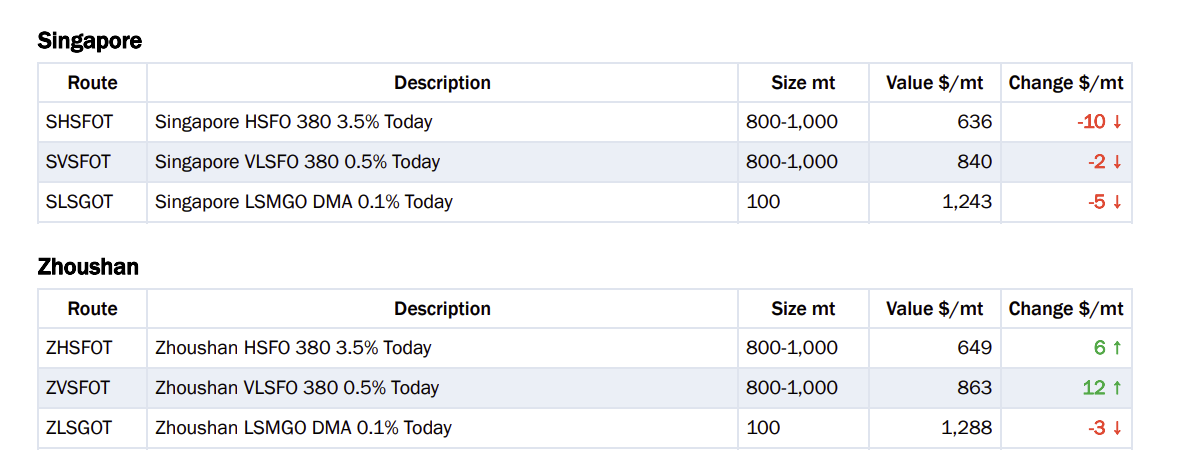
The following bunker report has been provided by freight market information provider Baltic Exchange for post on Singapore bunkering publication Manifold Times:
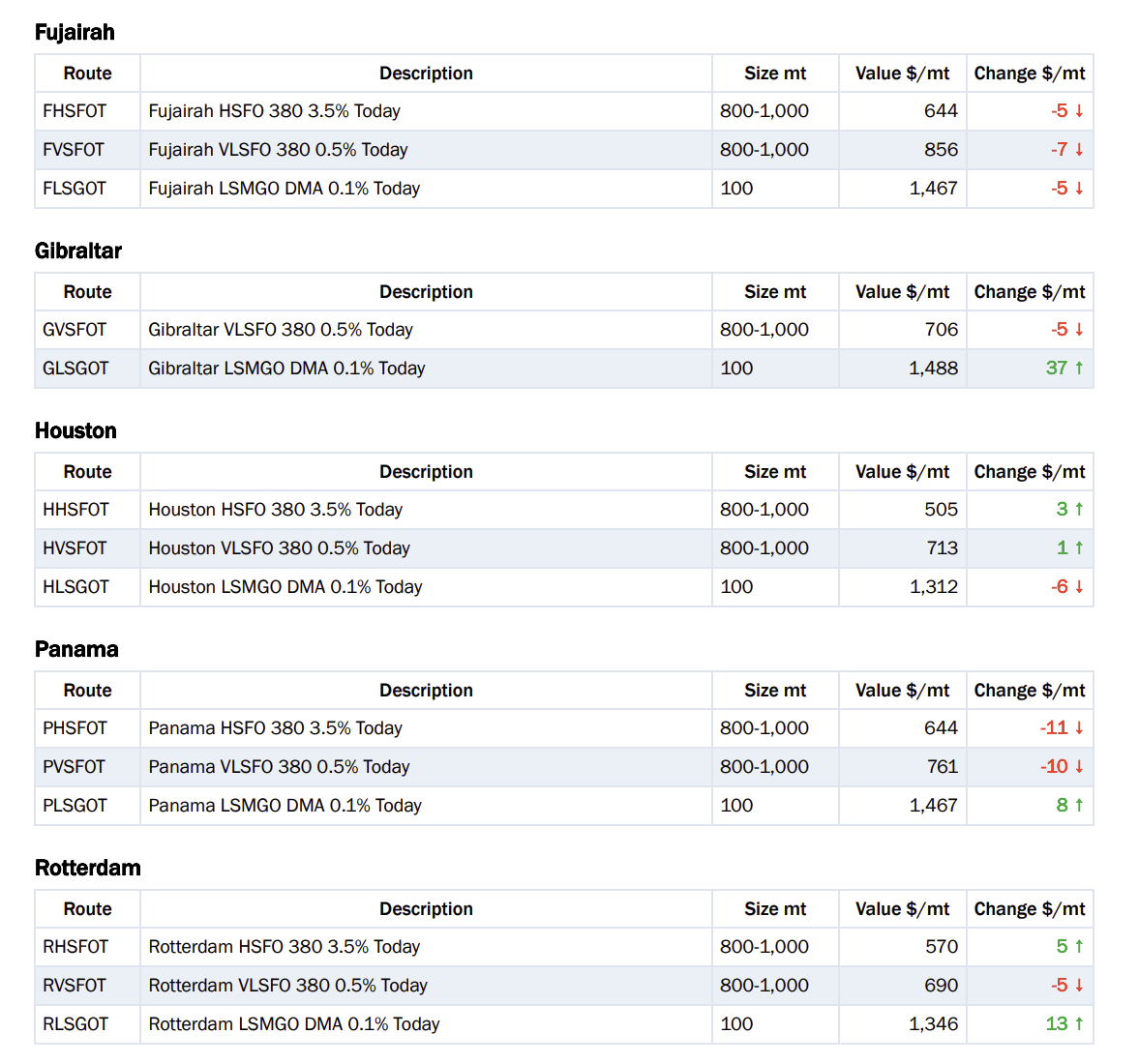
Screenshot 2026 05 29 at 2.27.58 PM

Screenshot 2026 05 29 at 2.28.14 PM

All values are in US$/metric ton, all-in (invoice price), delivered on board
Delivery in 7-10 days
ISO 8217:2010
IFO 380 3.5% Sulphur
IFO 380 0.5% Sulphur
DMA 0.1% Sulphur

Fujairah – Offshore Anchorage Area
Gibraltar – Anchorage area
Houston – Houston Harbor
Panama – (Pacific) dangerous cargo area, Balboa
Rotterdam – Waalhaven Maasvlakte range
Singapore – Anchorage, under SBA Scheme
Zhoushan – Southern anchorage area

Submitted weekly at Close of Business UK time Daily

Panellists:
Cockett Marine Oil Pte, Island Oil Limited, KPI OceanConnect, Monjasa A/S, NSI Marine and Transparensea Fuels


Photo credit and source: Baltic Exchange

Published: 29 May, 2026

Continue Reading

Trending