Connect with us

Business

DNV GL: Green technologies enhance efficiency of shuttle tankers

LNG dual-fuel shuttle tankers demonstrate environmental sustainability and operational flexibility are commercially viable.

Admin

Published

on

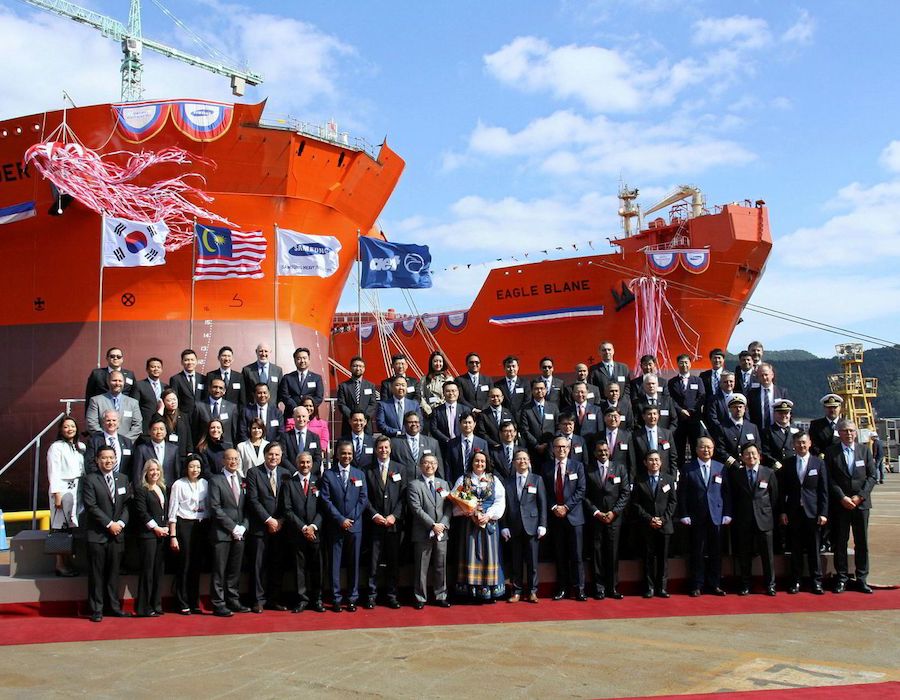
Christening ceremony of Eagle Blane and Eagle Balder

Classification society DNV GL has published an article analysing and outlining how technology can meet environmental targets while boosting the efficiency of shuttle tankers; the article is written by Business Director Tankers, Catrine Vestereng.

AET, one of the leading petroleum tanker owners and operators, has a long tradition of naming its vessels after some of the greatest energy locales, cities or ports in the world. Their latest two dynamic positioning shuttle tankers (DPSTs) will join the “B” ship series and are named after the Eagle Blane and Eagle Balder oil and gas fields on the Norwegian continental shelf.

Meeting international emission regulations

Eagle Blane and Eagle Balder not only continue AET’s naming tradition but also underline the company’s commitment to preserving the environment through state-of-the-art green technology, expanding AET’s fleet of environmentally friendly ships.

The twin-skeg, 123,100 dwt sister vessels will emit 85% less SOx, 98% less NOx, 98% less particulate matter and 93% less black carbon particulates than ships burning conventional fuel. They meet the International Maritime Organization’s (IMO) target to reduce carbon intensity per transport of work by 40% against 2008 baselines by 2030, and halving CO2 emissions by 2050.

The vessels will serve the Norwegian energy company Equinor on long-term charter in oilfields on the Norwegian continental shelf on the North Sea, the Norwegian Sea and the southern Barents Sea, as well as on the UK continental shelf.

“These trading areas not only require compliance with the Global Sulphur Cap but also with the new Gothenburg Protocol in force from 2020, which requires volatile organic compound (VOC) emissions to be capped at 131,000 tons per year,” explains John Baptist, Global Director VLCC & Shuttle Tankers, Crude Shipping at AET.

A new prototype

Powered by liquefied natural gas (LNG) as primary fuel, the DPSTs will be able to capture 100% of the harmful VOCs which escape into the air from crude oil cargoes during loading and voyage. The captured VOCs will be used as a supplementary fuel. “These are AET’s first vessels constructed with a VOC recovery system and fuelled by LNG. Being prototype vessels of this type, there were risks. The design and newbuilding teams have worked with all stakeholders to produce a very environment-friendly vessel type,” summarizes John Baptist. “Being part of the VOC reduction initiative makes this project even more exciting.”

Samsung Heavy Industries (SHI) built the shuttle tankers for AET Sea Shuttle AS (AETSS), a joint venture between the Norwegian shipping company ADS Shipping and AET Tankers which is headquartered in Singapore. AETSS is the owner and commercial operator of the vessels. Project management for the newbuilds was provided by MISC Group’s marine services arm Eaglestar and the Norwegian third-party ship management company OSM Maritime. “The shipyard has played an important role during the newbuilding process and maintained an excellent partnership with the classification society, which resulted in high-end technology solutions whilst ensuring regulatory compliance,” Baptist reports. “The collaboration with class in this project was exceptional in terms of the technical review. DNV GL has shown a high degree of technical expertise in defining, analysing and resolving critical design and engineering philosophies to ensure safe operation. For us, our project partners added remarkable value not only to the vessel but also for our company, as it helps us elevate our reputation among the top environment-friendly service providers.” Vidar Dolonen, Regional Manager Korea and Japan at DNV GL – Maritime , said about the project: “With this dual-fuel shuttle tanker project, DNV GL also broke new ground and we collaborated closely with our experts in various disciplines.

Enhanced technologies for more efficient operation

The vessels use a more efficient computer-controlled system for dynamic positioning that keeps them stationary above a specified seabed area while loading oil. The combination of LNG fuel, a powerful VOC recovery system and a more efficient dynamic positioning system enables estimated fuel savings of up to 3,000 tonnes per year compared with conventional DPSTs of the same size.

“These vessels are proof that environmental sustainability and commercial viability can coexist and are also testament to the fact that operational performance does not have to be sacrificed in the pursuit of reducing emissions,” Capt. Rajalingam Subramaniam, AET President & CEO and Chairman of AETSS says. “The goal was always to leverage our combined experience of AET, ADS and SHI to develop vessels that really push the boundaries in what is possible in North Sea dynamic positioning operations, and to prove the value of LNG dual-fuel solutions in the energy shipping segment.”

During the naming ceremony in October 2019, Lady Sponsor Ann-Elisabeth Serck-Hanssen, Senior Vice President for Asset Management in Marketing, Midstream and Processing at Equinor, said: “Taking these vessels on a long-term contract will further enhance our ability to provide safe, efficient and cost-competitive energy to our customers, and we are proud to play our part in what is an important step forward in the development of more sustainable energy shipping solutions.”

Increased operating opportunities

The two DPSTs will each be propelled by two low-pressure dual-fuel two-stroke engines, which meet IMO Tier III emissions requirements in gas mode without any exhaust gas after-treatment required. Designed for harsh operating conditions, the ships are equipped with latest-generation bow-loading systems (BLS) which offer greater connecting angles, extending the operating opportunities in conditions where shuttle tankers would normally struggle to connect. “The new-generation BLS is capable of connecting the loading hose in wave heights up to Hs = 4.5 m and at an entering angle of 110 degrees,” Stein Are Andersen, Sales Manager Offshore Loading Systems, MacGregor, reports.

Asked about future design and technology developments for shuttle tankers, Baptist believes that green energy will be the top item on the agenda, in particular LNG, VOC and hydrogen as fuels, as well as power generation optimization using variable frequency drives (VFD) batteries. Bow-loading system design has been improving and will continue to evolve to achieve more efficient offshore loading operations. “The demand for shuttle tankers as replacements of ageing tonnage is increasing. In my estimate about 40% of the existing tanker fleet is ready for replacement due to the 20-year age limitation,” Vidar Dolonen points out.

Related: AET names twin LNG dual fuelled DP shuttle tankers at ceremony


Photo credit and source:
DNV GL
Published: 24 February, 2020


Continue Reading

Mass Flowmeter

Hong Kong backs MFM adoption with voluntary scheme to boost bunkering competitiveness

Hong Kong’s Marine Department launched the Quality Bunker Operator Scheme to encourage bunker operators to install and use mass flow meter systems on their bunker vessels.

Admin

Published

on

By

RESIZED EH dual mfm setup

Hong Kong’s Marine Department (MD) on Wednesday (3 June) launched the Quality Bunker Operator Scheme to encourage bunker operators to install and use mass flow meter systems (MFM systems) on their bunker vessels.

MD said the scheme aims to enhance Hong Kong’s bunkering service quality and the competitiveness of Hong Kong ports, thereby further consolidating Hong Kong’s position as an international maritime centre and a major bunkering port.

Under the Scheme, bunker operators of traditional maritime fuel and biodiesel that install and use MFM systems on their bunker vessels, with the MFM systems inspected and certified by an accredited body in accordance with the International Organization for Standardization’s ISO 22192 Standard or equivalent requirements, can apply to the MD for inclusion in the scheme’s “List of Quality Bunker Vessels”, provided they meet the relevant technical and operational requirements. 

Details of the bunker vessels successfully included in the List will be published on a dedicated page on the MD’s website for reference by shipping companies and relevant stakeholders.

Participation in the Scheme is voluntary. In addition to receiving recognition from the MD, participating bunker operators will benefit from enhanced corporate image and competitiveness through the adoption of MFM systems, thereby boosting customers’ confidence and helping to create new business opportunities.

 A spokesman for the MD, said: “As an international maritime centre supported by our country, Hong Kong has a strategic location adjacent to major international fairways. Coupled with years of development in marine fuel bunkering, Hong Kong possesses rich experience and talent in the field. For many years, Hong Kong has consistently ranked as the seventh-largest bunkering port globally, the second-largest in our country, and the largest in the Greater Bay Area, providing reliable and competitive fuel bunkering services to ocean-going vessels from around the world. 

“As the international shipping industry has an increasing demand for accuracy and transparency in bunkering services, service quality and measurement precision in bunkering operations have become important indicators of a bunkering port’s competitiveness. The Scheme will enhance bunkering accuracy and transparency, further enhancing the quality of Hong Kong’s bunkering services.

The spokesman added that comprehensive port services are one of Hong Kong’s key advantages as an international maritime centre.

“We will also mandate the use of MFM systems on all methanol bunker vessels this year to ensure that Hong Kong continues to provide high-quality bunkering services in the era of green maritime fuels.” 

Note: The application form for the Scheme can be found on the MD’s website. Interested bunker operators can download the application form from the website or contact the MD’s Green Maritime Fuel Team via email ([email protected]) for details.


Photo credit: Manifold Times
Published: 4 June, 2026

Continue Reading

Alternative Fuels

MPA and MSC ink MoU to support adoption of alternative bunker fuels

MPA and MSC will explore new routes and services to strengthen connectivity, support the adoption of alternative marine fuels such as bio-LNG, and advance technologies to improve vessel energy efficiency.

Admin

Published

on

By

MPA and MSC ink MoU to support adoption of alternative bunker fuels

The Maritime and Port Authority of Singapore (MPA) on Wednesday (3 June) said it signed a Memorandum of Understanding (MoU) with MSC Mediterranean Shipping Company to strengthen collaboration in maritime decarbonisation, digitalisation, innovation, and manpower development. 

The MoU was signed on 25 May 2026 by Mr Ang Wee Keong, Chief Executive of MPA, and Mr Soren Toft, Chief Executive Officer of MSC.

The MoU underscores the shared commitment of MPA and MSC to foster a sustainable, digital, and future-ready maritime sector, while enhancing MSC’s operational and business activities in Singapore. This year also marks the 30th anniversary of MSC establishing its Asia Regional Office and local office in Singapore.

Under the MoU, MPA and MSC will explore new routes and services to strengthen connectivity, support the adoption of alternative marine fuels such as bio-LNG, and advance technologies to improve vessel energy efficiency and operational performance.

MPA and MSC will also collaborate on maritime digitalisation initiatives to improve operational efficiency, including streamlining vessel arrivals and port operations. 

On manpower development, MSC will support internship and scholarship opportunities through Singapore Maritime Foundation’s Maritime Outreach Network (MaritimeONE) platform, an industry-led tripartite partnership comprising industry, government and institutes of higher learning that aims to raise awareness of the maritime industry and attract quality talent into the maritime sector.

Mr Ang Wee Keong, Chief Executive of MPA, said: “This partnership reflects the strong collaboration between MPA and MSC in driving sustainability and digitalisation in the maritime sector. By working together on decarbonisation, operational efficiency and talent development, we aim to strengthen Maritime Singapore’s position as a trusted and future-ready global maritime hub.”

Mr Soren Toft, Chief Executive Officer of MSC, said: “Singapore is a strategically important hub for MSC and a key gateway to the broader Asia region. As we mark 30 years in Singapore, this MOU reinforces our long-term commitment to strengthening our presence here. MSC and Singapore are closely aligned on the priorities shaping the future of global shipping, and we look forward to deepening this partnership to drive the continued growth and resilience of the maritime industry.”


Photo credit: Maritime and Port Authority of Singapore
Published: 4 June, 2026

Continue Reading

Emissions reporting

StormGeo and OceanScore link emissions data, compliance workflows

Cooperation combines StormGeo’s expertise in operational vessel and emissions data with OceanScore’s expertise in emissions compliance workflows across EU ETS, FuelEU Maritime and UK ETS requirements.

Admin

Published

on

By

StormGeo and OceanScore link emissions data, compliance workflows

Weather intelligence and decision support solutions provider StormGeo and Hamburg-based technology platform OceanScore on Wednesday (3 June) said they have deepened their ongoing cooperation through the signing of a collaboration agreement during Posidonia 2026 in Athens on 2 June.

The cooperation combines StormGeo’s expertise in operational vessel and emissions data with OceanScore’s expertise in emissions compliance workflows across EU ETS, FuelEU Maritime and upcoming UK ETS requirements.

Together, the companies aim to help shipping companies seamlessly navigate increasing regulatory complexity more efficiently — from emissions reporting and data validation to compliance exposure management, pooling and financial settlement.

As emissions regulation becomes an increasingly important part of commercial shipping operations, the need for reliable operational data and streamlined compliance processes continues to grow. The cooperation between StormGeo and OceanScore is designed to support shipping companies with more connected, transparent and actionable processes across operational and commercial teams.

“From the outside, companies like StormGeo and OceanScore may sometimes be perceived as competitors because both operate around emissions and compliance workflows,” said Albrecht Grell, Managing Director at OceanScore. 

“But in reality, the industry increasingly needs both perspectives working together: trusted operational emissions data on one side and commercial compliance execution on the other. Our cooperation reflects that shipping companies are no longer looking for isolated solutions — they need connected processes, automated across different systems and reliable decision-making throughout the full compliance chain.”

By connecting validated operational emissions data with commercial compliance management, the cooperation supports workflows across:

  • emissions reporting and validation 
  • compliance management across EU ETS, FuelEU Maritime and upcoming UK ETS requirements
  • exposure visibility and cost transparency
  • pooling, settlement and financial processes 

The cooperation also aims to improve commercial transparency and coordination across operational and commercial stakeholders.

“StormGeo plays a central role in helping shipping companies turn operational vessel and emissions data into trusted, decision-ready insights,” said Espen Martinsen, Chief Commercial Officer at StormGeo. 

“As emissions regulations become more complex, this data is essential for transparent and efficient compliance management. By working with OceanScore, we can help customers connect StormGeo’s validated operational data with commercial compliance processes, creating a more integrated and practical approach to emissions management.”

The signing ceremony took place at the StormGeo booth during Posidonia 2026 in Athens and was attended by representatives from both companies.

Both companies expect the cooperation to continue evolving alongside upcoming regulatory developments, including FuelEU Maritime, EU ETS, the upcoming UK ETS and future emissions-related frameworks affecting global shipping.


Photo credit: StormGeo
Published: 4 June, 2026

Continue Reading

Trending