Connect with us

Biofuel

Conservation groups to IMO: ‘Keep biofuels out of Net-Zero Framework’

Biofuelwatch, Forest Watch Indonesia and Global Forest Coalition stressed the importance of preventing biofuels from being included as a supposed “green” alternative to fossil fuels.

Admin

Published

on

Conservation groups to IMO: ‘Keep biofuels out of Net-Zero Framework’

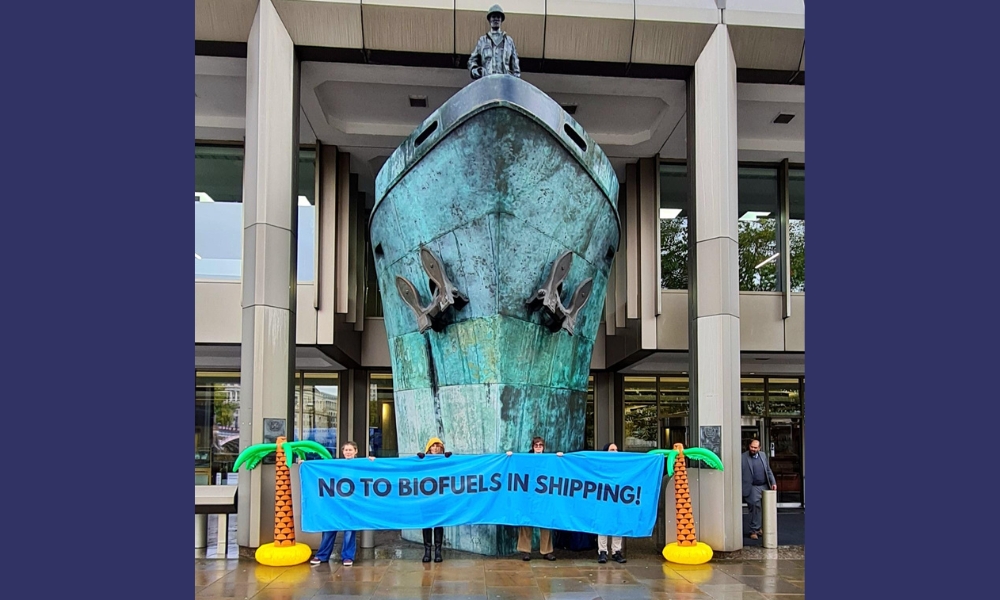
International nature conservation organisations Biofuelwatch, Forest Watch Indonesia and Global Forest Coalition on Monday (20 October) urged the International Maritime Organisation (IMO) to exclude harmful biofuels from compliance with the Net-Zero Framework. 

Last week, during the Extraordinary Session of the Marine Environment Protection Committee (MEPC ES.2) in London, countries decided to postpone the decision on the adoption of the Framework to 2026. 

But important discussions will continue on 20 to 24 October on key details on clean energy incentives in the Framework, and the organisations stressed the importance of preventing biofuels from being included as a supposed “green” alternative to fossil fuels.

Decades of evidence show that indirect land use change (ILUC) emissions from crop-based biofuels – such as soy and oil palm – wipe out their claimed climate benefits, driving forest loss, food insecurity, and land and water grabbing as agriculture is displaced onto marginal or uncultivated land. Soy and oil palm-based biofuels can generate emissions even higher than fossil fuels. 

“Biofuels are not a sustainable solution under any circumstances. In Latin America, the push for soy-based biofuels has accelerated deforestation and driven communities off their lands. If the IMO creates new demand for biofuels, it will unleash more emissions, more inequality, and more land grabbing” said Jana Uemura, Climate Campaigner at the Global Forest Coalition.

“Rejecting biofuels in the Net-Zero Framework means protecting the world’s remaining tropical forests – critical carbon sinks and biodiversity hotspots.” said Anggi Putra Prayoga, Forest Campaigner at Forest Watch Indonesia. 

“The climate crisis is already real. It is crucial to take a firm stance on adopting truly zero-emission energy sources, rather than biofuels that generate new emissions through deforestation.”

“The loss of forests not only worsens emissions but also endangers the lives and rights of Indigenous peoples who depend on forest resources,” added the Forest Campaigner.

To avoid these impacts, the IMO should make sure high-ILUC fuels are excluded in the Framework. Major national and industry frameworks, including the EU’s Maritime and Aviation policies, the UK SAF Mandate, and the International Civil Aviation Authority’s CORSIA scheme, already exclude or cap high-ILUC biofuels, or include ILUC emissions in the life cycle accounting. The organizations said the IMO must not fall behind. 

“We urge all IMO member governments to take a strong, united stance against the inclusion of biofuels in the Net-Zero Framework” said Pax Butchart, Biofuel Campaigner at Biofuelwatch. 

“The science is clear: crop-based and waste-derived biofuels cannot deliver real emissions reductions. Governments now have a historic opportunity to steer the shipping sector toward truly clean, zero-emission solutions that protect people and the planet.” 

Equally, biofuels produced from waste and residues such as used cooking oil (UCO), have limited availability and scalability, and won’t be able to satisfy the demand of international shipping in the long run. 

“The IMO governments must now pursue truly sustainable alternatives, including improved energy efficiency, wind-assisted propulsion and reducing demand for maritime transport in international trade,” the organisations concluded. 


Photo credit: Biofuelwatch
Published: 21 October, 2025

Continue Reading

Alternative Fuels

MPA and MSC ink MoU to support adoption of alternative bunker fuels

MPA and MSC will explore new routes and services to strengthen connectivity, support the adoption of alternative marine fuels such as bio-LNG, and advance technologies to improve vessel energy efficiency.

Admin

Published

on

By

MPA and MSC ink MoU to support adoption of alternative bunker fuels

The Maritime and Port Authority of Singapore (MPA) on Wednesday (3 June) said it signed a Memorandum of Understanding (MoU) with MSC Mediterranean Shipping Company to strengthen collaboration in maritime decarbonisation, digitalisation, innovation, and manpower development. 

The MoU was signed on 25 May 2026 by Mr Ang Wee Keong, Chief Executive of MPA, and Mr Soren Toft, Chief Executive Officer of MSC.

The MoU underscores the shared commitment of MPA and MSC to foster a sustainable, digital, and future-ready maritime sector, while enhancing MSC’s operational and business activities in Singapore. This year also marks the 30th anniversary of MSC establishing its Asia Regional Office and local office in Singapore.

Under the MoU, MPA and MSC will explore new routes and services to strengthen connectivity, support the adoption of alternative marine fuels such as bio-LNG, and advance technologies to improve vessel energy efficiency and operational performance.

MPA and MSC will also collaborate on maritime digitalisation initiatives to improve operational efficiency, including streamlining vessel arrivals and port operations. 

On manpower development, MSC will support internship and scholarship opportunities through Singapore Maritime Foundation’s Maritime Outreach Network (MaritimeONE) platform, an industry-led tripartite partnership comprising industry, government and institutes of higher learning that aims to raise awareness of the maritime industry and attract quality talent into the maritime sector.

Mr Ang Wee Keong, Chief Executive of MPA, said: “This partnership reflects the strong collaboration between MPA and MSC in driving sustainability and digitalisation in the maritime sector. By working together on decarbonisation, operational efficiency and talent development, we aim to strengthen Maritime Singapore’s position as a trusted and future-ready global maritime hub.”

Mr Soren Toft, Chief Executive Officer of MSC, said: “Singapore is a strategically important hub for MSC and a key gateway to the broader Asia region. As we mark 30 years in Singapore, this MOU reinforces our long-term commitment to strengthening our presence here. MSC and Singapore are closely aligned on the priorities shaping the future of global shipping, and we look forward to deepening this partnership to drive the continued growth and resilience of the maritime industry.”


Photo credit: Maritime and Port Authority of Singapore
Published: 4 June, 2026

Continue Reading

Biofuel

BHP and GCMD trial multi-feedstock B100 bio bunker fuel on bulk carrier

Bio-blend in the BHP and GCMD pilot is being used on a BHP-chartered bulk carrier “Berge Lyngor”, which was bunkered in Singapore in early May.

Admin

Published

on

By

BHP and GCMD trial multi-feedstock B100 bio bunker fuel on bulk carrier

BHP and the Global Centre for Maritime Decarbonisation (GCMD) on Wednesday (3 June) said they have blended biofuels from two distinct feedstocks—used cooking oil and waste animal fats —and introduced the lower-emissions marine fuel into a BHP-chartered bulk carrier as part of a pilot project.

The bio-blend in the BHP and GCMD pilot is being used on a BHP-chartered bulk carrier Berge Lyngor, owned and operated by Berge Bulk, transporting BHP iron ore from Western Australia to China. When run on bio-blend, the vessel has the potential to reduce well-to-wake greenhouse gas emissions by approximately 79 per cent per voyage compared to sailing on very low sulphur fuel oil (VLSFO).

The vessel bunkered in Singapore in early May with a B100 bio-blend comprising 50 percent tallow-derived biodiesel, sourced and supplied by HAMR Energy, and 50 per cent used cooking oil (UCOME) supplied by Mitsui & Co Energy Trading Singapore (METS).

Mitsui also blended the fuel and Dan-Bunkering coordinated and executed the bunkering operation, which was performed by Global Energy’s barge MT Maple.

The BHP and GCMD pilot will assess how biofuels from multiple feedstocks can be blended, handled, and introduced under real-world operating conditions using existing used cooking oil bunkering infrastructure.

At the same time, insights from this pilot will help identify solutions to challenges related to fuel quality, handling, traceability, and onboard vessel performance.

Biofuels for global shipping today rely heavily on used cooking oil – a feedstock whose availability is approaching its projected limits. Biofuel from waste animal fats presents a promising option to expand the supply of lower-emissions marine fuels.

The outcomes of the pilot are expected to shed light on the practical steps to integrate biofuel blends from different feedstocks into existing supply chains. The diversity of biofuels will provide shipowners and operators with greater flexibility to optimise fuel procurement based on cost, availability, and lifecycle emissions performance.

Biofuels derived from different feedstocks can exhibit varying properties that may impact operations, including potential corrosion from oxidation, fuel system clogging caused by wax formation, which this pilot aims to assess.

The pilot will trace and verify the biofuel blend’s integrity aimed at bolstering confidence in emissions reductions reporting. The pilot will also provide insights into how robust tracing can support future marine fuel supply chains where biofuels from multiple feedstocks with varying lifecycle greenhouse gas emissions footprints are blended together.

This project is co-funded by the Maritime and Port Authority of Singapore under the Maritime Innovation and Technology Fund (MINT).


Photo credit: Global Centre for Maritime Decarbonisation
Published: 3 June, 2026

Continue Reading

Biofuel

NYK starts one-year B100 bio bunker fuel trial on car carrier

In this trial, NYK will operate a car carrier continuously on B100 for one year to evaluate the impact on engines, fuel supply systems, and operational practices.

Admin

Published

on

By

NYK starts one-year B100 bio bunker fuel trial on car carrier

Japanese shipping firm NYK on Tuesday (2 June) said it has commenced a one-year long-term trial involving the continuous use of 100% biofuel (B100) on an NYK-operated car carrier. 

In this trial, NYK will operate a car carrier continuously on B100 for one year to evaluate the impact on engines, fuel supply systems, and operational practices. High-purity biofuels such as B100 are known to be susceptible to degradation from oxygen, light, and heat, raising concerns about the stability of such fuels during long-term use.

In this trial, the biofuel primarily comprises FAME (Fatty Acid Methyl Ester) derived from used cooking oil and similar feedstocks.

The initiative is designed to evaluate the fuel’s effects on the vessel’s equipment and verify operational safety under real-world conditions. 

Through this effort, NYK seeks to accumulate technical expertise that will support the broader use of high-purity biofuels and further accelerate efforts to reduce greenhouse gas (GHG) emissions.

NYK has been advancing the use of biofuels through various initiatives. In 2024, the company conducted a trial using biofuel blend B24 and subsequently expanded practical usage to B30. However, the company said there remains limited global experience with the long-term continuous use of B100.

“By collecting long-term operational data through this trial, NYK aims to accumulate valuable technical insights to support both the safe operation of vessels and the wider adoption of high-purity biofuels,” it said. 


Photo credit: NYK
Published: 3 June, 2026

Continue Reading

Trending