Connect with us

Bunker Fuel

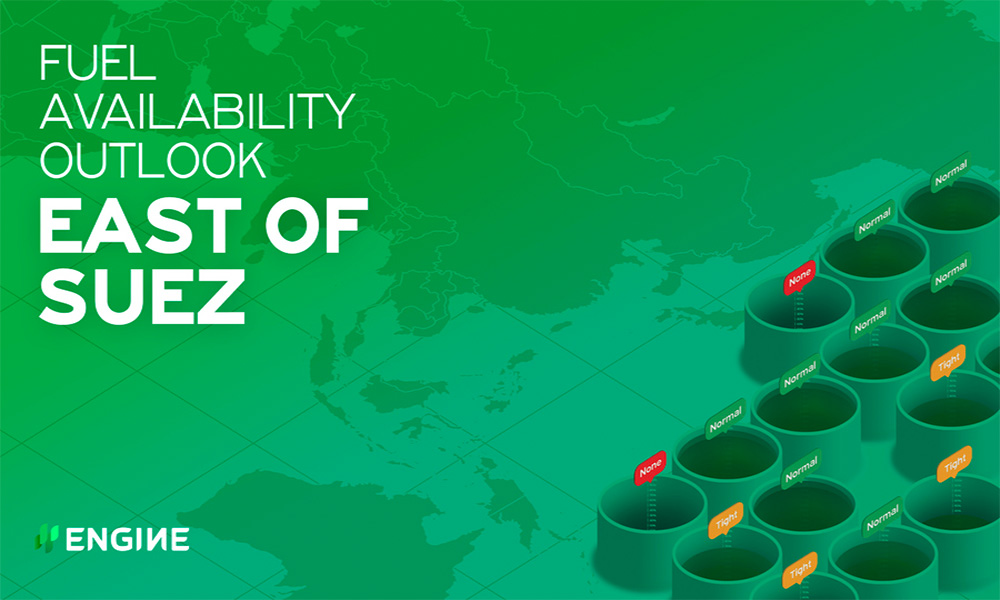
ENGINE: East of Suez Bunker Fuel Availability Outlook (9 June 2026)

VLSFO availability tight in Singapore; VLSFO and LSMGO availability good across several Taiwanese ports; bunker demand low in several South Korean ports.

Admin

Published

on

RESIZED ENGINE East of Suez

The following article regarding regional bunker fuel availability outlook for the East of Suez region has been provided by online marine fuels procurement platform ENGINE for publication on Singapore bunkering publication Manifold Times:

  • VLSFO availability tight in Singapore
  • VLSFO and LSMGO availability good across several Taiwanese ports
  • Bunker demand low in several South Korean ports

Singapore and Malaysia

VLSFO supply in Singapore remains constrained, with suppliers advising lead times of 8–14 days, a slight improvement from 10–15 days reported last week. HSFO availability has improved marginally, with lead times shortening to 5–12 days from 10–15 days previously. By contrast, LSMGO supply has tightened, with recommended lead times extending from around seven days last week to 9–14 days.

In Malaysia’s Port Klang, VLSFO availability remains broadly stable, particularly for smaller prompt requirements. LSMGO remains difficult to secure due to tight supply, while HSFO availability is still limited, leaving both grades under pressure.

East Asia

Bunker availability in Zhoushan remains under pressure despite subdued demand, with VLSFO lead times unchanged at 7–10 days. Supply conditions for LSMGO and HSFO have improved, with recommended lead times easing to 3–5 days from 4–7 days a week ago.

Elsewhere in northern China, supply conditions vary by port. Suppliers in Dalian and Qingdao have ample stocks of VLSFO and LSMGO, although HSFO remains difficult to secure in Qingdao. All fuel grades are in tight supply in Tianjin, while VLSFO and HSFO availability is tight in Shanghai. LSMGO supply in Shanghai remains comparatively stable.

In southern China, VLSFO and LSMGO supply remains constrained in Fuzhou. Xiamen has adequate VLSFO supply, but LSMGO availability is tighter. Similar supply pressures persist in Yangpu and Guangzhou, where both grades remain limited.

Hong Kong’s bunker market remains largely stable, with lead times for all grades holding steady at around seven days in recent weeks.

Meanwhile, Taiwan’s state-owned supplier CPC Corporation has temporarily halted new VLSFO nominations at Keelung port due to urgent maintenance work on its storage tanks and pipeline infrastructure. The restriction applies to deliveries scheduled on or before 14 June. LSMGO supply at the port remains unaffected.

Supply conditions at Taiwan’s other major ports – Hualien, Taichung and Kaohsiung – remain stable. Recommended lead times for both VLSFO and LSMGO are around two days, largely unchanged from last week.

In South Korea, bunker demand has weakened as elevated prices encourage buyers to source fuel from neighbouring markets, according to a local trader. Across southern ports including Busan, Ulsan, Masan, Onsan, Yeosu and Kwangyang, VLSFO and LSMGO lead times have extended to 3–10 days from about three days previously. HSFO availability has tightened considerably, with lead times widening to 9–11 days.

Supply conditions have also deteriorated across western ports, including Incheon, Daesan, Dangjin, Pyeongtaek and Taean. Lead times for VLSFO and LSMGO have increased to 3–9 days, while HSFO is now available only upon enquiry.

Weather-related disruptions remain a concern in the country, with operational delays forecast in Yeosu on 11 June and in Daesan between 13–14 June.

Japan’s bunker market has shown modest signs of improvement. Fuel oil remains available in Tokyo Bay, Nagoya and parts of western Japan, including Oita, Tokuyama and Mizushima, although supply is still limited to a small number of suppliers. Despite the broader market remaining tight, these pockets of availability indicate some easing of supply constraints.

Across major Japanese ports such as Tokyo, Chiba, Kawasaki, Nagoya, Mizushima, Tokuyama, Oita and Yokkaichi, recommended lead times stand at 7–10 days for HSFO and 10–12 days for VLSFO. In Osaka, Kobe and Kashima, both grades continue to be supplied only on a case-by-case basis.

By contrast, Indonesia’s bunker market remains relatively well supplied. VLSFO availability is steady in Jakarta, Surabaya, Balikpapan and Cigading, with suppliers generally recommending lead times of around three days.

Oceania

In Western Australia, VLSFO remains available at Kwinana and Fremantle, with suppliers generally recommending lead times of about seven days. Bunker deliveries at both ports are carried out by barge and are currently supported by a single supplier.

Supply dynamics vary along Australia’s east coast. In New South Wales, Port Kembla can receive VLSFO through truck or pipeline deliveries, while Sydney continues to maintain sufficient stocks of both VLSFO and LSMGO. HSFO availability in Sydney remains limited, with suppliers typically requiring around seven days’ notice.

In Queensland, VLSFO and LSMGO are available in Brisbane and Gladstone, where lead times are also around seven days. Further south, Melbourne and Geelong continue to report healthy VLSFO inventories. However, bunker operations at both ports rely on a single barge, resulting in recommended lead times of roughly one week.

HSFO stocks are running critically low in both Melbourne and Brisbane.

One supplier recommends lead times of approximately five days for all fuel grades across Brisbane, Sydney and Melbourne. In Dampier, bunker operations continue to depend on truck-assisted pipeline deliveries, making advance booking and berth confirmation particularly important, according to a source.

New Zealand’s bunker market remains largely unchanged. VLSFO is readily available in Tauranga and Auckland, with suppliers recommending lead times of around four days. At Marsden Point, both VLSFO and LSMGO can be delivered directly to vessels via pipeline.

Weather remains a key operational risk across New Zealand. Bunker deliveries are particularly susceptible to disruptions in Wellington and at ports across the South Island.

South Asia

Lead times of approximately seven days are currently recommended for all three bunker fuel grades across several Indian ports, according to a source.

Adverse weather conditions are expected to affect operations at several Indian ports over the coming days, potentially causing disruptions to bunker deliveries. Delays are forecast at Kandla and Sikka between 9–13 June, while high waves are expected to impact Cochin and Visakhapatnam during the same period. Similar weather-related challenges are also anticipated in Mumbai between 10–13 June.

In Sri Lanka, bunker supply conditions remain steady. Colombo and Hambantota continue to maintain healthy inventories across all fuel grades, with at least one supplier able to deliver stems within approximately five days, broadly in line with last week.

However, weather-related disruptions remain a risk, with bunker operations in Colombo and Trincomalee likely to face intermittent impacts until 13 June.

Middle East

Bunker supply in the UAE’s Fujairah port has tightened considerably. HSFO and LSMGO availability is extremely tight, while VLSFO is being offered only on an enquiry basis. Similar supply constraints are being reported at nearby Khor Fakkan.

Elsewhere in the UAE, port operations at Jebel Ali, Hamriyah and Sharjah continue without disruption, according to Inchcape Shipping. Ports in Ras Al Khaimah are also operating normally, although the RAK Ports Authority has continued to impose a marine risk surcharge on vessels calling at its ports, harbours and anchorages since March.

In Kuwait, port operations at Shuaiba and Shuwaikh continue without disruption despite ongoing tensions in the Middle East.

No formal operational advisories have been issued by Saudi Arabian ports. In Jeddah, VLSFO availability remains constrained, while LSMGO supply is comparatively stable. However, rough weather conditions could disrupt bunker operations in Yanbu between 10–13 June.

Qatar restored round-the-clock maritime navigation for all vessel types at the start of May, according to Inchcape Shipping. Availability of VLSFO and LSMGO remains tight at Ras Laffan.

Oman continues to offer strong prompt supply of LSMGO. One supplier is recommending lead times of just 1–2 days across key ports including Duqm, Muscat, Sohar and Salalah.

Egyptian ports are functioning normally. At Port Suez, VLSFO stocks are nearing depletion, while inventories of LSMGO and HSFO remain sufficient.

Availability of VLSFO and LSMGO remains tight in Djibouti. Meanwhile, port and bunker operations across Jordan, Iraq, Cyprus, Pakistan and Lebanon continue to proceed normally, according to Inchcape Shipping.

By Tuhin Roy


Photo credit and source: ENGINE
Published: 10 June, 2026

Continue Reading

Alternative Fuels

Ports of Barcelona and Shanghai team up to develop green ports, alternative bunker fuels

Agreement officially establishes the ‘sister ports’ relationship between Shanghai and Barcelona and aims to boost cooperation in areas such as developing green ports and alternative fuels.

Admin

Published

on

By

Ports of Barcelona and Shanghai team up to develop green ports, alternative bunker fuels

The Port of Barcelona on Thursday (11 June) said it signed a new strategic cooperation agreement with the Shanghai Municipal Transportation Commission (SMTC) and Shanghai International Port Group (SIPG).

The agreement officially establishes the “sister ports” relationship between Shanghai and Barcelona and aims to boost cooperation in areas such as the digitalisation and security of port operations; developing green ports and alternative fuels; intermodality and fostering sustainable maritime corridors between the Far East and the Mediterranean. 

The agreement was signed by José Alberto Carbonell, president of the Port of Barcelona; Xiao Hui, general director of the SMTC, and Yang ZhiYong, vice president of SIPG, in the presence of Jaume Duch, Regional Minister for European Union and Foreign Action. 

The relationship between the Port of Barcelona and the Port of Shanghai has intensified in recent years. In late July 2025, a preliminary agreement was signed between both port authorities, which led to a technical visit in September 2025 by a delegation from Shanghai led by Wang Haijian, Vice President and Director of Operations of SIPG, to advance the development of the Green Shipping and Digital Corridor between both ports. 

“This new institutional visit and the signing of the new agreement consolidates the Port of Barcelona’s position as a Euro-Mediterranean logistics hub and strengthens its links with one of the main ports and economic centres in the world,” the port said. 


Photo credit: Port of Barcelona
Published: 12 June, 2026

Continue Reading

Biofuel

NYK Line subsidiary Kinkai Yusen to trial B24 bio bunker fuel on RoRo vessel

Kinkai Yusen says it will conduct a demonstration operation using biofuel refuelled at Hakata Port on 16 June on the RoRo vessel “Nanotsu”.

Admin

Published

on

By

NYK Line subsidiary Kinkai Yusen to trial B24 bio bunker fuel on RoRo vessel

NYK Line subsidiary Kinkai Yusen on Tuesday (9 June) said it will conduct a demonstration operation using biofuel refuelled at Hakata Port on 16 June on the RoRo vessel Nanotsu, which operates between Hakata Port and Tsuruga Port.

The company said it will be the first instance of a domestic RoRo vessel operating using biofuel at Hakata Port. 

The biofuel (B24) which will be used will comprise 24% biofuel and conventional marine fuel, and is expected to reduce greenhouse gas (GHG) emissions without requiring major modifications to existing ship equipment. 

“The procurement of biofuel will be carried out in cooperation with Idemitsu Kosan Co Ltd and Itochu Enex Co Ltd,” it said in a statement. 


Photo credit: MarineTraffic / Tetsuya
Published: 12 June, 2026

Continue Reading

Bunker Fuel

Argus Media: Bunker lead times grow since US–Iran war began

Longer lead times, between the placing of a bunker fuel order and the fuel being supplied, reflect concerns about potential supply disruptions and strategies to deal with price volatility, says Argus.

Admin

Published

on

By

resized argusmedia

Shipowners and traders have been booking spot bunker fuel supplies further in advance since the start of the Iran–US conflict, according to data collected by Argus.

10 June 2026

The longer lead times, between the placing of a bunker fuel order and the fuel being supplied, reflect concerns about potential supply disruptions and strategies to deal with price volatility.

Disruption to shipping through and around the strait of Hormuz has encouraged buyers to secure fuel as far as four to six weeks ahead rather than risk encountering shortages, market participants said. Argus’ bunker assessments are typically for deliveries with a maximum of 9-12 days and up to 14 days for certain African ports.

The shift reflects concerns about reduced availability, with around 20pc of global crude having previously transited the strait now missing and therefore restricting supply of bunker grades. Higher freight costs have also reduced the economic incentive for suppliers to import fuel, which further reduced availability.

Very-low-sulphur fuel oil (VLSFO) prices have strengthened sharply across major bunkering hubs since the start of the US-Iran war, reflecting tightening feedstock availability and growing supply concerns. Delivered VLSFO indications in Rotterdam have rose by around 45pc from 28 February to 31 May, prices in Panama increased by 49pc and in Singapore by 47pc.

The tightening market has been particularly evident in Fujairah, the world’s fourth-largest bunkering hub, where an acute supply shortage has left most suppliers without prompt VLSFO availability until mid-June. Market participants said disruptions to regional feedstock flows and the loss of supply from Kuwait’s al-Zour refinery sharply reduced local blending activity, pushing Fujairah VLSFO premiums to record highs of $500-700/t against front-month Singapore cargo values in early June.

The change in buying patterns has been happening worldwide. Delivery times for VLSFO in Singapore have extended to about 10-15 days forward in some cases, depending on supplies given tight blendstock availability, traders said this week. Typical delivery periods of about 7-10 days forward remain possible.

Singapore loadings for low-sulphur marine gasoil (LSMGO) have also slowed, with market participants expecting this to ease only in the second half of June. LSMGO supplies are tight because of delays in cargo arrivals from South Korea, and most current availability will go towards previously booked orders. The lead time for high-sulphur fuel oil (HSFO) has been steady at around 4-5 days, as supplies are ample in Singapore.

In Gibraltar, the average lead time in the three months before the war started was around five days. This is now 10 days. In Rotterdam the average booking period is up to 10 days from seven.

In South America, rising vessel traffic through the Panama Canal has increased congestion and lengthened waiting times. The tighter transit window has pushed bunker buyers in Balboa and Cristobal to secure fuel further in advance, with market participants reporting a shift away from prompt procurement toward longer lead-time bookings to ensure product availability and align deliveries with delayed canal crossings.

The average bunker fuel lead time in the Panama Canal increased to 14 days in March-May, from 10 days in the three months ending 28 February.

In Brazilian ports, longer lead times have also been driven by rising fuel oil export flows to Singapore, where demand for Brazilian supply has increased because of the disruption linked to the strait of Hormuz. The additional export pull has reduced feedstock availability for VLSFO blending in Brazil, tightening prompt supply at key ports like Santos and Paranagua.

Santos’ average bunker fuel lead times increased to 10 days in March-May, from eight days in the three months to 28 February. In Paranagua, average lead times rose to 13 days from 10 days over the same period.

By Gabriel Tassi Lara, Natália Coelho and Cassia Teo


Photo credit and source: Argus Media
Published: 12 May, 2026

Continue Reading

Trending