Connect with us

Ammonia

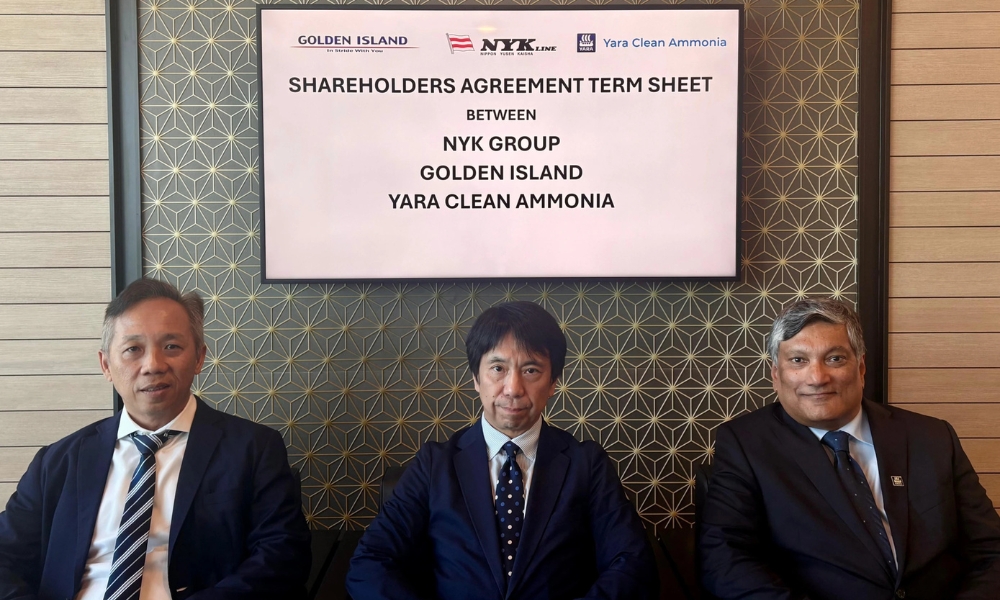
Golden Island, NYK Line and Yara move to explore ammonia bunkering in Singapore

Trio signed a non-binding term sheet to jointly explore the marketing and supply of low-carbon ammonia as a marine fuel to maritime end-users in Singapore.

Admin

Published

on

Golden Island, NYK Line and Yara move to explore ammonia bunkering in Singapore

Singapore bunker supplier Golden Island Pte Ltd on Monday (20 April) said the company has signed a non-binding term sheet with NYK Bulkship (Asia) (NYK Line) and Yara Clean Ammonia to jointly explore the marketing and supply of low-carbon ammonia as a marine fuel to maritime end-users in Singapore.

The partnership represents a major step in enabling ammonia as a zero-or-near-zero-emission (ZNZ) marine fuel, in line with Singapore’s broader ambitions to support the shipping community in meeting decarbonisation targets.

NYK Line will fully leverage its expertise gained through LNG bunkering operations, as well as its operational and technical experience with ammonia carriers and ammonia-fuelled vessel projects. 

Golden Island has more than 40 years of experience in Singapore’s bunkering industry, with an established customer base and operational capabilities in scheduling, a key aspect of bunkering. Yara Clean Ammonia is a major player in the global ammonia sector, with experience in ammonia production and handling, supported by a strong safety record.

NYK Line, Golden Island, and Yara Clean Ammonia began discussions at the beginning of 2024 to explore the launch of this business, aiming to commence operations within this decade.

Atsuya Nojiri, Managing Director of NYK Bulkship (Asia), said: “The NYK Group operates a fleet of more than 900 vessels and recognises the transition to ZNZ marine fuels as a critical step towards achieving net-zero emissions by 2050. With its potential to significantly reduce greenhouse gas emissions, ammonia is expected to play an important role in the future marine fuel mix. The NYK Group’s primary objective is to establish the infrastructure required to safely accelerate the adoption and scaling of ammonia-fuelled vessels, while taking a leading role through collaboration with experienced industry partners,” said 

Johnny Tan, Managing Director of Golden Island, said: “Golden Island is pleased to partner with NYK Line and Yara Clean Ammonia to advance the development of low-carbon ammonia bunkering in Singapore. With more than 40 years of experience in Singapore’s bunkering industry, we bring a strong customer network and deep operational expertise in bunker scheduling and supply chain coordination.

“Over the years, we have supported the industry’s transition through initiatives such as the adoption of VLSFO, biofuels, methanol as marine fuel, and digitalisation efforts including electric Bunker Delivery Note. Through this partnership, we look forward to contributing our operational capabilities and high safety standards to support Singapore’s development as a global hub for next-generation marine fuels.”

Murali Srinivasan, SVP Commercial, Yara Clean Ammonia, said: “This partnership marks an important milestone in realising our vision of a low-carbon ammonia supply chain for new markets. Together with NYK Line and Golden Island, we are developing a last-mile ecosystem that will make low-emission ammonia bunkering available safely and reliably at one of the world’s most critical maritime hubs. Singapore’s leadership in maritime decarbonisation makes it a natural starting point for scaling ammonia bunkering globally.”


Photo credit: Golden Island
Published: 21 April, 2026

Continue Reading

Ammonia

ENOVA-backed ammonia bunkering projects progress as planned, says Azane

Company remains committed to delivering all three terminals in line with the ENOVA plan, with the ambition of having them operational by 2029.

Admin

Published

on

By

ENOVA-backed ammonia bunkering projects progress as planned, says Azane

Azane Fuel Solutions subsidiary Azane Infrastructure AS on Tuesday (16 June) confirmed that it is continuing all three ENOVA-supported ammonia bunkering terminal projects and is moving forward with delivering the projects in accordance with the agreed plan and timeline.

The company said the projects represent a major step toward making ammonia a viable zero-carbon fuel option for vessels engaged in both coastal and offshore operations. At the same time, they mark the first major step toward establishing a clean ammonia fuel bunkering network along the Norwegian coast.

“By moving forward with the terminals at Florø, Stavanger and Mongstad, Azane is demonstrating its commitment to executing the ENOVA-supported projects and building the infrastructure required for the maritime energy transition,” the company said. 

The company remains committed to delivering all three terminals in line with the ENOVA plan, with the ambition of having them operational by 2029 to support growing demand for clean ammonia fuel in shipping.

“We are continuing all three projects with full commitment and in close alignment with the plan agreed with ENOVA,” said Steinar Kostøl, CEO of Azane Infrastructure AS. 

“These terminals are not only important individual projects – they are the first major step toward establishing a clean ammonia fuel bunkering network and enabling zero-carbon shipping along the Norwegian coast and beyond.”


Photo credit: Azane Fuel Solutions
Published: 18 June, 2026

Continue Reading

Bunker Fuel

Singapore: Bunker fuel sales drops by 6.8% on year in May 2026

4.55 million mt of various marine fuel grades were delivered at the world’s largest bunkering port in May, down from 4.88 million mt recorded during the similar month in 2025, according to MPA data.

Admin

Published

on

By

Singapore: Bunker fuel sales drops by 6.8% on year in May 2026

Sales of marine fuel at Singapore port dropped by 6.8% on year in May 2026, according to data from the Maritime and Port Authority of Singapore (MPA).

In total, 4.55 million metric tonnes (mt) (exact 4,548,000 mt) of various marine fuel grades were delivered at the world’s largest bunkering port in May, down from 4.88 million mt (4,878,100 mt) recorded during the similar month in 2025.

Deliveries of marine fuel oil, low sulphur fuel oil, ultra low sulphur fuel oil, marine gas oil and marine diesel oil in May (against on year) recorded respectively 1.79 million mt (-5.3% from 1.89 million mt), 2.29 million mt (-6.5% from 2.45 million mt), zero (-100% from 1,200 mt), 600 (35.2% from 1,700 mt) and zero (from zero).

Singapore: Bunker fuel sales drops by 6.8% on year in May 2026

Bio-blended variants of marine fuel oil, low sulphur fuel oil, ultra low sulphur fuel oil, marine gas oil and marine diesel oil in May, (against on year) recorded respectively 11,600 mt (-71.6% from 40,900 mt), 36,400 mt (-62.1% from 96,100 mt), zero (from zero), zero (from zero) and zero (from zero). B100 biofuel bunkers, introduced in February last year, recorded 12,800 mt (+573.7% from 1,900 mt). 

LNG and methanol sales were 70,300 mt (+56.2% from 45,000 mt) and zero (from zero) respectively. There were no recorded sales of ammonia for the month and so far since 2025.


Photo credit: Maritime and Port Authority of Singapore
Published: 15 June, 2026

Continue Reading

Alternative Fuels

DNV data shows shift in alternative-fuelled vessel ordering patterns

DNV says shipowners are adopting more varied fuel strategies, reflecting a growing emphasis on optionality, regulatory compliance and risk management in long-life vessel investments.

Admin

Published

on

By

DNV data shows shift in alternative-fuelled vessel ordering patterns

Latest data from classification society DNV’s Alternative Fuels Insight (AFI) platform showed a total of 36 new orders for alternative-fuelled vessels were placed in May 2026.

Activity was primarily driven by LPG/ethane carriers, which accounted for 26 of the orders. A further eight LNG-fuelled vessels were ordered, including six container vessels and two car carriers, alongside two ethanol-fuelled bulk carriers.

So far in 2026, a total of 119 orders have been placed for alternative-fuelled vessels. Of these, LNG-fuelled vessels (60) account for the largest share of the orderbook, with the majority of these (42) coming from the container segment, and a smaller share (12) from car carriers.  

A further 50 orders have been placed for LPG/ethane carriers, while activity in other fuel types remains limited, with orders for methanol/ethanol (4), ammonia (4), and hydrogen (1).  

By the end of May, the share of alternative-fuelled vessels in total tonnage was notably lower than over the same period in 2025.

DNV data shows shift in alternative-fuelled vessel ordering patterns

Jason Stefanatos, Global Decarbonization Director at DNV Maritime, said: “While the pace of alternative-fuelled contracting has varied compared to 2025, the industry continues to move forward in its transition, with owners advancing fuel and technology decisions against a backdrop of evolving regulatory and market conditions.  

“As in previous years, ordering of alternative-fuelled vessels has been led by the container segment, but dynamics are shifting. While activity remains strong, the focus has moved towards smaller vessels, with fewer very large container ships, which are historically more likely to adopt alternative fuels, being ordered. At the same time, we are seeing increased activity in tanker and bulker segments.  

“What is also becoming clearer is that fuel choice is no longer approached as a single bet. Owners are increasingly treating it as a portfolio decision, managing fuel optionality, timing of investment, and exposure to future regulation as they navigate long-life asset decisions.

“This is reflected in more varied ordering patterns, reinforcing that the transition is not progressing in a straight line.”


Photo credit: DNV
Published: 5 June, 2026

Continue Reading

Trending