Connect with us

Association

IBIA and INTERCARGO to reinforce collaboration on decarbonisation, safety, and marine fuels

Reciprocal membership agreement between both associations will strengthen coordination in international forums such as the IMO and enhance engagement on issues of mutual interest.

Admin

Published

on

IBIA and INTERCARGO to strengthen collaboration on decarbonisation, safety, and marine fuels

The International Bunker Industry Association (IBIA) and the International Association of Dry Cargo Shipowners (INTERCARGO) on Monday (3 November) said they have entered into a reciprocal membership agreement to reinforce collaboration between the dry bulk shipping and marine fuels communities.

This new partnership formalises the close working relationship between the two associations and reflects their shared commitment to advancing safe, efficient, and sustainable maritime operations, particularly in the areas of fuel quality, safety, and decarbonisation.

Through reciprocal membership, IBIA and INTERCARGO will gain greater access to each other’s expertise, activities, and working groups. 

The agreement will encourage the exchange of knowledge and best practices, strengthen coordination in international forums such as the International Maritime Organization (IMO), and enhance engagement on issues of mutual interest.

The collaboration will support dialogue between shipowners and the fuel supply chain, promote the development of safe and reliable bunkering practices, and contribute to the industry’s transition towards low and zero-carbon fuels.

Alexander Prokopakis, Executive Director of IBIA, said: “We are delighted to welcome INTERCARGO as an IBIA member. Collaboration is vital as the industry moves towards new fuels and technologies, and this collaboration ensures our associations work hand in hand to promote safe, sustainable, and practical solutions for the future.”

Dimitris Monioudis, Chairman of INTERCARGO’s Technical Committee, said: “INTERCARGO strives to engage and collaborate with all industry stakeholders for the sake of a genuinely sustainable dry bulk sector. IBIA’s joining the INTERCARGO wider membership will provide us with expert knowledge and experience in relation to fuels available both today as well as in the future, always focusing on safe and pragmatic roadmaps available to our members.”

Both organisations reaffirmed their commitment to continuous dialogue and cooperation in support of the wider maritime community.


Photo credit: International Bunker Industry Association
Published: 4 November, 2025

Continue Reading

Association

IBIA announces Caroline Yang as new Regional Board Chair for Asia

Yang, who brings over 30 years of experience in the shipping industry, succeeds Captain Rahul Choudhuri, who has completed his term as Regional Chair.

Admin

Published

on

By

Caroline Yang, CEO of Hong Lam Marine Pte Ltd

The International Bunker Industry Association (IBIA) recently announced that Caroline Yang, CEO, Hong Lam Marine Pte Ltd has been appointed by the IBIA Global Board as Chair of the Regional Board – Asia.

Yang, CEO of Hong Lam Marine Pte Ltd, brings over 30 years of experience in the shipping industry. She joined Hong Lam Marine as in-house legal counsel in 1991 and was appointed Executive Director in 2002. As CEO, she oversees the company’s legal and human resources functions.

Yang succeeds Captain Rahul Choudhuri, who has completed his term as Regional Chair. 

IBIA said the transition reflects IBIA’s commitment to rotating leadership roles across its boards, ensuring broader participation and strong regional engagement.

Alexander Prokopakis, Executive Director, IBIA, said: “We are pleased to welcome Caroline Yang as Chair of the IBIA Asia Regional Board. Caroline brings industry experience, leadership, and regional insight, which will be invaluable in further strengthening IBIA’s presence and engagement across Asia.

“I would also like to sincerely thank Capt. Rahul Choudhuri for his leadership and commitment over the past years, and for his continued support to the Association”.

Manifold Times previously reported IBIA appointing three new members to the IBIA Asia Regional Board including Yang. 

Related: IBIA appoints three new Asia Regional Board members


Photo credit: International Bunker Industry Association
Published: 10 June, 2026

Continue Reading

Association

Shipping industry issues guidance for vessel transit through Strait of Hormuz

Industry organisations ICS, BIMCO, INTERCARGO, INTERTANKO, IMCA, and OCIMF have worked together to produce guidance aimed at assisting ships in transiting the Strait of Hormuz.

Admin

Published

on

By

CHUTTERSNAP MT

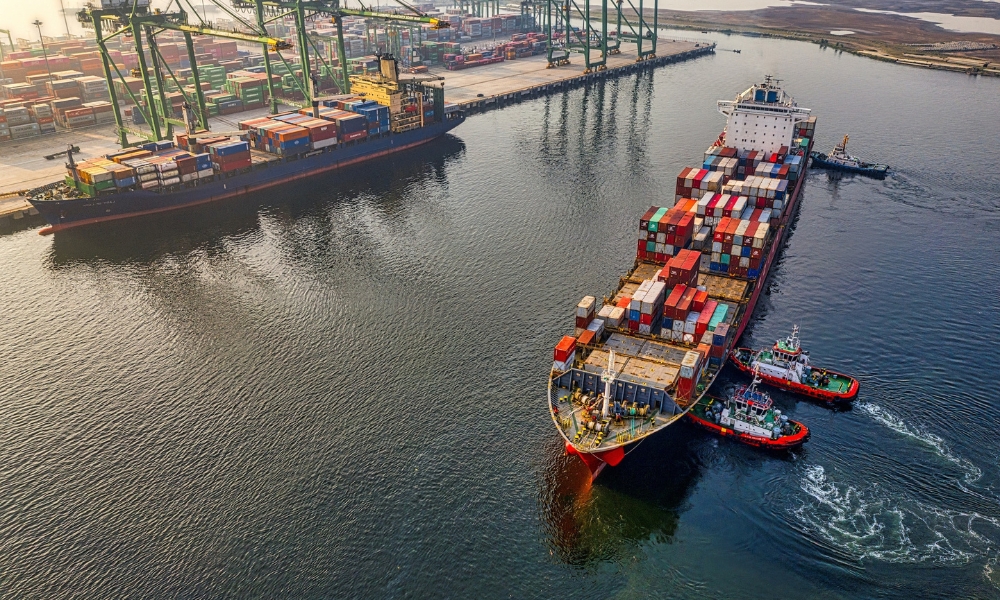
Industry organisations ICS, BIMCO, INTERCARGO, INTERTANKO, IMCA, and OCIMF have worked together to produce guidance aimed at assisting ships in transiting the Strait of Hormuz, according to BIMCO on Wednesday (20 May). 

BIMCO said the guidance was produced to help mitigate risks after hundreds of vessels remained unable to transit the Strait of Hormuz and, in the event of a return to more normal navigation conditions, the movement of all those vessels within the Strait could represent a considerable navigational hazard.

“The document complements the Best Management Practices Maritime Security (BMP MS) and is intended to support voyage-specific threat and risk assessment, facilitating shipboard and office planning,” it added. 

“The safety of life, safe navigation and protection of the environment remain the primary considerations, with the Master retaining overriding authority. A structured decision process has been developed to aid companies and to consider the likely threat scenario in the risk assessment for each ship.”

Note: The guidance can be found here


Photo credit: CHUTTERSNAP on Unsplash
Published: 21 May, 2026

Continue Reading

Hydrogen

ZESTAs unveils global alliance to advance liquid hydrogen as scalable marine fuel

ZESTAs launched the Global Liquid Hydrogen Alliance, dedicated to advancing pure green hydrogen and liquid hydrogen as a deployable, scalable, and commercially viable zero-emission fuel for shipping.

Admin

Published

on

By

RESIZED Chris Pagan

The Zero Emissions Ship Technology Association (ZESTAs) on Monday (18 May) launched the Global Liquid Hydrogen Alliance (Alliance), a new international platform dedicated to advancing pure green hydrogen and liquid hydrogen (LH2) as a deployable, scalable, and commercially viable zero-emission fuel for international maritime shipping.

The Alliance launches as the transition moves from aspiration to deployment. 

Over 600 hydrogen project announcements globally are linked to Europe, backed by more than EUR 175 billion (USD 203 billion) in committed investment, yet projects remain fragmented, offtake is uncoordinated, and final investment decisions are stalling. The gap is not ambition. It is architecture. ZESTAs is bringing together the organisations ready to build the LH2 value chain in the real world, faster, at scale, and with credibility.

“Zero-emission shipping is already underway. The investment is moving, the regulation is coming, and the early movers are setting the terms,” said Madadh MacLaine, Alliance Co-founder and Secretary General of ZESTAs. 

“According to industry reports, the liquid hydrogen market reflects that momentum: valued at $9 billion today, it is projected to reach $19 billion by 2032 and exceed $54 billion from 2037 onward, with global liquefaction capacity set to more than quadruple in the same period. 

“The Global Liquid Hydrogen Alliance exists because LH₂ needs to be at the core of that transition, at scale, not catching up to it. We’re here to do the coordination work that makes deployment happen: evidence, policy alignment, and commercial frameworks that turn LH₂ from a credible option into a bankable fuel.”

Unlike broader hydrogen initiatives focused primarily on derivatives or blended fuels, the Alliance will work exclusively on pure green hydrogen, building a neutral, transparent evidence base and driving the commercial and policy coordination needed to make the fuel bankable and operational. 

The Alliance will operate as an action-focused platform built around four priorities:

  • Build a global ground truth for LH₂

Create a neutral, verifiable evidence base around liquid hydrogen technology, safety, logistics, costs, and performance to support policymakers, investors, ports, shipowners, and offtakers.

  • Position LH₂ as a primary energy carrier for shipping

Advance a clear, technically grounded argument for LH₂ as a primary zero-emission marine energy carrier, particularly for long-range, energy-dense, and globally tradable applications.

  • Accelerate market creation and international alignment

Support for demand aggregation, offtaker coordination, standards development, certification pathways, and aligned policy engagement across the IMO, Europe, and across key producing regions like Africa, the Caribbean, Latin America, and even on the high seas.

  • Turn policy momentum into deployment

Identify how LH₂ rolls out through shipping corridors, port infrastructure, vessel integration, and supply chain partnerships, including routes that reduce dependence on fossil fuel chokepoints and build energy resilience for importing nations, making the case that climate alignment and supply chain security are the same investment.

“The discussion around zero-emission fuels is now shifting from ‘if’ to ‘how fast.’ Liquid hydrogen offers one of the few scalable pathways for truly zero-emission long-range shipping, and the Alliance is intended to help accelerate the ecosystem needed to make that transition commercially viable,” said Bart Biebuyck, CEO of Hybart and Alliance Co-founder.

The deployment gap for LH2 is geographic and coordination-related, not technical: Europe, which is projected to account for roughly one-third of global hydrogen demand, currently has only around 30 tonnes per day of liquefaction capacity. With vessel deployments already underway and investments in bunkering infrastructure advancing in key port hubs across Europe, Asia, and the Pacific, LH2 is ready to scale. The Alliance will provide the technical evidence base, policy coordination, and commercial frameworks that convert available technology into bankable deployment.

“Maritime navigation has the potential to become one of the leading sectors in the adoption of hydrogen technologies,” said Karima El Kmiti, from Dhamma Sea. “Real-world projects are already demonstrating that hydrogen is a viable solution for maritime decarbonisation and the future of cleaner mobility.”

The Alliance is open to companies across the value chain, including shipowners, ports, hydrogen producers, technology developers, classification and safety stakeholders, infrastructure developers, cargo interests, investors, and public-sector partners, united by a shared focus on making LH₂ bankable and deployable now.


Photo credit: Chris Pagan on Unsplash
Published: 19 May, 2026

Continue Reading

Trending